On August 5, 2026, Proxmox Server Solutions GmbH announced something people had been asking for on the forums since at least 2019. Proxmox VE, their virtualization platform, now officially runs on ARM64. Not a community fork, not some guy’s patched kernel you download from a sketchy GitHub repo. Official. With Debian 13.5 “Trixie” under the hood and kernel 7.0 as the stable default.
I saw the announcement pop up in a homelab Discord server I’m part of and within ten minutes there were like 40 messages. Somebody linked the Jeff Geerling blog post, somebody else was already trying to flash it onto an Ampere board they had lying around, and one guy just wrote “FINALLY” in all caps and nothing else. That’s basically the mood right now if you follow this space even a little.
If you don’t know what Proxmox is, don’t worry, I’ll get to that. But if you’re already nodding along, you probably know why this matters more than it sounds like on paper.
Wait, What Even Is Proxmox?
Proxmox VE (Virtual Environment) is an open source platform for running virtual machines and containers on a server. Think of it as an alternative to VMware ESXi, except you don’t have to deal with licensing costs that make your finance team cry. It’s built on Debian Linux and uses KVM for full virtual machines and LXC for lightweight containers, all managed through one web interface that you access from a browser.
A lot of small businesses moved to Proxmox after Broadcom bought VMware and jacked up the pricing. I know at least three IT guys personally who did this exact migration in the last two years, and all three said the same thing basically, that the switch was rough for about a month and then things were fine.
Home lab people love Proxmox too, for different reasons. You install it on some old Dell you bought off eBay or a mini PC, and suddenly you’ve got a place to run your Home Assistant instance, your Plex server, a Minecraft server for your kid, maybe a Kubernetes cluster you’re learning on, all isolated from each other so if one thing breaks it doesn’t take everything down with it.
The core stuff that makes Proxmox useful:
- Web based management, no separate client app needed
- Live migration, moving a running VM from one physical host to another with basically no downtime
- Built in backup tools (Proxmox Backup Server)
- Support for ZFS and Ceph storage, which handle redundancy and snapshots
- Clustering, so multiple Proxmox nodes act as one system
- High availability, where VMs automatically restart on another node if a host dies
Until this week, all of that only worked on x86–64 hardware. Intel and AMD chips, basically. If you had an ARM board and wanted real Proxmox, you were stuck using community forks like jiangcuo’s Proxmox-Port project, or Pimox, both of which worked, more or less, but weren’t officially supported and could break with any upstream update.
So What Actually Changed on August 5
The official release is Proxmox VE 9.2 for arm64. According to Proxmox’s own announcement, it shares the same codebase, package repos, and release lifecycle as the x86–64 version. Same QEMU 11.0, same LXC 7.0, same ZFS 2.4. The idea is that configuration and documentation stay identical across both architectures, with only a small set of arch-specific differences.
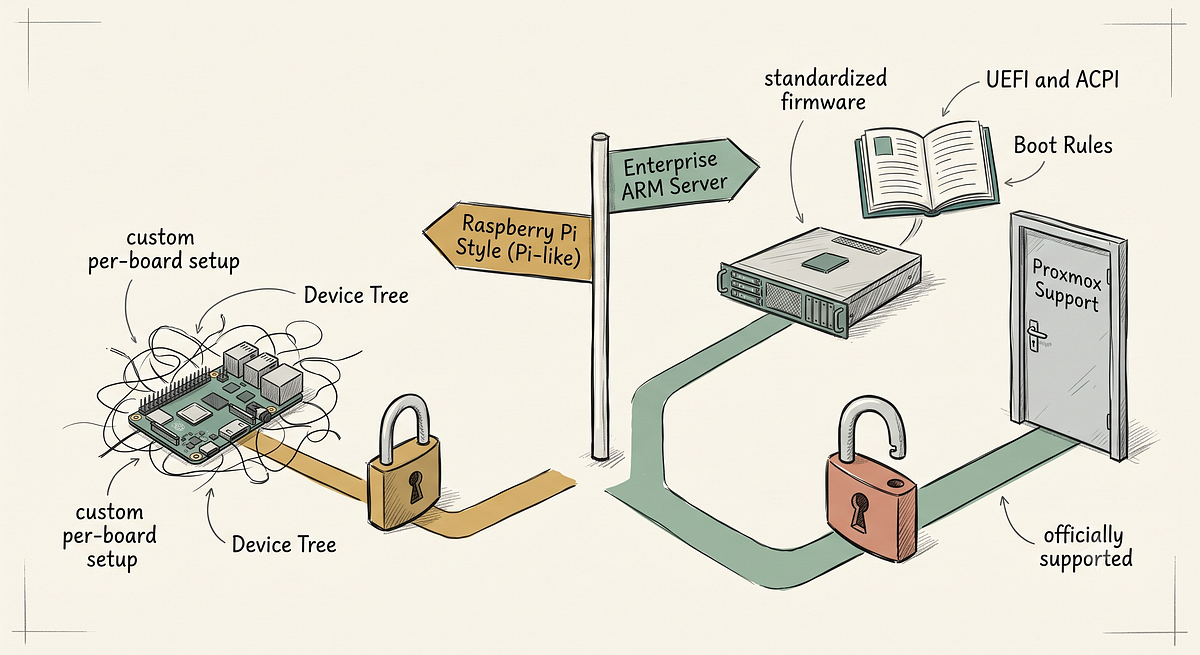
Here’s the part that surprised me a little. Proxmox isn’t targeting Raspberry Pi users with this first release. Officially supported hardware right now is systems using NVIDIA Grace and NVIDIA Vera CPU architectures, the kind of chips that show up in data centers doing AI training and inference, not your homelab shelf. Proxmox engineers apparently worked directly with NVIDIA and Supermicro to validate the platform on Grace Hopper Superchip systems, and it’s already running in some enterprise production environments according to the press release.
Why go enterprise first instead of Pi first? Honestly it makes sense once you think about it for a second. Proxmox’s official support requires UEFI and ACPI firmware, the standardized boot process that most x86 servers use. Enterprise ARM platforms like Ampere and the NVIDIA Grace systems already do this. Raspberry Pi and most single board computers use Device Tree instead, which is a totally different boot mechanism, and supporting both properly would mean maintaining separate kernel builds for basically every board out there. From a small engineering team’s perspective, that’s a nightmare to maintain long term.
Jeff Geerling, who tests this kind of hardware for a living basically, installed it on his Ampere Altra Dev Platform the same day it dropped. He said the install itself was smooth because the Altra uses proper UEFI, so Proxmox didn’t need any special tailoring the way it would for a Pi. He did run into one snag trying to install an Ubuntu 24.04 minimal server image inside a VM, and opened a forum thread about it. Small thing, but it’s the kind of detail that tells you this is a genuine first release, not a polished five-year-old product. There will be rough edges.
Can You Actually Run This on a Raspberry Pi?
This is the question everyone in my Discord actually cared about, not the enterprise data center stuff.
Short answer: not officially, but people are already doing it anyway.
The Proxmox forums lit up almost immediately. One subscriber posted that they manually installed it on a Pi 5 within hours of the announcement and said it worked great, though they weren’t sure 8GB of RAM was really enough for anything serious. That tracks honestly, Proxmox itself likes memory, and once you start stacking VMs on top of a Pi’s limited RAM you hit walls fast.
Community projects had already been solving this problem for years anyway. Pimox lets you build a cluster of Raspberry Pis, or even mix Pis with x86 hardware in the same cluster. There’s also a compiled ARM64 build of Proxmox Backup Server that someone turned into a Docker container just last month, specifically so it’s easy to drop onto a Pi. And jiangcuo’s Proxmox-Port project has apparently tested against Rockchip boards, Kunpeng processors, even Apple Silicon (VM only, no KVM support there though) and RISC-V hardware like the VisionFive2.
Will official Raspberry Pi support ever happen? Proxmox developers have said in the forums before that the main blocker was a lack of enterprise-grade ARM hardware for proper testing, and that they’d reconsider if that changed. Given that enterprise ARM is now clearly on their roadmap with this release, I wouldn’t be shocked if broader SBC support follows eventually. But I’m not holding my breath for it to happen this year.
Why People Actually Care About This
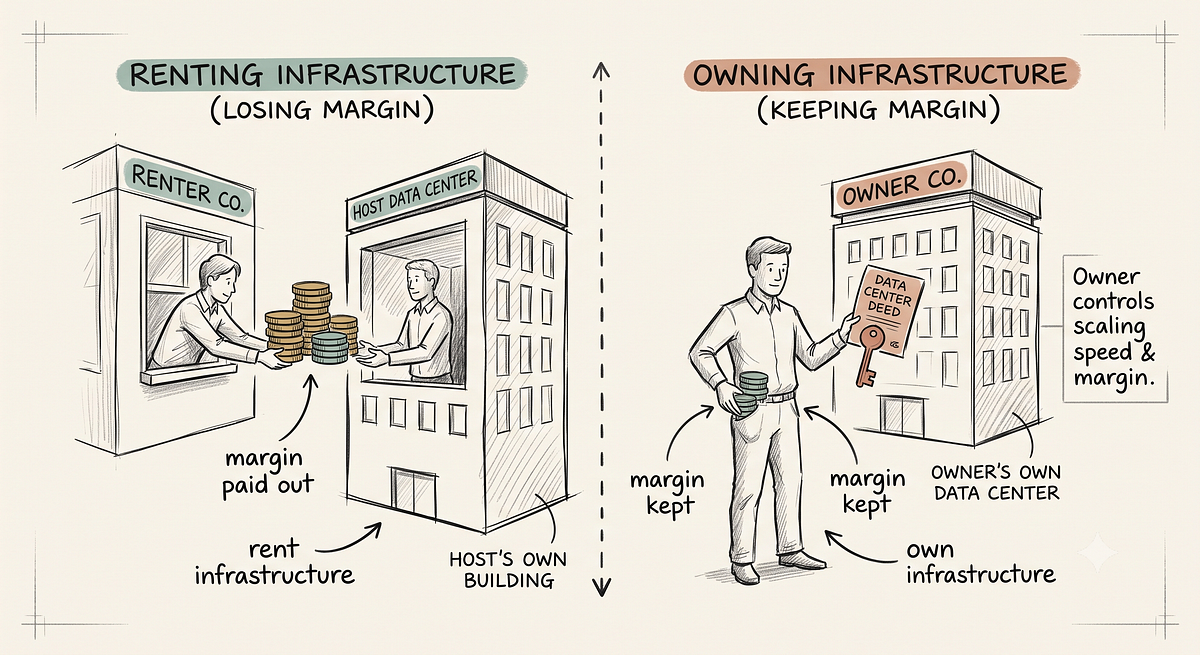
Power efficiency is the big one. ARM chips typically use way less electricity than comparable x86 chips for similar workloads. If you’re running a homelab 24/7, that difference shows up on your electricity bill every single month. For a data center running thousands of nodes, it’s a much bigger deal, we’re talking real operational cost savings at scale.
There’s also the AI angle, which honestly is probably why this got prioritized now instead of, say, three years ago when people were first asking for it. NVIDIA’s Grace and Grace Hopper platforms are built for AI training and inference workloads, and pairing them with a proper open source virtualization layer means companies can build out AI infrastructure without being locked into VMware or a single cloud provider. Someone on the Proxmox forum back in May was already asking pointed questions about exactly this, wanting to know Proxmox’s long term plans around hyperscale cloud, Kubernetes native environments, and sovereign cloud initiatives. Seems like they got at least a partial answer now.
And then there’s the simple fact that ARM server hardware has gotten a lot more available in the past few years, both on the enterprise side and, honestly, even for hobbyists. High RAM Raspberry Pi 5 variants make homelab-level virtualization experiments genuinely cheap now. Most software already ships native ARM builds anyway, containers, databases, whatever, ARM isn’t the second class citizen it used to be.
Real Use Case Scenarios
Let me walk through a few situations where this actually matters, instead of just talking in the abstract.
Edge computing deployments. A company running retail locations or factory floors wants small, low power compute nodes at each site instead of shipping everything back to a central data center. ARM boards running Proxmox let them run local VMs and containers for things like point of sale systems or local inference models, with centralized management still possible through Proxmox’s clustering tools.
AI training and inference clusters. This is the headline use case Proxmox is clearly chasing. A research lab or company with Grace Hopper hardware can now virtualize their AI workloads instead of running everything bare metal, which gives them better resource isolation between projects and easier backup and recovery if something goes wrong mid-training run.
Home labs chasing lower power bills. Somebody running three or four ARM mini PCs instead of an old power hungry x86 tower, running the same Plex, Home Assistant, and Nextcloud setup they always ran, just using a fraction of the electricity. Not officially supported hardware in most cases yet, but the community workarounds exist and people are already using them.
Hybrid clusters. Pimox already demonstrated this is possible, mixing ARM nodes with existing x86 Proxmox nodes in one cluster for redundancy. Imagine keeping your old x86 boxes around as backup capacity while gradually shifting main workloads to more efficient ARM nodes over time. Not something most people need, but for the tinkerers, it’s a fun problem to chew on.
Sovereign and regional cloud providers. Some governments and regional cloud operators want infrastructure that isn’t tied to Broadcom licensing or a specific chip vendor’s roadmap. Open source virtualization on ARM gives them another option that isn’t x86-locked.
What the Community Is Actually Saying
I spent a good chunk of yesterday reading through the Proxmox forum threads and the Hacker News discussion, and the mood is mostly excitement with a healthy dose of “yeah but” mixed in.
On the more skeptical side, someone made a fair point that this whole thing is basically catching up to what Incus OS has offered for a while already, with a decent web UI of its own. That’s a real criticism, not just noise. Proxmox isn’t first here, they’re playing catch up in some ways even while being ahead in others.
There’s also a small but vocal group annoyed that Windows VMs, still the reason a lot of small businesses adopted Proxmox in the first place, don’t really benefit from ARM64 at all, since Windows on ARM is its own separate mess entirely. So this release doesn’t help everyone equally. It mostly helps people running Linux workloads and containers, which, to be fair, is most homelab and cloud native use anyway.
But overall? People are happy. Really happy. The reactions on the announcement thread include a lot of the “super cool, now I know what to do this weekend” energy you’d expect from a community that’s been asking for this specific thing since 2019.
Things Still Rough Around the Edges
I want to be honest here because most coverage of stuff like this glosses over the messy parts. This is a first release. Proxmox themselves say fewer systems are currently available for validating arm64, which means individual packages might lag behind their x86 equivalents for a while. Live migration between different ARM CPU types is apparently still shaky, one forum user described trying to migrate between a Raspberry Pi 5 and an Orange Pi 5+ and hitting failures because there’s no properly abstracted ARM CPU type system yet, unlike the mature CPU type abstraction x86 has had for years.
If you’re on enterprise Grace or Vera hardware, this is probably solid enough for production, Proxmox says it’s already running in select production environments. If you’re trying to shove it onto a Pi 5 this weekend because you’re excited, which, same, just go in expecting some jank. That’s kind of the whole homelab experience anyway, isn’t it.
Where This Goes From Here
Nobody knows exactly how fast Raspberry Pi and consumer SBC support will officially arrive, if it ever does in the form people want. What’s clear is that the door is open now in a way it wasn’t a week ago. Proxmox has committed engineering resources to ARM64, they have a real hardware partner in NVIDIA, and the community projects that kept this dream alive for years, Pimox, Proxmox-Port, PiPBS, all of that groundwork, means there’s already a decent playbook for pushing this onto smaller boards even without official blessing.
If you’ve got an old Ampere box or access to enterprise ARM hardware, this weekend is probably a good time to go try it. If you’re a Pi person, keep an eye on the forums, somebody in your homelab circle is definitely already three beers deep trying to get it running and will post about it soon enough.