That email is basically the whole story of AI deflation in one line.

Here’s the simple version. AI tools like Copilot, Cursor, Claude Code, and a dozen others are letting engineers do in days what used to take weeks. That part is genuinely great, no argument there. But the client on the other side of that contract isn’t stupid. They can see the calendar too. If a project that used to eat 10 people and 3 months now takes 4 people and 3 weeks, the client starts asking why they’re still paying like it’s the old world. So the price gets pushed down, even while the company doing the work becomes more profitable per person. That’s AI deflation. Faster delivery, cheaper output, and somewhere in the middle, a fight over who actually keeps the savings.
What “AI Deflation” Actually Means
The term itself isn’t some official economics word you’ll find in a textbook from 2015. It’s more of a working label people in tech and consulting have started using since around 2025–2026 to describe a very specific squeeze. Regular inflation is when the same rupee buys you less stuff over time. AI deflation is sort of the opposite happening to service pricing: the same output now costs less to produce, so buyers expect to pay less for it too.
Think about what changed. A cloud research firm called CloudZero pointed out that AI infrastructure costs have been dropping fast, and providers may end up running trillion-parameter models for a fraction of what they cost in 2025. Meanwhile GitHub’s own numbers show something like 46% of code across scanned repositories is now AI-assisted or AI-generated, up from basically nothing three years back. So the input cost of writing software is falling. Naturally, someone downstream is going to ask why the output price hasn’t fallen with it.
I want to be upfront about something here. I’m not an economist, and if you asked ten people to define AI deflation precisely, you’d probably get ten slightly different answers. Some people use it narrowly for software pricing. Others stretch it to cover customer service, content writing, design work, basically anything where AI shrinks the labor input. I’m using it in the broader sense in this piece, mostly because that’s how I’ve seen it discussed most often on Twitter and in agency newsletters this year.
The Billable Hour Problem
This is where it gets interesting, at least for anyone who’s ever billed a client by the hour.
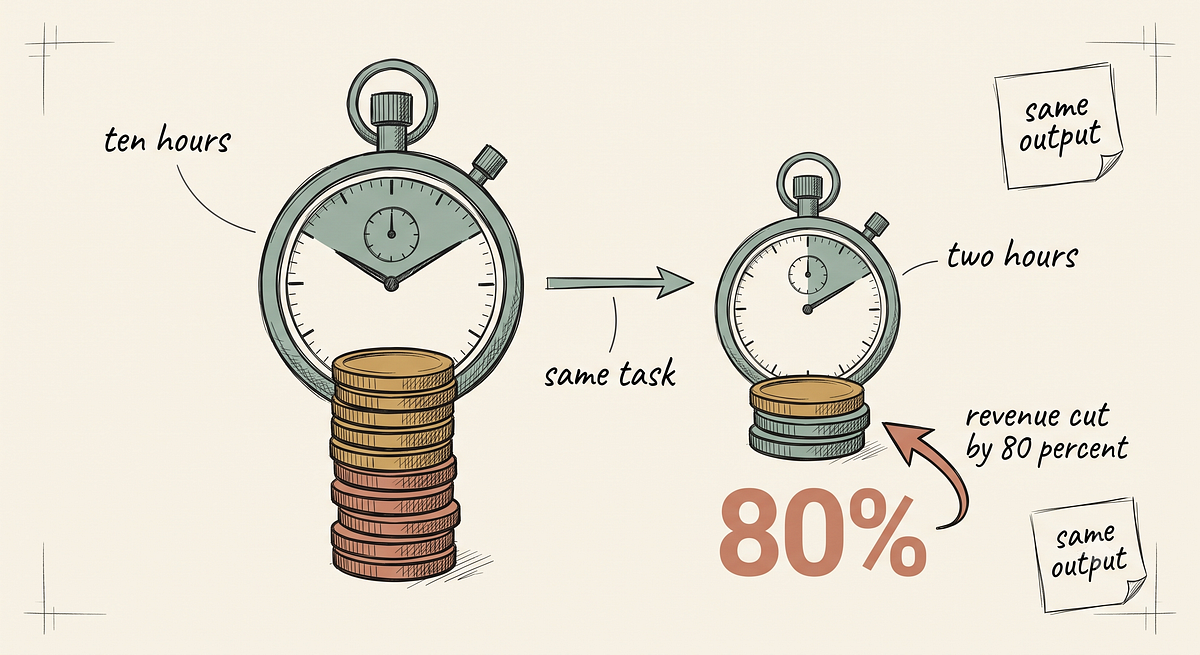
For decades, service businesses ran on a dead simple formula. Hours worked times a rate equals the invoice. It worked fine when developer time really was the bottleneck. You couldn’t magic up more hours in a day, so charging for time made sense as a proxy for value delivered.
AI broke that proxy. If a task that used to take ten hours now takes two, and you’re still billing hourly, you just cut your own revenue by 80% for identical output. One writer covering this exact problem for agencies described it well: bill by the hour and you earn a fraction of what you used to, for a client who is equally happy either way. Nobody signs up for a business model that punishes them for getting good at their job. So agencies are scrambling, mid-2026, to reprice everything before that math quietly wrecks their margins.
There’s a nastier version of this problem too, and I don’t think enough people talk about it. Some agencies are already using AI to cut delivery time in half, but they’re still logging the same number of hours on the timesheet. Basically padding. One Medium piece I read called this the agency profiting from the inefficiency of the old model while running on the efficiency of the new one. It’s a quiet extraction of margin and honestly, it’s kind of dishonest, though I get why a struggling agency owner might do it.
So what’s the fix? A lot of shops are moving toward outcome-based or value-based pricing instead. You don’t pay for the hours a developer sat typing. You pay for the fact that the checkout flow now converts 2% better, or the app shipped on time, or whatever the actual business result was. This flips the whole incentive. Get faster with AI, and now the savings are yours to keep instead of the client’s to claim.
Real Numbers, Not Just Vibes
I don’t want this to be one of those articles that just throws around “AI is changing everything” without backing it up. So here’s some actual data points I came across while researching this.
A 2025 survey from Productive.io, which tracked more than 180 agencies, found AI compressing project timelines by 3 to 4 times at some creative shops. That’s not a small bump, that’s a fundamental change to the unit economics. Around a third of agencies surveyed had already gotten explicit requests from clients for an “AI discount.” Think about that phrase for a second. Clients aren’t just noticing faster delivery, they’re literally asking for the savings back by name.
On the pure software development side, one 2026 piece I found claimed the average traditional agency was still taking 120-plus days to deliver a production-ready product, while AI-native teams running agentic workflows were doing the same class of work in 38 days. That’s roughly a 3x compression too, which lines up with the agency survey numbers. Two different sources, same rough multiplier, which makes me trust the pattern more than either number alone.
And it’s not just services. On the pure software product side, SaaS companies are facing their own version of this. A newsletter called vaasblock argued that AI is training customers to ask harder pricing questions across the board, things like why this seat count, why this premium tier, why this contract length. Software that used to justify its price tag just by existing now has to prove it’s doing something an AI wrapper couldn’t replicate over a weekend.
Who Actually Wins Here
This is the part that annoys a lot of engineers I’ve talked to, and honestly it annoyed me too when I first started thinking about it seriously.
In most versions of this story, the company captures the gains, not the individual doing the work. If one senior developer with good AI tooling can do the job of three average developers, the obvious business move is to keep the one senior person and let the other two go, or just not backfill when someone quits. The company’s margin per remaining employee goes up. The client’s bill might go down a little, or stay flat while delivery gets faster, either way it’s a win for whoever’s writing the checks on both ends of that relationship. The person actually operating the AI tools rarely sees a proportional cut of that saved value, unless they’re the owner or have serious leverage.
There’s a quote I keep thinking about, from an Indian AI firm co-founder who was blunt about it. All their corporate clients were asking AI solutions specifically to help reduce headcount. Not to help teams do more, though that’s the marketing line everyone uses. The actual ask, in plain words, was fewer people on payroll. That’s not cynicism on my part, that’s literally what buyers are asking for in the room.
Not gonna lie, this is the part of researching this topic that got a bit depressing for me. I went in expecting a neutral productivity story and came out feeling like the whole thing is basically a wealth transfer dressed up as an efficiency story.
But it’s not purely one-sided either, and I should be fair here. Freelancers and small agencies who reposition fast, away from selling raw hours and toward selling judgment, strategy, or outcomes, are actually doing fine, sometimes better than fine. The ones getting squeezed hardest are the ones still selling undifferentiated production work at hourly rates while a client watches AI eat their timeline in real time.
Why Clients Push Back On Price
Put yourself in the client’s shoes for a second, because I think a lot of engineers skip this step and just get defensive.
If you’re a client and you find out a project took a fraction of the expected time, and you’re not naive about how AI coding tools work in 2026, you’re going to ask questions. That’s not the client being cheap or ungrateful. That’s basic procurement logic. You wouldn’t keep paying full catering price if half the guest list cancelled.
The tricky part, and this is something the agencies I read about are still figuring out, is that speed and value aren’t actually the same thing, even though it feels that way when you’re the one paying. A landing page delivered in 2 hours instead of 10 might still be worth exactly what it was worth before, if it converts customers and makes money. The hours were never really the product. They were just the unit everyone agreed to measure by, because there wasn’t a better one available at the time.
So the honest answer to “why should I pay the same” isn’t really about hours at all. It’s: are you paying for time, or are you paying for the outcome and the judgment that got you there safely. Most contracts from before 2024 don’t make that distinction clearly, which is exactly why this whole mess is happening right now, mid-2026, across basically every services industry that touches software.
What People Are Actually Searching For
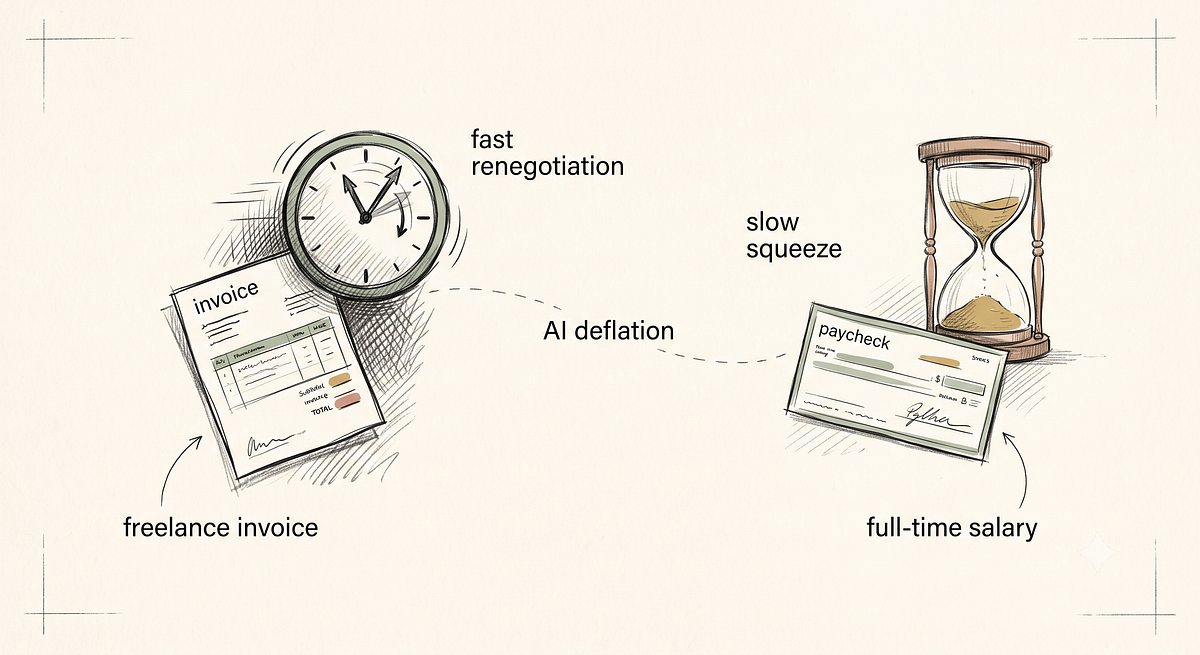
While digging into this I noticed a cluster of questions showing up again and again in forums and comment sections, which tells me this is bothering a lot of regular working people, not just consultants writing thinkpieces. Stuff like: should I lower my freelance rates because of AI, how do agencies bill for AI-assisted work now, will AI make developers cheaper to hire, is value-based pricing better than hourly for small teams, how do I explain to a client why my price didn’t drop even though I got faster. There’s also a good chunk of people asking the reverse question, wondering if AI deflation will eventually hit their own salary the way it’s hitting freelance day rates.
I think that last question is actually the sharpest one in the bunch. Because a full-time employee’s salary doesn’t renegotiate every project the way a freelance invoice does. But over a year or two, if a company realizes one AI-assisted engineer replaces three, the salary pressure shows up eventually anyway, just through layoffs, hiring freezes, or flat raises instead of an itemized invoice. Same math, slower and quieter delivery mechanism.
Where This Probably Goes
I don’t think AI deflation is a passing phase that corrects itself in six months. The cost of running these models keeps dropping every quarter, and clients aren’t going to un-notice that once they’ve seen it. The floor under service pricing is genuinely falling, and pretending otherwise just delays an uncomfortable conversation with your client.
What I do think changes is who wins inside that shrinking floor. The people and companies still selling raw hours of production work, the stuff AI genuinely does well on its own, are going to keep getting squeezed hardest. The ones who move toward selling judgment, taste, accountability, and the ability to catch the thing AI would’ve gotten subtly wrong, those are the ones who can actually hold pricing power even as the underlying task gets cheaper to execute.
If you’re reading this as someone who bills clients directly, freelancer or agency owner, the practical move isn’t to hide the fact that you’re using AI, and it isn’t to bill the same hours out of habit either. It’s to figure out, honestly, what you’re actually being paid for. If the honest answer is “typing code,” that’s a shrinking market. If the honest answer is “making sure the thing doesn’t break in production and the client doesn’t get burned,” that’s still worth paying for, AI tools or not.