My grandfather used to walk to the State Bank branch, stand in a line for two hours, fill a withdrawal slip by hand, and wait for the clerk to check his passbook against a giant ledger. If the ledger entry was wrong, he’d come back the next day. That was just Tuesday for him.
Last month I needed to dispute a wrong charge on my credit card. I opened an AI chat, described the situation in one line, got a formal complaint letter in about ten seconds, copy-pasted it into my bank’s app, and moved on with my morning. Total time: maybe four minutes, including the time I spent deciding what to have for breakfast.
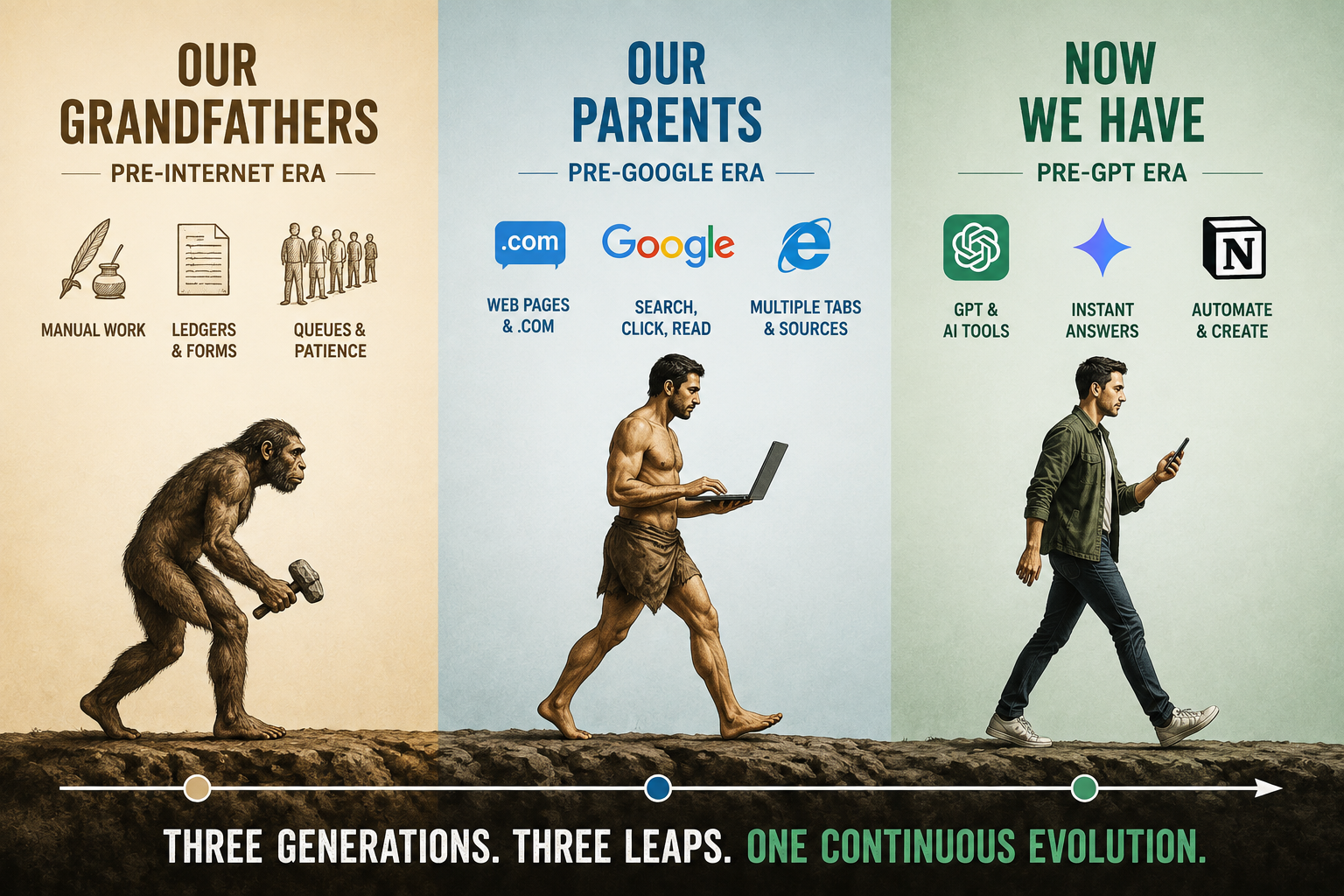
Three generations. Three completely different relationships with information, effort, patience, and time. And I keep noticing that each shift wasn’t just “a bit faster” than the one before it, it was a multiple. Not 20% better. Not double, even, in some cases. The gap between my grandfather’s world and my father’s was big. The gap between my father’s world and mine was bigger. And the gap between the internet I grew up on and the one I use now, post-GPT, might be the biggest jump of all three, and it happened in about three years.
When Information Was a Physical Thing
For my grandfather’s generation, information had weight. It lived in a specific place, and you had to physically go there. Want to know today’s train timings? Walk to the station or call the enquiry number and hope someone picks up. Want a second opinion on a medical diagnosis? You went to another doctor, in person, and probably waited a week for an appointment. Want to write to a relative in another city? You wrote a letter, walked to the post office, and waited anywhere from three days to two weeks for a reply, depending on where they lived.
There was no shortcut only. Everything required a trip, a queue, a person, a paper form, or all four at once. My grandfather kept a small notebook of phone numbers because there was no other place to store them. He remembered dozens of numbers by heart, actually, something none of us can do anymore because we’ve never had to.
This wasn’t a small inconvenience layered on top of an otherwise similar life. It shaped what people even attempted. You didn’t casually research something out of curiosity, because research meant a library trip, and a library trip meant half a day gone. Decisions got made with whatever information was locally available, from whoever you could reach by foot or by landline. My grandfather bought his first scooter based entirely on what his neighbour and the shop owner told him. No reviews. No comparison. Just word of mouth and a bit of faith.
Google Made It Searchable, Not Simple
My parents’ generation got something genuinely new: information that didn’t require a physical trip. But people wave their hand and say “the internet changed everything” like it was one clean jump. It wasn’t. It changed things in stages, and the early stage was rough.
Before Google properly took over, and before broadband was common in most Indian homes, you had dial-up. You had a 56k modem screeching through a connection, a phone line that got blocked the second you went online, a per-minute cybercafe bill if you didn’t have a connection at home, and a login page that timed out if you looked away for too long. My father tells me he’d type out his search queries on paper first, at his office, so he wasn’t paying for connection time while he thought about what to search. That single habit tells you everything about the era. Time online was expensive, so you planned your curiosity in advance.
Even once you were online, results were messy. Early search engines like AltaVista and the pre-2000 version of Yahoo weren’t ranking things the way modern search does. You’d get a page full of links with no real sense of which one was trustworthy, and you’d click through five or six of them just to confirm one basic fact. This was progress over the library trip, don’t get me wrong. But it wasn’t instant, and it wasn’t reliable. It was “the answer exists somewhere on this list, go find it.”
So this generation’s shift was: information stopped requiring travel, but it still required effort, patience, and a fair bit of guesswork about which source to trust. My father still double-checks anything he reads online against a second source, a habit he never dropped even after the connection got fast.
The Pre-GPT Normal We Forgot We Were Living In
Somewhere between 2005 and 2022, we built a version of the internet that felt so complete, so finished, that most of us stopped noticing how far it had already come. Broadband became normal. Smartphones put the whole thing in your pocket. Google got good enough that you rarely clicked past the first page. Wikipedia replaced the encyclopedia set nobody’s family could actually afford. Maps apps replaced asking strangers for directions. YouTube replaced the “how do I fix this” uncle who used to be your only source for anything mechanical.
This was the internet I grew up on, and honestly, at the time it felt like the end state. Like, this is just what the internet is, this fast, this searchable, this convenient. I remember thinking that any further improvement would be marginal. Slightly better search. Slightly faster load times. A new app here and there. I did not expect a fundamentally different category of tool.
And that’s exactly why the pre-GPT era matters in this comparison. It wasn’t a slow, boring, unfinished stage the way dial-up was. It was fast, mature, and genuinely useful. Search worked. Apps worked. You could get an answer to almost any factual question in under thirty seconds. The bottleneck wasn’t finding information anymore. It had moved. The bottleneck was now synthesis: taking twenty scattered facts and turning them into one coherent answer, one plan, one piece of code, one document. That part still needed a human, every single time, no matter how good the search engine got underneath it.
What Actually Changed When GPT Arrived
Here’s where I think a lot of people get the story wrong. They treat ChatGPT and its rivals like “a better search engine,” a faster Google. It’s not that. Search gave you the raw material. GPT-era tools give you the finished thing, or close enough to finished that you’re editing instead of writing from scratch.
I noticed this first with something small. I needed a formal email to a landlord, a slightly awkward one about a maintenance issue that had been ignored for three weeks. Pre-GPT, I would have opened five old emails I’d sent before, copied the tone, edited it, probably rewritten the middle paragraph twice, and spent fifteen or twenty minutes on something that mattered but wasn’t worth twenty minutes. Post-GPT, I described the situation in two lines, got a draft, changed one sentence I didn’t like, and sent it. Ninety seconds, if that.
Multiply that across a day, across every small writing task, every summary, every “explain this contract clause to me,” every first draft of anything, and the time saved isn’t marginal. It compounds. A friend of mine, who works in HR at a mid-size firm, told me her team cut the time spent drafting policy documents from what used to be a full day downto about two hours, starting from when his manager rolled it out to the whole team back in March. he was skeptical at first. Now he says he can’t imagine going back to a blank document.
But it’s not all smooth. I’ve had it confidently give me wrong information, stated with the same tone as the correct stuff, which is arguably worse than old-school search giving you five conflicting links, because at least there you knew to be suspicious. I’ve also seen it completely miss the point of a question I thought was clearly worded, and I had to rephrase three times before it understood what I actually wanted itself. So no, it’s not magic. Last week it also gave me a phone number for a support line that turned out to be disconnected, and I only realised after I’d already called twice.
The 2x, 3x Jump, in Code, Not Just Chat
If you want to see the scale of this shift most clearly, look at software development, because the numbers there are almost embarrassing.
Before, if you hit an error you didn’t recognise, the workflow was: copy the error, paste it into Google, open four or five Stack Overflow tabs, read through answers from 2014 that may or may not still apply to your version, try one, fail, try another, eventually cobble together a fix. This could take anywhere from ten minutes to an entire afternoon depending on how obscure the bug was. I’ve personally lost a full day once chasing a dependency conflict that turned out to be a single misnamed environment variable. That kind of thing used to be normal. You just accepted it as the cost of writing software.
Now we paste the same error into an AI coding assistant, and more often than not it identifies the exact line, explains why it’s failing, and gives me a fix, in under a minute. Not always right the first time, I’ll admit that. But even when it’s wrong, it’s usually wrong in a useful direction, closer to the answer than a fresh Stack Overflow search would’ve gotten me in the same amount of time.
The scale of this shows up in real numbers, not just vibes. GitHub published its own research on Copilot users back in 2023 and found developers completing tasks close to 55 percent faster on common coding work, and that’s on the conservative end compared to what individual devs report anecdotally on forums. Whole categories of grunt work, boilerplate code, writing test cases, converting a function from one language to another, have gone from “budget half a day” to “budget five minutes and a review pass.” One of the popular AI coding agents actually had a fairly public bug last week where it kept rewriting a config file in a loop on certain projects, and people were still arguing about whose fault it was on forums as of a few days ago, nobody’s fully sure if it’s fixed yet. Which tells you something too: we’ve moved fast enough that even the tools built to speed us up are shipping their own new kind of bugs.
And this isn’t only about developers. Consumer tech has the same shape of jump. Photo editing that needed Photoshop skills and an hour, now a two-line prompt. Video subtitles that needed manual transcription, now automatic and mostly accurate. Customer support chat that used to route you through six menu options, now a bot that actually solves the problem half the time. My cousin runs a small tailoring business and now uses an AI tool to write all her Instagram captions, something she’d have paid someone else to do two years back.
Where This Leaves Us
So here’s my honest take on the pattern across all three generations. Each shift removed a different bottleneck. My grandfather’s era had an information bottleneck, you often simply couldn’t find out something. My parents’ era removed that but kept a trust and effort bottleneck, the information existed, you just had to dig for the reliable version. My own pre-GPT years removed most of that too, information was fast and mostly trustworthy, but synthesis, turning information into a finished output, still needed a human hand for every single task. GPT-era tools are the first ones chipping away at that last bottleneck.
I don’t think this means human judgment is done. It isn’t. Someone still has to decide what to ask and whether the answer is actually worth trusting. My grandfather’s notebook of phone numbers, my father’s paper-planned search queries, my own habit of double-checking whatever an AI gives me before I send it anywhere important, these are all versions of the same thing: people adapting their habits to whatever the current bottleneck happens to be.
What strikes me, sitting here writing this on a laptop that would’ve seemed like science fiction to my grandfather, is that the next shift is probably already happening and I probably won’t notice it either, same as I didn’t notice the pre-GPT internet was itself a huge leap until something bigger came along and made the comparison obvious. That’s usually how it goes. You don’t see the size of the jump you’re standing on until you’ve already jumped again.