Right, so a friend of mine who does ROS stuff for a small robotics startup was trying to get a 70B parameter model running on his old Jetson AGX Orin last year. Didn’t work. Ran out of memory itself before it even finished loading the weights. He ended up either quantizing everything down until the model was basically useless, or just not running it locally at all and eating the latency of a cloud call. That’s the exact gap Nvidia built Thor to close.
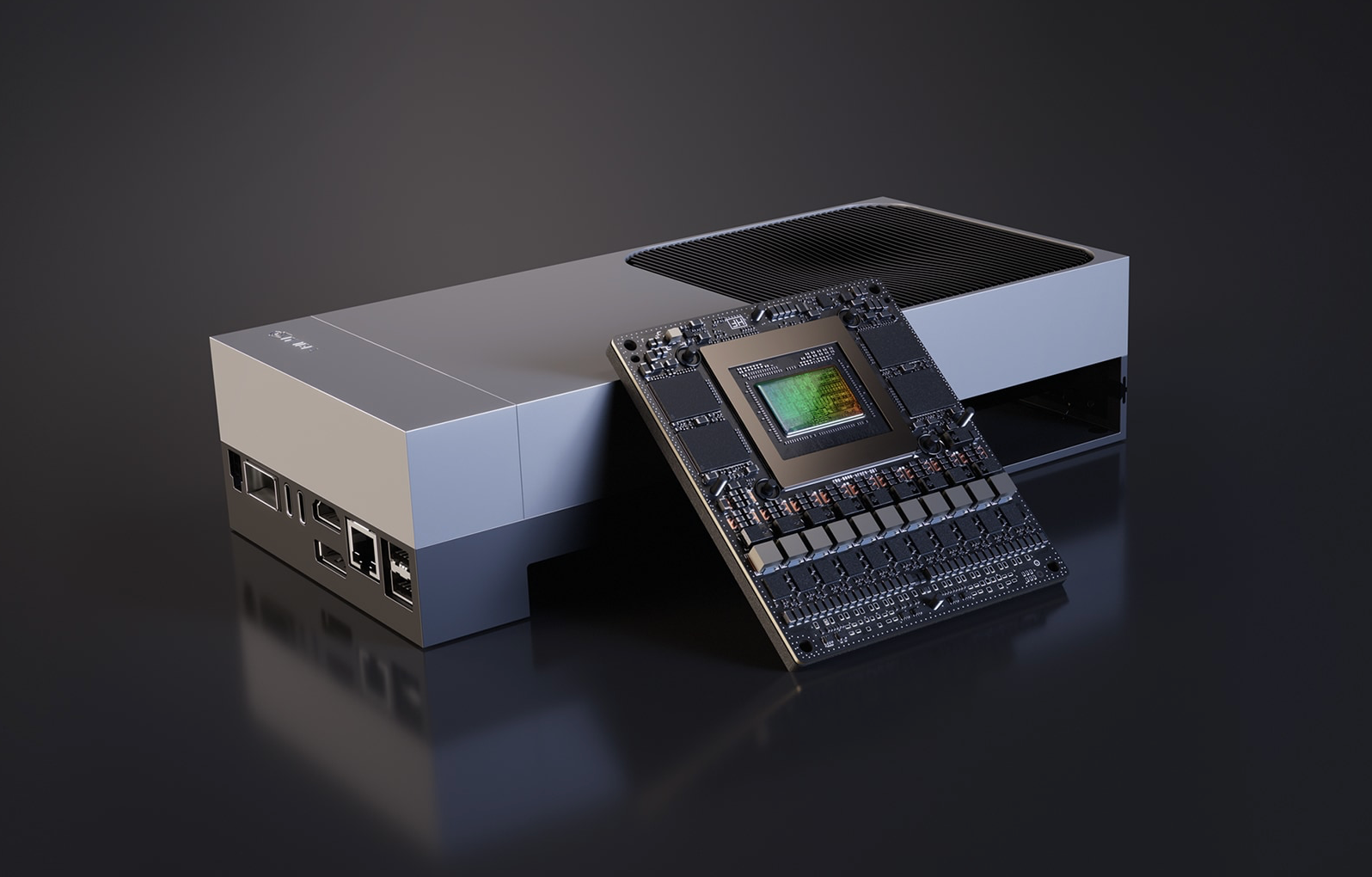
Jetson Thor is Nvidia’s new line of “robot brain” computers, boards small enough to bolt onto a humanoid robot or a delivery bot, but with enough compute to run large language models and vision-driven control policies at once, on the device itself, with no cloud round trip. It’s built on the same Blackwell GPU architecture that powers Nvidia’s big data center chips, just shrunk down and repackaged for edge power budgets. The flagship version can push over 2,000 FP4 teraflops while pulling somewhere between 40 and 130 watts, depending on how you tune it.
When I first read the spec sheet I assumed this was another incremental Jetson refresh, like Orin NX to Orin AGX. It isn’t. This one’s a proper architecture jump, and it changes what kind of robot software is actually possible to run without a network connection.
The Thor Lineup, and Where “Nano” Actually Fits
There isn’t one Jetson Thor. There are four, and the naming trips people up constantly.
The Jetson T5000 is the flagship. This is the one in the $3,499 developer kit that launched general availability in August 2025. It pairs a Blackwell GPU with 2,560 CUDA cores and 96 Tensor cores against a 14-core Arm Neoverse V3AE CPU, sitting alongside 128GB of LPDDR5X memory with over 270GB/s of bandwidth. That memory number matters more than people give it credit for. It’s what lets a 70B parameter model actually fit on the device with room left for the KV cache and activations, instead of you having to gut the model down to something dumb just to make it fit.
Below that sits the T4000, roughly 1,200 FP4 TFLOPS with 64GB of memory, running on 40 to 70 watts. Then the T3000, announced in July 2026, which delivers 865 FP4 TFLOPS in a package Nvidia says is about half the size and power draw of the T5000. And under that, the T2000, at 400 FP4 TFLOPS with 16GB of memory, built for lighter jobs like visual AI agents and industrial manipulators that don’t need to run a full LLM on board.
Now here’s where I see people get confused, myself included at first. There’s no “Jetson Thor Nano.” The Nano naming (Orin Nano, Orin Nano Super) belongs to the older Orin family, not Thor. The Orin Nano Super Developer Kit is still around, still $249, and it’s still Nvidia’s cheapest way into edge AI for anyone who’s just experimenting or teaching a class. If you see someone online mixing up “Thor Nano” with an actual product, they’re probably thinking of the T2000, which is the smallest Thor variant, but it’s not called Nano and it costs a fair bit more than $249.
There’s also an IGX version, IGX T3000, same silicon as Jetson T3000 but built for functional safety certification. That one’s meant for robots working physically close to people, where a fault has to fail safe rather than just fail. Nvidia rolled this out alongside something called Halos for Robotics back in June, which is basically their safety stack sitting underneath the hardware.
What People Are Actually Building With It
The obvious use case is humanoid robots, and that’s where most of the noise is. Nvidia has named 1X, Agile Robots, Amazon Robotics, Boston Dynamics, Fanuc, Hitachi, and Techman Robot as companies building on Jetson AGX Thor. That’s not a small list, and a few of those names, Boston Dynamics especially, aren’t exactly known for jumping on hardware that doesn’t actually work. The core idea is running a Vision Language Action model, Nvidia’s own Isaac GR00T N is the one they push hardest, directly on the robot. A VLA model takes in camera feed and maybe some sensor data, reasons about what it’s seeing, and outputs actual motor commands. Basically it’s the thing that lets a robot look at a coffee cup on a table and figure out how to pick it up without someone hand-coding every possible cup position. That kind of reasoning used to require a cloud connection because the model was too big to run locally. Thor’s whole reason for existing is to make that on-device instead.
I found one detail from Analog Devices worth mentioning here: their engineers described using isolated GPU slices on Thor to run locomotion, grasp planning, perception, and the VLA policy simultaneously, each getting its own dedicated chunk of the GPU rather than fighting for the same compute. That’s the MIG support (Multi-Instance GPU) carried over from Nvidia’s data center chips, and for robotics it means one bad or slow model doesn’t stall the whole system.
There’s also Cosmos 3 Edge, a 4 billion parameter world model Nvidia introduced alongside the T3000 in July. It’s meant to help a robot predict what happens next in its environment, and the pitch is that developers can post-train it for a specific robot body and sensor setup in about a day, then run the whole thing on-device. Whether that “about a day” claim holds up outside Nvidia’s own demos, I don’t know. Nobody I’ve talked to has tried it themselves yet.
Beyond humanoids, the T2000’s aimed at simpler stuff, autonomous mobile robots moving pallets around a warehouse floor, industrial arms doing pick and place, that sort of thing where you don’t need a 70B model, you just need fast, reliable perception running locally.
Thor vs Orin, With Actual Numbers
This is where I want to slow down, because the marketing slide numbers and the real-world benchmark numbers aren’t quite the same thing, and it’s worth knowing both.
On paper, Nvidia claims the T5000 delivers 7.5 times the AI performance of the previous Jetson AGX Orin generation, and about 3.5 times the energy efficiency. The architecture shift explains why. Orin runs on Ampere GPU cores paired with Arm Cortex-A78AE CPUs and it maxes out around 275 TOPS of INT8 performance. Thor moves to Blackwell, adds a proper Transformer Engine that switches between FP4 and FP8 precision on the fly, and that’s the part that actually matters for LLMs, since it’s what lets a 70B model sit in memory without falling apart.
ServeTheHome ran actual hands-on benchmarks rather than just repeating Nvidia’s slides, and Thor beat Orin across every model they threw at it. On Llama 3.1 8B specifically, they measured 149.1 tokens per second against Nvidia’s own claimed figure of 150.8, close enough that I’d call the marketing honest for once. CPU-side, the 14-core Neoverse V3AE landed somewhere around an AMD Ryzen AI 7 350 or an Apple Mac Mini M4 in multi-threaded work, which is fine since Thor’s whole design point is the GPU carrying the load, not the CPU.
HotHardware’s review put it in more relatable terms: Orin performance felt closer to an RTX 3050, Thor closer to an RTX 5070. That’s roughly the gap you’re paying for.
Price tells its own story too. The T5000 developer kit runs $3,499. The AGX Orin 64GB, still very much a current product, sits at $1,999. That’s not a small gap, and it’s not one you should close just because Thor is newer. According to one 2026 buyer’s framework I came across, Orin 64GB is still the better call for multi-stream vision pipelines and any multimodal model under 13B parameters, basically anything that isn’t asking “can I run a huge model on this,” which is the one question Thor exists to answer.
One honestly unresolved thing: by early 2026 software updates had reportedly pushed Thor’s generative AI throughput up around 7x from where it launched at in August 2025, according to that same framework piece. Early reviewers flagged this too, that the hardware shipped ahead of the software stack maturing. If you buy one today, expect JetPack and driver updates to keep meaningfully changing what the thing is capable of, for better, over the next year or so.
Do You Actually Need One
For most people reading this, no.
If you’re a student, a hobbyist, or you’re just messing around with computer vision on a weekend project, the Orin Nano Super at $249 does more than enough, and setup itself will only take you an afternoon, so you’ll actually finish your project instead of returning a $3,499 board because you didn’t need a fifth of its capability. If you’re doing multi-camera vision pipelines, running models under 13B parameters, or you already have something working fine on an Orin 64GB, there’s no real reason to move.
You’d be paying for headroom you’re not using.
Thor earns its price when you’re doing one specific thing: running something big, on-device, with no cloud fallback. A 30B+ LLM reasoning about camera input in real time. A VLA policy controlling a humanoid arm while a second model handles perception, both running simultaneously without stepping on each other. If that’s not your workload, and for most people it isn’t yet, you’re buying compute you’ll never touch.
There’s also a maturity question nobody talks about enough. A friend building on Jetson boards for a couple of years now told me Orin’s software ecosystem, drivers, container images, community fixes, is just further along, since it’s had years to bake. Thor’s newer, and while Nvidia’s pushing updates fast, you’ll hit rougher edges. If you need something that works reliably today without babysitting it, that’s worth weighing against the raw compute numbers.
Where This Leaves Things
I keep coming back to the same thought: Thor isn’t really competing with Orin, it’s competing with the idea that heavy AI reasoning has to happen in the cloud. That’s the actual bet Nvidia’s making, and given who’s already building on it, Boston Dynamics doesn’t strike me as a company that signs onto hardware for the marketing. Whether it pays off broadly depends less on the silicon and more on whether the software catches up fast enough for smaller teams to actually ship something on it, not just Nvidia’s own demos.
If you’re deciding right now, go by the workload, not the hype. Orin if you don’t need frontier-scale models on-device.Thor if you do, and you’re fine riding out a still-maturing stack for the next several months.