I first heard about OpenRouter from a friend who builds Discord bots for a living. He was complaining, actually, not recommending it. He said something like, “bro I switched my whole bot to Claude in one line, I didn’t even touch my code.” I didn’t get it at first. Why would changing a model be a one line change? Isn’t every AI provider’s API different?
That question is basically the whole reason OpenRouter exists.
If you’ve built anything with AI in the last one year, you already know the problem even if you never had a name for it. OpenAI has its API. Anthropic has its own, slightly different one. Google’s Gemini API works differently again. Then there’s Mistral, DeepSeek, Meta’s Llama models hosted by five different companies, and a growing pile of open weight models from labs you’ve probably never heard of. Every one of them wants its own API key, its own billing account, its own quirks in how it formats a request. Multiply that by the number of models you actually want to try before picking one, and you end up with a mess of dashboards, invoices, and half-broken integration code nobody wants to touch again.
OpenRouter’s answer to this mess is simple to describe. One API key. One endpoint. Over 400 models from more than 60 providers, all reachable through a request format that looks like OpenAI’s own chat completions API. You change one string, the model name, and your app is now talking to Claude instead of GPT, or to a random open source model from a lab in Singapore, without rewriting anything else.
Why This Even Needed Solving
Here’s the part I find interesting, and it’s not really about the tech.
OpenRouter was started in early 2023 by Alex Atallah, who had previously co-founded OpenSea and served as its CTO through the company’s peak valuation of around 14 billion dollars. He left OpenSea in mid 2022 wanting to build something new from scratch. Then, in February 2023, Meta released LLaMA and Stanford followed shortly after with Alpaca, and Atallah noticed something that a lot of people missed at the time: small teams with limited resources were suddenly able to build genuinely competitive AI models. That’s not a small observation. Up until that point, most people assumed only OpenAI, Google, and maybe two or three others would ever matter in this space. Atallah bet the opposite. He figured the model landscape was about to explode into dozens, then hundreds, of competing options, and that nobody had built the plumbing to make sense of all of it. He teamed up with Louis Vichy, a collaborator from the browser extension framework Plasmo, to launch OpenRouter.
So basically, OpenRouter wasn’t built to be clever middleware for its own sake. It was built on a bet about market structure, whether AI inference would end up winner take all (one company owns everything) or fragmented into a genuine marketplace. As of mid 2026, it looks like Atallah’s bet paid off. By May 2026, OpenRouter had grown to more than eight million registered developers, processing around 25 trillion tokens a week, which works out to roughly 100 trillion tokens a month. That’s an insane number, honestly, and it only makes sense if the “many models, many providers” theory of the AI world turned out to be correct.
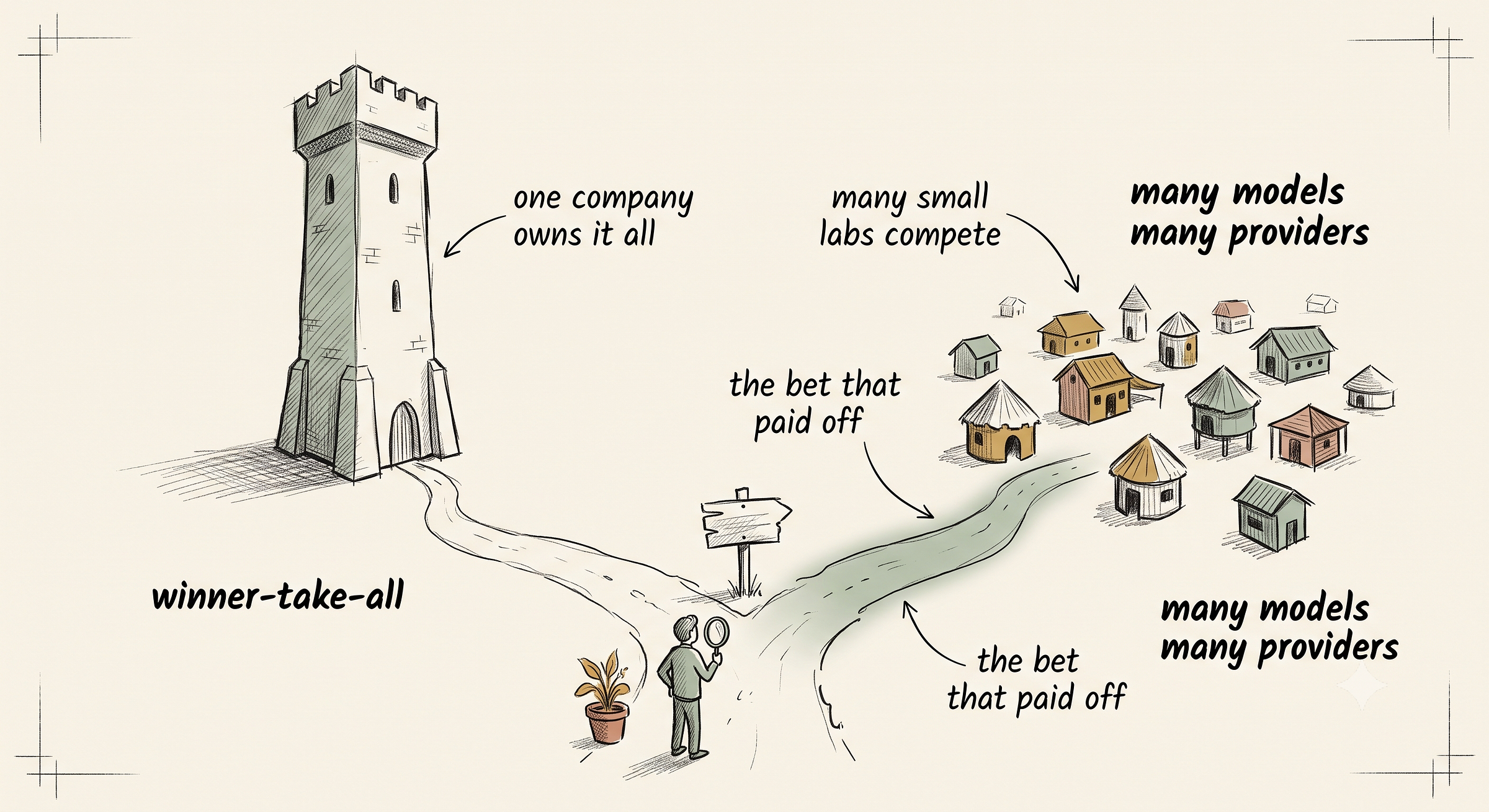
The company also raised real money on this thesis. OpenRouter pulled in around 113 million dollars in venture funding at a valuation of about 1.3 billion dollars, led by CapitalG, which is Alphabet’s growth investment arm, with NVIDIA’s venture fund and existing backers like a16z also putting in more money. Google’s own investment arm funding a company that helps developers avoid getting locked into Google’s models is a bit funny if you think about it for more than five seconds. But that’s venture capital for you, I guess.
What It Actually Does Under the Hood
I won’t drown you in API syntax here, there’s documentation for that. But the shape of it matters if you want to understand why people reach for this tool.
You send a normal looking chat request, the same kind you’d send to OpenAI directly, except you point it at OpenRouter’s endpoint instead and specify a model slug like anthropic/claude-sonnet-4.5 or deepseek/deepseek-v4-flash. OpenRouter takes that request, normalizes it so it matches whatever format the actual underlying provider expects, sends it off, and hands the response back in a consistent shape no matter which model answered. If your first choice provider is having a bad day (and providers do have bad days, more often than any of them admit publicly), OpenRouter can automatically fall back to a different host serving the same model, or even to a comparable model entirely, depending on how you've set things up.
There’s also a billing layer sitting on top of all this. You load prepaid credits into one account instead of setting up separate billing with OpenAI, separate billing with Anthropic, separate billing with whoever hosts the Llama model you like. OpenRouter charges a 5.5 percent fee on credit purchases, so a 100 dollar top-up gives you about 94.50 dollars of actual inference credit, and the underlying model token rates themselves are passed through from the provider without an added markup. There’s also a Bring Your Own Key option, where your traffic routes through your own provider account and OpenRouter just handles the orchestration.
Is this elegant? Sort of. Is it also, if you squint, a toll booth sitting between you and a dozen AI companies? Also sort of. Both things are true at once and I don’t think that’s a contradiction worth losing sleep over.
Who Actually Uses This, and For What
This is where things get interesting, because the actual usage doesn’t split the way I expected when I first looked into this.
The biggest and probably most surprising chunk of usage isn’t enterprise dashboards or Fortune 500 pilot projects. It’s roleplay and character chat. Apps like SillyTavern and Janitor AI, along with custom character chatbots and interactive fiction engines, lean on OpenRouter heavily because it gives them access to the top ranked roleplay and creative writing models through one connection, with rankings updated based on real weekly usage data rather than marketing claims. If you’ve ever wondered how some random AI companion app manages to offer you a choice of ten different personality models, this is usually the answer. Somebody plugged in an OpenRouter key once and never looked back.
Coding assistants are the second big category, and this one I actually understand from personal experience. Tools like Cline, Aider, Continue, and OpenCode all support pointing at OpenRouter instead of a single hardcoded provider.Developers use it to compare coding models for generating code, debugging, and refactoring, pulling from providers like Anthropic, Google, xAI, and OpenAI without juggling four separate API keys. I tried this myself a few months back, wiring my own small automation script through OpenRouter just to A/B test two coding models on the same prompt without rewriting my request logic twice. It worked fine, though figuring out the right model slug naming convention took me longer than it should have, the docs assume you already know the provider’s own naming scheme.
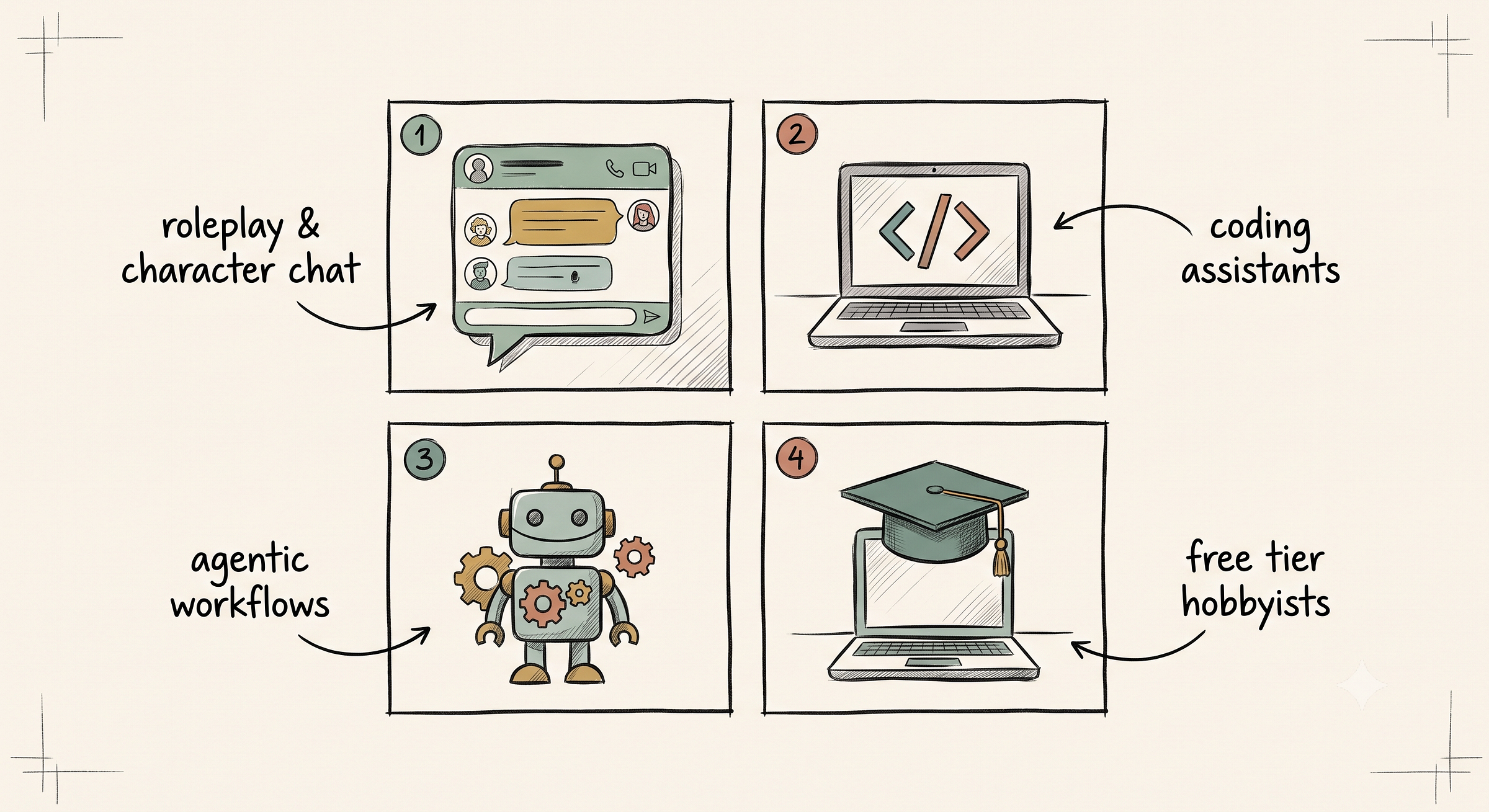
Then there’s the agentic workflow crowd, people building autonomous agents that plan, call tools, and keep working through multi-step tasks. OpenClaw, an open source autonomous agent project, ranks its most popular underlying models directly through OpenRouter usage data. And there’s a growing embeddings and vision use case too, semantic search, RAG pipelines, document understanding, all routed the same way.
Free models deserve their own mention because they’re a bigger deal than you’d think. OpenRouter maintains a set of free models, partly to let people experiment and learn without a credit card, and it actively expands this free capacity by onboarding new providers and, in some cases, directly covering the inference cost itself. Students, hobbyists, people building a weekend project, this is where a lot of first contact with OpenRouter happens. I’ve seen a fair number of small WordPress automation tools and n8n workflows lean entirely on the free tier, which honestly surprised me. Nobody talks about that segment much but it’s real.
When It’s the Right Call, and When It Genuinely Isn’t
Here’s the thing I think a lot of “OpenRouter is amazing” articles skip over. It’s not always the right tool. Not because it’s bad, but because the value it adds depends entirely on your situation.
If your product runs on exactly one model from one provider and you already have a direct account set up, OpenRouter mostly adds a fee for something you don’t need. You’re paying 5.5 percent on top ups for routing flexibility you’re never going to use. Skip it. Same story if you need something OpenRouter’s standardized interface can’t expose properly, some providers have batch APIs or fine-tuning endpoints that don’t map cleanly through a unified chat completions format. And if your app is doing anything latency sensitive, real time voice, sub 200 millisecond response windows, that extra network hop through a proxy layer is a real cost, not a theoretical one.
Compliance is another one people underestimate. If you’re building something in healthcare or finance where data residency and audit trails actually matter, routing your traffic through a third party gateway complicates your story with auditors, even if OpenRouter itself has nothing sketchy going on.
So where does it actually shine? Early stage products, prototyping, and anything where you genuinely don’t know yet which model is going to work best for your use case. One writer put it well: use OpenRouter for version zero of your product, and if your monthly spend crosses somewhere around a thousand dollars, that’s usually when the 5.5 percent fee starts to sting enough that switching to something like a self-hosted LiteLLM setup makes financial sense. That threshold isn’t a hard rule, more of a rough signal, but it matches what I’ve seen from a couple of indie developers I follow.
The Reviews Are a Lot More Mixed Than the Marketing Suggests
I’ll be honest about this part because most articles about OpenRouter read like they were written by someone on the payroll.
On Trustpilot, OpenRouter’s TrustScore sat at 1.7 out of 5 across 41 reviews as of May 2026, with 79 percent of those reviews rated one star. That’s rough. The complaints aren’t random either, they cluster around slow support response times, with reviewers describing filing a request and waiting weeks, and several mentioning that Discord is effectively the main support channel rather than any structured ticketing system built for urgent production issues.
I want to be fair here though. Positive reviews exist in large numbers too, and they’re consistent about what they like: the model catalog, the ease of switching models, not having to manage five separate accounts. The catch is that those glowing reviews mostly come from people who haven’t hit a production emergency yet. Once something breaks at 2am and you actually need someone to answer you fast, that’s apparently where the cracks show. Make of that what you want, but I’d rather tell you this upfront than pretend the tool is flawless.
How It Stacks Up Against LiteLLM and Portkey
If you’ve been reading around this topic, you’ve probably seen these three names thrown around together constantly: OpenRouter, LiteLLM, and Portkey. They solve a similar sounding problem but they’re really not interchangeable.
LiteLLM is the open source, self-hosted option. You run it yourself, usually on a small VM, and you pay providers directly at zero markup, just your own hosting cost on top. That’s appealing if you have the engineering capacity to manage it, but somebody on your team has to own that infrastructure, patch it, monitor it, and deal with it when it goes down. Portkey sits at the other end, it’s built for teams that need serious observability, semantic caching, and compliance guardrails, the kind of thing a healthcare or fintech company going through a security audit actually needs. It costs more but the governance features are the whole point.
OpenRouter sits in the middle in terms of effort, closer to LiteLLM in terms of simplicity though. Sign up, get a key, start making requests within minutes, no infrastructure to run. That’s genuinely its biggest strength and also, depending on your stage, its biggest weakness, because you’re trading that convenience for a recurring fee and less control over routing decisions than a self-hosted setup gives you.
A Few Things Worth Knowing Before You Start
A couple of practical odds and ends that don’t fit neatly into a section but matter if you’re actually going to try this.
OpenRouter introduced a feature called Workspaces in April 2026, which lets an account split its projects into separate environments, each with its own API keys, routing defaults, guardrails, and observability dashboards. This turned out to be a bigger deal than the initial announcement suggested. Teams use it to keep development, staging, and production traffic from stepping on each other, and to give each internal team or customer their own spend caps and activity logs. If you’re running more than one project through a single OpenRouter account, this is worth setting up early rather than untangling it later.
Also, model names on OpenRouter change more often than you’d expect. Free model listings especially. A model that was free last month might quietly become paid only, or get pulled entirely and replaced with something similar from a different provider. I got bitten by this once, a script I’d wired up to a free Llama variant just started failing silently until I noticed the model slug had shifted. Worth checking the free models list every so often rather than assuming it’s static.
None of this makes OpenRouter a bad tool, honestly. It solved a real problem that got worse, not better, as more labs kept shipping competitive models through 2024 and 2025. Whether it’s the right call for your specific project depends mostly on where you are: prototyping and figuring things out, or already locked into a scale where every basis point of fee actually shows up on your invoice. Either way, at least now you know why that one line model switch your friend bragged about actually works.