There is a version of Apple that would never do this.
That version — the one obsessed with premium margins, sleek minimalism, and a price floor that quietly excluded entire demographics — would not release a laptop for $599. It would not drop an iPhone chip inside a MacBook. It would not name it “Neo,” paint it citrus yellow, and market it to students who track their grocery spending.
And yet, here we are.
The MacBook Neo launched on March 4, 2026, at an event in New York. It starts at $599. For education buyers, it goes down to $499. It runs on the A18 Pro — the same processor inside the iPhone 16 Pro. It has a 13-inch Liquid Retina display, up to 16 hours of battery life, Apple Intelligence built in from day one, and four colors that feel more like a fashion statement than a hardware choice.
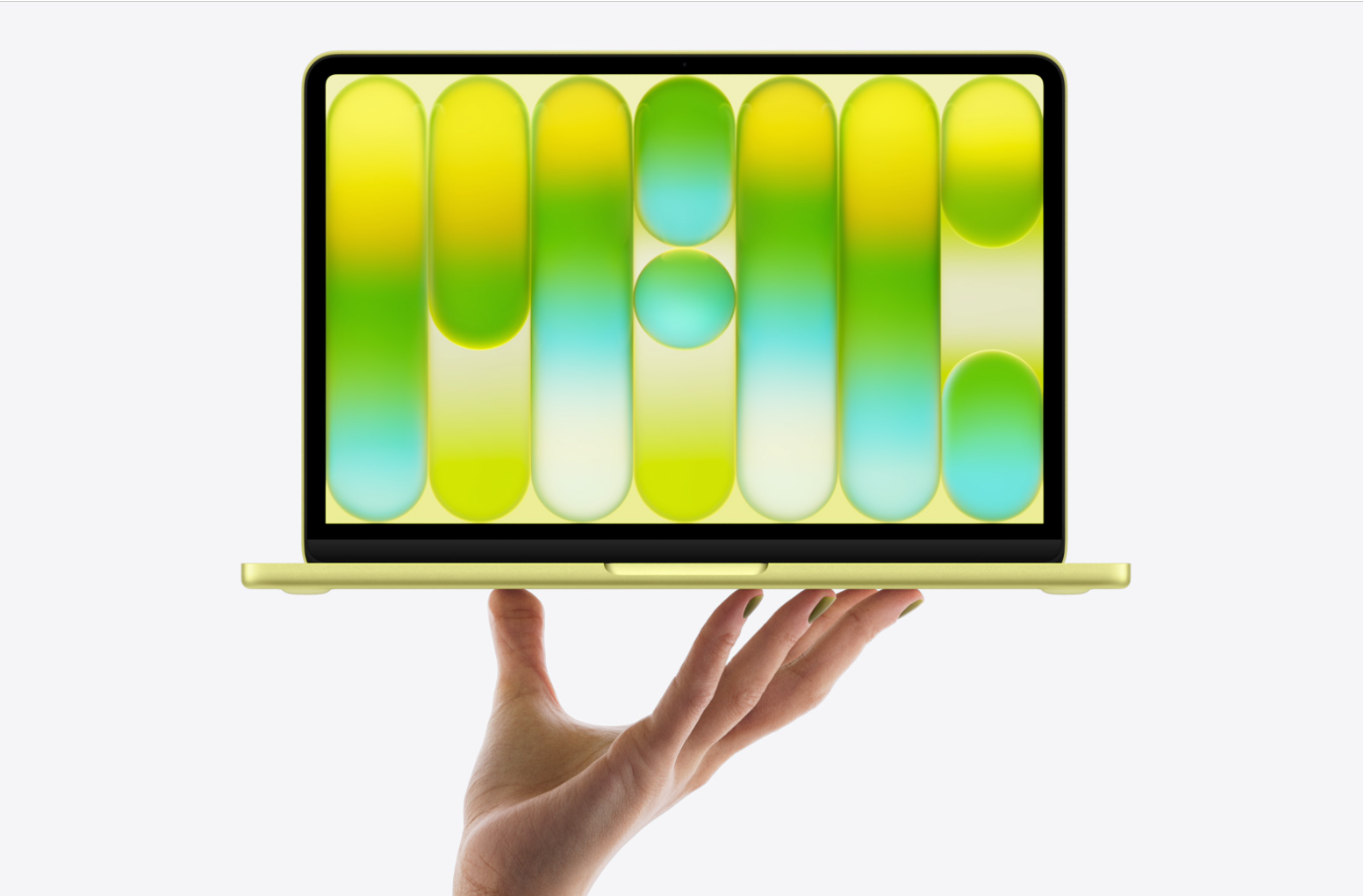
But the headline buried underneath all of that is the one nobody in the Windows world wants to discuss openly: the MacBook Neo can now run Windows applications. Not perfectly, not natively, but well enough to remove the last real excuse most Windows users had for not making the switch.
This is not a minor product update. This is Apple making a calculated, patient, decade-long argument reach its conclusion. The argument goes: you already carry an iPhone. You already live in our ecosystem. You just could not afford the entry point. That problem is solved now.
And oh, by the way — your Windows software works here too.
The $400 Price Drop That Changes Everything
For years, the cheapest way into the Mac lineup was $999. That number did real work — it kept a specific kind of buyer permanently on the wrong side of the decision. Not the buyer who could not imagine spending $999 on a laptop. The buyer who could imagine it perfectly, weighed it seriously every time they needed a new machine, and then bought a $650 Windows laptop because the math did not quite work.
The MacBook Neo is $599. The education version is $499. A $699 model doubles the storage to 512GB and adds Touch ID.
That gap closure — from $999 to $499 for education buyers — is not a rounding error. It is Apple stepping into the exact price band where Chromebooks and mid-range Windows laptops have operated without any real competition from Cupertino for the better part of fifteen years.
John Ternus, Apple’s senior vice president of hardware engineering, described it directly at the launch event: the MacBook Neo was built from the ground up to be more affordable for even more people. That framing is deliberate. Apple is not describing a compromised product at a lower price. It is describing a new product category, designed specifically for an audience it has never prioritized before.
What Is Actually Inside This Machine
Before we get to the Windows conversation, it is worth understanding what the MacBook Neo actually is as a piece of hardware — because the numbers are more interesting than the price alone suggests.
The Processor. The A18 Pro chip has a 6-core CPU and 5-core GPU. Apple claims it runs AI tasks up to three times faster than rival PC laptops. It is also about 50 percent faster in real-world performance than comparable Intel-based PCs. Those numbers come from Apple, so apply some scepticism — but the underlying architecture is real. This is the same silicon that powers one of the best smartphone cameras in the world and handles real-time computational photography at 48 megapixels. It is not slow.
The Display. A 13-inch Liquid Retina panel at 2408 x 1503 resolution, 500 nits of brightness, running at 60Hz. It supports sRGB color. Text is sharp, video looks vivid, and it performs well in indoor environments. It does not support True Tone technology, and it is not ProMotion — those features live higher up the lineup. For $599, this screen is genuinely good.
The Build. Recycled aluminum chassis. 2.7 pounds — identical to the 13-inch MacBook Air in weight. WiFi 6E for fast wireless. Bluetooth 6. Two USB-C ports and a 3.5mm headphone jack. A 20-watt charger in the box, similar to what ships with recent iPhones.
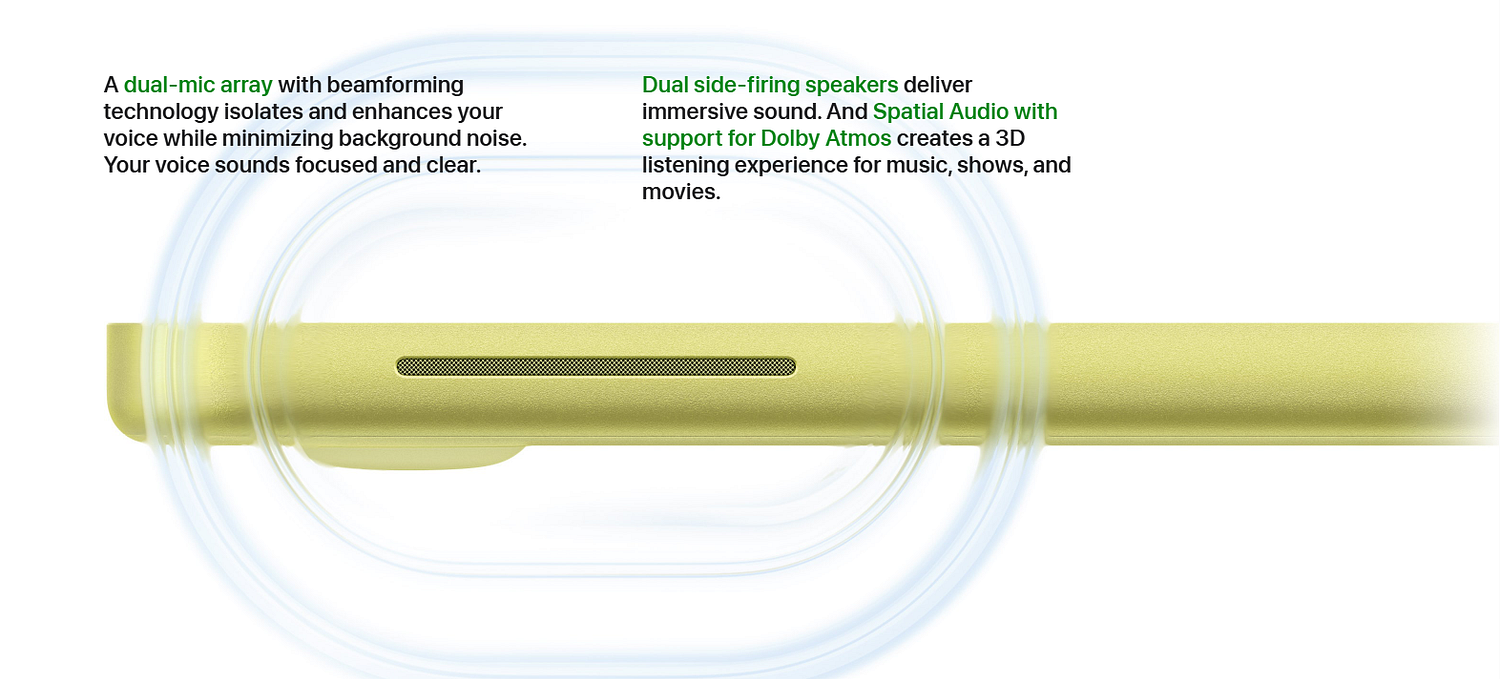
The Camera and Microphones. A 1080p FaceTime HD camera with a dual-microphone array using beamforming technology. Beamforming, in simple terms, is a digital filter that locks onto the direction of your voice and softens everything else — background noise, fan sounds, that housemate cooking in the kitchen. On a laptop at this price, this combination is unusual.
The Audio. Dual side-firing speakers with Spatial Audio and Dolby Atmos support. These are not laptop speakers in the way most budget laptop speakers work. Spatial Audio creates a sense of three-dimensional sound around you rather than sound coming at you from a thin slit. The difference is real and noticeable with headphones off.
The Battery. Up to 16 hours on a single charge, tested against real web browsing and 1080p video streaming. The MacBook Air with M5 chip gets 18 hours — so the Neo trails by two hours. The MacBook Air also costs $500 more. Sixteen hours covers a full academic or working day without a charger in sight.
The Memory. 8GB of unified memory. This is the configuration ceiling — there is no upgrade path. For the tasks the Neo is designed for, 8GB is adequate. Web browsing, documents, video calls, light photo editing, streaming, note-taking, email — all of these run fine. Multiple heavy browser sessions with dozens of tabs open, video editing timelines, or running virtual machines will show the limit. The Neo is honest about what it is, and 8GB is part of that honesty.
Apple Intelligence. Writing Tools for proofreading and rewriting across any app. Clean Up in Photos for removing unwanted objects with a click. Genmoji for generating custom emoji from text descriptions. Notification summaries. Article condensing. Integration with ChatGPT and Canva for more demanding creative tasks. All of this runs on a $599 machine with the same feature depth as a MacBook Pro that costs $2,499.
iPhone Integration. iPhone Mirroring shows your iPhone screen on the Mac display — you can operate your phone from the laptop without touching it. Handoff passes tasks between devices seamlessly. AirDrop transfers large files without a network. Universal Clipboard lets you copy on iPhone and paste on Mac instantly. Instant Hotspot shares your iPhone’s cellular connection with the MacBook automatically, no password required.
The Windows Apps Question — and Why It Matters More Than People Admit
Here is the objection Apple has heard for twenty years whenever a Windows user considers switching to Mac: “But my software only runs on Windows.”
For a long time, that objection was legitimate. Enterprise tools, certain design applications, niche utilities, legacy business software — much of it was Windows-only, and the workarounds were genuinely painful. You either ran a full Windows virtual machine inside macOS (which required buying a Windows license, installing Parallels or VMware Fusion, and accepting a performance hit), or you simply stayed on Windows.
That calculus has been shifting for years. And with the MacBook Neo, the last wall is coming down in a way that should make Windows laptop makers genuinely uncomfortable.
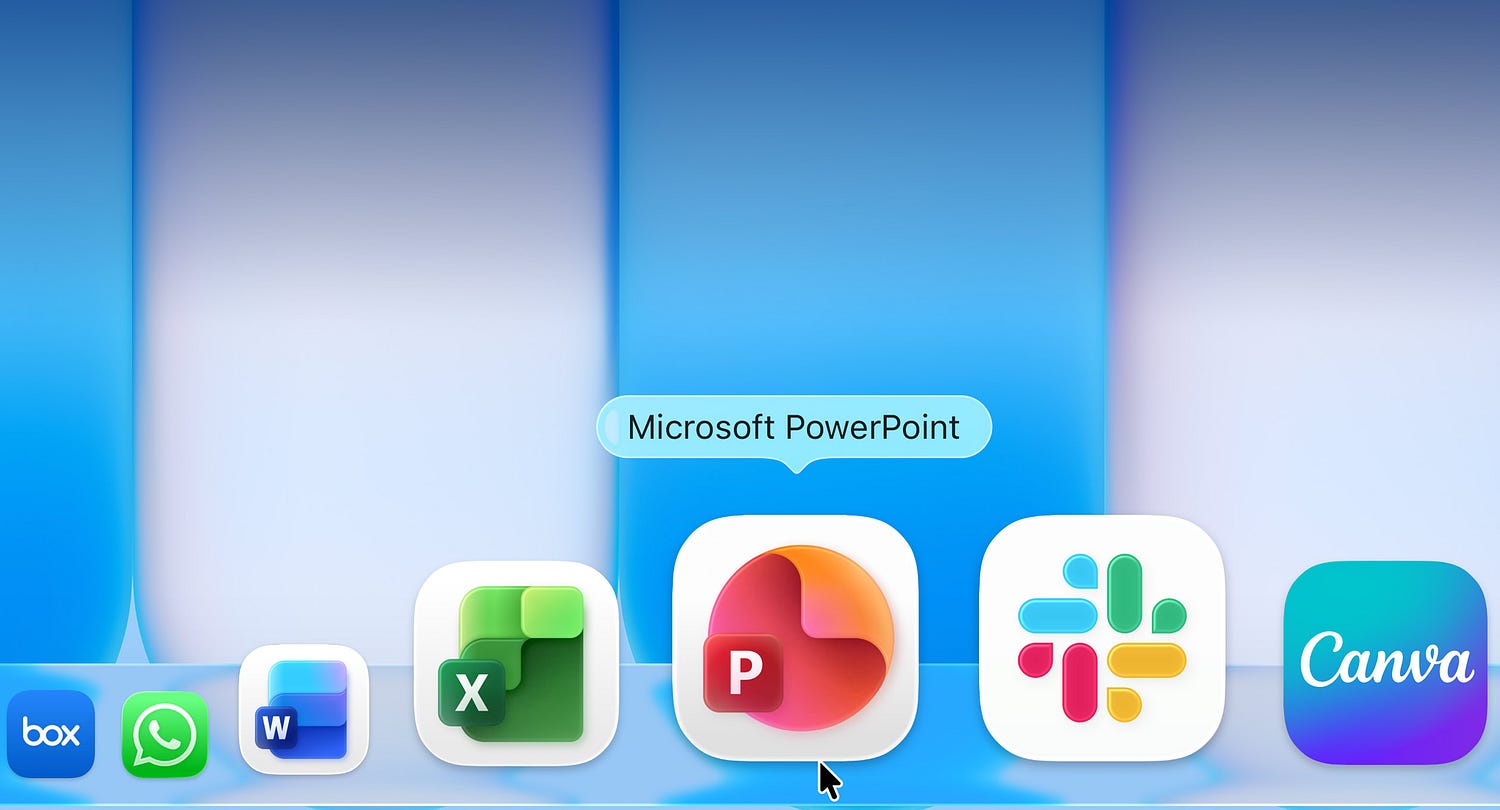
Microsoft 365 runs natively on macOS. Word, Excel, PowerPoint, Outlook, Teams — all of these are native Mac applications. Microsoft has maintained serious, feature-equivalent macOS versions of its Office suite for years. Starting in mid-February 2026, Microsoft even began pushing Microsoft 365 Copilot directly through the macOS installer, meaning that enterprise Mac users now get AI-powered productivity tools as part of the default setup flow. A Windows user who switches to the MacBook Neo does not lose a single Microsoft 365 feature.
CrossOver translates Windows apps without a Windows license. CrossOver 26, released in February 2026, is built on Wine 11.0 — a compatibility layer that translates Windows system calls into macOS commands in real time. It introduced over 6,000 technical improvements and hundreds of bug fixes. Critically, CrossOver runs on Apple Silicon through Apple’s Rosetta translation layer, and CodeWeavers — the company behind CrossOver — is actively developing native Apple Silicon support. CrossOver does not require you to buy a Windows license. It does not require rebooting. It installs Windows applications the way you would install any Mac application, and they run directly alongside your macOS apps. Pricing starts at $74 per year, which is significantly less than a Windows license.
Parallels Desktop offers full Windows virtualization. For users who genuinely need a complete, full-featured Windows 11 environment running inside macOS, Parallels Desktop is the solution. It runs Windows in a window (or full screen) on your Mac, supports full Microsoft Office 365, AutoCAD, accounting software, and even Windows-exclusive enterprise applications. You switch between macOS and Windows as easily as switching between any two apps. Parallels subscribers also get access to extensive documentation and customer support.
The practical result for a switcher. Consider a typical Windows user whose daily workflow involves Microsoft Office, a browser, video calls, a design tool like Canva or Adobe Express, and perhaps one or two Windows-specific utilities. In 2026, the MacBook Neo handles all of it — Office natively, the browser natively, video calls natively, design tools natively, and Windows utilities through CrossOver or Parallels if absolutely necessary. The “my software only runs on Windows” objection still exists for very specific edge cases. For the vast majority of Windows users, it has quietly evaporated.
Apple’s own positioning acknowledges this. The MacBook Neo is explicitly marketed as compatible with both Mac and iPhone apps. The product page links directly to Mac Does That — Apple’s Windows comparison tool built specifically for hesitant switchers. Migration Assistant is featured prominently in the onboarding experience. Apple is not leaving the Windows switcher to figure this out alone.
Why Windows Users Are the Actual Target — and the iPhone Factor Is the Real Weapon
Think about what the average $600 Windows laptop experience actually looks like.
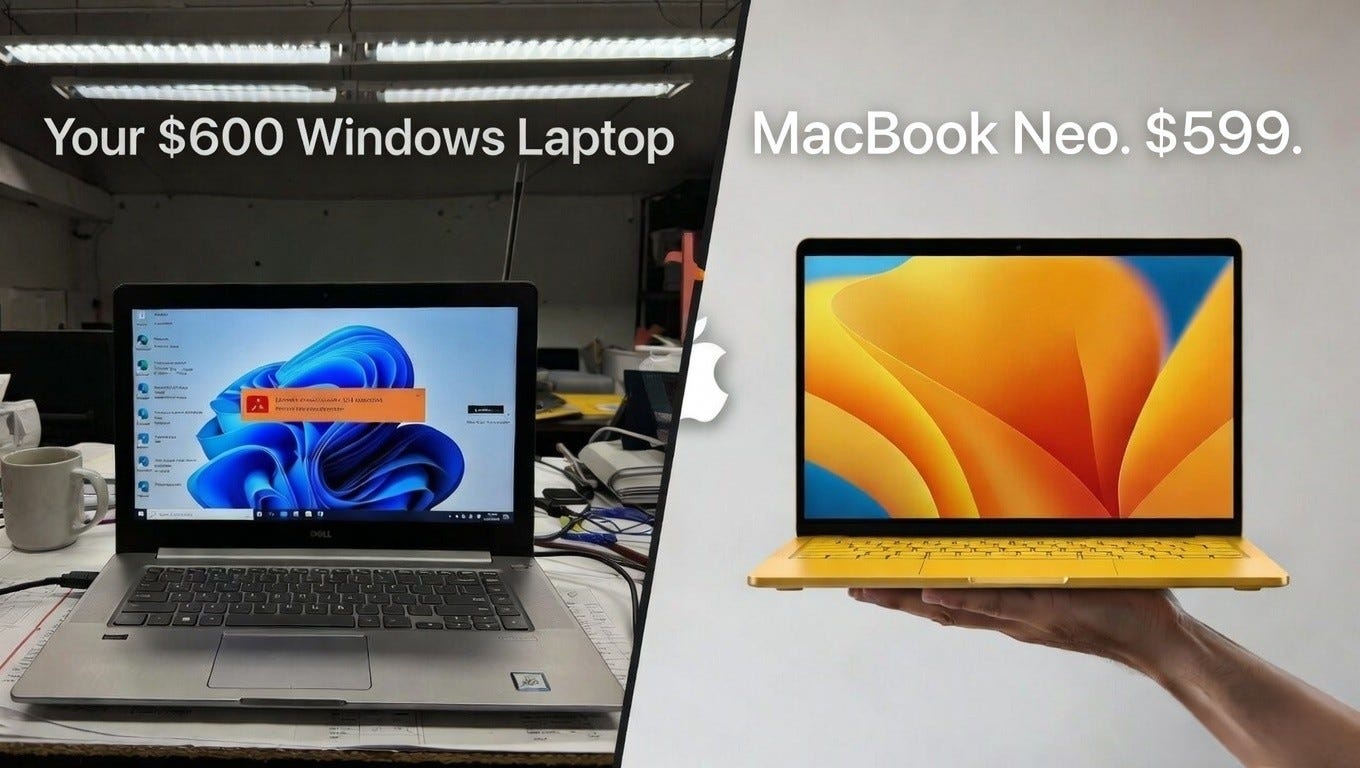
You unbox a machine running Windows 11. It has software trials pre-installed — an antivirus subscription, a photo editor demo, possibly a gaming launcher. You spend the first hour cleaning it out. You install a proper antivirus. You update drivers. The trackpad is serviceable but feels mushy compared to Apple’s glass surface. The battery lasts six hours with brightness at 70 percent. The display is a 1080p IPS panel — it does the job without inspiring anything.
Over two or three years, the machine slows down. Windows accumulates background processes, registry entries, software residue from apps you uninstalled months ago. This is not a failure of the hardware — it is a structural tendency of the operating system, and Windows users have accepted it as the natural lifecycle of a laptop.
macOS does not work this way. It does not slow down in the same way, because it does not accumulate in the same way. Software updates are free and tend to keep performance stable or improve it. The operating system is built for the exact hardware it runs on, because Apple designs both. There is no negotiation between a third-party OS and third-party hardware — it is one coherent system from the beginning.
This argument has always been true. What was missing was the price.
Now consider the iPhone factor, because this is the argument Windows cannot touch.
Apple sees this as an opportunity to draw new customers into its product ecosystem, which could open further opportunities to sell additional devices like iPhones, iPads, and Apple Watches. But the reverse is also true, and it is more immediate: millions of people already inside Apple’s ecosystem via iPhone are being handed a reason to complete the picture.
Over 55 percent of smartphone users in the United States carry an iPhone. Many of them have used a Windows laptop for years not because they prefer Windows, but because no Apple laptop existed at a price they were willing to pay. They live in an iPhone world and commute to a Windows world every time they open a laptop. The friction is real — iMessage does not appear natively on Windows, AirDrop does not cross platforms, Handoff does not work, iPhone Mirroring is not possible, Universal Clipboard does not exist. Every workaround for these things requires effort and does not work as cleanly as the native experience.
The MacBook Neo removes that friction entirely. At $599, an iPhone user can now own a laptop where their messages appear without workarounds, their files transfer by air, their phone appears on their screen without cables, and starting a document on one device and finishing it on the other requires nothing more than proximity.
That is not a feature comparison. That is a lifestyle change. And it is available at a price that was not possible twelve months ago.
The Market Conditions That Made This the Perfect Moment
Gartner expects PC prices to increase by 17% in 2026, while the International Data Corporation estimates PC sales will decline by 11.3% this year. The cause is a memory shortage driven by surging demand for AI data center components — the same memory that goes into laptops is being diverted upward in the supply chain.
Every Windows laptop maker is raising prices or squeezing margins. The $600 Windows laptop of 2025 may cost $700 or $750 by late 2026. The value proposition that made budget Windows machines attractive is eroding at the exact moment Apple enters that price tier with something that does not feel budget at all.
Apple’s machine runs three times faster for artificial intelligence than rival PC laptops, according to the company’s own benchmarks. That gap is a direct consequence of Apple’s chip design advantage — and it is a gap that Windows hardware makers cannot close quickly because they are dependent on Intel, AMD, and Qualcomm for their processors.
The MacBook Neo is $400 less than any new-generation laptop Apple has sold before, coming in well below the now $1,099 MacBook Air. In a market where every competitor is moving prices upward, Apple moved its entry point down by $400. That is a counterintuitive move that only works if you have the chip economics to support it — which Apple does, because using the A18 Pro instead of an M-series chip reduces component cost meaningfully.
Mac revenue fell nearly 7 percent to $8.39 billion in the holiday quarter before this launch, missing analyst expectations. The MacBook Neo is at least partly a response to that pressure — a move to expand the addressable market rather than rely on a shrinking pool of premium buyers.
The Classroom and the Corporate Angle
Two specific audiences beyond the typical consumer deserve attention here.
Students. Gartner analyst Autumn Stanish pointed directly at the classroom. Chromebooks have owned K-12 education for years because they are cheap, manageable, and sufficient for Google Docs and a browser. But schools are integrating AI tools rapidly, and the MacBook Neo runs Apple Intelligence on-device — meaning sensitive student data stays on the machine rather than traveling to a server. For school districts with student privacy obligations, that distinction matters.
There are $100 discounts on each model for education buyers, bringing the entry price down to $499. At $499, the MacBook Neo is within range of premium Chromebook deployments. It is the first time Apple has been able to make that comparison with a straight face.
Corporate buyers. Beyond targeting more downscale shoppers, Apple will be able to pitch the computer as an option for corporate and organizational buyers — given its lower price and compatibility with both Mac and iPhone apps. Organizations that already standardize on iPhone for mobile devices have an obvious reason to consider the Neo for employees who need a functional laptop without the cost of a MacBook Air. Microsoft 365 runs natively. Teams runs natively. The security architecture — Touch ID, FileVault encryption, built-in antivirus, automatic security updates — meets enterprise requirements without additional configuration.
The Honest Conversation About What the Neo Cannot Do
This article would be dishonest if it did not spend time on the genuine limitations, because they exist and they matter for the right buyer.
The Neo feels snappy for daily tasks, but power users who frequently edit video, run virtual machines, or compile code should consider a MacBook Air or Pro with Apple Silicon.
The display does not support True Tone and runs at 60Hz rather than the higher refresh rates available on more expensive models. The two USB-C ports — one at USB 3 speed, one at USB 2 — mean slow transfers for large files and no Thunderbolt connectivity. There is no MagSafe magnetic charging, which is a real convenience loss. The 8GB of RAM cannot be upgraded after purchase, which is a meaningful constraint if your workload evolves over three or four years of ownership.
The A18 Pro is a mobile processor running a desktop operating system. For everyday productivity, it is genuinely excellent. For sustained heavy workloads — large Xcode projects, DaVinci Resolve timelines, multi-instance virtual machines — it will show its ceiling before an M-series chip would.
None of this makes the MacBook Neo a bad product. It makes it the right product for a specific buyer and the wrong product for a different specific buyer. Knowing which one you are takes about thirty seconds of honest self-assessment.
The Colors Are Not a Gimmick — They Are a Message
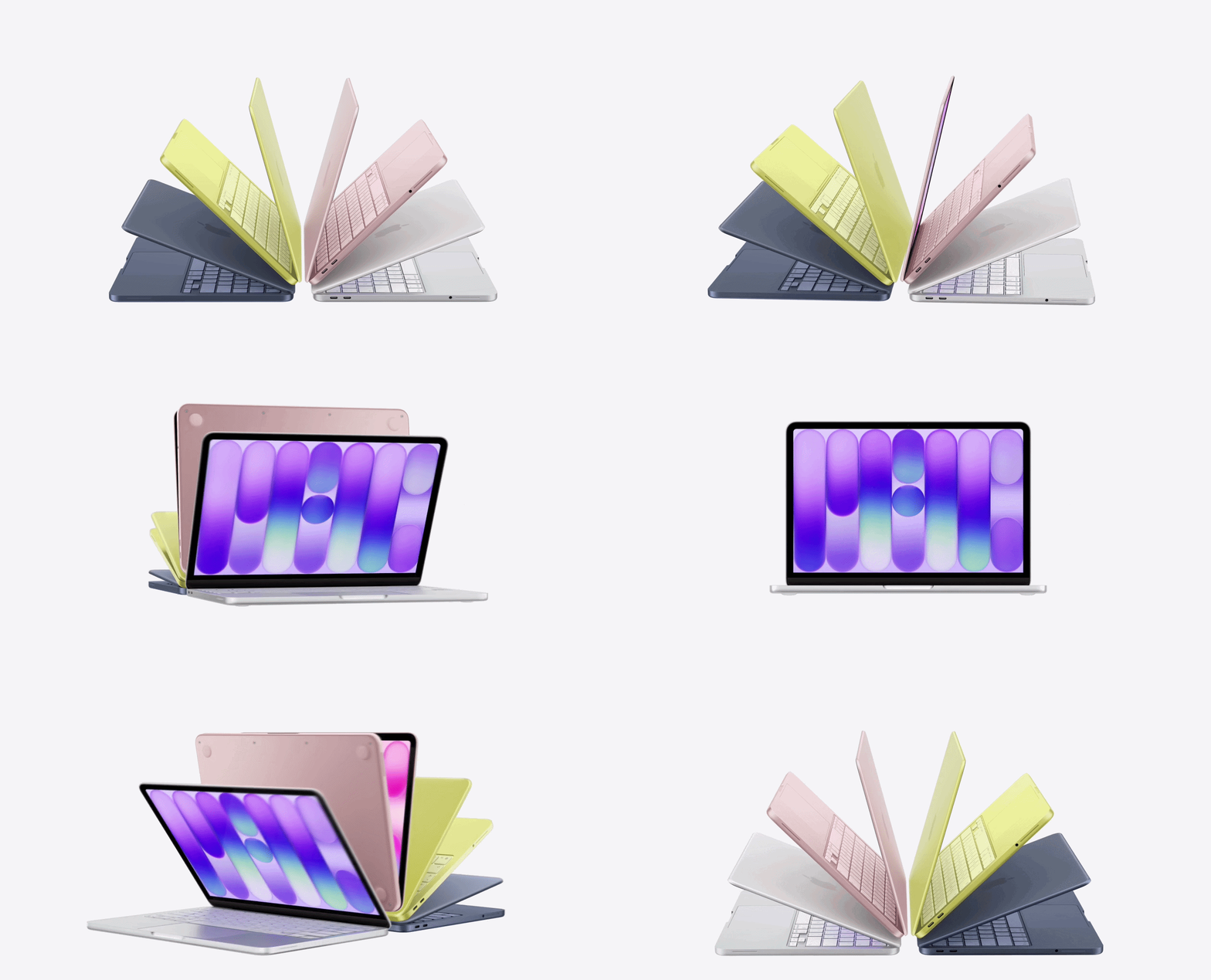
Silver, Blush, Citrus, and Indigo.
The MacBook Neo will be offered in citrus, silver, indigo and blush color options, potentially making it appealing both to students and mainstream consumers.
MacBook Pro comes in Silver and Space Black. MacBook Air comes in Sky Blue, Silver, Starlight, and Midnight. These are restrained, professional choices for a buyer who wants their laptop to disappear into a meeting room.
Citrus yellow is not restrained. It is a statement. It is the color of a product designed to be seen in a lecture hall or a coffee shop, to announce itself as something different from the sea of silver laptops that have defined the category for a decade. It is, frankly, the color of a product that wants to feel like the iPhone in your pocket — personal, expressive, and worth carrying everywhere.
The design uses 60 percent recycled content by weight — the highest in any Apple product to date. Packaging is fully fiber-based with no plastic. For a product aimed at a younger audience that increasingly evaluates brands on their environmental accountability, these are not footnotes. They are part of the pitch.
What Happens Next
The MacBook Neo ships on March 11. Pre-orders are open now.
What happens in the months following that date will be genuinely interesting to watch. Does it convert Windows users in meaningful numbers? Does it take classroom share from Chromebook? Does it give the Mac business the growth it needs after a disappointing holiday quarter?
The conditions are unusually favorable. PC prices are rising while the Neo holds at $599. The Windows app compatibility story is better than it has ever been. The iPhone ecosystem integration is deeper than anything a Windows user can access on their current machine. The education pricing at $499 is legitimately competitive with premium Chromebook deployments.
Apple has never had a stronger argument for Windows switchers. It has never been better positioned to make that argument at a price that removes the primary reason people said no.
The MacBook Neo does not guarantee a mass migration from Windows to Mac. Nothing does. But it is the first time in a very long time that the question “why are you still on Windows?” does not have an obvious answer.
Something shifted on March 4, 2026. The $599 MacBook Neo — the one Apple was never supposed to make — is the proof.