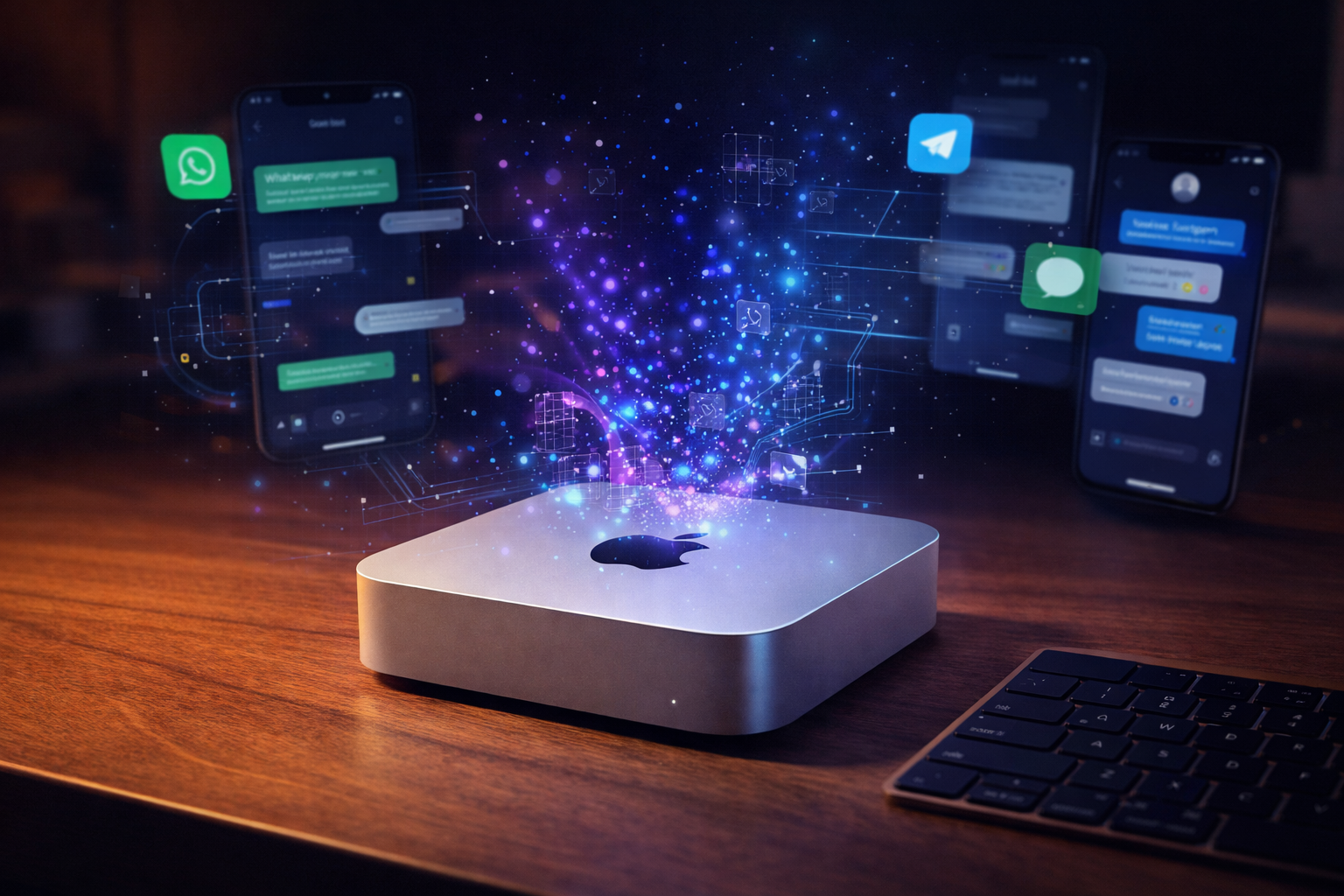
Something strange happened in early 2026. Apple stores started running low on Mac Minis. Tech forums exploded with setup guides. Developers were ordering three, five, sometimes twelve units at a time. The reason had nothing to do with Apple and everything to do with what people were tired of giving away.
Your data. Your privacy. Your money. Month after month.
When Productivity Tools Started Feeling Like Surveillance
Sarah, a freelance designer in Berlin, was paying 100 pounds monthly for Claude Pro, another 20 for ChatGPT Plus, and 100 for Gemini Advanced. She calculated it one morning while waiting for her coffee to brew. Over 300–400pounds annually to chat with computers that forgot her preferences every few weeks. Worse, every prompt she typed was flying through someone else’s servers. Every design brief. Every client name. Every creative idea before it had a chance to exist.
She was not alone in this growing discomfort. Across developer communities and privacy-focused forums, a quiet rebellion was forming. People wanted their AI assistants to actually assist them without becoming another subscription vampire or another company with access to their entire digital life.
The Clawdbot Phenomenon
The catalyst arrived with an open-source project that began circulating in late 2024. Vienna-based software engineer Peter Steinberger published a detailed account of his workflow transformation. He had built something different. Not another chatbot interface. Not another cloud service demanding monthly payments. An actual AI operator that lived on his computer and worked through the apps he already used every single day.
The project gained a name. Clawdbot. Later renamed OpenClaw. The GitHub repository went from 5,000 stars to over 40,000 in weeks. The concept was deceptively simple yet fundamentally different from everything people had tried before. Instead of opening yet another browser tab to talk to an AI, the assistant showed up directly in WhatsApp, Telegram, iMessage, Slack, Discord, and Signal. It remembered conversations from weeks ago. It could actually do things rather than just suggest things.
Run scripts. Fill forms. Organize files. Send emails. Browse websites. Create presentations. All while you were doing something else entirely. All while keeping every byte of data on your own hardware.
Why the Mac Mini Became the Unexpected Hero
The hardware requirements for running AI locally used to mean expensive gaming rigs or server-grade equipment. Then Apple released the M4 chip in a machine the size of a paperback book. The Mac Mini with 16GB of unified memory cost 599 dollars. The 64GB Pro configuration ran 1,899 dollars. Both could run AI models that would have required 10,000 dollar workstations just two years earlier.
The unified memory architecture changed everything. Traditional computers shuffle data back and forth between system RAM and graphics card memory. Every transfer creates delay. Every copy wastes energy. Apple Silicon eliminated this entirely. The CPU, GPU, and neural processing unit all share one massive pool of memory. For AI workloads where the bottleneck is memory bandwidth rather than raw compute power, this design is transformative.
Jeff Geerling ran benchmarks showing the M4 Pro with 64GB could run 32 billion parameter models at 11 to 12 tokens per second. Fast enough for real-time conversation. Fast enough for coding assistance. Fast enough that the AI feels present rather than laggy. The base model with 16GB could handle 7 to 8 billion parameter models at 15 to 20 tokens per second.
But the real advantage was not performance. It was form factor and silence. You could tuck a Mac Mini behind your monitor, plug it in, and forget it existed. No fan noise. No heat. No dedicated server room. It became an appliance. An always-on AI brain that cost less to run monthly than a single streaming service subscription.
The Messaging App Integration That Changed Everything
Here is where the magic clicked for most people. Ritesh Kanjee, who runs a corporate automation company, described the moment it hit him. He was already paying for multiple AI subscriptions. He had built complex automation workflows in n8n. Then he tried feeding his landing page and customer profile documents to his locally running AI through Telegram.
The AI browsed his website. Retrieved his documents from Google Drive. Delivered a complete audit without him copying and pasting between seventeen different tools and browser tabs. He could be on his phone at a coffee shop and his Mac Mini at home was doing the work. The AI responded in the same Telegram chat where he talks to his team. No context switching. No opening laptops. No remembering which AI service had which conversation.
This integration pattern became the killer feature. People were not excited about running AI models locally. They were excited about having an AI assistant in the same place where they already communicate. Your WhatsApp group chat with friends discussing weekend plans. Your Slack workspace where your team coordinates projects. Your iMessagethread with family. The AI was just there. Available. Remembering.
The Privacy Equation That Finally Made Sense
Dan Peguine uses his local AI to manage his parents’ tea business. Customer orders. Inventory tracking. Email responses. All the data stays on a Mac Mini in their shop. No third party processes their customer information. No cloud service has access to their supplier contracts. The AI gets smarter about their business patterns without those patterns becoming training data for someone else’s model.
This resonated with a specific type of user. Not paranoid. Not anti-technology. Just tired. Tired of wondering which company was reading their emails to train better ad targeting. Tired of terms of service updates that gradually expanded what platforms could do with user data. Tired of feeling like the product rather than the customer.
The math shifted too. A ChatGPT Plus subscription costs 192 dollars yearly. Claude Pro costs 216. Gemini Advanced costs 204. A Mac Mini cost 599 dollars once. After three years, the Mac Mini was cheaper than maintaining three AI subscriptions. After five years, the savings became substantial. And you owned the hardware.
The Performance Reality Check
Not everyone needed a Mac Mini. The viral posts and social media hype created an impression that local AI required dedicated Apple hardware. Developer communities pushed back hard on this narrative. A five dollar monthly cloud server could run Clawdbot perfectly well for most use cases. A Raspberry Pi cluster worked. An old laptop gathering dust in a closet worked. Any computer that could stay powered on worked.
The Mac Mini advantage was real but specific. If your workflow centered on iMessage and you wanted seamless integration with the Apple ecosystem, the Mac Mini was the path of least resistance. If you needed to run larger models or keep multiple AI instances active simultaneously, the unified memory architecture delivered measurable benefits. If you valued silent operation and minimal physical footprint, the form factor mattered.
But if your primary messaging happened on WhatsApp, Telegram, or Slack, any Linux server or spare Windows machine could handle the job. The M4 chip was impressive. It was not mandatory. Some developers even joked that Peter Steinberger had single-handedly boosted Apple’s quarterly revenue while the actual requirement was just something that could run Docker containers.
The Security Nightmare Nobody Wanted to Discuss
Then the security researchers started publishing their findings. What they discovered was uncomfortable. Exposed configuration files containing API keys and Telegram bot tokens. Control panels accessible from the public internet because users misunderstood how reverse proxies work. Instances with no authentication at all. Full command execution available to anyone who knew where to look.
The architectural problem ran deeper. An AI assistant powerful enough to book restaurant reservations and edit videos is also powerful enough to delete your file system or email your private keys to strangers. The vector was prompt injection. Someone sends you an email. The email contains hidden instructions. Your AI reads the email to summarize it. The hidden instructions override your safety rules.
This was not theoretical. Security researcher Jamieson O’Reilly found instances where he could access months of conversation history across all connected platforms. Configuration files with OAuth credentials. Systems where a carefully crafted message could trick the AI into running arbitrary shell commands. The attack surface was massive because the whole point of these AI agents was giving them permission to do things automatically.
Prompt injection became the new buffer overflow. A malicious WhatsApp forward could contain instructions invisible to humans but perfectly clear to language models. Those instructions could persist in the AI’s memory for weeks. The attack could be time-delayed. Fragmented across multiple innocent-looking messages. Assembled only when the AI’s internal state aligned just right.
The Security Solutions That Actually Work
The OpenClaw documentation deserves credit for honesty. The security page opens with a warning. Running an AI agent with shell access on your machine is spicy. There is no perfectly secure setup. The goal is being deliberate about what the AI can access and what it can touch.
The recommended configuration is restrictive by default. The gateway only listens on localhost unless explicitly configured otherwise. Unknown senders receive a pairing code and get blocked until approved. Group chat integration requires explicit mentions to prevent the AI from processing every message. A built-in security audit command flags common misconfigurations and can automatically tighten insecure settings.
More sophisticated users run the AI in sandboxed environments. Docker containers with limited file system access. Virtual machines with isolated networks. Separate reader agents that sanitize untrusted content before the main AI processes it. Human approval required for destructive operations like deleting files or sending emails.
The problem is adoption gap. The user attracted by viral tweets promising life automation from WhatsApp is not the user who will configure Docker isolation, network firewalls, and least-privilege access controls. They see a one-click install script. They run it. They connect their Telegram account. They grant file system permissions. They do not read the security documentation because they do not know there should be security documentation.
The Enterprise Shadow AI Problem
Corporate security teams started noticing the pattern. Employees were running personal AI assistants on company laptops. Connected to company Slack workspaces. With access to company file shares. Processing confidential emails and internal documents. None of it sanctioned. None of it monitored. All of it outside the security perimeter.
This was shadow IT on steroids. With SaaS applications, security teams could at least detect unusual authentication patterns or block specific domains. With local AI agents, the traffic looked like normal messaging app usage. The computing happened entirely on the endpoint. Traditional data loss prevention tools could not see the AI reading sensitive files and summarizing them in Telegram messages.
Gartner research from January 2026 showed 35 percent of enterprises were using autonomous agents for business-critical workflows. Up from 8 percent in 2023. Most of those deployments were sanctioned and controlled. But the Clawdbot phenomenon represented the inverse. Unsanctioned capability that employees were adopting because it genuinely made their work easier. Security teams were playing catch-up because the technology moved faster than policy.
What This Actually Means for Normal People
Strip away the hype and the security panic. What remains is a legitimate shift in how people can interact with AI. The cloud model works brilliantly for casual users who want to ask questions occasionally. Open a browser tab. Type a query. Get an answer. Close the tab. No commitment. No configuration.
But for people who want AI deeply integrated into their actual workflows, local deployment offers something cloud services struggle to match. Persistent memory that spans weeks and months. Integration with the specific tools and services you already use. Control over your data that does not require trusting a terms of service agreement. Cost structures that reward long-term use rather than punishing it.
The Mac Mini became a symbol of this shift not because it was the only option but because it was the easiest option for a specific demographic. Apple ecosystem users who valued simplicity and were willing to pay a premium for integrated experiences. The broader trend transcended hardware. People were choosing to run AI on their terms even when it meant accepting complexity and responsibility.
The Future That Is Already Here
The Clawdbot story is not finished. The project continues evolving. Security improves. Capabilities expand. The community grows. More AI models become viable for local deployment. Hardware gets faster and cheaper. The gap between cloud AI and local AI narrows every month.
We are watching the democratization of powerful AI in real time. Not through corporate platforms that monetize attention. Not through subscription services that charge monthly rent for software. Through open source projects that anyone can download, modify, and deploy. Through hardware that sits in your home and works for you rather than for advertisers.
The Mac Mini will not remain the preferred platform forever. Better options will emerge. Different architectures will prove superior for specific use cases. The cloud will claw back advantages through scale and convenience. But the fundamental question is answered. People want AI that works for them. That remembers them. That integrates with their lives without requiring them to adapt their lives to it.
The question was never whether local AI would work.
The question was whether people would bother.
Apparently, they will. Thousands already have. More join daily. The Mac Mini is just the first chapter.
If people are using cloud based LLM services, why does the Mac Mini's UMA capability still matter?
ReplyDelete