Let Me Be Clear Before We Start
Nothing in this article is confirmed. Microsoft has explicitly stated, as recently as February 2026, that Windows 12 has not been announced. No release date. No official feature list. No pricing. No system requirements published anywhere with a Microsoft logo on them.
What exists right now is a growing pile of leaks, buried code strings, hardware partner signals, and industry whispers that paint a picture compelling enough to take seriously. But a picture built from rumors is still a picture built from rumors.
So read this the way you would read a very well-sourced detective story. The clues point somewhere interesting. Whether the ending actually goes there … we do not know yet.
With that said, here is what the clues suggest.

Why People Are Talking About Windows 12 Right Now
The conversation did not start overnight. References to something beyond Windows 11 have been circulating in developer communities and tech media since 2023. The codename “Hudson Valley Next” first surfaced in a December 2023 report by Windows Central, and it has been appearing in internal references ever since.
Normally, codenames come and go. Microsoft runs dozens of internal projects simultaneously and most of them never become real products. What makes Hudson Valley Next different is that it keeps appearing alongside very specific technical details … details that align with the direction Microsoft has been publicly signaling for over two years.
The company has been talking about AI PCs. About Copilot. About a new category of devices built around neural processing. About modernizing Windows from the inside out. When you line up those public statements with the leaked details about Hudson Valley Next, they fit together in a way that feels less like coincidence and more like a deliberate strategy being assembled in slow motion.
Again … might be. Could be. Possibly. Not confirmed. But worth paying attention to.
The Timing Is Not Accidental
One reason analysts are taking Windows 12 rumors seriously is the timing. Windows 10 reaches its official end of support in October 2026. After that date, Microsoft stops providing security updates for it. For everyday users that might sound abstract, but for businesses running millions of Windows 10 machines, it is a hard deadline that forces action.
Historically, Microsoft has used end-of-support dates as migration pressure. The end of Windows 7 support pushed millions of users toward Windows 10. The end of Windows 10 support could, theoretically, push users toward whatever comes next.
If Windows 12 were to arrive in 2026 … and right now “if” is doing enormous work in that sentence … the timing would land exactly in the window where businesses and consumers are already feeling compelled to make a decision about their operating system. That is not a coincidence Microsoft would accidentally stumble into. It is the kind of calculated market strategy the company has been executing for decades.
Some observers are calling this a potential “PC supercycle.” The idea is that AI hardware requirements, an aging Windows 10 install base, and a next-generation OS arriving at the same moment could trigger the kind of broad PC replacement cycle the industry has not seen since the pandemic-era work-from-home boom.
Maybe. Or maybe the transition happens more slowly, spread across several years, with no dramatic supercycle at all. The pressure exists. Whether it translates into a concentrated wave of buying is far from certain.
Hudson Valley Next and the CorePC Architecture
If Windows 12 exists in the form leaks suggest, its most significant innovation might not be visible to most users at all. The CorePC architecture … referenced repeatedly in technical documentation and developer conversations … reportedly represents a fundamental rethinking of how Windows is structured internally.
Right now, Windows is essentially a monolithic system. Everything is deeply interconnected. That is partly why Windows updates sometimes break things unexpectedly, why certain system components feel impossible to remove, and why the same codebase has to serve everything from a $300 budget laptop to a $5,000 workstation.
CorePC would change that by making Windows genuinely modular. System components would reportedly be isolated from each other. Updates could be applied to individual pieces without touching the whole. Different editions of Windows could be assembled from the same building blocks but shaped specifically for different device categories … a lighter, stripped-down version for tablets and entry-level machines, a full-featured version for high-performance AI PCs.
This would also enable something increasingly central to Microsoft’s strategy … the ability to split workloads between the local device and cloud servers, with the operating system managing the handoff. Some AI tasks would run on your machine. Others would offload to Microsoft’s infrastructure. The user would ideally not notice the difference.
This is all based on reports from people who have reportedly seen internal documentation. None of it has been published in an official Microsoft roadmap. The architecture could change before anything ships. What exists publicly is a pattern of technical references that collectively point in this direction.
If AI Really Becomes the Foundation
Here is the part that makes Windows 12 genuinely interesting as a concept, if the rumors hold.
Windows 11 added Copilot. It arrived as a sidebar, a chat interface bolted onto the edge of the desktop. Useful occasionally. Easy to ignore entirely. The AI felt optional because it was optional … a feature you could summon or dismiss without it affecting anything else about how Windows worked.
The rumored vision for Windows 12 is reportedly different at a fundamental level. Rather than AI being a feature you access, it would become the layer through which you experience the entire system. Copilot would evolve from an optional assistant into something closer to the central control layer of the OS.
What might that look like in daily use? Imagine opening a folder and having the system immediately surface the three files most relevant to what you worked on yesterday, without you asking. Imagine a search bar that finds a document based on a vague description of its contents rather than requiring you to remember the exact filename. Imagine the operating system monitoring your usage patterns and automatically adjusting performance profiles based on how you actually work … not what a generic preset assumes you do.
Semantic search is one of the specific capabilities mentioned in leaked references. The idea is that the system indexes your files by meaning rather than just by name and date. You could search for “the client budget file from last autumn” and the system would find it even if the actual filename is a string of numbers.
Context-aware automation is another rumored capability. The OS might learn that every Monday morning you open certain applications in a certain order and begin loading them before you even sit down at your desk.
These sound impressive. They also sound like capabilities that could fail in frustrating ways across the enormous variety of hardware and software configurations that Windows has to accommodate. The history of ambitious Windows features includes plenty of capabilities that worked beautifully in demos and erratically in real usage.
That uncertainty is real. The ambition being described is also real, if the leaks are accurate.
The Hardware Requirement That Could Leave Many Users Behind
This section will generate the most concern, and it deserves to be addressed directly.
Leaked information points to a dedicated NPU … a Neural Processing Unit … with a minimum of 40 TOPS as a requirement for the full Windows 12 experience. TOPS stands for Trillions of Operations Per Second. An NPU is a specialized chip designed specifically for AI calculations, handling the kind of matrix math that machine learning models require far more efficiently than a general-purpose CPU or GPU.
To put 40 TOPS in perspective, it is roughly the level of AI performance needed to run real-time tasks like live transcription, semantic search, and local image analysis without hammering the main processor. Qualcomm Snapdragon X series chips, Intel Core Ultra processors, and AMD Ryzen AI chips already meet or exceed this threshold. Hardware manufacturers are reportedly labeling new devices as “Windows 12 Ready” based on this benchmark.
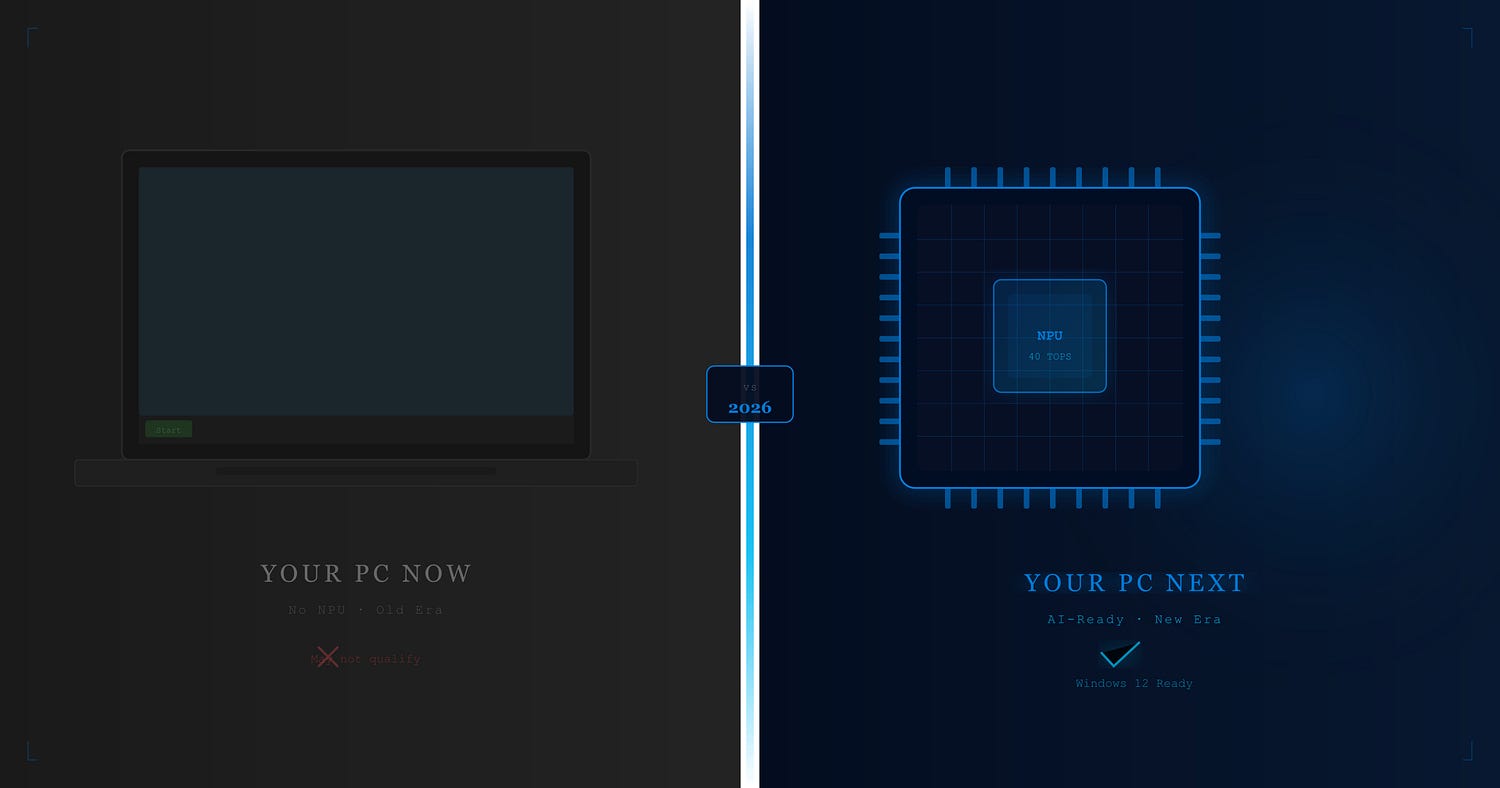
The uncomfortable reality is that the vast majority of computers currently in use … machines sitting on desks in offices, laptops bought in 2021 or 2022, perfectly functional Windows 10 machines that businesses have not gotten around to replacing … have no NPU at all.
What happens to those machines? The most likely outcome, based on how Microsoft handled Windows 11 hardware requirements, is a tiered experience. Older machines might install and run some version of Windows 12 but be locked out of the AI features that define the new OS. A reduced experience rather than a full exclusion.
Or Microsoft could draw a harder line, as they initially tried to do with Windows 11 and the TPM 2.0 security chip requirement.
This is genuinely unknown. The 40 TOPS figure comes from leaks, not official documentation. Microsoft could raise that number, lower it, or structure requirements differently. What seems consistent across multiple independent sources is that Windows 12 is being built with AI-capable hardware as its primary target. Older hardware is an afterthought at best in that design philosophy.
A Visual Language That Finally Moves On
The aesthetic overhaul, if leaked visuals are accurate, is the most immediately visible change. Windows 11’s design is clean but still anchored in the traditional taskbar-at-the-bottom layout that has defined Windows since 1995.
Leaked concepts and reportedly sourced mockups show something different. A floating taskbar with rounded corners, visually detached from the bottom of the screen … hovering rather than anchored. Glass-like transparency effects throughout. System indicators and the clock migrating to the upper-right corner. Most significantly, a prominent search and Copilot bar centered at the top of the screen.
That last detail carries meaning beyond aesthetics. Placing a prominent AI search bar at the very top of the screen, where it is the first thing you see, signals a shift in how Microsoft wants you to begin interacting with your computer. The implicit message is that the primary interface is no longer the desktop as a surface where files and icons live. The search bar, and the intelligence behind it, becomes the starting point.
Window management is also reportedly being overhauled. Snap layouts, virtual desktops, and widgets would adapt dynamically based on usage patterns rather than requiring manual configuration every time.
Design in development evolves constantly. What leaked today may not be what ships. But the direction being pointed toward … AI as the primary interface rather than a secondary layer … appears consistent across sources.

Security Gets a More Serious Treatment
Windows security has historically been a compromise between protection and backwards compatibility. Every legacy system that had to keep working was another potential attack surface. Every old application that needed to run was a reason not to make breaking changes to the underlying security model.
CorePC’s modular approach potentially changes this calculation. With better isolation between system components, a vulnerability in one area theoretically does not automatically compromise everything else. Security modules could be updated faster and more precisely.
Zero-trust architecture … a concept from enterprise security that treats every access request as potentially hostile until verified, regardless of where it originates … is reportedly being incorporated more deeply into the consumer version of Windows 12. Modernized authentication methods. Cloud-based threat detection running continuously.
Because many AI workloads would reportedly run locally on the device rather than being sent to Microsoft’s servers, data privacy could be addressed at the architectural level rather than as a policy statement. Whether that holds up once privacy researchers actually examine the shipped product is a completely different question.
Gaming on Windows 12
PC gaming has been Windows territory for decades, and nothing in the current rumor landscape suggests that is changing. If anything, the gaming-related features being described are meaningful to enthusiast players.
DirectStorage, which allows games to pull data directly from NVMe storage to the GPU without routing through the CPU, would receive further optimization. Faster loading, smoother open-world asset streaming. Cloud gaming improvements are mentioned, which would benefit Xbox Cloud Gaming in particular.
The genuinely new element is AI-assisted performance management. The concept being described is a system that monitors gameplay in real time, identifies where the hardware is struggling, and automatically adjusts graphical settings to maintain a smooth frame rate. For players who currently spend time manually tweaking settings to find the right balance, this could be a quiet but meaningful quality-of-life improvement.
Whether it works as described, or works as smoothly as the concept suggests, only a shipping product can answer.
The Subscription Question
The rumor that generates the most alarmed reactions involves subscription pricing. Code fragments found in recent Windows builds contain references to a “subscription status.” The fear is obvious. People imagine paying monthly fees just to use their computer’s operating system.
The more grounded interpretation of the available evidence does not support that worst-case scenario, at least not based on current leaks. The core Windows license would reportedly remain a one-time purchase. The subscription tier, according to the most credible analysis of the code references, would cover premium AI capabilities that require significant cloud computing resources … not the operating system itself.
The Adobe Creative Cloud transition is the comparison that gets made repeatedly. Adobe did not remove Photoshop from people who owned it outright. They built a cloud-based ecosystem of services, collaborative tools, and AI features that run as a subscription alongside the base product.
Microsoft already has Windows 365, a cloud-delivered Windows environment aimed at businesses. Extending a consumer version with AI-enhanced cloud features follows a logical trajectory. Whether consumers would pay for it depends entirely on what those features actually do.
This is speculation built on leaked code strings. It might not reflect what Microsoft actually ships. The presence of subscription-related references is not nothing, but it is far from a confirmed plan.
The Honest List of What We Do Not Know
Let us account honestly for the size of the uncertainty, because it is genuinely large.
Microsoft has not confirmed the name “Windows 12.” They might call it something different. They might release it as a major update to Windows 11 rather than a numbered successor. The branding could change multiple times before anything ships publicly.
The “2026 release” is an extrapolation from leaked timelines and the Windows 10 support deadline. It is plausible. Development delays happen. The product could arrive later, in stages, or in a more modest form than what the rumors describe.
Exact system requirements are unconfirmed. The 40 TOPS NPU figure might change. Upgrade paths for Windows 10 and Windows 11 users are completely unaddressed. Whether upgrading would be free, paid, or hardware-dependent is unknown.
The features themselves might be scaled back between now and launch. Microsoft has a record of announcing ambitious capabilities and shipping something more conservative. Windows 11 was positioned as a meaningful generational shift. Many users experienced it as a visual refresh with stricter hardware requirements.
Windows 12 could follow that same pattern. Real evolution, dressed in ambitious descriptions, that feels incremental in practice.
Why This Still Matters Right Now
Given all that uncertainty, why pay attention to Windows 12 at all today?
Because the direction Microsoft is moving in matters, regardless of the exact form it takes when it arrives. The company is making a visible commitment to artificial intelligence at the operating system level, not as an application or optional feature. That commitment is reflected in hardware partnerships, Copilot investments, CorePC architectural work, and the positioning of AI PCs as the next major product category.
Even if Windows 12 ships later than expected, or under a different name, or with fewer features than rumored … the underlying direction is set. The PC you buy today is being designed with this kind of operating system in mind. The chips going into new laptops right now are being built around requirements that have not been officially published yet.
For anyone buying a new computer in 2026, that is relevant information. A machine with a qualifying NPU positions you well for whatever Microsoft ships. A machine without one might mean a more limited experience sooner than expected.
For anyone trying to understand where the computing experience is heading more broadly, the Windows 12 rumors are the clearest available signal that the industry has decided AI belongs at the foundation of the operating system, not as an addition on top of it.
The Honest Conclusion
Windows 12 might be coming. Based on everything available, something significant is being built in the direction these rumors describe. The codename is real. The architectural work is real. The hardware partner preparation is real. The pressure created by Windows 10’s end of support is real.
But “might be coming” is not the same as “is definitely coming.” And “is being built” is not the same as “will ship as described.” Technology development is full of projects that started with genuine ambition and landed as something more ordinary.
What we can say with reasonable confidence is that Microsoft is working toward a version of Windows where AI is not an option. Where hardware requirements will favor a new generation of devices. Where the interface philosophy moves from managing files to interacting with intelligence.
Whether that vision arrives in 2026, in 2028, or in a form different from everything described here … we will find out when Microsoft decides to tell us.
Until then, hold the conclusions loosely. Watch the leaks with appropriate skepticism. And maybe, just maybe, start thinking about whether your next PC comes with an NPU.
This article is based entirely on leaks, rumors, unconfirmed reports, and industry analysis. Microsoft has not officially announced Windows 12. Every feature, requirement, and timeline mentioned is speculative until confirmed by Microsoft directly.