There was no press release. No tribute video. No Tim Cook standing on stage in a black turtleneck, holding it aloft one last time. On Thursday afternoon, March 26, 2026, Apple simply removed the Mac Pro from its website, redirected the buy page to the general Mac lineup, and quietly confirmed to reporters that the machine is gone — and won’t be coming back. Ever.
That’s how you kill a legend, apparently. Quietly, bureaucratically, with a 301 redirect.
And here’s the uncomfortable truth: Apple made the right call. That doesn’t mean it doesn’t sting a little — for longtime Mac professionals, this machine meant something. But the Mac Pro had been on life support for years, and keeping it on the shelf at $6,999 while selling a faster, cheaper, more modern machine right next to it wasn’t respecting the product. It was disrespecting the customer.
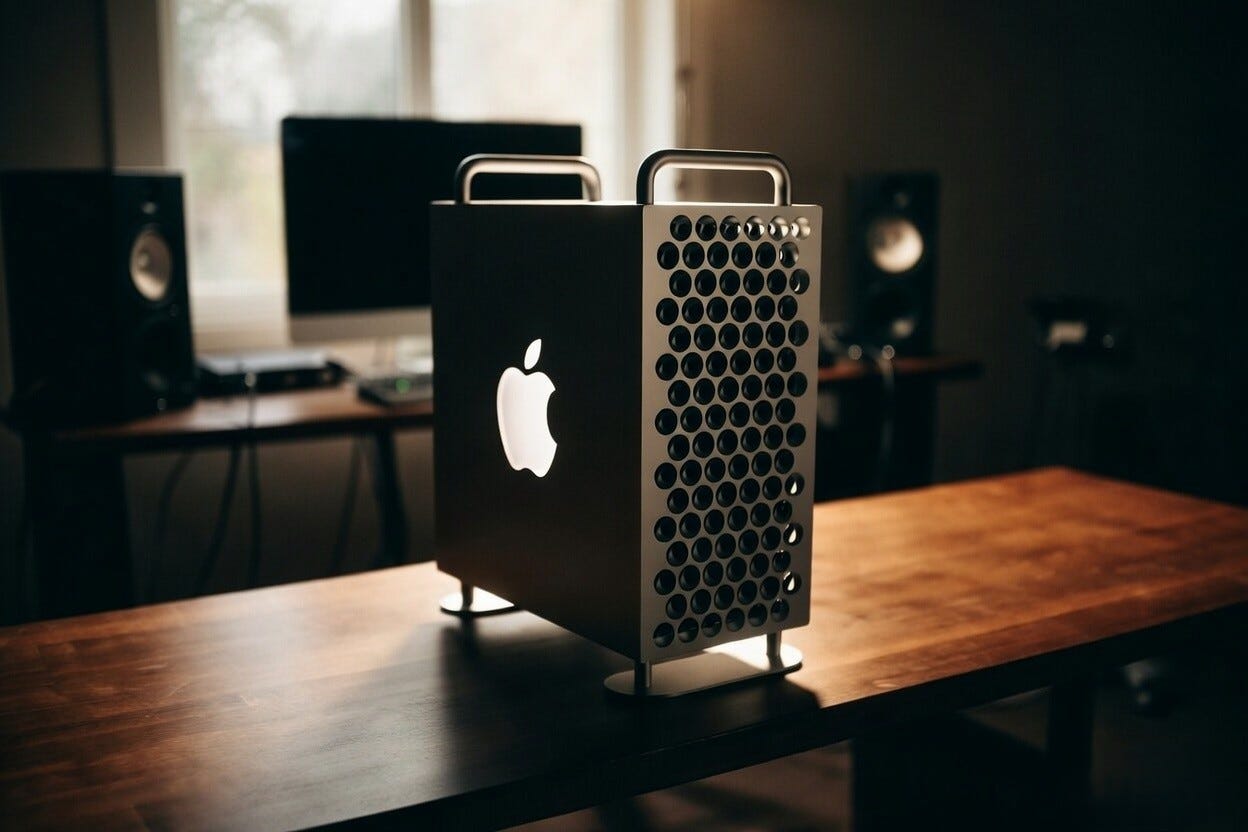
The Mac Pro wasn’t just a computer. For a certain generation of creative professionals — the editors cutting feature films, the engineers building the sonic landscapes of Grammy-winning albums, the architects rendering buildings that hadn’t been built yet — it was a symbol. Owning one meant you were serious. It sat under your desk like a declaration of intent. That’s a lot of weight for a piece of aluminum and silicon to carry. And maybe that’s part of why its death feels bigger than the sales numbers ever justified. Some machines outlive their specs. The Mac Pro was one of them.
A Machine That Lived Too Many Lives
The Mac Pro’s history is, depending on your perspective, either a saga of relentless innovation or a cautionary tale about what happens when a company tries to be clever instead of practical.
Cast your mind back to 2013. Apple introduced what it called a “completely rethought” Mac Pro — a sleek black cylinder that journalists immediately nicknamed the trash can. It was visually striking, confidently strange, and almost immediately a disaster for anyone who actually needed to do professional work. The thermal design was so constrained that it couldn’t accommodate the GPU upgrades that studios and post-production houses needed. By 2017, Apple was publicly apologizing for it, which is about as rare an event in Silicon Valley as a Halley’s Comet sighting.
So in 2019, they went back to the drawing board and produced the cheese-grater Mac Pro — a stainless steel tower built for modularity, with PCIe expansion slots and a design that looked like it could survive a minor earthquake. It launched alongside the Pro Display XDR, a $5,000 monitor that triggered an entirely separate cultural moment when someone pointed out the stand cost $999 extra. The machine started at $5,999 and could scale to configurations well past $50,000 if you were truly committed to spending money. Video editors at high-end studios loved it. It shipped assembled in Austin, Texas, which Apple made a point of mentioning, repeatedly.
A year later, Apple began transitioning to its custom M-series chips, proving Macs could be more powerful and power-efficient by abandoning Intel entirely. That decision was one of the most consequential in Mac history. But it also put the Mac Pro in an impossible position.
Here’s the thing about Apple Silicon that most coverage glosses over: the architecture that makes it so fast is the same architecture that makes a truly modular workstation difficult to build. Unified memory means the RAM is bonded to the chip. The GPU isn’t a discrete card — it’s baked into the same silicon die. The RAM and graphics were not upgradeable because of the integrated design of Apple’s chips. You could still put PCIe cards in the slots — storage expansion, specialized I/O, external GPU connections — but the core compute was fixed. So what exactly was the point of the tower?
That question got harder to answer every year.
The Slow Fade
The Mac Pro was last updated in 2023, when Apple added an M2 Ultra Apple silicon chip, but the chassis had not been refreshed since 2019. Think about that timeline. Three years. In semiconductor terms, that’s geological time.
While the Mac Pro sat frozen at M2 Ultra, Apple was busy updating everything else. The Mac Studio, introduced in 2022 and initially dismissed by some as a “Mac mini for rich people,” quietly became the most capable desktop Apple offered. The Mac Studio debuted the M3 Ultra chip last year — a chip that wasn’t available in any other Apple computer. That’s a genuinely remarkable thing. Apple’s most powerful chip, its crown jewel for desktop computing, went into the compact, fan-cooled box that costs $1,999 — not the $6,999 tower with the expansion slots.
The message was pretty clear, even if Apple wasn’t saying it out loud.
In late 2025, Bloomberg’s Mark Gurman reported that Apple had put the Mac Pro “on the back burner” and had “largely written off” the product line. “The sentiment internally is that the Mac Studio now represents both the present and future of Apple’s professional desktop strategy,” he wrote at the time. So by the time this week’s news landed, it wasn’t exactly a shock. The writing had been etched into the wall in six-inch letters for the better part of a year.
What makes this particularly bittersweet is that the Mac Pro never got a fair shot at Apple Silicon. The 2023 M2 Ultra refresh was the only Apple Silicon version it ever received — one update, one chip generation, then silence. Compare that to the MacBook Pro, which has cycled through M1, M2, M3, M4, and M5 in roughly the same window. The Mac Pro wasn’t just discontinued. It was, for all practical purposes, quietly abandoned long before Thursday’s announcement made it official. The website change was paperwork. The decision had already been made.
What’s interesting, though, is what took so long. One theory floating around the Apple community — and it’s more plausible than it might sound — is that the Mac Pro fulfilled a specific political purpose. It ticked the “made/assembled in the USA” box Apple needed to tick, but now a percentage of Mac Minis will tick that box instead, with Apple now producing Mac Minis in Houston. Once that assembly shift was in place, the last practical reason to keep the Mac Pro around evaporated.
What the Mac Studio Actually Is Now
Let’s be specific about what professionals are being pointed toward, because the Mac Studio has genuinely earned its new position at the top of the desktop lineup.
The Mac Studio can be configured with the M3 Ultra chip, a 32-core CPU, an 80-core GPU, 256GB of unified memory, and 16TB of SSD storage. Those are numbers that would have seemed absurd for a machine this size five years ago. To put the memory figure in context: the 2019 Intel Mac Pro maxed out at 1.5TB of RAM, which sounds impressive until you realize it was standard DDR4 and the machine cost north of $35,000 to configure that way. The M3 Ultra’s 256GB of unified memory, with its enormous bandwidth advantage over traditional architectures, is a more practical choice for the vast majority of professional workloads — video editing, 3D rendering, machine learning, audio production — than raw gigabyte counts on slower memory would suggest.
But here’s the genuinely interesting technical development that most of the obituary coverage has glossed over. With the release of macOS Tahoe 26.2 last year, Apple added a low-latency feature that lets you use RDMA over Thunderbolt 5 to connect multiple Macs together. RDMA — Remote Direct Memory Access — is the same technology used in high-performance computing clusters. It lets machines share memory and workloads at very low latency, effectively pooling their resources. What that means in practice: two Mac Studios connected via Thunderbolt 5 can behave, for certain workloads, like a single much more powerful machine. Apple is quietly building a path toward scalable computing that doesn’t require a single massive tower. It’s distributed by design.
Thunderbolt 5 models can be connected to pool their SoC’s resources together, which can create powerful clusters for AI workloads. You can even rack mount the Mac Studio. While Apple doesn’t sell that option, a number of enterprise IT vendors make 3U and 5U mounts to fit Apple’s new professional machine in server rooms. So the Mac Studio isn’t just a desktop anymore. It’s becoming infrastructure.
That context matters when you hear Mac Pro loyalists complain about losing PCIe expansion. They’re not wrong that PCIe is useful — for certain specialized workflows, connecting high-speed storage arrays, specific capture cards, or custom hardware interfaces, expansion slots are genuinely irreplaceable. But the question Apple is implicitly asking is: how many professionals actually need that? And the honest answer is: not many. Not enough to justify a separate product line.
The Lineup That Remains
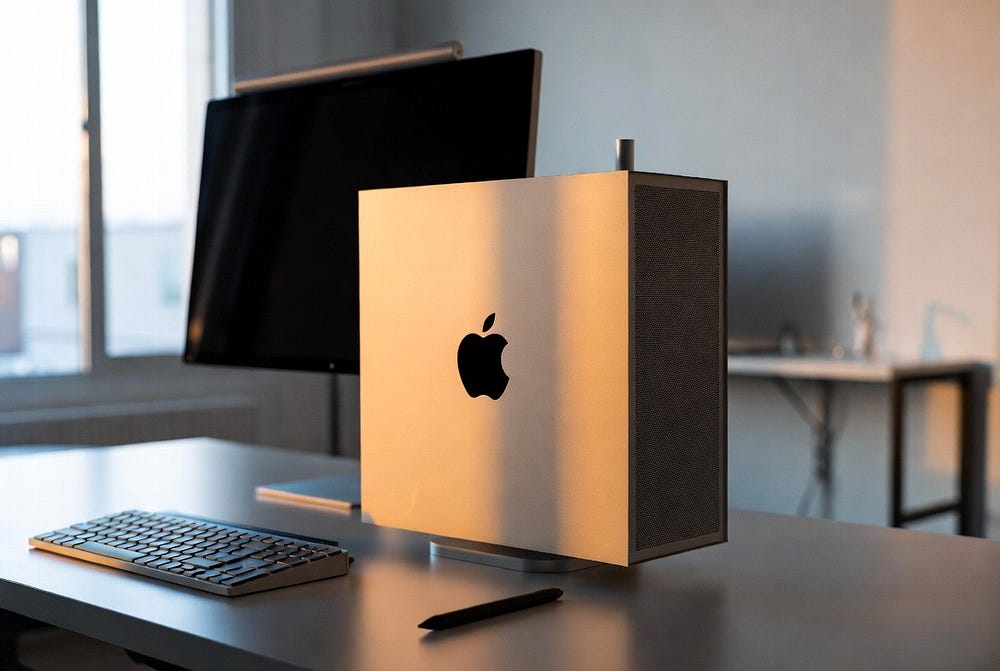
Apple’s desktop Mac lineup is now three machines. That’s it.
The 24-inch iMac with M4 is the entry point — the “I want a beautiful all-in-one that handles everything I throw at it” machine. It starts at $1,299 and is, by most accounts, an excellent computer for most people. The Mac mini, which Apple recently began assembling in the United States, covers the compact desktop segment from $599 upward with M4 and M4 Pro options. And the Mac Studio sits at the top, starting at $1,999 and scaling to configurations that comfortably exceed $10,000 when you add the highest memory and storage tiers.
No Mac Pro means no machine above $10,000 in the desktop lineup, which will genuinely matter to a slice of the professional market — the Pixar rendering farms of the world, the high-end audio production studios running Logic Pro with hundreds of tracks and plug-ins, the scientific research institutions that pushed Mac Pro configs into the $30,000-plus range. Those buyers exist. They’re just rare enough that Apple has apparently decided they can find their own solutions, whether that’s multiple Mac Studios, moving workloads to cloud infrastructure, or switching platforms.
That last option, for what it’s worth, is less common than it used to be. Apple Silicon has been quietly winning over a creative industry that was starting to drift toward Windows workstations in the late Intel years. A photographer or video editor who tried a MacBook Pro with M3 Max and discovered they could render timelines in Final Cut faster than their old Mac Pro would be reluctant to go back.
To be fair, though, there are real losers in this decision. Those who want a desktop Mac now have three choices: the diminutive Mac Mini, which uses previous-generation M4 chips, the Mac Studio, with M3 Ultra and M4 Max chips, or the all-in-one iMac, which provides just a single 24-inch display option. Nobody in that lineup is running M5 chips yet in a desktop configuration, which means the “pro” desktop crown is being handed to a machine that’s already a generation behind Apple’s laptop silicon. The MacBook Pro launched with M5 earlier this year. Mac Studio buyers today are getting M3 Ultra — a chip that, by Apple’s own cadence, is two full generations old. That gap is expected to close when Apple refreshes the Mac Studio with M5 Ultra later in 2026, but right now, if you’re buying the Mac Studio as the top desktop Apple sells, you’re not buying the fastest chip Apple makes.
That’s not nothing. It’s worth saying clearly.
Was the Mac Pro Ever What We Thought It Was?
Here’s a contrarian take that might land badly with some readers: the Mac Pro was always, to some degree, a statement machine more than a utility machine.
Don’t misread that. The people who bought it and used it professionally — the audio engineers running it with $50,000 worth of outboard hardware, the VFX houses rendering frames for Marvel films on racks of them — got real value from the machine. But for most of the decade it existed in various forms, most “pro” Mac users were buying MacBook Pros and Mac Studios anyway. The Mac Pro was what Apple could point to when journalists asked if it was “serious” about professional users. It was the flag planted on a hill to signal intent.
The trash can era made this uncomfortably visible. Apple designed a machine so constrained by its aesthetic ambitions that it couldn’t be upgraded, then spent three years selling it anyway, then had to apologize publicly. The 2019 cheese grater was the overcorrection — a machine so committed to modularity that it shipped with PCIe slots that Apple Silicon would later make mostly redundant. The Mac Pro has always been a slightly awkward product, positioned between what Apple’s chip architecture can do and what a certain kind of professional customer expected from a “pro” tower computer.
The Mac Studio doesn’t have that awkwardness. It knows exactly what it is. It’s a small, dense, very fast box that you plug things into and it does an enormous amount of work without complaint. No PCIe drama, no $999 casters, no existential questions about what “modular” means when the CPU, GPU, and memory are all the same silicon. It’s honest.
The Machines That Went With It
One quiet detail in this week’s news deserves more attention than it got. Apple also discontinued the Pro Display XDR earlier this month, in March 2026. That display launched alongside the 2019 Mac Pro as part of Apple’s big “we’re back for professionals” statement. The two products were positioned as a bundle — the ultimate creative workstation. Now both are gone within weeks of each other.
Apple’s effort to cater to professionals, creatives, and anyone with a chunk of change to drop on a fast computer lives on through the Mac Studio, and the recently announced Studio Display XDR, itself a replacement for the Pro Display XDR. So the ecosystem is shifting, not disappearing. The Studio Display XDR takes over monitor duties, and the Mac Studio handles compute. It’s a cleaner, simpler story than what Apple was telling before, even if some of the old ambition has been quietly set aside.
What Comes Next
The Mac Studio is expected to be refreshed with M5 Ultra chips later in 2026, which should close the performance gap with Apple’s laptop lineup and give the machine an unambiguous claim to the top of Apple’s desktop hierarchy. If Apple is smart — and it usually is about these things — that refresh will also come with a serious price reconsideration, positioning the Mac Studio not just as the “new Mac Pro” but as a machine that actually reaches a broader segment of professionals than the Mac Pro ever did.
The RDMA over Thunderbolt 5 clustering story also has room to grow. Right now, it’s a technical capability that most users won’t touch. But as AI workloads become more central to creative workflows — generative video, real-time audio processing, on-device model inference — the ability to chain Mac Studios together into a local compute cluster becomes genuinely interesting for studios and research labs. Apple could build serious enterprise software around that capability if it chooses to.
What won’t come back is the Mac Pro itself. Apple was unusually direct about that. Not “we have no current plans for a new Mac Pro” — the kind of language companies use when they want to leave a door technically open — but a flat confirmation that there are no plans, period. That’s rare for Apple, which usually says as little as possible about future products. The clarity suggests they’ve genuinely decided, not just paused.
Some loyalists will mourn it. A few might switch platforms. The professional Mac community will spend a few weeks relitigating whether the Mac Pro was ever truly “pro” or just expensive, which is always a fun argument that nobody ever wins.
But the Mac that remains — the Studio, compact and capable and honest about what it is — might be the more interesting machine for what comes next. The era of the tower as a status symbol in creative work is probably over anyway. What matters now is throughput, efficiency, and how well your machine handles the kinds of workloads that didn’t exist five years ago.
The Mac Pro had a good run. Longer than it probably deserved, if we’re being honest. And the Mac Studio, for all its lack of drama and PCIe slots, is ready to carry whatever comes next.
If you’re a professional sitting on a 2019 or 2023 Mac Pro right now, don’t panic. Your machine still works. Apple supports hardware for many years after discontinuation, and the M2 Ultra is still genuinely fast for most workloads. But if you’re in the market today, the answer is simple: buy the Mac Studio, wait for the M5 Ultra refresh later this year, and stop mourning a tower that the industry quietly stopped needing. The work hasn’t changed. The tools just got smaller.