Back in maybe 2018 or 2019, if you read any tech magazine, both AI and quantum computing were sold to us as the “next big thing.” Same tone, same hype, almost same headline template. Every second article was something like “this will change everything in ten years.” I remember reading about IBM’s quantum chips and OpenAI’s early GPT papers in the same week and honestly thinking both were equally far away from being useful.
Fast forward to August 2026, and one of them basically speedran the entire hype cycle while the other one is still in the lab, still expensive, still mostly a research topic. AI didn’t just meet the hype, in some areas it went past what people expected. Quantum computing, meanwhile, is having real breakthroughs too, just not the kind you can use on your laptop or even your company’s server rack yet.
This article is my attempt to actually compare the two properly. Not the “both are amazing, both will change the world” stuff you see everywhere. I want to get into what each one can actually do right now, what full potential even means for them, and why the gap between “cool demo” and “everyday tool” is so different for these two technologies.
Why AI Went From Chatbot to Coworker So Fast
The thing about AI’s speedrun is that it wasn’t one breakthrough. It was compounding. GPT models, Gemini, Claude, Llama, all of them kept releasing new versions every few months, and each one closed a gap that seemed permanent the version before. In March 2026 we had GPT-5.4, Gemini 3.1 Pro and Claude 4.6 landing within weeks of each other, and by July we already had GPT-5.6, Gemini 3.6 Flash, Kimi K3, and Claude’s Sonnet 5 and Fable 5 family out. That’s not a slow curve. That’s basically a new “best model” claim almost every month. And now Opus 5 in July
What changed isn’t just raw intelligence either. The bigger shift is agentic behaviour, models that can actually use a computer, click buttons, fill forms, run code, browse the web, and fix their own mistakes without a human doing every step. GPT-5.4 added native computer use. Claude added tool use and long running agent tasks. Even open source models like Llama 4 and Kimi K3 are being built specifically for agent workflows now, not just chat.
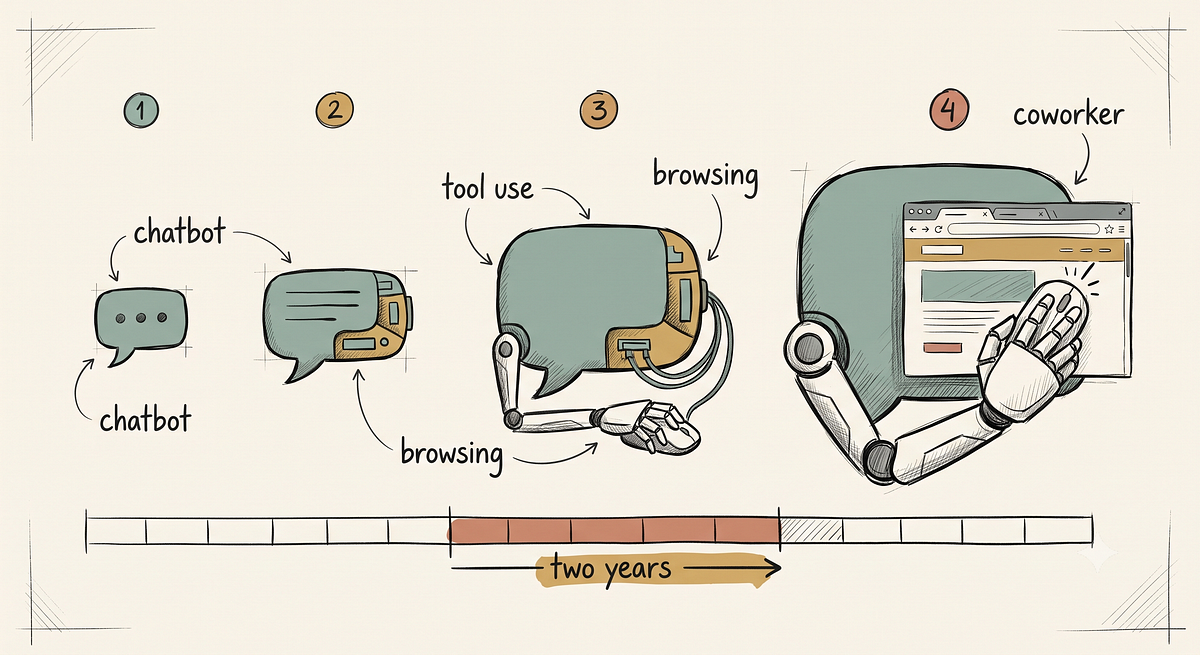
I use these tools daily for work, and I’ll admit something. A year and a half ago I would have laughed if you told me an AI model would debug my code, restructure my files, and only ask me one clarifying question in the whole process. Now it’s just… normal. That’s the speedrun part. The jump from “cute chatbot” to “coworker that does actual tasks” happened in about two years.
But here’s a small tangent, not directly related but it stuck with me. My friend works at a company and he told me last month their team replaced a whole manual QA testing step with an AI agent. It broke twice in the first week and everyone panicked and went back to manual for two days. Then they fixed the prompt and it’s been running fine since June. That’s basically the AI story in miniature: fast progress, occasional face plant, quick recovery, then it just works and nobody talks about it again.
The Part Where AI Actually Struggled
Not everything went smoothly though, and I think it’s dishonest to pretend AI just had a clean run. Hallucination is still a real problem, it’s just less obvious now because models are better at sounding confident even when wrong. Cost also went up a lot for the frontier models before some labs pushed prices back down in mid 2026. And agentic AI running for long stretches without supervision has caused actual production issues at companies, not just funny anecdotes. The 2026 version of AI is powerful, but it’s also more of a “supervise it closely” tool than a “set and forget” one, whatever the marketing says.
There’s also this whole AGI debate that never really settled. Musk apparently said AGI could happen as early as 2026, Altman was betting on 2027 or 2028, and Demis Hassabis has always been more careful about naming a year at all. Nobody agrees on what AGI even means exactly, which tells you something about how messy this space still is even while the tools themselves keep getting better.
Quantum Computing: Real Progress, Just Not Your Kind of Progress
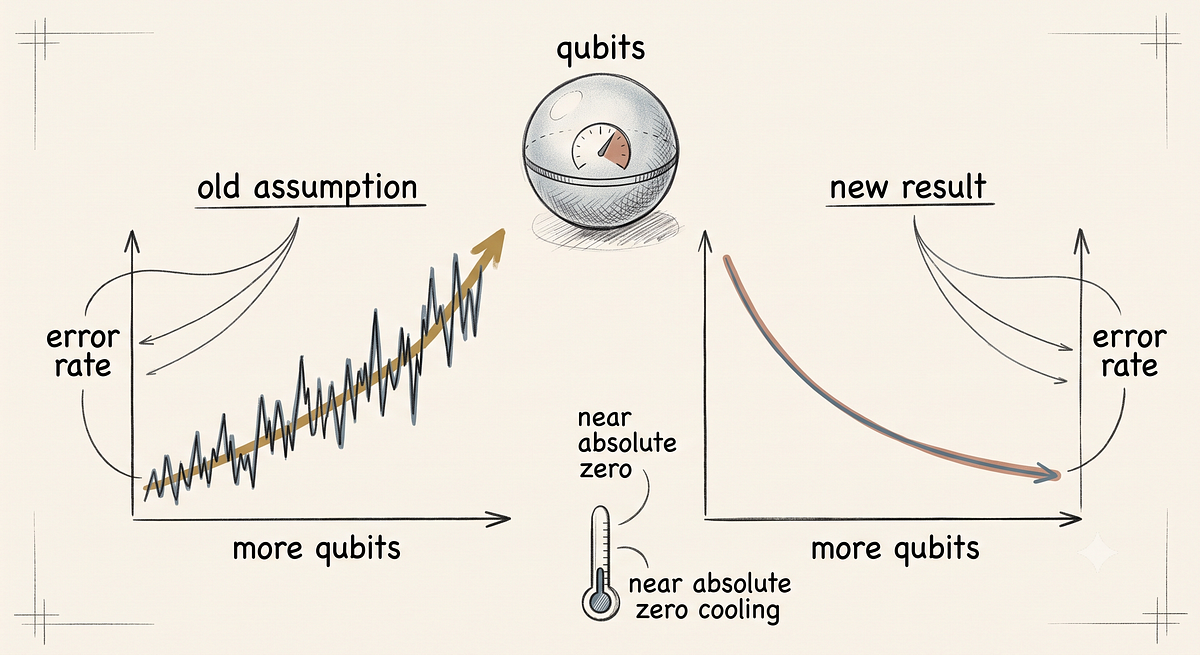
Quantum computing is a different story completely. It hasn’t failed, not even close. If you actually read what’s happening in labs right now, 2026 has been called by some people the year quantum crossed from “promise” to “practice.” Google’s Willow chip did something genuinely wild in late 2024 and the follow up work through 2025 and 2026 proved that as you add more qubits, the error rate actually goes down instead of up, when you use the right error correction. That’s a huge deal because for years the assumption was more qubits equals more noise equals more useless results.
IBM, Microsoft with Atom Computing, QuEra, Quantinuum, all of them are racing toward what’s called fault tolerant quantum computing, where a “logical qubit” (basically a cleaned up, error corrected version of a physical qubit) can hold its state reliably. Quantinuum’s Helios system is reportedly a trillion times more powerful than their previous H2 machine, at least on their own benchmarks. Google demonstrated a physics simulation that took just over two hours on their quantum hardware versus an estimated 3.2 years on a classical supercomputer. These are not small numbers.
So why doesn’t it feel like AI’s speedrun? Because none of this is available to a normal developer the way ChatGPT or Claude is. You can’t open an app and ask a quantum computer to help you write an email. The use cases are narrow right now: drug discovery simulations, materials science, cryptography research, optimization problems in logistics and finance. Real, important stuff, but not something a college student or a small business owner touches directly.
Actually, let me back up a second, because I think I’m overselling how “not ready” quantum is. There are cloud platforms now where you can actually run a quantum circuit as a paid service, sort of like renting GPU time. It’s called Quantum as a Service in some of the reports I read, and pricing is per shot or per circuit. So it’s not locked away in a university basement anymore. It’s just that almost nobody outside research teams and a few enterprise labs has a real reason to use it yet.
Comparing What Each One Can Actually Do Today
Let’s get concrete instead of talking in generalities, because that’s usually where these comparisons fall apart.
AI today can write code, summarize documents, generate images and video, control a browser to complete a task, hold a reasonably long conversation with memory of earlier context, and increasingly act as an autonomous agent for hours at a stretch. It runs on regular cloud GPUs, anyone with a laptop and internet can use the top models within seconds of signup, and pricing has actually come down this year, not up. Terra from OpenAI, Gemini 3.6 Flash, and Claude’s newer tiers are all cheaper per token than their equivalents from a year ago.
Quantum computing today can, in narrow demonstrated cases, outperform classical supercomputers on very specific physics simulations and optimization problems. It’s being used to help design new experiments in chemistry, to explore molecule interactions for drug discovery, and increasingly to support AI itself, tasks like calibration, error mitigation, and specific optimization steps inside larger AI training pipelines. But it needs specialized hardware kept near absolute zero in most approaches, it needs PhD level expertise to program properly, and there isn’t a consumer facing “app” for it the way there is for AI. You can’t onboard a random employee onto a QPU workflow in an afternoon. People in the field openly admit the talent gap here is a real bottleneck, not just a marketing excuse.
If I had to, comparing them head to head like this feels a little unfair to quantum computing, because they’re not really solving the same category of problems. AI is a general purpose tool that touches almost every knowledge work task. Quantum computing right now is a specialized tool for a narrow but genuinely important set of scientific and optimization problems. It’s a bit like comparing a smartphone to a particle accelerator. Both are impressive technology, only one of them fits in your pocket.
What “Full Potential” Actually Means for Each
This is where I think most articles get lazy and just say “the future is bright for both,” so let me actually try to answer it.
AI’s full potential, going by what labs themselves are saying, points toward AGI, systems that can reason and act at or above human level across basically any task, not just narrow ones. Whether that happens in 2026, 2028, or later is genuinely unclear and honestly kind of a mess of a debate. But even short of AGI, AI at its current trajectory is heading toward something like a fully autonomous digital coworker that can run entire projects with minimal supervision. We’re not fully there. Long running agent tasks still fail in weird ways, and trust in autonomous AI for anything high stakes is still low for good reason.
Quantum computing’s full potential is different in kind. At its ceiling, a fault tolerant, large scale quantum computer could break current public key encryption (this is the “Q-Day” people keep mentioning), simulate molecular and chemical systems with a precision classical computers simply cannot match no matter how much hardware you throw at them, and solve certain optimization problems at speeds that make today’s best supercomputers look almost quaint. Forrester’s 2026 report suggested practical quantum computing by 2030 is likely, and Q-Day security risk along with it. That’s not next year. That’s a real chunk of time away still, even with the current pace of breakthroughs.
Here’s the honestly interesting part though. Some researchers now argue the two aren’t really competing at all, they’re converging. AI is already being used to calibrate quantum hardware and design better quantum experiments, and quantum computing is being explored as an accelerator for the specific parts of AI training that classical GPUs struggle with, like certain optimization and sampling steps. Quantum Machine Learning is apparently one of the more active research areas in 2026, though it’s still mostly experimental and running on what people call NISQ era hardware, meaning noisy and not error corrected in the way fault tolerant systems eventually will be.
So Which One Actually Won the Race
Neither, and also kind of AI, if I have to just pick a side, which I will because that’s more honest than sitting on the fence.
AI won the adoption race by a mile. It’s in your phone, your work laptop, your kid’s homework app, probably your grandmother’s WhatsApp forwards by now if she’s into that sort of thing. The speed at which it went from research curiosity to daily tool, in roughly three to four years, is genuinely unprecedented for any computing technology in history. Nothing else has scaled to over a billion regular users this fast.
Quantum computing didn’t lose though. It’s just running a different race, a slower and much harder one, against actual physics rather than against user adoption curves. Error correction, decoherence, extreme cooling requirements, none of that gets solved by better marketing or a bigger training run. It gets solved by grinding, incremental hardware engineering, and 2026 has genuinely been a strong year for that grind. The exponential error suppression results from multiple labs this year are a real scientific milestone, even if regular people will never interact with a QPU directly for a long time.
What I keep coming back to is that people expected both of these to be “mainstream” at roughly the same pace, and that expectation itself was probably wrong from the start. Software adoption and hardware physics just don’t move on the same timeline, no matter how much money gets thrown at either one.
What This Means If You’re Trying to Learn or Invest Time in Either
If you’re a student or a working professional trying to decide where to spend your learning hours, AI is the obvious pick for near term career value. The tools are accessible, the job market wants people who can use and build with AI right now, and the barrier to entry is basically just curiosity and a laptop.
Quantum computing is a longer bet. If you’re genuinely into physics, chemistry, or advanced optimization problems, and you don’t mind that the payoff might be five or more years out, it’s a fascinating field to get into early, before it gets crowded. IBM’s Qiskit and similar frameworks are free to learn from, and cloud access to actual quantum hardware is more available than most people realize.
For everyone else, honestly, just keep an eye on it. Quantum computing isn’t going away and it isn’t failing. It’s just following the timeline that hard physics problems actually follow, not the timeline that software hype cycles follow. Give it another few years and this comparison article is going to read very differently.