Cloud AI has one habit that annoys people fast. It keeps sending you a bill.
Every million tokens has a price. Run more prompts, pay more money. Build an agent that works all day and the number can become uncomfortable. So the pitch for local AI sounds clean: buy a machine once, run models on your desk, stop paying the token tax.
I like local AI. I use it whenever privacy, offline access, or control matters. But the “pay once” story is too neat. We didn’t remove the AI bill. We moved most of it into hardware, electricity, depreciation, storage, cooling, setup time, and a box that may look old much faster than a normal PC.
And the funny part is that electricity is probably not even the biggest cost.
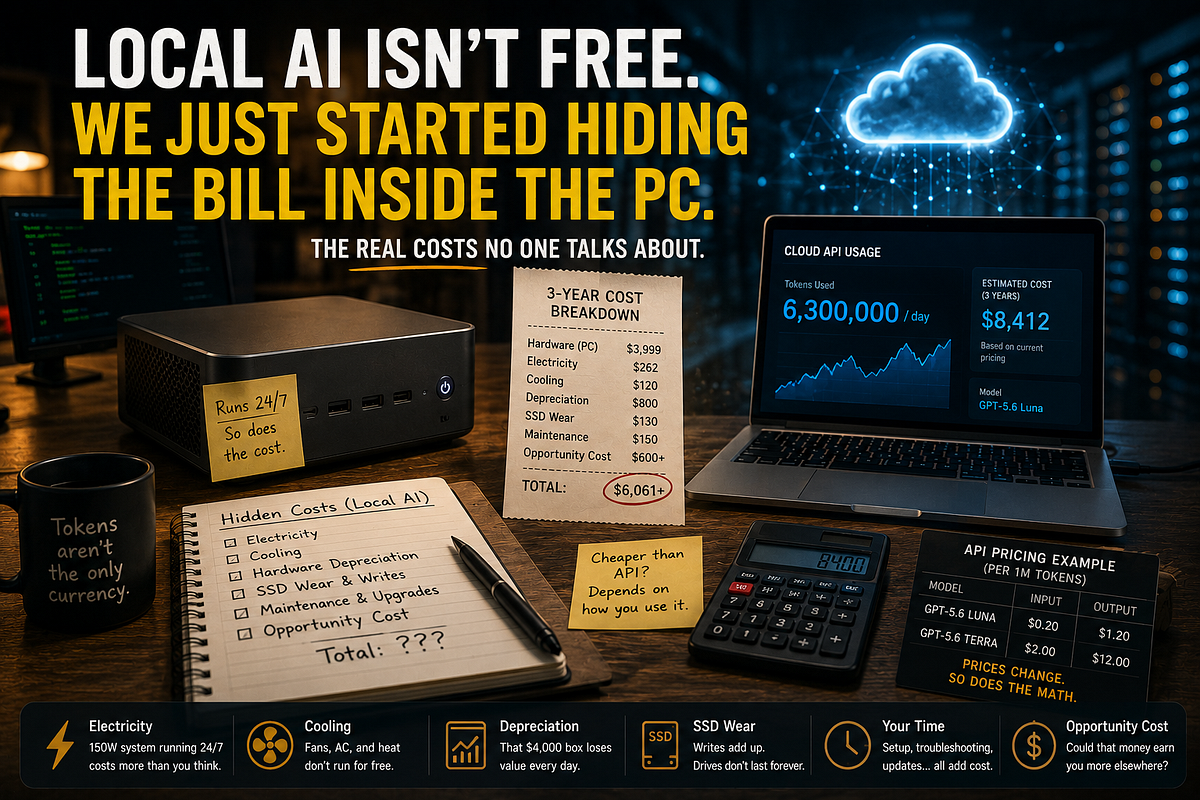
The $4,000 Bill Arrives Before Your First Token
AMD’s Ryzen AI Halo developer box is currently priced at $3,999. NVIDIA’s DGX Spark is $4,699. Both sit in the new class of compact machines built around 128GB unified memory and local large model work.
That means the local AI experiment starts with roughly four to five thousand dollars leaving your account before you ask the model anything.
Cloud pricing works in the opposite direction. You can spend almost nothing during a quiet month. If a project dies after six weeks, you stop calling the API and the bill mostly stops with it. A local machine doesn’t care that your side project died. It is still sitting on desk.
This sounds obvious, but hardware marketing tends to treat the purchase price like a one-time inconvenience rather than part of every future token. I think that is the wrong way to look at it.
Take a $3,999 AI PC and keep it for three years. Ignore resale value for a moment. Straight-line depreciation is about $111 per month. A $4,699 DGX Spark works out to about $130 per month. That cost exists even if the machine spends half the month idle.
Sure, you still own something at the end. Maybe you sell it. Maybe it becomes a home server. Maybe your cousin gets the world’s strangest Plex box. But AI hardware is moving quickly. A machine that feels unusual in August 2026 may look pretty normal by 2029.
Basically, local AI has a monthly bill too. It just doesn’t email the invoice.
Electricity Is Real, but It Is Not the Scary Part
AMD has been marketing Ryzen AI Halo with the phrase “No token tax” and says the machine can deliver up to 6x lower three year cost than equivalent cloud API use in one modeled sustained workload.
The footnote is more useful than the headline.
AMD assumes 150W sustained draw for electricity, running 24 hours a day at $0.15 per kWh. That comes to about $16.20 per month. Over three years, electricity is around $583.
Honestly, I expected the electricity number to look worse. It doesn’t.
Even if your local rate is $0.25 per kWh, 150W running continuously works out to around $27 per month. If the machine only works hard for eight hours a day, the direct power cost falls a lot further.
So if somebody tells you local AI is expensive mainly because of electricity, I don’t buy it. The hardware itself hurts more.
Cooling is messier. A machine pulling 150W eventually turns most of that energy into heat. In a cool room during winter, who cares. In Hyderabad in May with AC already fighting for its life, that extra heat has to go somewhere. Your cooling system pays part of the bill. The exact cost depends on the room and HVAC setup, so pretending there is one universal number would be silly.
Noise counts too, at least for a desk machine. A fan running beside you eight hours every day is not a dollar cost, but after a few weeks you may suddenly care a lot about acoustics.
AMD’s 6x Cloud Claim Has a Huge Assumption Inside It
This part took me longer than expected because the headline sounds simple and the actual comparison isn’t.
AMD’s current cost model assumes about 5.73 million input tokens and 573,000 output tokens every day. That is roughly 6.3 million total tokens per day. The model assumes eight hours of effective AI use and compares the local box against Claude Sonnet 4.5 pricing of $3 per million input tokens and $15 per million output tokens.
That’s serious usage.
At that volume, cloud cost piles up fast. The local machine gets used enough that its fixed purchase price is spread across a giant number of tokens. Of course the economics start looking good.
But change the API model and the whole calculation goes wonky.
OpenAI cut GPT 5.6 Terra and Luna API prices on July 30, 2026. Luna now costs $0.20 per million input tokens and $1.20 per million output tokens. Terra costs $2 and $12. GPT 5.6 Sol remains $5 input and $30 output at standard pricing.
Use AMD’s same approximate monthly token volume, around 172 million input tokens and 17 million output tokens, and the API bill looks very different. Luna lands around $55 a month. Terra is roughly $550. Sol is about $1,375.
Same token count. Wildly different bill.
And this is before prompt caching, batch discounts, model routing, or simply using a smaller model for easy work.
That doesn’t mean Luna replaces a 120B open model running locally. Capability is different. Privacy is different. Tool support is different. The point is that “local versus cloud” is not one price comparison anymore. Choosing the API model can matter more than choosing local or cloud in the first place.
SSD Writes Are a Cost, Just Not the One People Think
Local AI users collect models like browser tabs.
You download one quant. Then another quant because the first one is too slow. Then a newer checkpoint appears. Then you test a vision model, an embedding model, a reranker, a speech model, and some 80GB thing from Hugging Face that looked interesting at 1:30 in the morning.
Suddenly a 2TB SSD doesn’t feel big.
Large model files, caches, temporary conversions, vector databases and datasets create writes. SSDs do wear out. But I would not scare people with the idea that Ollama is going to murder a good NVMe drive in six months. For most developers, storage capacity becomes annoying before endurance becomes a disaster.
The hidden cost is more boring. You may add another SSD, buy a NAS, keep backups, or spend time deleting models because you forgot why you downloaded half of them.
I’ve done the “which 70GB file can I delete without regretting it tomorrow” routine. Not exactly datacenter economics, but still part of owning the thing.
Maintenance Is Where the Cheap Local Box Can Become Expensive
Cloud APIs hide a ridiculous amount of work.
You send a request. Somebody else worries about failed hardware, driver versions, deployment, scaling and replacing dead SSDs.
Local AI hands some of that work back to you.
CUDA updates. ROCm support. Python environments. Containers. Broken model formats. A library that worked last month and now wants a different dependency. A quant that loads but performs badly. Windows support that isn’t quite the same as Linux support. A new runtime promising 20 percent more speed if you’re willing to rebuild half the setup.
For hobby use, this can be fun. I mean, half the reason people buy these machines is to mess with them.
For paid work, time has a price.
If you lose four hours in a month fixing a local inference stack and your time is worth $50 an hour, you just spent $200. That is more than a month of electricity by a huge margin. A company paying an engineer much more than $50 an hour can erase the supposed cloud saving with one annoying afternoon.
And cloud systems break too. APIs have outages, rate limits change, models get retired, prices change. I’m not giving cloud a free pass. The difference is that local failures often become your personal weekend project.
The Opportunity Cost Is Easy to Ignore
A $4,000 machine is also $4,000 you cannot use somewhere else.
If that money could earn 5 percent annually, that is roughly $200 of first-year opportunity cost. If you financed the PC, interest makes the calculation even less friendly. If the machine helps you bill clients or avoids a larger cloud bill, fine. Then it is earning its place.
But buying a local AI workstation because token pricing feels emotionally annoying is not the same as saving money.
This is where I think enthusiasts, myself included, can fool ourselves a little. Owning hardware feels permanent. API spending feels like money disappearing. So we treat the PC as an asset and API tokens as waste, even when the API would have been cheaper for our actual workload.
A gaming PC owner will understand this immediately. Nobody calculates the cost of a graphics card by saying, “The games are free now.”
Cloud Gets Embarrassingly Cheap When Your Usage Is Light
Say your project uses 10 million input tokens and 2 million output tokens in a month.
At current standard OpenAI pricing, that would be around $4.40 on GPT 5.6 Luna, $44 on Terra, or $110 on Sol.
At $44 a month, a $3,999 machine needs more than seven and a half years just to match the hardware purchase price. That’s before electricity, storage, maintenance or the money tied up in the machine.
Even the $110 Sol example needs about three years to reach $4,000. And again, that comparison is technically unfair because a local open model and Sol are not interchangeable products.
Now increase the workload ten times to 100 million input tokens and 20 million output tokens each month. Luna is around $44. Terra jumps to roughly $440. Sol reaches about $1,100.
Now local hardware starts looking very different.
At $440 per month, a $4,000 box can cross the hardware-only break-even point in around nine months. At $1,100 per month, the hardware price looks small after a few months. Heavy sustained inference is where local economics can become hard to ignore.
So the argument isn’t “local is cheaper.”
The argument is “local can be cheaper when you keep it busy.”
Local AI Still Has Reasons That Have Nothing to Do With Money
This is why I wouldn’t make the purchase decision from a spreadsheet alone.
Local AI can keep sensitive documents off an external inference service. It can work without internet. Latency can be predictable. You can run weird open models that no API provider hosts. You can experiment without staring at a token meter. You can keep a specific model version after a cloud provider moves on.
Those benefits are real.
For some teams, privacy alone can justify a $4,000 machine even if the API would cost less. A researcher running millions of tokens every day may save serious money. A developer building offline software needs local inference because cloud dependency defeats the product idea itself.
But a person running a few coding prompts at night probably does not need a 128GB AI workstation to escape a $20 or $50 cloud bill.
That’s the part I would keep in mind before buying one of these new mini AI boxes.
The Bill Never Disappeared
Cloud AI makes the cost painfully visible. Every token can be counted.
Local AI hides the cost inside objects you already paid for: the machine, SSD, power socket, air conditioner, your time, and eventually the next machine you convince yourself you need because 192GB suddenly looks normal.
I still like local AI. For heavy use, privacy-sensitive work and offline systems, I think owning the hardware can make a lot of sense.
For light and unpredictable use, cheap APIs are becoming harder to beat. OpenAI cutting Luna to $0.20 per million input tokens in July made that gap even stranger. The cloud is getting cheaper at the same time local machines are getting more capable.
So before buying a $4,000 box to avoid token fees, check one boring number first: how much did you actually spend on API calls during the last three months?
If that number is small, the token tax may be cheaper than the machine you are trying to escape.