Zhipu AI dropped GLM-5.3 on August 14, and within a few hours the press releases were already fighting each other. One says it beat Anthropic on a cybersecurity benchmark. Another says it’s “approaching” Claude Fable 5 on coding. A third just says the base model didn’t even change. All three are technically true, which is sort of the problem.
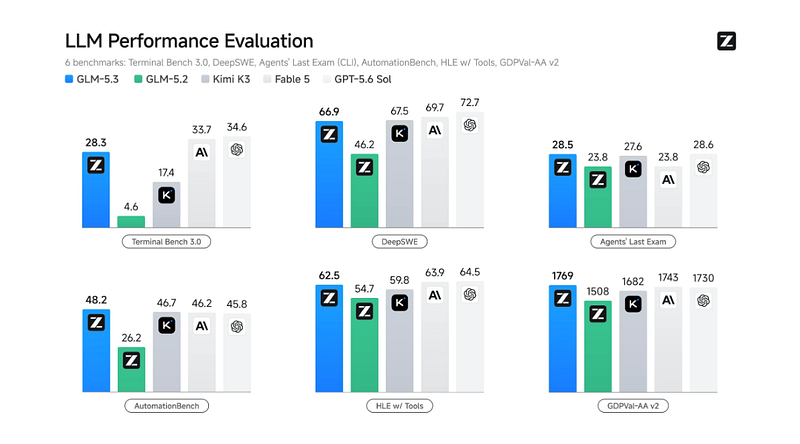
I spent an evening trying to line up the numbers from Zhipu’s own announcement against independent testing, and honestly, it took longer than it should have. Different labs use different harnesses, different prompts, sometimes different versions of the same benchmark. So before getting into what GLM-5.3 is good at, it’s worth being upfront: some of these numbers are Zhipu grading its own homework, and some aren’t. I’ll flag which is which.
This isn’t a small point release either, even though the version number reads that way. It’s the sixth major open-weight model from a Chinese lab to launch in about a month, and it’s arriving into a field that’s suddenly a lot more competitive than it was even two months back. Kimi K3, DeepSeek V4, Qwen 3.8 Max, all recent, all making very similar claims about closing the gap to closed frontier models. GLM-5.3 has to earn its place in that lineup, not just show up in it.
What actually changed here
GLM-5.3 shares its base model with GLM-5.2. Nothing new was pretrained. Every capability gain came from post-training, meaning Zhipu ran the same underlying network through more reinforcement learning against a wider set of long-horizon task environments, for a lot longer. That’s a real strategy, not a shortcut. It’s basically what happened with a lot of 2026-era model updates: the base network gets expensive and slow to retrain, so labs squeeze more agentic competence out of post-training instead.
The stated result is a 50 percent jump in coding capability over GLM-5.2, according to Zhipu’s internal evaluations, with the biggest gains showing up in agent-based tasks rather than plain single-turn code generation. It now ranks first among open-weight models on Terminal Bench 3.0 and Agents’ Last Exam, and Zhipu is framing its coding and agent skills as “approaching” Claude Fable 5. That word is doing a lot of work. Approaching isn’t matching, and the gap on independent testing tends to be wider than vendor self-reports suggest. Still, for an open-weight model to even be in that sentence is new.
The cybersecurity numbers, and where they fall apart
This is the part that made headlines. On CyberGym, a benchmark that measures whether a model can find and validate real security vulnerabilities from source code, GLM-5.3 scored 84.5 percent. That edges out Anthropic’s Mythos 5 at 83.8 percent and GPT-5.6 Sol at 83.6 percent. Working with domestic security teams, Zhipu says it used the model to find 2,436 vulnerabilities across 269 projects, some of the codebases decades old, and published the findings in a public registry.
But then there’s ExploitBench, which measures how far a model can actually climb the exploitation chain once it finds a flaw, not just whether it spots one. GLM-5.3 scored 54.4 percent there. Mythos 5 scored 78 percent. GPT-5.6 Sol scored 76.5 percent. That’s not a close gap, that’s a different tier.
So here’s the real read: GLM-5.3 is genuinely strong at flaw detection, and weaker at turning a flaw into a working exploit chain. Detection and exploitation are different skills, and conflating them is how you end up with a headline that says “beats Anthropic” while leaving out the benchmark where it doesn’t. If you’re doing vulnerability triage at scale, this model earns a look. If you need something that reasons through a full exploitation path, the gap to closed frontier models is still real.
Where it sits against the rest of the open-weight field
This is where things get crowded, because 2026 has been a genuinely good year for Chinese open-weight labs. On the Artificial Analysis Intelligence Index, an independent benchmark suite that scores everything on the same test rather than trusting vendor claims, GLM-5.2 (the predecessor) sat at 51. Kimi K3 from Moonshot AI scored around 57, putting it fourth overall behind only Claude Fable 5, GPT-5.6 Sol, and ahead of Claude Opus 4.8. DeepSeek V4 Pro landed at 44.
GLM-5.3’s independent Intelligence Index score wasn’t out yet as of writing, only Zhipu’s own numbers were, which is exactly the kind of gap that makes side-by-side comparisons tricky right now. What’s known: GLM-5.2 was a 744 billion parameter mixture-of-experts model with roughly 40 billion active parameters and a 1 million token context window. GLM-5.3 keeps that same architecture, so whatever gains show up are entirely from training, not size.
Compare that to the competition. Kimi K3 is 2.8 trillion parameters total, the largest open-weight model released so far, and it’s the only one in this group with native multimodal input built in from launch. DeepSeek V4 Pro runs 1.6 trillion parameters with 49 billion active, and its cheaper V4 Flash variant is priced at $0.14 per million input tokens and $0.28 per million output tokens, which is aggressive even by open-model standards. Qwen3-Coder-Next takes a completely different approach: 80 billion total parameters, only 3 billion active, Apache 2.0 licensed, built to actually run locally rather than through an API.
So the honest ranking depends entirely on what you’re optimizing for. Kimi K3 wins on raw intelligence score and frontend coding, where it’s the first open model to beat Claude Fable 5 on the Frontend Code Arena. DeepSeek V4 Pro wins on cost-per-task and leads raw SWE-bench Verified among downloadable weights at 80.6 percent. Qwen3-Coder-Next wins if you need to self-host on modest hardware. GLM-5.3’s pitch is narrower but specific: it wants to be the coding and cybersecurity option, not the general-purpose one.
I’ll admit I went in expecting GLM-5.3 to just be a bigger number on a leaderboard, and it isn’t. It’s a fairly targeted update aimed at two things, agentic coding and vulnerability discovery, and it’s honest about the second one being uneven.
Actually using it for coding work
GLM-5.3 is live now through the GLM Coding Plan, and it plugs into existing coding agents rather than requiring its own interface. It works with Claude Code, with Zhipu’s own ZCode, and with OpenCode. That’s a smart distribution choice. Instead of asking developers to switch tools, it slots into workflows people already have set up.
Zhipu’s internal Code Bench evaluation apparently focused as much on token efficiency as raw capability, meaning the model is meant to complete agentic coding tasks without burning an excessive number of output tokens along the way. That’s a real cost lever if you’re running long agent loops, and it’s one area where GLM-5.3 might have an edge over Kimi K3, which early users have reported burns noticeably more output tokens per completed task than comparable models.
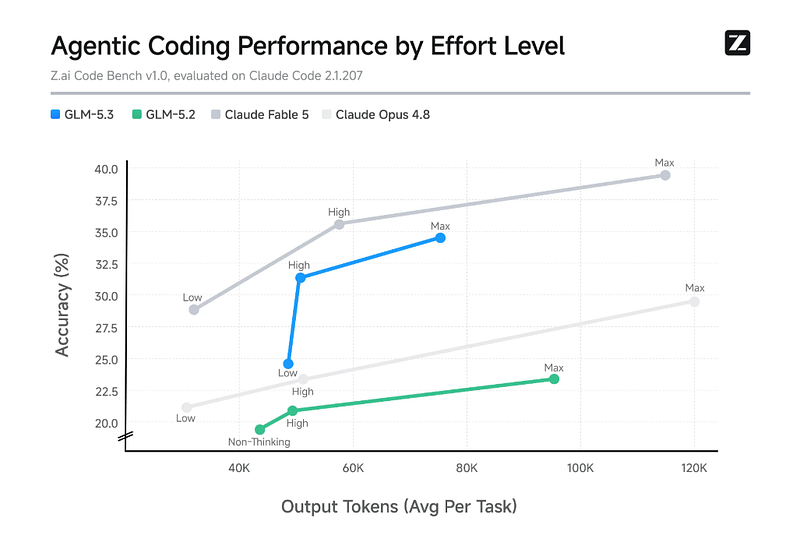
I tried routing a handful of small agentic coding tasks through it in the days after launch, nothing complicated, mostly refactors and test-writing loops. It handled multi-file edits fine and didn’t lose track of state across steps, which is where a lot of earlier open models used to fall apart. What tripped me up wasn’t the model, it was figuring out which reasoning mode I was actually running. Zhipu ships both a High and a Max reasoning setting, carried over from GLM-5.2, and the documentation on when to use which one is thin. I burned a good chunk of a session assuming Max was strictly better before realizing it’s slower and not obviously more accurate for shorter tasks. That’s a small thing, but it’s the kind of friction that doesn’t show up in any benchmark table.
One thing that’s still unresolved: the open-weight release. Zhipu says weights will be published two weeks after the initial launch, but as of release day, GLM-5.3 is API-access only, and the exact licensing terms haven’t been confirmed. Will it be MIT-style like DeepSeek, or something more restrictive? Nobody outside Zhipu knows yet. If you’re planning to self-host this for a production coding agent, that’s a two-week wait with an unknown ending.
Zhipu also claims it built its most thorough risk review process to date for this release, though what that review actually covers hasn’t been detailed publicly. Given how directly this model is being marketed around vulnerability discovery, a public writeup of that review process would matter more than usual. Right now it’s just a line in a press release, and I’d want to see it before trusting the model with anything sensitive.
A quick word on the base-model question
It’s worth sitting with the fact that GLM-5.2 and GLM-5.3 are, underneath everything, the same network. Zhipu isn’t hiding this, they’re actually leading with it as a selling point, framing it as proof that post-training alone can unlock capability nobody expected. That’s a real technical claim and it lines up with something the broader field has been circling for a while now: full pretraining runs are enormously expensive, and the return on a fresh base model has been shrinking relative to the return on smarter, longer post-training against better environments.
So is this the new playbook. Train a strong base once, then keep re-training it against increasingly realistic long-horizon tasks every few months, ship a point release, repeat. If GLM-5.3’s coding jump really does hold up under independent testing and not just Zhipu’s own harness, other labs are going to copy this approach fast, because it’s a lot cheaper than what it looks like on a spec sheet.
How the pricing actually shakes out
Nobody talks about pricing in the launch posts, which is annoying because it’s usually the thing that decides adoption faster than any benchmark. GLM-5.3 ships through the GLM Coding Plan, a subscription-style quota system rather than pure pay-per-token, and Zhipu reset everyone’s usage allowance the same day the model launched. That’s a good sign for existing subscribers. It’s a slightly confusing one for anyone trying to estimate cost per task from the outside, because subscription quotas don’t map cleanly onto the dollar-per-million-token numbers everyone uses to compare models.
Set that against DeepSeek V4 Flash’s straight $0.14 input and $0.28 output per million tokens, and Kimi K3’s roughly $3 input and $15 output through Moonshot’s own API. Those are real, comparable numbers. GLM-5.3’s aren’t, at least not yet, and until Zhipu publishes a plain per-token rate for API access outside the coding plan, cost comparisons against it are going to stay approximate. I’d treat any “GLM-5.3 is the cheapest option” claim with some suspicion until that number actually exists somewhere official.
Setting it against Qwen 3.8 Max too
It’s worth throwing one more model into this pile, because Alibaba’s Qwen team was moving at the same time. Qwen 3.8 Max launched with 2.4 trillion total parameters, 95 billion active, and the same 1 million token context window that’s basically become table stakes for this generation of models. Independent testing on it is thin so far, a single blind comparison run put Qwen 3.8 Max at 80 against Kimi K3’s 83 on one task set, which is one data point and not really a verdict on anything.
What’s notable is the pattern across all of these releases, GLM-5.3, Kimi K3, Qwen 3.8 Max, DeepSeek V4, they all landed within about a month of each other, and every single one is being pitched with the same framing: closing the gap to the closed frontier, cheaper than the closed frontier, better agent behavior than last quarter’s version. At some point that framing stops being remarkable and starts being the baseline expectation. I think we’re close to that point already.
Should you actually use it
If your workload is agentic coding and you want an open-weight option that’s cheaper than the closed frontier models, GLM-5.3 is worth testing against Kimi K3 and DeepSeek V4 side by side, not picked blind off a press release. If your priority is frontend work specifically, Kimi K3’s independent lead on the Frontend Code Arena is hard to ignore. If cost-per-token is what actually decides your budget, DeepSeek V4 Flash at $0.14/$0.28 per million tokens is going to be tough to beat regardless of what any intelligence index says.
Where GLM-5.3 genuinely stands alone right now is vulnerability detection at scale, the CyberGym number backs that up even accounting for it being vendor-reported. Just don’t expect it to carry a full exploitation chain the way Mythos 5 or GPT-5.6 Sol can. That’s a different, harder problem, and GLM-5.3 isn’t there yet.
Why the cybersecurity framing matters more than it looks
Step back from the raw scores for a second, because the CyberGym number is being used for something bigger than a leaderboard entry. This release is being talked about as part of a broader push to build a domestic answer to Western AI security tooling, not just a coding assistant that happens to be good at finding bugs. The 2,436 vulnerabilities found across 269 projects, some of them decades old, weren’t a benchmark exercise, they came from actual security teams using the model on real codebases before the public launch.
That framing matters because it changes what success looks like. A coding model gets judged on whether it ships working code. A security model gets judged on whether it finds things nobody else found, and whether it can be trusted not to also become a tool for the exact attacks it’s meant to catch. The ExploitBench gap I mentioned earlier cuts both ways here, weaker exploitation-chain reasoning is a limitation for defenders, but it’s also, in a strange way, a bit of a safety margin against the same model being turned toward offense. I don’t think that’s an accident, and I don’t think it’s the whole explanation either. Probably some of both.
The base model not changing is, I think, the detail that matters more than either benchmark. It says something about where the frontier is right now. Scaling training data and post-training environments is turning out to be cheaper and faster than training a new base model from zero, and if a 50 percent capability jump can come from that alone, expect more labs to try the same trick before they try anything more expensive.
For now, my actual takeaway is smaller than any of the headlines. GLM-5.3 is a real, measurable step up from GLM-5.2 on agentic coding, it’s genuinely competitive on vulnerability detection, and it’s honest, at least in the numbers, about where it still falls behind. That’s a decent place for an open-weight model to be in August 2026. Whether it’s a great place depends entirely on what you’re building, and on numbers that, for at least a couple more weeks, only Zhipu has actually seen.