Something happened last week, that I think more people should know about. On June 25, 2026, a group of 17 people and small businesses filed a class-action lawsuit in California federal court against Samsung, SK Hynix, and Micron. These three companies together make roughly 90% of the world’s DRAM. The lawsuit says they worked together to cut off supply of regular consumer RAM and push prices up by around 700% over the past four years. Seven hundred percent. I had to read that again when I first saw it.
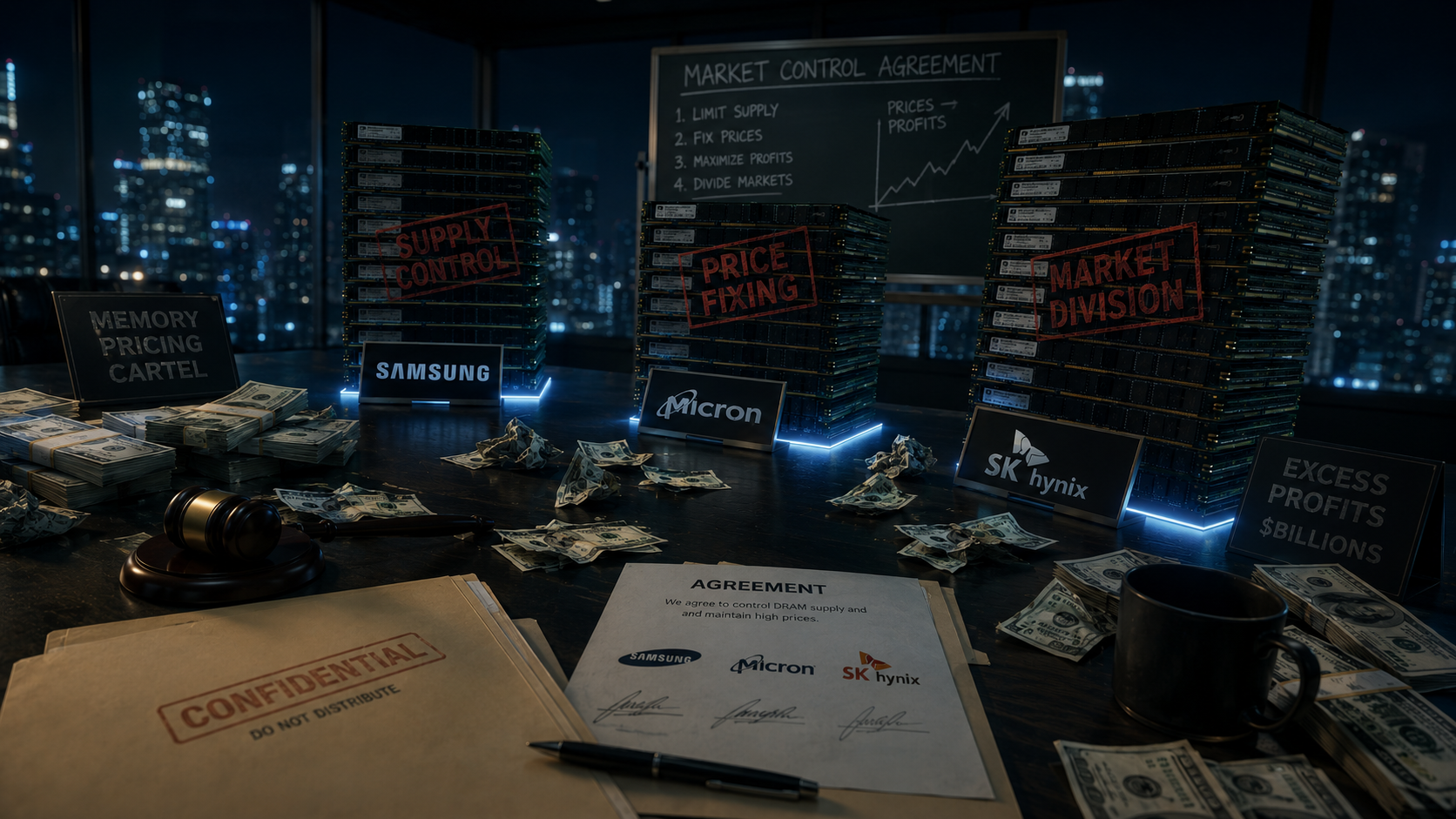
And the explanation these companies have been giving? AI. The AI datacenter boom is eating all the memory. HBM chips for Nvidia GPUs are in crazy demand. There is just not enough wafer capacity to go around. That is basically the story Samsung, Micron, and SK Hynix have been telling, and to be fair, a big chunk of it is actually true. But the lawsuit is asking whether they saw an opportunity and quietly made sure the shortage was worse than it had to be.
What makes this really interesting is that Samsung and SK Hynix have literally pled guilty to DRAM price fixing before. Not just accusations. Actual guilty pleas, with fines and prison time. We will get to that part.
How We Got Here
The short version is this. AI chips like Nvidia’s H100 and the newer Blackwell GPUs need a special type of memory called HBM, which stands for High Bandwidth Memory. It is stacked memory, built in layers, and it gives GPUs the bandwidth they need to run big AI models. The problem is, making one bit of HBM takes roughly three times the wafer capacity that making one bit of regular DDR5 takes. So every HBM chip that comes out of a fab is basically three regular RAM chips that didn’t.
Samsung, SK Hynix, and Micron all shifted their production hard toward HBM starting around 2023–2024. The demand from Nvidia, Microsoft, Google, Amazon, all locking in multi-year contracts, was just too profitable to ignore. A single HBM3E module sells for roughly $60 to $100, while a comparable amount of regular DDR5 sells for $5 to $10. If you are running a fab, that math is pretty clear.
So the move to HBM makes sense as a business decision. But the lawsuit’s argument is more specific than that. The plaintiffs say the companies didn’t just shift to HBM because AI companies were paying more. They say Samsung, Micron, and SK Hynix also coordinated to wind down DDR3 and DDR4 production much faster and deeper than the market needed. The complaint says they used the HBM shift as cover to cut older memory supply while prices were already going up.
And honestly the timing does look a bit off. Micron actually shut down its consumer Crucial brand in late 2025 to focus on AI memory. Crucial was the consumer RAM brand they had been running for decades. They killed it at the exact moment consumer RAM prices were at their highest, which the lawsuit points to as unusual. You don’t normally exit a market when prices are at a record high, unless maybe you are already getting much better prices somewhere else. I tried to find a statement from Micron on this. They denied the claims and said they will fight it in court. Samsung and SK Hynix have not said much publicly yet.
What Actually Happened to Your RAM Budget
Let me give you a concrete idea of what this looks like if you are trying to buy hardware. A 64GB DDR5 kit that cost around $195 in 2025 reportedly reached $788 in some markets at the worst of the spike. That is roughly a 300% jump on one product. DDR4, which is the older standard most servers and mid-range PCs still use, reportedly went up 1,360% since April 2025. I honestly do not know what to do with that number except stare at it.
Industry reports from April 2026 show price increases of 15% to 60% depending on what specific component you are buying. DDR5, DDR4, SSDs, NVMe drives, all going up. The variation itself tells you something. Products that compete most directly with AI memory for the same wafer capacity got hit hardest.
And it is not staying in the PC parts space. Apple raised prices on several Macs and iPads earlier in 2026 and pointed directly at memory costs. Samsung, SK Hynix, and Micron supply memory across Apple’s whole hardware lineup, so this dispute is not some distant industry thing, it is already in your phone and your laptop. Dell was reportedly planning price hikes that could add hundreds of dollars to laptop costs. Lenovo said this is the “new normal” through 2030. If you are a small business buying even five or ten machines a year, that is a big problem.
They Did This Before, in the Early 2000s
Here is the part the companies would probably prefer you did not look up.
Back in 2002, Dell and Gateway complained to the US Department of Justice that memory prices were too high and eating into their margins. The DOJ opened an investigation. What they found was an international price-fixing cartel that had been running since 1998. Five manufacturers ended up pleading guilty: Hynix, Infineon, Micron, Samsung, and Elpida. All of them.
Samsung paid a $300 million criminal fine. Hynix paid $185 million. Infineon paid $160 million. Samsung’s fine was the second largest criminal antitrust fine in US history at that time. Multiple Samsung executives got prison time, from seven to eight months each, plus $250,000 personal fines. One Samsung DRAM senior manager did his eight months and then, less than ten years later, became President of Samsung Europe. I do not know whether to find that funny or depressing.
Micron actually avoided a fine completely. They were the ones who reported the conspiracy to the DOJ and cooperated with prosecutors. So Micron was in on the original cartel, ratted on the others, and walked away free. That is the same Micron that is now one of the three defendants in the new lawsuit.
So this is not a theoretical concern. Samsung and SK Hynix have actual criminal convictions for doing basically the same thing they are now accused of doing again. The new lawsuit cites that history directly.
There was also a similar lawsuit in 2018 when DRAM prices nearly tripled between 2016 and 2017. That one got dismissed. The court said the plaintiffs could not prove there was an actual agreement, not just similar behavior by companies that happened to make the same calls. That is the same hurdle the current lawsuit has to clear.
The Legal Problem Here
This is the part I find most intresting about this whole situation.
US antitrust law does not say companies cannot charge high prices. It says they cannot agree with competitors to fix prices. The tricky thing is that when you have three companies controlling 90% of a market, they can make nearly identical decisions without ever talking to each other. Economists call this “conscious parallelism.” Company A sees that HBM is more profitable. Company B sees the same numbers. Company C does too. All three shift at the same time. Prices go up. No phone calls needed, no emails, no secret meetings.
The lawsuit turns on whether the three companies coordinated those production decisions or just all reached the same conclusion independently. Antitrust law only goes after actual agreements between competitors, not similar business decisions driven by the same market incentives.
So the plaintiffs need to find something beyond “they all did the same thing at the same time.” That is where discovery could matter a lot. If internal emails or documents show any communication between executives at these companies about production targets, that changes things a lot. But if the documents just show three separate companies all looking at the same market data and making the same call, the defense has a strong case.
The defendants will probably argue that this is just a normal business response to demand that nobody could have predicted at this scale. They also have new fabs to point to, SK Hynix has one opening in South Korea in 2027, Micron has one in Idaho around the same time. Building more capacity is not the behavior of companies trying to keep supply artificially low, at least that is how they will frame it.
That is not a crazy argument actually. The AI demand really did come faster than anyone expected. But the Crucial shutdown still bugs me.
If the Lawsuit Actually Wins
Realistically this is a long shot. The 2018 case with basically the same structure got thrown out. But let’s say discovery turns up something useful.
Best case for consumers: the court certifies the class, the case goes to trial, the jury finds collusion under the Sherman Act. That could mean treble damages, which is three times the actual amount of overcharges. On a 700% price run affecting millions of consumers and businesses, that would be a very large number. It could also bring in the DOJ for a separate criminal investigation like 2002. If executives start looking at prison time again, things tend to change quickly.
There could also be regulatory pressure to make sure these companies maintain some minimum level of consumer DRAM production rather than sending everything to hyperscaler contracts. The Korean government has already started monitoring prices. South Korea announced a $520 billion semiconductor investment plan with Samsung and SK Hynix, but there is also pressure at home to not let consumer markets get completely starved.
Worst case is more or less what we are living through now. The case drags on for years, gets dismissed on conscious parallelism grounds like 2018, and we just wait until 2027 or 2028 for new fab capacity to help. Investment bank Jefferies is forecasting a 40–50% rise in memory prices in Q3 2026 compared to this quarter, and another 30–40% in Q4. For 2027 they expect another year-over-year increase of around 40–45%, with prices only maybe starting to calm down in 2028.
So even in the scenario where there is zero collusion and this is just pure market forces, it is not getting better soon.
One Other Angle Nobody Talks About
China’s CXMT has been quietly building DDR4 and DDR5 capacity. They do not have HBM yet and US export restrictions cut them off from the most advanced equipment. But CXMT briefly flooded the market with cheap DDR4 in 2024 before pulling back under government direction. If China decides it wants to use memory pricing as some kind of trade pressure tool, they are getting more ability to do that. It would not fix the HBM shortage at all, but regular consumer RAM could see some pressure from that side.
That is speculative though. I honestly do not know what CXMT’s real production numbers look like or what they have been told to prioritize.
My Opinion on whole Situation
I think the truth sits somewhere between “pure cartel” and “pure market forces,” and I lean more toward thinking there was at least some level of coordination that made all three companies feel comfortable cutting consumer supply faster than any one of them would have done on their own.
The thing about oligopolies is they do not need to literally call each other. When you have been in the same industry for 30 years, competed at the same conferences, read each other’s quarterly reports, and watched what happened to the executives before you who did get caught, you develop a feel for what everyone else is going to do. You can coordinate without coordinating. That probably does not meet the legal standard for a Sherman Act violation, but it produces the exact same result for someone trying to buy a laptop.
So the lawsuit might not succeed even if the prices are, in some meaningful sense, partly the result of companies reading each other’s moves. The law is narrower than the actual market reality.
But the fact that this case was filed, that Samsung and SK Hynix have guilty pleas on their record, and that prices are up 700% over four years, means regulators on both sides of the Pacific are going to be watching closely for a while. That pressure alone might push some behavior in the right direction.
For anyone buying hardware right now, prices are bad. The used DDR4 market is more reasonable than retail. Waiting until late 2027 will probably look like the right call financially, though I know that is not an option for everyone.