A few years ago, nobody seriously compared a MacBook to an NVIDIA GPU for running artificial intelligence. NVIDIA owned the conversation completely. Then Apple’s unified memory architecture quietly changed the math, and by 2026, “Mac or GPU?” has become one of the most argued questions in local AI communities, with threads on Hacker News and Reddit regularly stretching past 500 comments.
The debate isn’t really about brand loyalty, even though it sometimes looks that way online. It’s about two fundamentally different engineering philosophies colliding at the exact moment regular developers, researchers, and hobbyists started wanting to run large language models on their own desks instead of renting cloud GPUs. One side bets on massive shared memory. The other bets on raw bandwidth and a fifteen-year software head start. Both bets are paying off, just in different rooms.
This piece breaks down where each platform actually wins, where the marketing oversells the reality, and what the numbers say heading into the second half of 2026.
Why This Debate Exploded in the First Place
Local AI used to be a niche hobby. Running a large language model meant either paying for cloud API access or owning a rack of NVIDIA cards that cost more than a car. That changed once open-weight models like Llama, Qwen, and Mistral became genuinely good, and once Apple’s M-series chips proved capable of running them without melting a laptop.
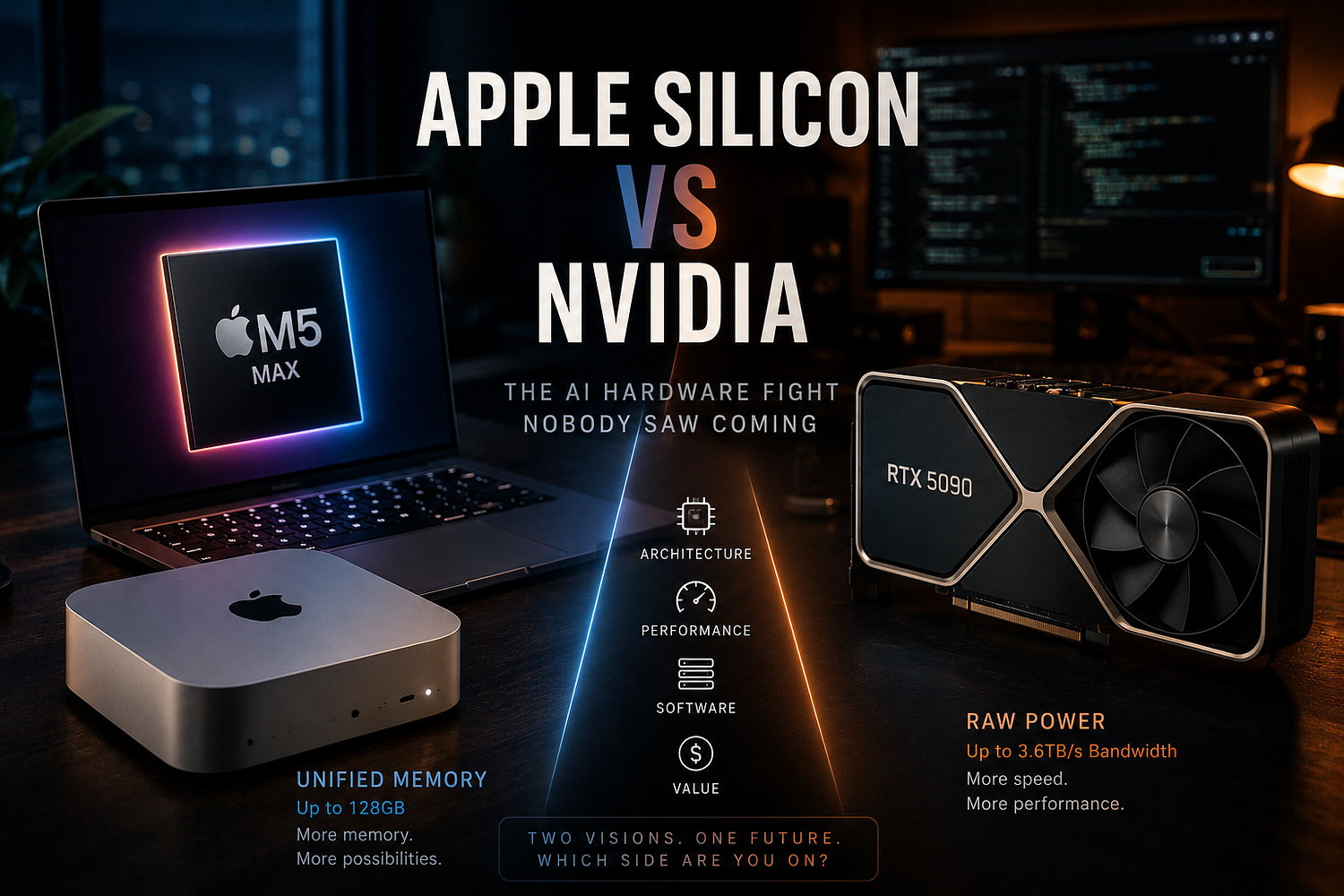
The core disagreement comes down to one architectural decision: how memory is built. NVIDIA GPUs use dedicated VRAM — fast, but capped. A consumer RTX 4090 tops out at 24GB. Apple Silicon uses unified memory, where the CPU, GPU, and neural engine all share one large pool, with configurations now reaching 128GB on the M5 Max and historically up to 192GB on the M3 Ultra.
That single difference explains almost the entire argument. Everything else — price, power draw, software maturity — flows from it.
The Memory Capacity Argument: Apple’s Strongest Card
Large language models need to fit entirely in memory to run at reasonable speed. A 70-billion-parameter model at 4-bit quantization needs roughly 40GB of memory just to load, before accounting for context window overhead. An RTX 4090, sitting at 24GB of VRAM, simply cannot load it. Not slowly — not at all, unless layers get offloaded to system RAM, which tanks performance by a factor of 10 to 50 times.
A Mac with 64GB or 128GB of unified memory loads that same 70B model without breaking a sweat. This is why Apple Silicon has become the default recommendation for anyone who wants to run genuinely large open-weight models on consumer hardware, without assembling a multi-GPU rig.
There’s a real cost trade-off buried here too. A Mac Studio with 128GB unified memory runs somewhere in the $3,000–4,000 range depending on configuration. Hitting equivalent capacity on the NVIDIA side means either a data center card like the H100, or stacking multiple RTX 4090s in tensor parallel — a setup that easily clears $6,000 once you add the motherboard, power supply, and cooling needed to keep two or three 450-watt cards from cooking themselves.
Power consumption tells a similar story. The M5 Max draws roughly 60 to 90 watts under sustained inference load. A comparable NVIDIA workstation running two or three GPUs draws 400 to 1,200 watts and sounds, as more than one reviewer has put it, like a small server rack. For anyone running a machine for hours at a time in a home office, that’s not a footnote — it’s the difference between a quiet desk and a machine you can hear from the next room.
The Bandwidth Argument: NVIDIA’s Strongest Card
Memory capacity wins headlines, but it isn’t the only number that matters. Token generation speed is bound by memory bandwidth, not just how much memory exists — and this is where NVIDIA pulls far ahead.
The numbers are stark. The M5 Max delivers 614 GB/s of memory bandwidth in its top configuration. A single RTX 5090 delivers 1,792 GB/s — nearly three times as much. Put two RTX 5090 cards together and combined bandwidth reaches 3,584 GB/s, more than four times what even the M3 Ultra, Apple’s highest-bandwidth desktop chip, can offer.
That bandwidth gap translates directly into tokens per second on models that fit comfortably within NVIDIA’s VRAM limits. On a 7B or 8B model — small enough to load on either platform without issue — the RTX 4090 consistently outpaces the M4 Max. Benchmarks circulating through local AI communities put the gap at roughly 20 to 30 percent in NVIDIA’s favor for these smaller models. Apple wins the capacity game; NVIDIA wins the speed game, at least for anything that fits inside a single card’s VRAM.
Compute throughput follows the same pattern. The RTX 5090 delivers roughly 209 TFLOPS of FP16 tensor performance through dedicated Tensor Cores built specifically for matrix math. Apple doesn’t publish a directly comparable figure for its Neural Engine, and there’s a deeper reason for that: Apple’s current LLM tools — Ollama, llama.cpp, MLX — actually run on the GPU cores, not the Neural Engine, because the Neural Engine has no public instruction set that developers can program against directly. The Neural Engine handles Apple Intelligence features quietly in the background, but for the kind of token generation people care about, it’s mostly sitting idle.
The Software Question Nobody Likes Talking About
Hardware specs are only half the comparison, and arguably the easier half. The harder, messier half is software — and this is where NVIDIA’s fifteen-year head start still shows.
CUDA isn’t just a programming framework. It’s an entire ecosystem: cuDNN, cuBLAS, TensorRT, NCCL, Triton, and a mountain of institutional knowledge built up across over a decade of machine learning research defaulting to NVIDIA hardware. vLLM, widely considered the gold standard for production-grade LLM serving, was built CUDA-native from day one. Apple Silicon support for vLLM only arrived through the vllm-metal project in early 2026, and even now it’s limited — text-only inference, no vision model support, none of the advanced request scheduling that production teams rely on.
Apple’s answer is MLX, its own machine learning framework built specifically for Apple Silicon. It’s genuinely good for what it does. MLX delivers 40 to 80 percent higher throughput than Ollama or llama.cpp on the same Mac hardware, and Apple’s own benchmarks show real generational gains — FLUX-dev image generation running close to four times faster on the M5 compared to the M4, and prompt processing on a 70B model dropping from roughly 30–40 seconds down to 8–10 seconds for a 16K-token prompt. Those are not small improvements.
But MLX is still young. PyTorch’s Metal Performance Shaders backend has improved a lot but remains slower than MLX for most inference workloads, and it doesn’t yet take full advantage of the M5’s new Neural Accelerators the way MLX does. There’s no equivalent to FlashAttention running natively on Metal — arguably the single most impactful optimization for transformer inference on NVIDIA hardware, and one Apple’s stack simply doesn’t have yet. CoreML, Apple’s other ML framework, behaves something like a black box: developers can’t see exactly how it routes operations between the Neural Engine, GPU, and CPU, which makes systematic optimization closer to trial-and-error than the deep visibility NVIDIA’s Nsight and TensorRT tooling provide.
There’s also a practical, day-to-day difference that matters more than spec sheets suggest. Setting up a model on a Mac is close to instant — install Ollama, pull a model, start chatting, often within ten minutes of unboxing. NVIDIA setups, by contrast, frequently involve CUDA driver versions, Python environment conflicts, and figuring out why a particular quantization library doesn’t support a specific GPU architecture. Developers switching from Mac to NVIDIA workflows often underestimate how much time goes into environment management rather than actual model work. Budgeting a few hours for initial setup, with the occasional dependency conflict on Linux, is realistic rather than pessimistic.
Scaling: Where the Comparison Breaks Down Entirely
For training large models or serving many concurrent users, the comparison stops being close. Apple Silicon is fundamentally single-node — there’s no way to link two Mac Studios together the way NVIDIA systems scale across multiple cards using NVLink and InfiniBand. For any model exceeding the unified memory ceiling of a single Mac, there is currently no Apple-native path forward.
NVIDIA’s data center hardware operates in an entirely different category. An H100 delivers 3,350 GB/s of bandwidth via HBM3 memory — more than five times the M5 Max’s 614 GB/s — and NVIDIA’s upcoming NVLink 6.0, announced for the Vera Rubin platform arriving later in 2026, pushes interconnect speeds to 3.6 TB/s for multi-GPU clusters. That’s data-center territory, well outside what either platform offers consumer buyers, but it underlines a structural truth: NVIDIA scales horizontally across many chips, while Apple Silicon does not.
This is also exactly why the comparison gets contentious online. People arguing about “Apple Silicon vs NVIDIA” are frequently talking about two different use cases without realizing it — one person means solo inference on a laptop, the other means serving a production application to thousands of users. Both are right about their own situation and wrong to assume it generalizes.
What This Actually Means for Different Buyers
For someone building a private coding assistant, running a local document analysis pipeline, or experimenting with open-weight models without sending data to a cloud API, Apple Silicon in 2026 remains close to friction-free. Tools like Ollama, LM Studio, and Jan all ship with polished macOS interfaces, and unified memory means a Mac Mini M5 Pro starting around $800 — or roughly $1,200 with 64GB — can comfortably run 13B to 33B parameter models that would require expensive multi-GPU setups on the NVIDIA side.
For someone who needs maximum interactive speed on smaller models, multi-GPU scaling, or a CUDA-native fine-tuning pipeline, NVIDIA remains the more capable option, particularly for anything resembling production serving or model training rather than personal inference.
The NVIDIA DGX Spark, NVIDIA’s own answer to the “AI workstation on your desk” category that Apple Silicon effectively pioneered, landed in early 2026 at a launch price of $3,999, later raised to $4,699 due to memory supply constraints. It offers 128GB of unified memory with full CUDA compatibility — essentially an attempt to borrow Apple’s memory-capacity advantage while keeping NVIDIA’s software ecosystem intact. Early adoption has been mixed, with some users noting that interactive latency on a Mac still feels meaningfully different from cloud inference through ChatGPT or Claude, regardless of which local hardware is doing the work — a gap that matters more for live chat use cases than for overnight batch processing or agentic workflows running unattended.
The Numbers People Actually Cite in These Arguments
Anyone who has spent time in local AI forums has seen the same benchmark figures repeated until they become shorthand for an entire position. It’s worth laying a few of them out directly, since most online debates compress them into oversimplified soundbites.
On the Apple side, the M5 Max generates roughly 230 tokens per second on an 8B model and around 28 tokens per second on a 70B model at 4-bit quantization through MLX — fast enough for interactive chat on the smaller model, and still genuinely usable for the larger one. Push further to a 122B mixture-of-experts model and throughput drops to around 15 tokens per second, which suits batch processing and document analysis better than live conversation. One widely shared data point from mid-2026 testing put prefix processing on a 64GB M5 at roughly 1,500 tokens per second, with decode speeds around 45 tokens per second on newer model architectures at extended context lengths — numbers fast enough to surprise people running them for the first time, even if they still fall short of cloud-frontier speed for demanding agentic coding tasks.
On the NVIDIA side, the comparison shifts depending entirely on whether the model fits in VRAM. For anything under roughly 13B parameters at reasonable quantization, an RTX 4090 simply outruns Apple Silicon, often by a comfortable margin. The RTX 5090 widens that gap further for users willing to pay its premium. But the moment a model crosses the 24GB VRAM ceiling, the comparison stops being about speed and becomes about whether the model runs at all — and that’s the exact point where Apple Silicon’s unified memory takes over the conversation.
Binning matters more than most buying guides mention. Apple sells multiple variants of the same chip name, and the difference is not trivial. A base M5 Max with a 32-core GPU delivers around 460 GB/s of bandwidth, while the top-bin 40-core variant reaches 614 GB/s — a gap of roughly 25 percent that changes real-world token generation speed, even though both chips share the same marketing name on Apple’s website. Anyone comparing benchmark numbers from different reviews without checking which bin was tested is, in a real sense, comparing two different products.
A Practical Way to Think About Which Side Wins
Most “Apple Silicon vs NVIDIA” arguments online go in circles because the two sides are quietly answering different questions. Context length is one example that rarely gets mentioned directly but shapes everything else. A 64k context window isn’t free on either platform — it consumes additional memory during inference, and on Apple Silicon specifically, pushing context higher while running a large model can be the difference between smooth generation and the system swapping to disk, which tanks performance immediately and noticeably.
A reasonable way to cut through the noise: buy a Mac for unified memory capacity, quiet operation, and a software stack that works the moment you open the laptop, and accept that interactive latency will sometimes feel slower than what cloud-based assistants deliver. Buy NVIDIA hardware for raw bandwidth, CUDA compatibility, and interactive speed on models that comfortably fit inside VRAM, and accept the VRAM ceiling along with meaningfully higher power draw and noise. For anyone whose actual goal is frontier-level agentic coding assistance rather than private, offline inference, neither local option currently matches what cloud-hosted frontier models deliver — which is a separate decision from the local hardware question entirely, even though the two conversations get mixed together constantly.
The Trade-Off That Isn’t Going Away
Looking ahead, both platforms are expected to push their respective strengths further rather than converge. Apple’s M5 Ultra, expected in late 2026 based on the company’s established pattern of doubling its Max-tier specifications for Ultra chips, would likely push unified memory toward 256GB and bandwidth toward 1,200 GB/s — substantial, but still short of a single RTX 5090’s 1,792 GB/s. NVIDIA’s next consumer GPU generation will likely push past the current 24GB VRAM ceiling that has defined the RTX 4090 and 5090 generation, narrowing Apple’s capacity advantage somewhat without eliminating it.
AMD’s ROCm ecosystem is also worth watching as a genuine third option. Support in vLLM and llama.cpp has matured enough that the Radeon RX 7900 XTX, with 24GB of VRAM, has become a credible alternative for people who want NVIDIA-style throughput without NVIDIA pricing — though it still trails both Apple and NVIDIA in mainstream adoption and tooling depth.
The underlying architectural trade-off — unified memory capacity against discrete bandwidth and compute — is structural, not a temporary gap that next year’s chip closes. Apple chose to make memory abundant and shared. NVIDIA chose to make memory fast and purpose-built. Neither company is likely to abandon the strategy that built its current market position, which means buyers will keep choosing based on which side of that trade-off matches their actual workload rather than waiting for one platform to simply outgrow the other.