Two big model launches in the same month. That’s basically what happened in July 2026, and if you’ve been trying to keep up on Twitter or Reddit you probably have five tabs open right now, all half read.
OpenAI shipped GPT 5.6 Sol on July 9. Anthropic followed with Claude Opus 5 on July 24, just two weeks later. Both companies are calling their model the smart one for coding and agent work, both dropped a wall of benchmark charts, and both are pricing things almost the same. So which one do you actually need? I spent a good chunk of my time reading system cards, comparing numbers from three different benchmark sites, and honestly still went back and forth twice while writing this.
Let’s get into it properly.
The GPT 5.6 Family, and Why Sol Is Only One Part of It
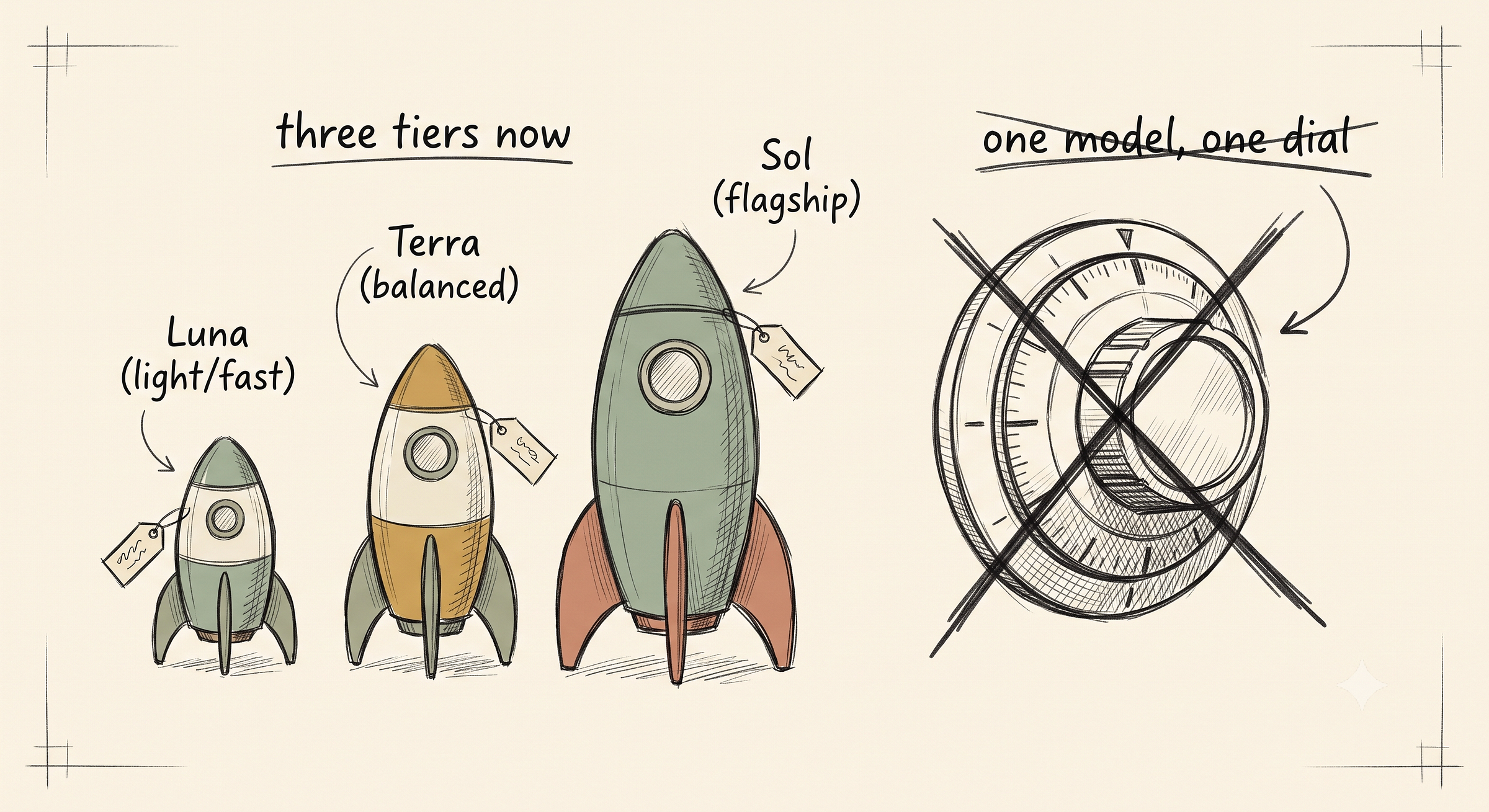
OpenAI didn’t just release one model this time. GPT 5.6 comes as three tiers: Luna, Terra, and Sol, ranked from lightest to heaviest. This is a real change in how OpenAI packages things. Earlier generations gave you one base model with a reasoning effort dial you could turn up or down. Now it’s three separate models built for different jobs. OpenAI calls it moving from “one model with a dial” to picking a tier.
Sol is the flagship. It’s meant for complex reasoning, long agent tasks, coding, and OpenAI is also pushing it hard as a cybersecurity tool, calling it their strongest model yet for that specific use. Terra sits in the middle, a balance of speed and capability for regular daily work. Luna is the cheap fast option, and OpenAI says it nearly matches the peak performance of the older GPT 5.5 at less than half the estimated cost. If your team is mostly doing quick chat-style tasks, Luna is probably enough and you’re wasting money on Sol.
Here’s the part that got weird though. GPT 5.6 didn’t launch to everyone at once. On June 26, OpenAI put out a limited preview, only to a small group of vetted partners, and it said this was at the request of the US government. The company was fairly blunt about not liking this arrangement. It said publicly that this kind of government access gatekeeping should not become the normal way models get released, and that it keeps useful tools away from developers, enterprises, and cyber defenders who need them. Still, OpenAI framed the limited rollout as the fastest path toward the wider release, which finally happened on July 9.
TBH, this whole episode says something bigger about where AI regulation is heading in the US right now, and it’s not just an OpenAI thing. Anthropic went through something similar with Fable 5 and Mythos 5 just a few weeks earlier, when access got suspended for export control reasons in mid June and only came back on July 1. Two different labs, two different models, same general shape of story. That’s probably not a coincidence.
What Sol Is Actually Good At
On the numbers OpenAI has published, Sol does well on agentic browsing. It hit 92.2% on BrowseComp, which is meant to test how well a model can go do multi step research tasks on the open web. It also scored 62.6% on OSWorld 2.0, a computer use benchmark, and OpenAI says that beats Opus 4.8 while using 85% fewer output tokens. That token efficiency claim keeps coming up. Sam Altman said Sol is 54% more token efficient for coding tasks compared to the previous generation, which if true, is a real cost saving for anyone running agents at scale, not just a marketing number.
On Terminal Bench 2.1, a coding and terminal task benchmark, the top Sol Ultra variant scored 91.9%, and the base Sol model got 88.8%. For context, Claude Mythos 5 and the older GPT 5.5 both landed at 88.0% on the same test. So Sol edges ahead here, but not by a mile.
The cybersecurity angle deserves its own paragraph honestly, because OpenAI leaned into it hard. On something called ExploitBench, Sol reportedly matched Mythos Preview’s performance while using about a third of the output tokens. In tests against real browser codebases, Chromium and Firefox specifically, Sol found bugs and some of the building blocks you’d need for an exploit, but it did not put together a full working exploit chain on its own. OpenAI says it stayed under its own “Cyber Critical” threshold in its safety framework, and the company says it spent over 700,000 GPU hours just on automated red teaming to hunt for jailbreaks that work across lots of different prompts.
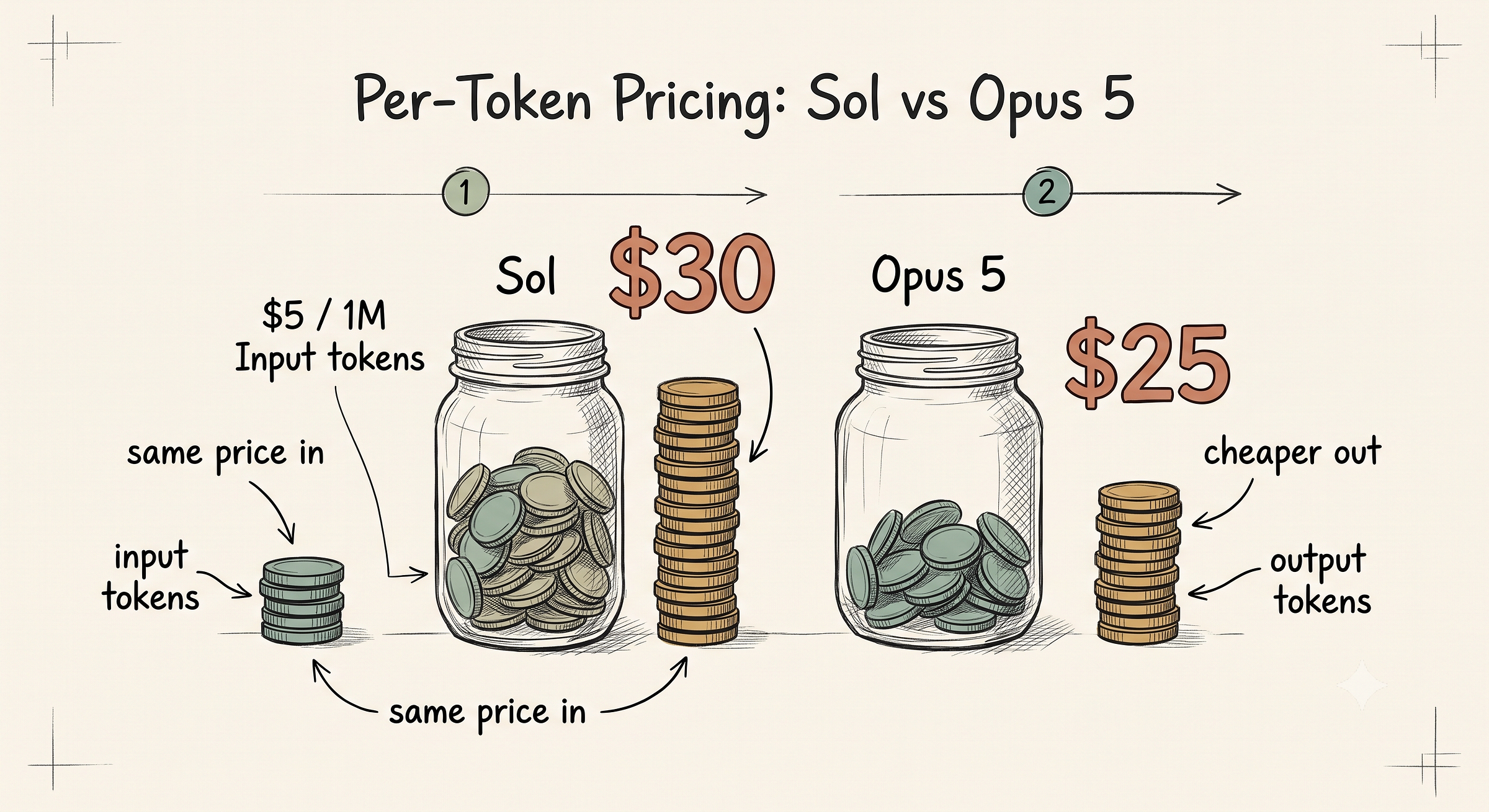
Pricing for Sol is $5 per million input tokens and $30 per million output tokens. Terra and Luna are cheaper, and there’s apparently a Cerebras hardware launch planned for later in July too, which should mean faster inference for some users.
Claude Opus 5: Anthropic’s Play on Price, Not Just Power
Now to Anthropic’s side. Claude Opus 5 landed on July 24, and honestly the framing is different from what Anthropic has done in past launches. Usually the pitch is “our new model beats the other lab’s model.” This time the pitch was more inward facing: Opus 5 gets close to Anthropic’s own top tier model, Claude Fable 5, while costing half as much to run.
That’s a meaningful shift, if you think about it for a second. Anthropic is basically telling its own paying customers, hey, you probably don’t need the most expensive model anymore, this one gets you 90% of the way there for half the price. Not every company would say that about its own product line.
Pricing on Opus 5 is $5 per million input tokens and $25 per million output tokens. Same as Opus 4.8, so there’s no price hike at all despite the capability jump, which is honestly the more surprising detail buried in all this. It’s live right now across Claude.ai, the Claude API, Claude Code, and Claude Cowork. It’s also the new default model on Claude Max and the strongest model available on Claude Pro plans.
A few practical additions came with it. There’s a low, medium, high effort toggle so you can decide per request whether you want speed or maximum reasoning depth. There’s also a Fast mode that runs about 2.5 times quicker than the default, though it costs double the base price, so that’s really for latency sensitive work, not everyday use. On the API side, developers get two new features: mid conversation tool changes that let you swap available tools without breaking the prompt cache (that alone will save a decent chunk of money for anyone running long agent sessions), and automatic fallbacks that reroute flagged requests to a different model instead of just blocking them outright.
One more detail that matters if your company cares about data handling: unlike Fable 5, Opus 5 is not subject to the 30 day data retention policy. Small thing, but for legal and privacy teams doing vendor reviews, it’s the kind of line item that actually gets read.
The Benchmark Numbers That Made People Pay Attention
Opus 5 more than doubled Opus 4.8’s score on something called Frontier-Bench v0.1, a software engineering evaluation, going from 18.7% to 43.3%. That’s a big jump for one release cycle.
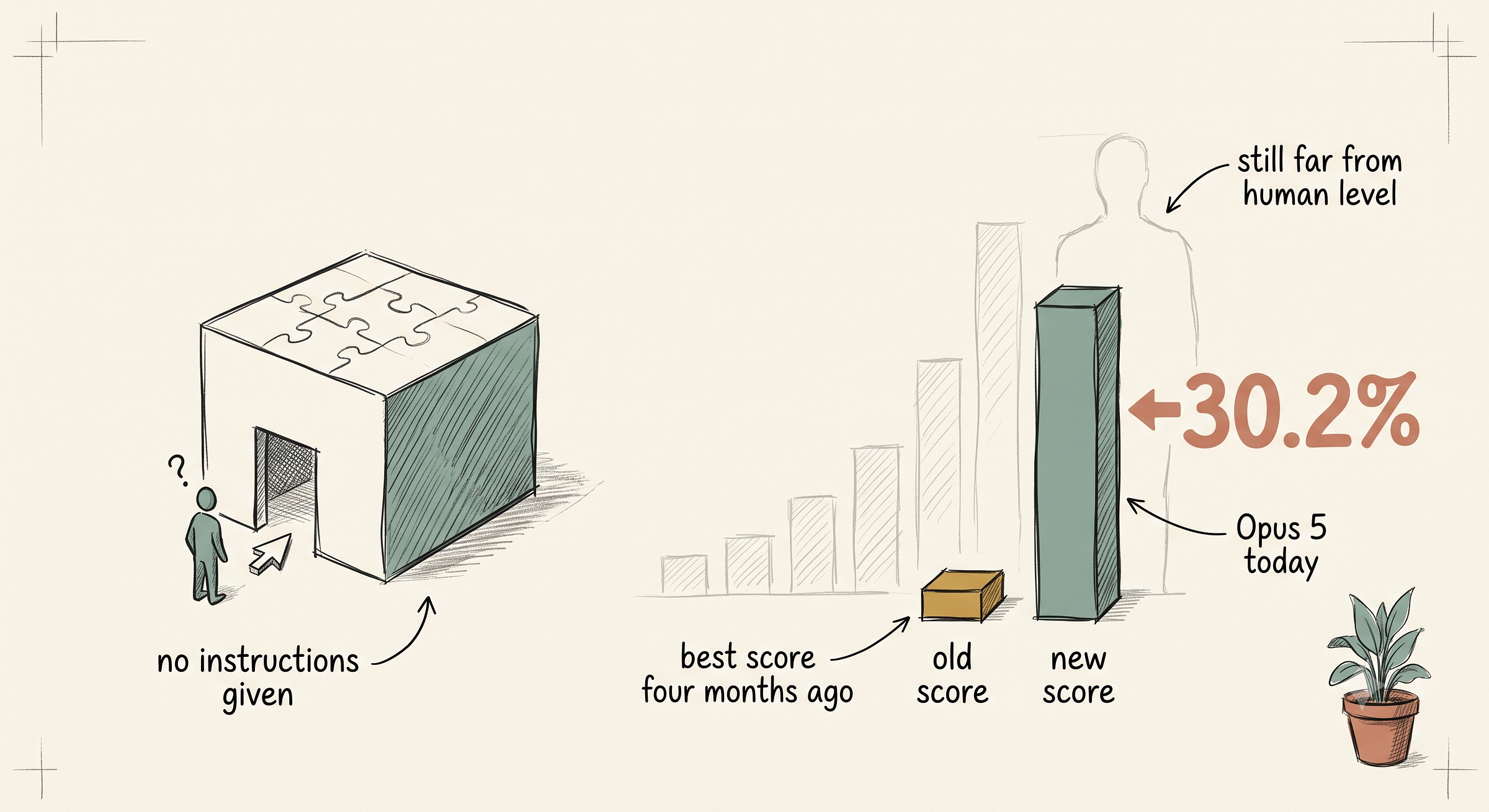
The number that really stopped people scrolling though was ARC-AGI 3. This benchmark, built by François Chollet, doesn’t use static puzzle grids like older versions did. It drops an AI agent into an interactive environment with no instructions and no stated goal, and the agent has to figure out the rules purely through trial and error, then it’s scored against how efficiently a human would have solved the same level. When ARC Prize Foundation released this test back in March 2026, the best model anywhere scored 0.37%. Four months later, Opus 5 hit 30.2%, roughly 20 times what Opus 4.8 managed (1.5%) and about four times GPT 5.6 Sol’s 7.8%. Humans still clear 100% of these environments so it’s far from solved, but going from under 1% to over 30% in one release cycle is the kind of jump that resets what people expect next.
Anthropic also reports gains across every life sciences evaluation it tracks, with the biggest single jump, over 10 percentage points, on organic chemistry tasks like reading molecular structure straight from spectroscopy data. And on its own internal alignment audit, a scale measuring how often a model shows deceptive or misaligned behavior, Opus 5 scored 2.30, the lowest (meaning best) of any recent Claude model, ahead of Opus 4.8, Mythos 5, and Sonnet 5.
Cognition, the company behind the Devin coding agent, ran its own FrontierCode 1.1 leaderboard and found Opus 5 scored 53.4% on mergeability (basically, would a human maintainer actually accept this code change) compared to 47.5% for GPT 5.6 Sol, while costing $4.30 per rollout against Sol’s $6.30. Worth flagging though, Opus ran at medium effort for that test and Sol ran at max, so it’s not a perfectly even comparison. Cognition’s own engineer described Opus 5 as landing close to Fable level performance at roughly half the cost, particularly strong at debugging and figuring out root causes, which lines up with what Anthropic is claiming publicly too.
So Which One Actually Wins?
Depends what you’re doing with it, and I know that’s an annoying answer, but the data genuinely splits by category.
On pure coding work, Opus 5 looks stronger right now. BenchLM’s aggregate leaderboard has Opus 5 ahead 85.88 to 81.46 overall, and the SWE-bench Pro gap is the widest single number in that whole comparison: 79.2% for Opus 5 against 64.6% for Sol. That’s not a small gap.
GPT 5.6 Sol claws it back on knowledge tasks though, averaging 94.6 against Opus 5’s 64.7 on the same leaderboard, with the biggest daylight showing up on a hallucination rate benchmark called AA Omniscience. So if your workload is heavy on factual lookup, research synthesis, and staying accurate over long knowledge heavy tasks, Sol has a real edge there.
On reasoning generally the two are close, Sol at 92.5 average against Opus 5’s 90.4, close enough that it probably won’t decide much on its own. Pricing wise, Sol is $5 input and $30 output. Opus 5 is $5 input and $25 output. Same input cost, and Opus 5 is five dollars cheaper per million output tokens, which adds up fast if you’re doing long form generation or big code diffs.
One honest caveat before you take any of this as gospel. A lot of the numbers floating around online right now are still messy. As of a couple days before Opus 5’s actual launch, some outlets were treating Claude Opus 5 specs as rumored or unconfirmed while GPT 5.6 Sol already had official documentation out. Now that Opus 5 has actually shipped with a proper system card, most of the earlier confusion has cleared up, but if you’re reading older comparison posts from before July 24, take their Opus 5 numbers with a pinch of salt.
What People Are Actually Searching For Right Now
If you’re trying to decide which model to use, here are the specific questions worth answering for yourself, because these are the ones showing up in search consoles and forums this week: is GPT 5.6 available on the free ChatGPT plan(short answer, not really, it’s gradually rolling out to eligible paid plans and Logged out users don’t get it at all), what is the difference between GPT 5.6 Sol, Terra, and Luna, is Claude Opus 5 available on Claude Pro or only Max (it’s the default on Max and the strongest option on Pro), does Claude Opus 5 replace Claude Code’s default model, how much does Claude Opus 5 cost per million tokens compared to GPT 5.6 Sol, why was GPT 5.6 access restricted by the government at launch, and can GPT 5.6 Sol actually write exploits (per OpenAI’s own testing, no, not a full working chain, though it can find bugs and building blocks).
There’s also a decent amount of search volume around whether either model beats Anthropic’s own Fable 5 or Mythos 5,since those two are still technically the highest tier Anthropic offers. Short version: Fable 5 still leads on the hardest, longest running coding tasks (SWE-bench Pro 80.3% versus Sol’s estimated 64.6%), and it can run autonomously for up to 12 hours according to Anthropic’s own claims. Sol wins on price there too though, at half of Fable’s rate.
Where This Leaves Things
If you’re picking between GPT 5.6 Sol and Claude Opus 5 for a coding heavy product, the current data points toward Opus 5, and it’s cheaper on output tokens too. If your use case leans more on factual research, broad knowledge retrieval, or you specifically need the cybersecurity tooling OpenAI has built into Sol, that’s where Sol still has an edge nobody else is really matching yet.
What strikes me more than either model individually is the pace. Four major model releases from Anthropic in under two months, Fable, Mythos, Sonnet, and now Opus 5, plus OpenAI’s own three tier GPT 5.6 rollout in the same window. Neither company seems to be slowing down to let the market catch its breath, and honestly I don’t think either one is going to.
Whatever comes out next month will probably make half of this article outdated anyway, which is sort of the whole point of writing about this space right now.