Whenever I think of business, I think of profit (obvisouly), Which makes me think about What’s the most profitable company. The term profitability doesn't mean it gave 100% profits one year and then gone, or making $2–$3M dollar on $1M investment, But a continuous large scale entity operating on a huge money flow, that too being almost 30–50% profit margins.
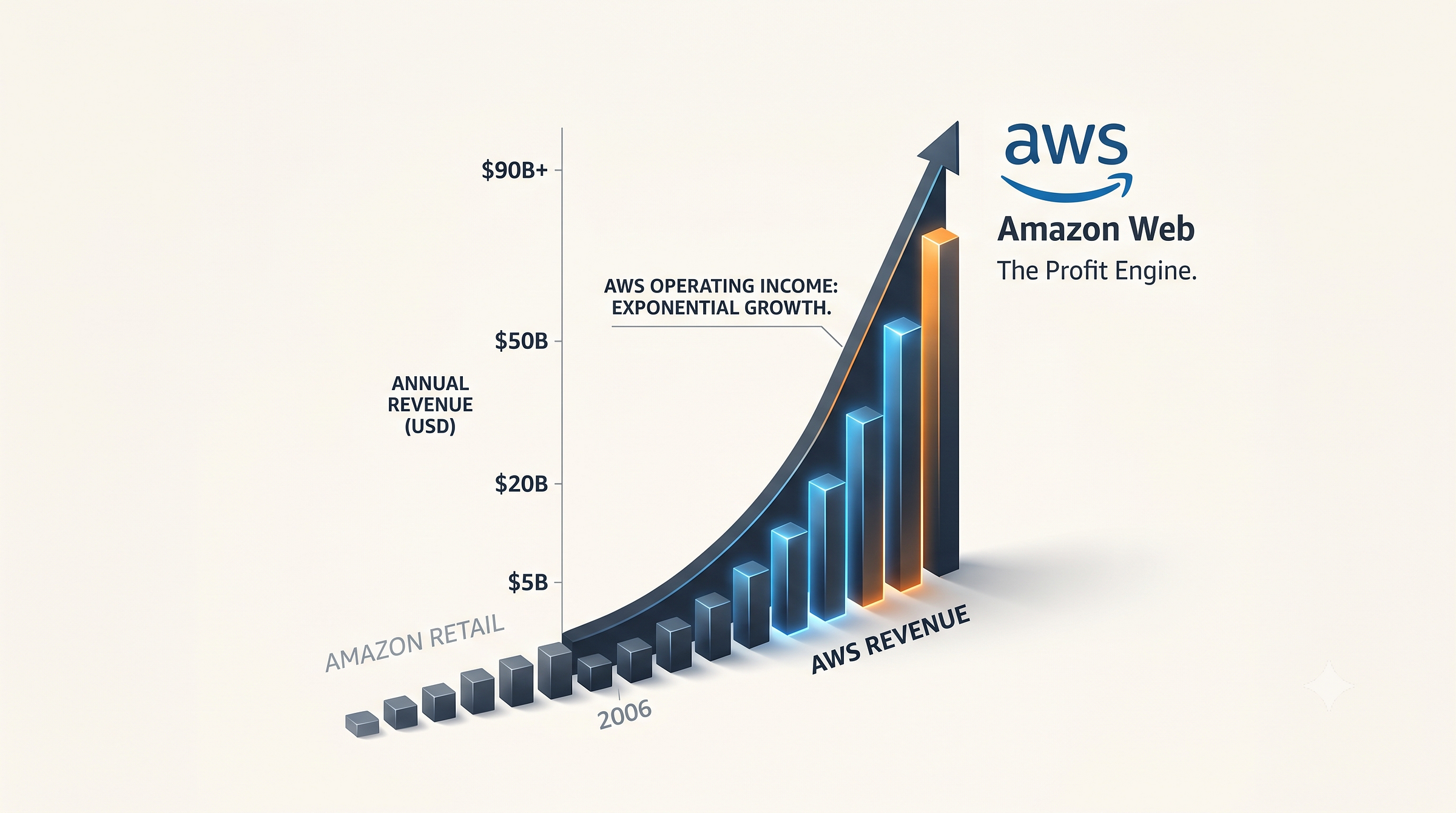
So I went on a adventure on the internet to find some companies like that, If you google the same you can find many known companies like recently Nvidia, Google, Mastercard and some pharmaceutical companies. But one of the intriuiged me. Which is Amazon Web Services.
AWS might not even be in the list, because amazon being the parent company and most of its shine can be overshowded by the margins of its parent company. So lets understand how Amazon build this money making Empire when everyone thought it was a joke and would fail eventually.
It all started because of codebase mess
In 2000’s amazon was not quite big company, it was still struggling with its services and websites. Doing any change in the code would litrally take many days because of the deeply coupled monolithic architectures. We Know working on a monolithic service means adding a small typo fixing or button will require running a whole end-to-end suite which are not even connected to ur change. And hoping nothing breaks because of your change.
Then Bezos and other senior engineers started recommeding and enforcing building small service instead one big block of code, Which is kind of start of microservice architecture. It was not famous around then, but amazon started enforcing this rule accross amazon. Keep in mind that every engineer might know how hard to is convert a monolithic service to a micro service, Many lines of changes, Many technical debts, Many non-used components, Dead code etc etc. This was a very clever tactic which will increase the deployment cycles for amazon in future but comes at a very cost of structuring code.
The came 2 engineers Chris Pinkham and Benjamin Black, Who thought when we are building this infrastructure for our internal use cases, this fully automated pipelines, virtual machines, storage services etc. Why cant we commercial this and sell this to people, They pitched this to Jeff bezos and he liked it. Bezos asked them to work on this idea and see what could be made out of it.
It was a green flag for the engineer, then they moved to cape town in Africa to work on this project, which was intially EC2, They also launched Simple Queue service which was AWS first ever service. But EC2 was a major service which could revolutionise the whole cloud domain.
2006: The Year Nobody Noticed What Actually Happened
They launched Amazon s3 in March and EC2 in August, 2 of the founding services which are even know the most used services in AWS. Pay the hours you use, No need of buying any infracstructure or mainting servers etc. Just clicking few buttons to setup service with much cheaper costs.
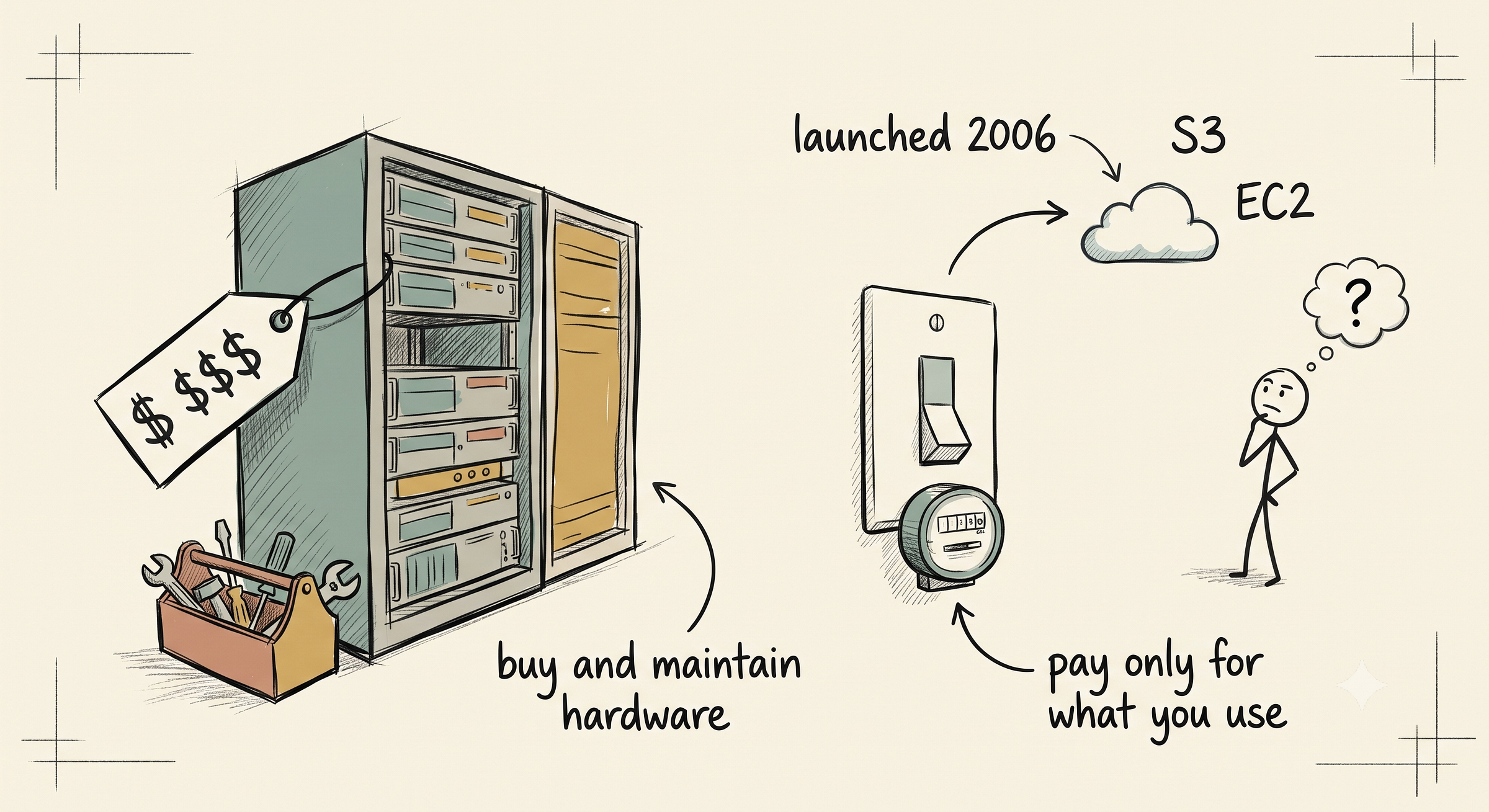
You might think this is kind of normal, like renting compute in 2026 but in 2006 it was a big deal, Not just operations but people in those time still think this was not a manageble business, I mean why would anyone rent a server like tax and pay on the amount of usage. So amazon was cricitized very much during this phase, but it kept going and introducing new services.
Andy Jassy Who was the person controlling whole AWS as CEO, is the one who became CEO for amazon in 2021 after Jeff Bezos. I still think of this question, How a company which started as selling books online then pivoiting to full e-commerce, then building a most profitable cloud service provider. . The answer, which sounds obvious now, is that the technology behind selling books had everything to do with running large scale computing, and running large scale computing was the actual business Amazon had accidentally gotten really good at.
Wall Street was still Not happy with Amazon
Even after releasing many usefull products critics where suspicious about amazon able to make profits from such ventures. Many from wall street joked about amazon entering this market, and it would never survive in that domain. Comparing it to Microsoft or Google which were really outperforming every other company during that era. Bezos listened to everything but amazon still kept on working on AWS.
But things were slowly shifting, everything was moving to cloud, every new startup was trying to reduce costs as much as possible, and cloud is the best option for it. Companies like Dropbox, Netflix, AirBnb, massively used AWS service to minimize their costs, and it seemed like finally the servers and services which amazon is working on half a decade would earn them profits. But the term “cloud” was still confusing to most people outside tech backgrounds.
Many companies started adopting amazon, Which are the ones about to becoming multibillion dollar companies like Dropbox, Netflix, Airbnb, etc its like Amazon collecting Infinity stones but when they are born. Slowly, slowly drop by drop the revenue was increasing.
By 2015, AWS made $7.9 billion in revenue, up 70% from the year before. Thats when it got peoples attention, it was because AWS margins were never public, and seeing this huge margins it would have been talk of the town. So nobody outside the company actually knew how big or profitable it already was. Turns out it was not a distraction. It was quietly becoming the thing propping up the entire company’s profitability.
I even read somewhere, That AWS was earning more profits then the Total profits its parent company Amazon could make, while being a much smaller slice of total revenue. That’s a strange kind of business to run, and it’s still basically true today.
What That company Looks now?
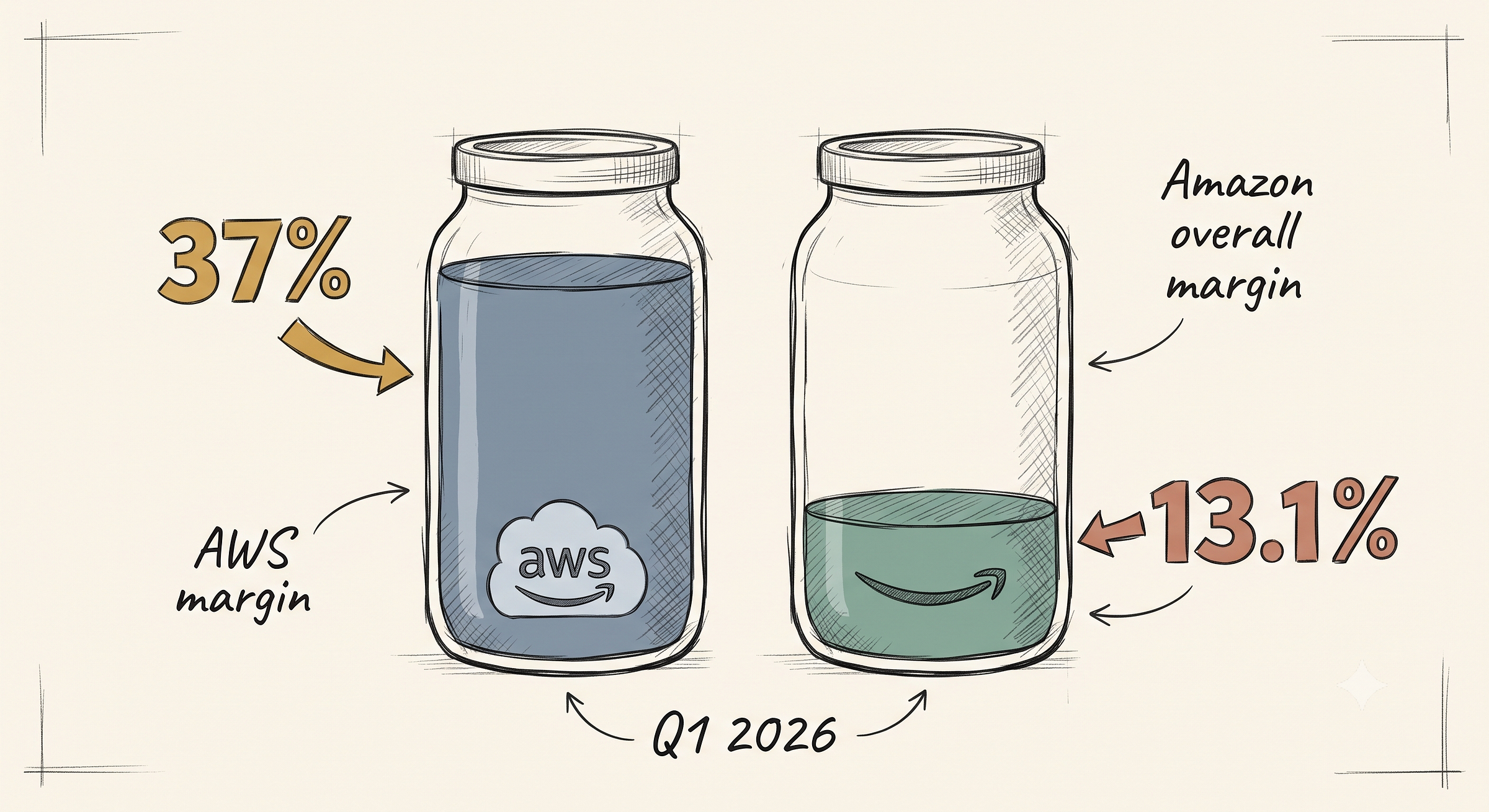
Okay, let’s get to the numbers, because this is where you will understand the scale. In Q1 2026, AWS pulled in $37.6 billion in revenue, up 28% year over year, which Jassy called the fastest growth rate AWS had seen in 15 quarters. Segment operating income was $14.2 billion, at a margin north of 37%. For comparison, Amazon’s overall company wide operating margin that same quarter was 13.1%, which the company itself called its highest ever.
So AWS is roughly a fifth of Amazon’s total revenue but usually accounts for well over half its operating profit. That gap is basically the whole story of why Amazon poured so much money into AWS for two decades even while people raised questions about it.
There’s a backlog number too that’s worth sitting with. Jassy said AWS had over $364 billion in committed backlog by the end of Q1 2026, not even counting the separate Anthropic deal. Trainium, Amazon’s custom AI chip, reportedly has revenue commitments north of $225 billion, and Trainium2 is basically sold out, with Trainium3 (which started shipping earlier this year) nearly fully booked too.
Whether all of that actually pans out as smoothly as the backlog numbers suggest, I genuinely don’t know. Backlogs are commitments, they are not guaranteed, and building out that much AI infrastructure at once is a real bet, not a sure thing. And seeing current cost of building AI infra it quite huge of a deal.
How is the cloud Market growing in 2026?
I heard a number where it tells almost 90–95% of the total infra is cloud. It kind of seems correct, But i still think some of the enterprise networks are onsite infra. And most companies also adopt mutlicloud setup based on the use cases, Like some tasks AWS provides better services and feature and some GCP or Azure might provide. But that’s a statement about enterprise adoption of cloud in general, not about AWS’s specific slice of the pie.
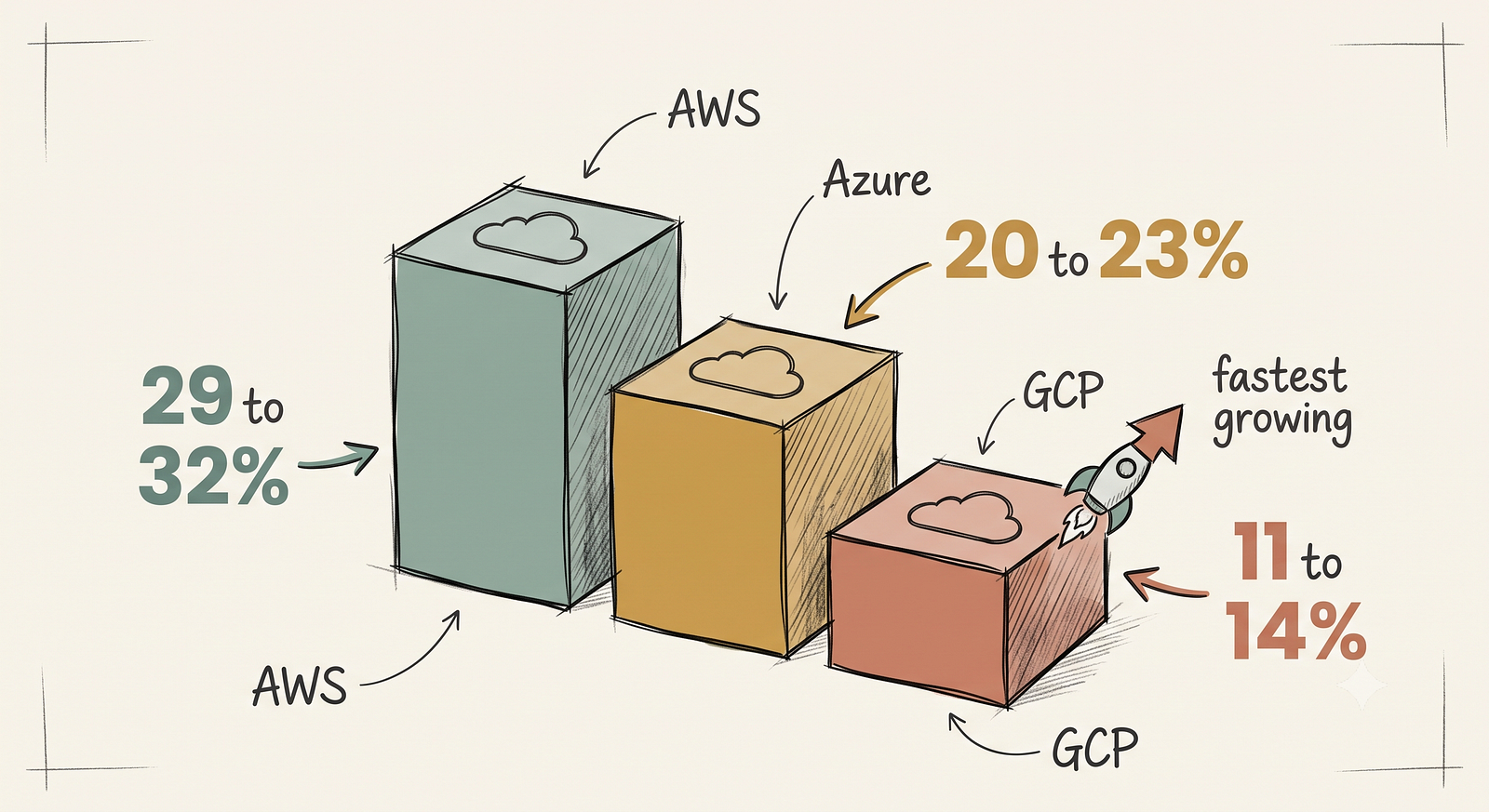
AWS market share in cloud is around 29–32%, ahead of GCP and Azure where Azure beign 20–23% and GCP beign 11–14%. Point to note that GCP is rapidly growing, AWS recording a incease of 30% whereas GCP is increasing at a rate of 50–60% per year. But AWS still the market leader with a good lead, and it would be staying in the position for alteast a decade iguess.
The overall cloud market itself crossed roughly $900 billion in 2026 and Synergy expects it to cross a trillion dollars before the year ends. Gartner puts public cloud spending alone at around $850 billion for 2026, up over 21% from last year. So the pie keeps growing faster than anyone’s slice of it, which is honestly the more important story than who’s winning by a couple of percentage points.
My personal experience with AWS.
When talking about AWS, I also want to point out one incident, which I am 90% sure anyone who used aws should know. I once kept a EC2 in running state after my use. Fortunately i was a having a trigger to email my when the cost was exceeding the budget. But it costed me whole 10$ which was my budget for the month to test services.
I expected for something that was supposed to be “pay only for what you use.” Turns out that principle works great until you forget to turn things off. A lot of people learn AWS billing the same painful way, myself included.
That’s actually part of why AWS became so profitable in the first place, if you think about it. The pricing model rewards scale but also punishes carelessness, and most companies using it at real scale have entire teams whose only job is watching the bill. Amazon isn’t hiding this. There are whole product categories inside AWS, like Cost Explorer and Trusted Advisor, that exist specifically to help you not waste money on AWS itself.
Where This Actually Goes From Here
Andy Jassy, who ran AWS from close to its earliest days before becoming Amazon’s CEO, compared the current AI infrastructure buildout directly to the first big AWS growth wave, back on the Q1 2026 earnings call. Taking same amount of bets which they took during 2006–2011 for improving infrastructure, But during that time it was a good move, Not sure if this would end up in the same way.
Nobody can say for sure the AI infrastructure bet pays off as cleanly as the original cloud bet did. Building data centers, training chips, and satellite manufacturing all at once is a lot to juggle together, and Amazon has admitted as much in its own guidance language. But if you’d told that analyst from wall street who were criticising amazon in 2006 that this “distraction” would one day be generating tens of billions in quarterly operating income and also funding an entirely new AI chip business, he probably wouldn’t have believed you either.
Which, I think, might be the actual lesson here. The stuff that gets called a distraction early on is sometimes just the thing nobody understood the shape of yet. And a Good Entrepreneur can find this distrcation as a business opportunity to make an empire out of it.