For most of the last decade, comparing an Apple chip to a Snapdragon chip has been a formality more than a real contest. Apple wins the single-core benchmarks, Qualcomm closes the gap on GPU throughput, and everyone moves on until next year. But the chips arriving this September are different, and not because either company suddenly leapfrogged the other. They’re different because, for the first time in years, the two companies are not even building on the same version of the same manufacturing process, and that detail is about to matter more than any spec sheet.
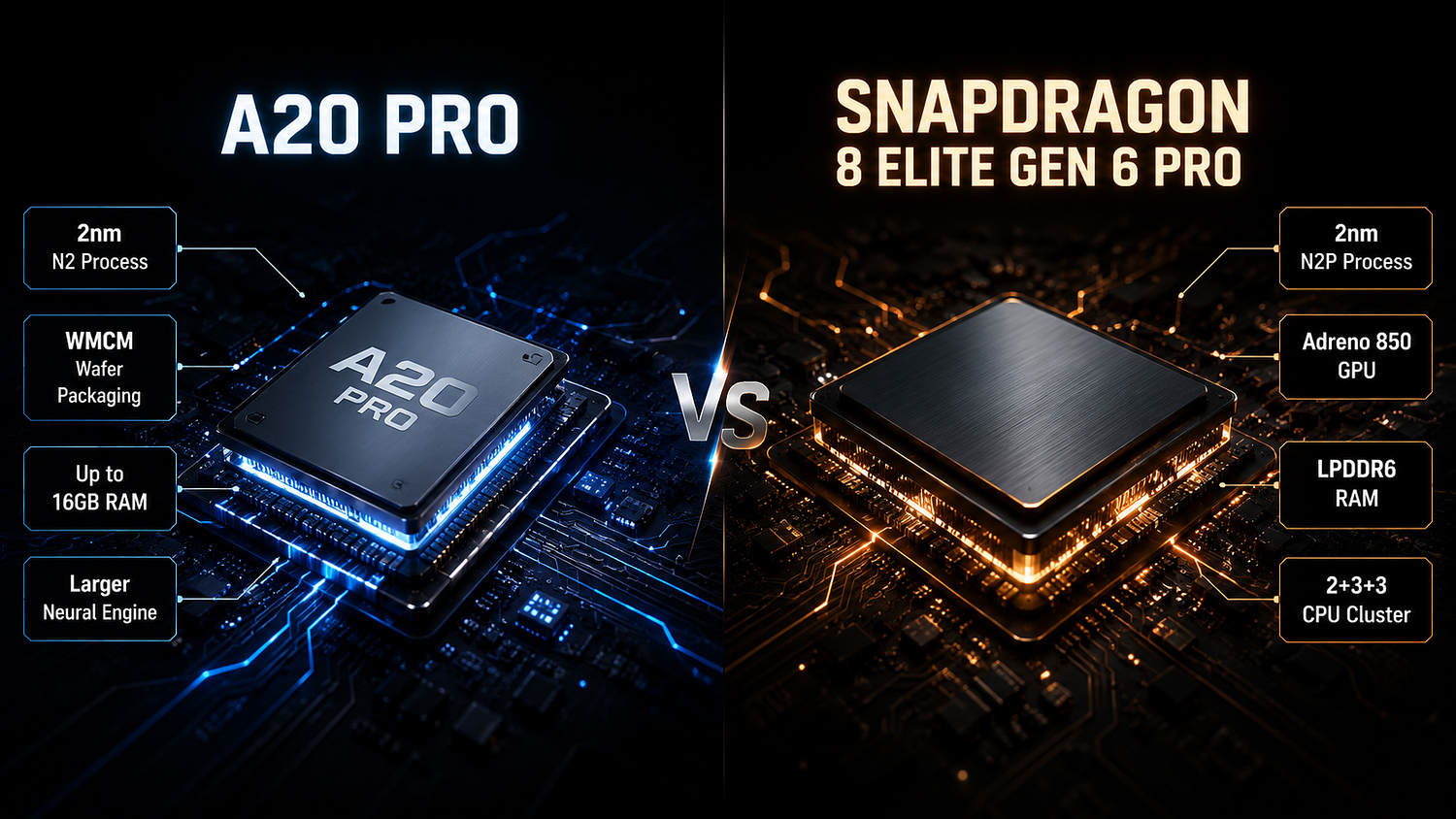
Apple’s A20 Pro is set to power the iPhone 18 Pro, the iPhone 18 Pro Max, and the long-rumored iPhone Fold when they launch this September 2026. It will be Apple’s first chip built on TSMC’s 2-nanometer N2 process, a jump the company has been securing capacity for since before the A19 Pro even shipped. On the other side, Qualcomm is preparing not one but two flagship chips this cycle: the Snapdragon 8 Elite Gen 6 and, for the first time in the company’s history, a separate Snapdragon 8 Elite Gen 6 Pro. Both are also built on a 2-nanometer node, but reportedly a newer variant of it, one that Apple itself won’t get access to this generation.
That single manufacturing detail is the whole story here. It’s why this comparison has actual stakes, and it’s why the usual “Apple wins on efficiency, Android wins on raw numbers” script might not hold up this time.
The Node War Nobody Saw Coming
Apple reportedly locked down more than half of TSMC’s initial 2-nanometer production capacity, the same aggressive early-access strategy it used to dominate the 3nm and 5nm rollouts before it. That head start is why the A20 Pro is arriving on schedule this fall while most of the Android world is still finalizing silicon.
But here’s the twist. Qualcomm and MediaTek are reportedly skipping the first-generation N2 process entirely and waiting for N2P, a refined version of the same 2nm node that shows up after N2. N2P is expected to deliver roughly 5% higher performance at the same power draw compared to N2. So even though Apple’s A20 Pro will likely reach store shelves before the Snapdragon 8 Elite Gen 6 Pro, Qualcomm’s chip could technically be built on newer, more efficient silicon by the time it lands. Whether that translates into a meaningfully better phone is a separate question, and one that won’t get answered until independent reviewers get retail units in hand.
It’s the kind of detail that sounds small in a spec sheet but changes the entire framing of “who won 2026.” Apple gets to ship first. Qualcomm gets to ship second, but arguably smarter.
What’s Actually Inside the A20 Pro
Set the node debate aside for a second, because the A20 Pro has plenty going on by itself. Industry analyst Jeff Pu has projected performance gains of up to 15% faster and 30% more efficient than the current A19 generation, and Macworld’s early performance modeling puts predicted Geekbench scores at roughly 4,200 single-core and over 10,000 multi-core, numbers that would keep Apple’s usual single-core lead intact heading into the fall.
The more interesting change isn’t the CPU. It’s the packaging. Apple has used package-on-package design for years, stacking RAM directly on top of the processor. That approach cuts latency and saves power, but it also concentrates heat in a small area, which is exactly the kind of problem that shows up as throttling during long gaming sessions or heavy on-device AI workloads. The A20 Pro is expected to switch to TSMC’s Wafer-Level Multi-Chip Module (WMCM) packaging instead, integrating RAM directly onto the same wafer as the CPU, GPU, and Neural Engine side by side rather than stacked. The chip is also expected to gain new SHPMIM capacitors in its power delivery system, which more than double capacitance density and cut sheet and via resistance by roughly 50%, changes aimed squarely at power stability and thermals.
RAM configuration is still being debated in the leaks. Some reports point to 12GB as the likely standard across the iPhone 18 Pro line, with select higher-tier configurations possibly reaching 16GB, a real jump from the 8GB Apple has shipped on recent Pro models. That extra headroom matters less for scrolling Instagram and more for the thing every phone maker is chasing right now: running larger AI models directly on the device instead of routing every request to the cloud. The Neural Engine is reportedly getting a disproportionately large upgrade this generation for exactly that reason. Apple isn’t chasing 2nm for bragging rights on a benchmark chart. It’s chasing it because Apple Intelligence needs local horsepower it doesn’t currently have.
One more number worth knowing: each A20 Pro unit is estimated to cost Apple around $280 to manufacture, according to supply chain analysis from Wccftech, a price that reflects just how expensive early access to a brand-new node actually is.
What Qualcomm Is Building to Answer It
Qualcomm’s answer arrives in two pieces this year, which is itself the headline. The standard Snapdragon 8 Elite Gen 6 is expected to carry part number SM8950, while the flagship Gen 6 Pro carries SM8975, and the split is deliberate. It mirrors Apple’s own standard-versus-Pro strategy, something Qualcomm has never done before with its top-tier silicon.
Both chips reportedly move to a 2+3+3 CPU cluster configuration, a change from the 2+6 layout used in the Snapdragon 8 Elite Gen 5. That breaks down to two super cores, three performance cores, and three efficiency cores, built on next-generation Oryon architecture with a shared 16MB L2 cache, up from 12MB in the previous generation. Clock speeds on the higher tier are rumored to reach up to 5.0GHz.
The standard Gen 6 is expected to ship with an Adreno 845 GPU, 12MB of GMEM graphics cache, and 6MB of system-level cache, paired with LPDDR5X memory. The Gen 6 Pro is where Qualcomm is holding back its real upgrades: a faster Adreno 850 GPU, support for LPDDR6 RAM, UFS 5.0 storage, and that larger 8MB cache mentioned in earlier leaks. LPDDR6 in particular is a genuine differentiator, since it’s significantly faster than the LPDDR5X Apple is still expected to use, and faster memory bandwidth directly helps on-device AI tasks like image generation and running local language models.
So on paper, the Gen 6 Pro isn’t just catching up to Apple. In a few specific areas, like memory bandwidth, it’s arguably ahead of it. Whether that shows up in real-world use is where things get less certain.
The Catch Nobody’s Talking About
Here’s where the story gets less flattering for Qualcomm, and it’s worth sitting with for a moment. A recent leak suggests the Snapdragon 8 Elite Gen 6 Pro, despite the new node and the architectural overhaul, might deliver under 20% CPU performance improvement over the current generation. That’s a modest gain for a chip built on a completely new manufacturing process, and it’s raised a real question inside the Android enthusiast community about whether mobile CPU performance is simply plateauing across the industry, Apple included.
It’s a fair concern. Diminishing returns on raw CPU gains have been creeping into flagship silicon for a few generations now, on both sides. The difference this year is that both companies seem to know it, which is exactly why the real fight has moved to GPU performance, memory architecture, and on-device AI capability instead of the old single-core benchmark chase.
For context on how competitive the current generation already is: the outgoing Snapdragon 8 Elite Gen 5 dominated AnTuTu’s flagship performance rankings heading into 2026, with eight of the top ten phones on the chart running Qualcomm silicon, led by the RedMagic 11 Pro+ at an average score of 4,104,271 points. That’s the bar the Gen 6 series has to clear, and it’s a high one.
Two Very Different Bets on AI
This is really where the comparison stops being about clock speeds and starts being about strategy. Apple is betting that tighter integration wins, packing RAM directly onto the same wafer as the processor and routing a bigger share of the chip’s die area to the Neural Engine, all in service of running Apple Intelligence features locally without leaning on the cloud. It’s a controlled, vertically integrated approach, which is exactly how Apple has built every major chip transition since the M1.
Qualcomm’s bet is closer to a brute-force memory upgrade. LPDDR6 on the Gen 6 Pro isn’t a small spec bump, it fundamentally changes how much data the chip can move per second, which is the actual bottleneck for running larger local AI models on a phone. Reports suggest this could let flagship Android devices generate images and run assistant-style workloads noticeably faster, assuming phone makers actually ship the Pro variant in devices people can buy rather than reserving it for a handful of ultra-premium models.
Neither approach is obviously better. Apple’s method is safer and more predictable because the company controls both the chip and the software stack end to end. Qualcomm’s method has more raw upside if LPDDR6 lives up to the bandwidth claims, but it also depends on device makers actually adopting the Pro chip broadly instead of keeping it exclusive to a few flagship models, the way “Ultra” and “Pro” variants often end up.
The GPU Fight Underneath the Headlines
While the CPU comparisons get most of the attention, the GPU story here is arguably more important for how these phones actually feel to use. Apple’s A20 Pro is expected to carry an updated GPU built around a third-generation dynamic cache technology, which allocates on-chip memory in real time based on demand rather than using fixed partitions. That matters most in gaming and in non-native apps running through emulation layers, where memory needs can spike unpredictably. Combined with a reportedly larger system-level cache, the goal is a smoother frame rate under sustained load rather than a higher peak number that only shows up in a five-second benchmark run.
Qualcomm’s approach with the Adreno 845 and Adreno 850 is more about raw throughput. The standard Gen 6 pairs its GPU with 12MB of GMEM graphics cache, while the Pro variant is expected to go further still. Qualcomm has historically led on GPU benchmarks against Apple’s silicon, even in years when Apple wins single-core CPU tests, and there’s no strong signal yet that this generation breaks that pattern. If anything, the LPDDR6 memory on the Gen 6 Pro should widen that GPU advantage further, since graphics-heavy and AI-heavy workloads are usually bottlenecked by memory bandwidth long before they’re bottlenecked by core count.
Pricing, Availability, and the Devices That Will Actually Ship These Chips
Chip comparisons are interesting in the abstract, but they only matter once real phones show up with real price tags attached. The iPhone 18 Pro, iPhone 18 Pro Max, and iPhone Fold are all expected to launch together this September, meaning every A20 Pro buyer gets the same silicon regardless of which of the three devices they choose. That’s consistent with how Apple has handled its Pro-tier chips for years: one chip, multiple devices, no confusing sub-variants for the buyer to research.
Qualcomm’s rollout looks messier by comparison, and that’s worth flagging honestly. With both a standard Gen 6 and a Gen 6 Pro launching in the same window, phone makers get to choose which chip goes into which device, and history suggests the Pro variant, with its LPDDR6 memory and Adreno 850 GPU, will likely be reserved for a small number of ultra-premium flagships and foldables rather than showing up across the board. Samsung, Xiaomi, and OnePlus will each make their own calls here, and it’s entirely possible that most Android buyers this cycle end up with the standard Gen 6, not the chip getting all the leaked headlines. That’s an important asterisk on any claim that Qualcomm has “won” this generation on paper. A chip’s specs only matter to the people who can actually buy a device with it inside.
Why This Generation Feels Different
Chip comparisons happen every year, but most of them settle into predictable patterns within a few weeks of launch. This year has more genuine uncertainty baked in, and that’s mostly because of timing. Apple is shipping first-generation N2 silicon on a fixed September date, while Qualcomm is reportedly waiting for the more refined N2P process, which means the two companies aren’t just competing on chip design anymore, they’re competing on which manufacturing strategy pays off first. That’s a more interesting question than “whose GPU scores higher,” and it’s one that won’t have a clean answer until well after both chips are shipping in real phones.
There’s also the AI angle running underneath everything. Every major decision described here, Apple’s WMCM packaging, its larger Neural Engine, Qualcomm’s jump to LPDDR6 on the Pro tier, traces back to the same underlying pressure: phones need to run bigger AI models locally without murdering battery life or overheating in someone’s pocket. Two years ago, that wasn’t the primary design constraint driving flagship silicon. Now it clearly is, and it’s reshaping how both companies think about packaging, memory, and even which node to prioritize.
So Who Actually Wins This Round?
Honestly, the fair answer is that it depends what you’re measuring, and anyone giving you a clean one-line verdict in July is getting ahead of actual retail testing. Apple gets first access to 2nm silicon and ships months earlier, which matters for anyone buying an iPhone this fall. Qualcomm gets a technically newer node revision and a genuine memory bandwidth advantage on its top-tier chip, which matters more for the phones that show up in early 2027.
If sustained performance and thermal control under heavy AI workloads end up mattering more than launch date, the Gen 6 Pro’s LPDDR6 advantage could make it the more interesting chip by spring, at least in devices that actually ship with it. If raw single-core speed and Apple’s tighter software-to-silicon integration matter more to you, the A20 Pro’s WMCM packaging and Neural Engine upgrades give it a real, if narrower, edge where it counts most for daily use.
What’s clear is that 2026 is the first year in a while where this comparison isn’t a formality. Both companies are making real architectural bets, not incremental refreshes, and both are explicitly building around on-device AI rather than treating it as a feature checkbox. The benchmark charts will start filling in by September, and the picture will get a lot sharper once independent reviewers get actual retail hardware in hand rather than leaked spec sheets. Until then, this is as close as the Apple-versus-Qualcomm chip race has been in years, and that alone is worth paying attention to.
What to Watch Before September
A few things will settle a lot of this debate once they’re confirmed. Whether Apple actually ships 16GB RAM configurations broadly or reserves them for the priciest tier will decide how much of the AI story is marketing versus reality. Whether Qualcomm’s Gen 6 Pro shows up in more than one or two flagship phones at launch will decide whether LPDDR6’s advantage is something most buyers ever actually get. And whether that under-20% CPU gain leak turns out accurate will say a lot about where the entire mobile chip industry is heading, not just Qualcomm.
None of that will be fully clear until phones are in hands and reviewers start running their own benchmarks instead of relying on leaked slides and analyst notes. For now, both companies have made their bets. September will start showing who called it right.