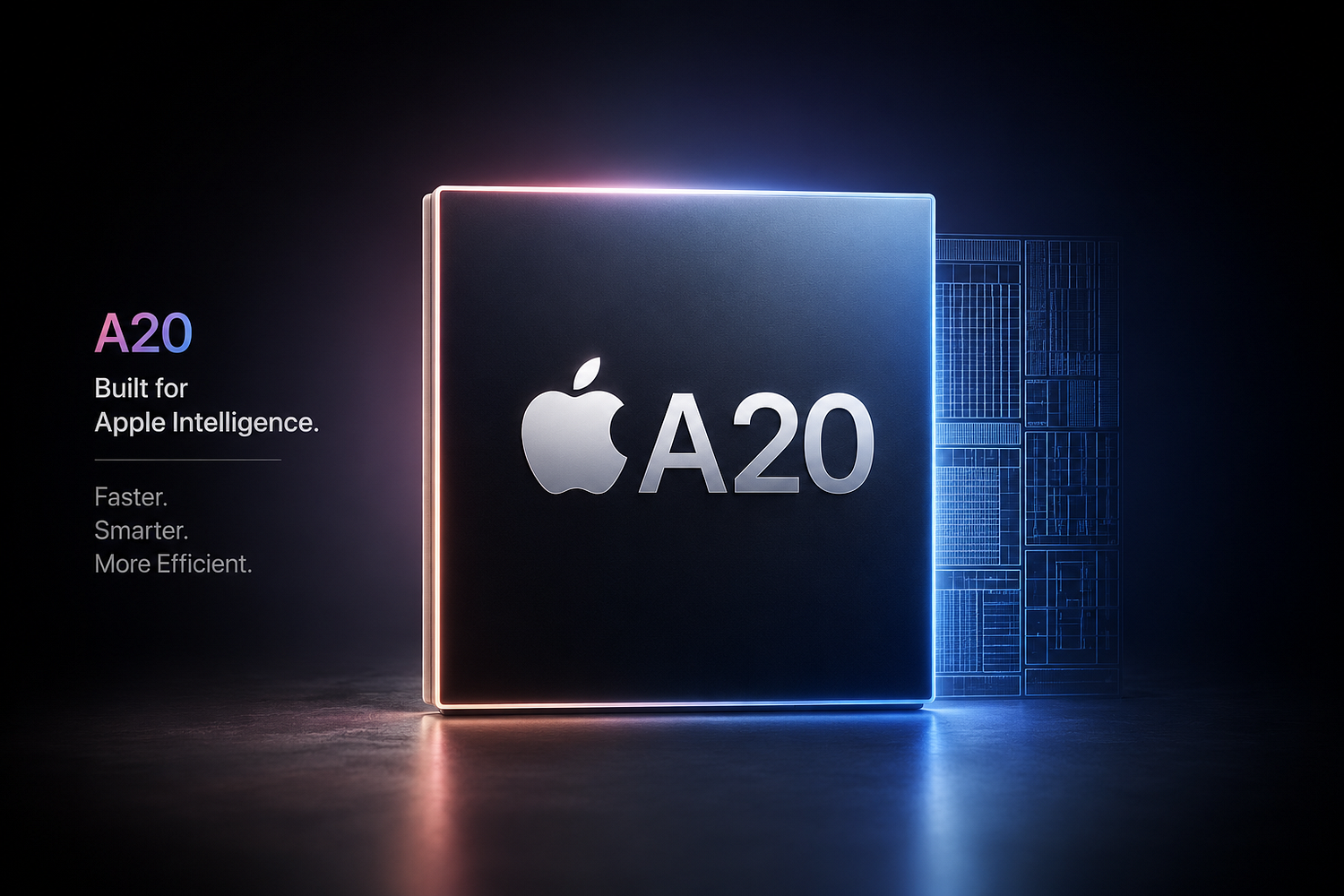
Apple’s next iPhone will run on the smallest, densest chip the company has ever shipped in a smartphone. The A20 and A20 Pro are expected to power the iPhone 18 lineup, including the foldable iPhone, when Apple’s fall event arrives in September 2026. Built on TSMC’s 2-nanometer N2 process for the first time, the chip is being framed by leakers and analysts as Apple’s biggest silicon jump since the move to 3nm with the A17 Pro in 2023.
None of this is officially confirmed by Apple. Everything below comes from supply chain leaks, analyst notes, and a factory data breach that reportedly exposed A20 Pro data sheets. Apple has said nothing on the record. That matters, because a fair amount of the “confirmed” language floating around tech blogs right now is actually just repeated speculation dressed up as fact. This article separates what multiple sources agree on from what’s still a rumor, and lays out the specs, the expected pros and cons, and how much of a real upgrade the chip is likely to be.
Access without medium partner: Apple A20 chip explained
The 2nm Process: What Actually Changes
TSMC’s N2 process is the headline feature, and for good reason. Moving from 3nm to 2nm allows more transistors to be packed into the same physical space, which typically translates into better performance per watt. Industry estimates point to roughly 10 to 15 percent performance gains and up to 30 percent better efficiency compared with 3nm technology. Apple reportedly moved fast to lock this down: the company is said to have secured more than half of TSMC’s initial 2nm production capacity, a strategy that mirrors what it did with 3nm and 5nm ahead of previous launches.
Here’s the part that gets buried under the 2nm headline: Qualcomm and MediaTek aren’t using the same node. Both are reportedly waiting for N2P, a refined version of the 2nm process expected to arrive after N2, for the Snapdragon 8 Elite Gen 6 and Dimensity 9600. N2P is expected to deliver roughly 5 percent more performance at the same power draw than the plain N2 node Apple is using. So even though Apple gets to market first, its rivals may technically be on newer silicon by the time their phones ship. That’s a genuinely interesting wrinkle, and it’s going to fuel a lot of comment-section arguments about who actually “won” the 2026 chip race.
WMCM Packaging: The Quiet Redesign
If there’s one part of this story getting less attention than it deserves, it’s the packaging. Apple has used package-on-package design for years, stacking RAM directly on top of the processor die. The A20 Pro reportedly moves to TSMC’s Wafer-Level Multi-Chip Module (WMCM) packaging, which places DRAM alongside the processor instead of on top of it, specifically to cut down on heat.
A separate leak, reportedly sourced from a breach at a Tata iPhone factory in India, showed logic board designs and A20 Pro data sheets that back this up. That leak also pointed to a bigger vapor chamber making direct contact with the silicon die, with heat dissipation potentially exceeding what the iPhone 17 Pro and iPhone 17 Pro Max are capable of. The A20 Pro is also said to use SHPMIM capacitors offering twice the capacitance density of previous designs. None of this shows up on a spec sheet the way a clock speed does, but it’s arguably more important. Thermal throttling has been the thing separating benchmark numbers from real-world sustained performance on flagship phones for years, and this is Apple’s attempt to close that gap.
CPU and GPU: Incremental on Paper, Bigger in Practice
The raw performance numbers being floated aren’t dramatic jumps. Leaked Geekbench predictions put the A20 Pro at a single-core score around 4,200 and multi-core performance exceeding 10,000, which would keep Apple’s long-running lead in single-thread performance. GPU core counts haven’t leaked yet. One report notes plainly that information on GPU core numbers isn’t available, and Apple has apparently taken chip binning to a new level this generation, meaning the A20 and A20 Pro will likely have several sub-variants depending on which device they end up in.
For context on what “keeping the lead” means: Apple’s single-core scores have led the smartphone market since the A11 in 2017, and nothing in these leaks suggests that changes with the A20 generation. What’s shifting is how close the competition is getting on multi-core and GPU workloads, which is where Android flagships have narrowed the gap in the last two generations.
Memory: The Bandwidth Upgrade Nobody Was Asking For
This might be the most underrated change in the whole leak cycle. The A20 Pro’s memory interface is reportedly widening from 64 bits to 96 bits, a jump that could increase memory bandwidth by up to 50 percent before even accounting for gains from faster memory itself. Combined with a possible move to LPDDR6, that’s a meaningful upgrade for anything memory-hungry, and on-device AI models are exactly that.
RAM capacity is also going up. Multiple analyst notes converge on 12GB of LPDDR5 becoming standard across the iPhone 18 Pro, Pro Max, and Fold, a jump from the 8GB Apple has shipped on recent Pro models. Some later leaks suggest the ceiling could go even higher, with rumors of up to 16GB on the higher-tier configurations. That extra memory won’t do much for switching between Instagram and Safari. It matters for running larger on-device AI models locally instead of offloading them to a server, which is the direction Apple has been pushing Apple Intelligence since it launched.
Neural Engine: Where Apple Is Actually Betting Big
CPU and GPU gains this generation look incremental by Apple’s own historical standards. The Neural Engine does not. Leaked die images reportedly show the NPU getting a noticeably larger allocation of die space, and one report goes further, stating the Neural Engine is getting a disproportionate share of the die area increase compared to other parts of the chip. Overall die size is expected to stay close to the A19 Pro’s footprint, meaning that extra NPU space is coming directly out of budget that might otherwise have gone to CPU or GPU cores.
That’s a deliberate choice, not an accident. It lines up with what Apple has signaled across the last two iOS cycles: push more Apple Intelligence processing on-device, rely less on sending user data to a server. Reports frame it directly this way, arguing that a chip capable of running AI models locally, for longer, without overheating or draining the battery, is the actual product Apple is trying to ship this generation, not raw CPU or GPU gains. Whether users notice this in daily use depends entirely on how aggressively Apple leans into on-device AI features in iOS 20 and beyond, and that’s still an open question.
A20 vs A20 Pro: How the Lineup Splits
Following the pattern set in recent years, Apple is expected to split the family across three tiers. The iPhone 18 Pro, Pro Max, and the new foldable iPhone are all expected to share the same A20 Pro chip, along with 12GB of RAM and Apple’s own C2 baseband modem, which continues the company’s slow move away from Qualcomm modems. The standard iPhone 18 and the budget iPhone 18e are expected to run the base A20 chip, arriving later, in spring 2027 rather than alongside the Pro models in September.
The iPhone Air 2 is also expected to carry the standard A20 rather than the Pro variant. Interestingly, this generation adds a genuine wildcard: the foldable iPhone. Apple hasn’t shipped a foldable before, and giving it the same top-tier chip as the Pro Max, rather than a cut-down version, suggests Apple isn’t treating the Fold as an experiment it’s willing to compromise on.
How the A20 Pro Stacks Up Against the Competition
2026 is shaping up to be a genuinely competitive year on the chip side, which hasn’t always been true. Qualcomm’s Snapdragon 8 Elite Gen 6 is expected to use LPDDR6 memory as well, and depending on how it’s implemented, that could give it an edge in sustained AI workloads even if it launches on a slightly older process node than Apple’s chip. MediaTek’s Dimensity 9600, its first flagship chip on TSMC’s 2nm process, is also landing in September 2026 and is being positioned to rival the A20 series directly, with OPPO and vivo expected to be first to ship it.
One detailed comparison summed up the trade-off reasonably well: sustained performance and thermal control under heavy AI load might end up mattering more than which chip technically launched first, and if that turns out to be the deciding factor, Qualcomm’s memory advantage could make its chip the more interesting one by the following spring. On the other hand, if raw single-core speed and tight software-to-silicon integration matter more to a given buyer, Apple’s packaging and Neural Engine work give the A20 Pro a real, if narrower, edge in daily use. Nobody’s going to have a definitive answer here until independent reviewers get retail hardware in September, not leaked spec sheets.
Real-World Use Cases: Where This Chip Would Actually Matter
Specs on a page rarely mean much until they translate into something a person actually notices when using the phone. A few areas stand out as places where the A20 Pro’s rumored changes would show up in daily use rather than just a benchmark chart.
On-device AI assistants are the obvious one. Running a large language model locally, instead of routing every request to a server, requires both memory bandwidth and a Neural Engine that can sustain load without throttling. That is exactly the combination Apple appears to be building here: a wider memory bus, more RAM, and a bigger NPU. If Apple Intelligence in iOS 20 leans harder into on-device processing, the A20 Pro is the first Apple chip actually built with enough headroom to support it properly.
Camera processing is another. Computational photography, night mode stacking, and the increasingly AI-driven photo pipeline Apple has been building since the iPhone 12 all lean on Neural Engine throughput. A bigger NPU should, in theory, mean faster processing of multi-frame shots and less of the shutter lag that shows up in low light.
Gaming and sustained workloads are the third area, and probably the one most directly tied to the WMCM packaging change. A vapor chamber that makes direct contact with the silicon die is specifically aimed at problems like frame-rate drops twenty minutes into a demanding game, or a phone getting uncomfortably warm during a long video call. Whether that translates into a noticeably cooler phone in someone’s hand is something no leak can really confirm. That part just has to wait for review units.
Pricing and Availability: What to Expect
Apple hasn’t announced pricing, and won’t until the September event. But a few data points are worth flagging. Early yields on a brand-new process node are typically lower and more expensive than a mature one, and TSMC’s N2 is about as new as it gets for smartphone-scale production. Several reports have hinted at a probable price increase for the Pro lineup this cycle, tied partly to the new packaging and partly to the jump in base RAM. None of the numbers being floated right now are official, so treat any specific dollar figure attached to the iPhone 18 Pro as a guess dressed up as a leak.
Availability follows Apple’s usual split. The iPhone 18 Pro, iPhone 18 Pro Max, and the foldable iPhone are expected in September 2026, running the A20 Pro. The standard iPhone 18 and the more affordable iPhone 18e, both expected to run the base A20, are reportedly pushed to spring 2027, continuing the staggered release pattern Apple started with the iPhone 16e.
Pros: What the A20 Pro Gets Right (On Paper)
The efficiency story is the strongest part of this chip. A 2nm process combined with WMCM packaging and a bigger vapor chamber should mean less thermal throttling during sustained tasks like 4K video editing, gaming, or running local AI models for extended periods. Being first to a 2nm node with a new packaging architecture is, as one analysis put it, a genuine engineering milestone rather than marketing spin, given that Apple’s two biggest rivals are reportedly holding off for a refined node.
The memory bandwidth jump is arguably underrated in the coverage so far. A 96-bit interface with LPDDR6 support addresses a real bottleneck rather than adding a spec that only shows up in a marketing slide. And the Neural Engine expansion, paired with a possible jump to 16GB of RAM on higher configurations, positions the chip well for whatever Apple Intelligence becomes over the next two or three iOS versions, assuming the software keeps pace with the hardware.
Cons: Where the Story Gets Shakier
The raw CPU and GPU performance gains being predicted are incremental by Apple’s own historical standards, and multi-core and GPU performance gaps with Android flagships are closing faster than they have in years. A predicted single-core score around 4,200 is a solid number, but it’s not the kind of generational leap that made headlines with, say, the jump to the A14 or A17 Pro.
There’s also the pricing question hanging over all of this. Early 2nm production tends to be expensive, and multiple reports hint at a likely price increase for the Pro lineup this year, though nobody has locked in numbers yet. Combine that with GPU core counts still being unknown and heavy reliance on leaked data that traces back to what looks like a factory security breach, and there’s real reason for caution here. As one outlet put it plainly, the leak “remains unverified, so caution is warranted.” Integrating a wider memory bus and new packaging into a mass-market device at scale is also not guaranteed to go smoothly. Thermal management and manufacturing yield could still turn into real obstacles between now and September, and Apple’s 3nm ramp with the A17 Pro wasn’t entirely free of early yield issues either.
There’s also a specificity problem in most of the current coverage. A lot of it repeats the same handful of numbers, the same 4,200 single-core estimate, the same 96-bit bus figure, without much independent verification. That’s normal for a chip that’s still two months from launch, but it’s worth remembering when reading confident-sounding headlines about “the fastest iPhone chip ever.”
How Effective Will It Actually Be?
The honest answer is that nobody knows yet, and anyone claiming certainty right now is working from leaked spec sheets, not retail hardware. What can be said is that the changes Apple appears to be prioritizing (packaging, memory bandwidth, and Neural Engine size) are the kind of upgrades that show up more in sustained, real-world use than in a single Geekbench run. A phone that can run a local AI model for ten minutes without throttling or draining half the battery is a bigger deal to most people than a chip that’s 8 percent faster in a synthetic benchmark. That’s the actual bet Apple looks like it’s making with the A20 Pro.
Whether that bet pays off depends on two things outside the chip itself: how well Apple’s software actually uses the extra Neural Engine capacity, and how the competition’s chips perform once they ship in real devices rather than spec sheets. The benchmark charts will start filling in through August and September, and the picture gets sharper the moment actual review units land in reviewers’ hands. Until then, the A20 Pro is a genuinely interesting engineering story with a lot of real, verifiable groundwork behind it, wrapped in the usual amount of pre-launch noise that surrounds every new iPhone chip.