Today Valve finally confirmed it. $1,049 for the 512GB Steam Machine. $1,349 for the 2TB. Add the new Steam Controller to the 2TB and you are at $1,428. Pre-orders open June 25 through a lottery, not regular first-come-first-served, and both models ship June 30.
I watched the LTT’s video too, that dropped today which litrally titled “Even Valve is Disappointed.” That’s Linus Sebastian quoting what Valve told him directly. The machine Valve actually wanted to sell you was probably a $749 box. Instead, a global RAM and storage shortage pushed everything up, and now we are talking about a $1,049 starting price with no controller included.
Both things can be true at the same time. The hardware itself is genuinely good. The price is genuinely bad. I want to explain both properly, including one part most reviewers are skipping over today which is the software story, because that is actually where Valve has done the most work.
What Is This Thing
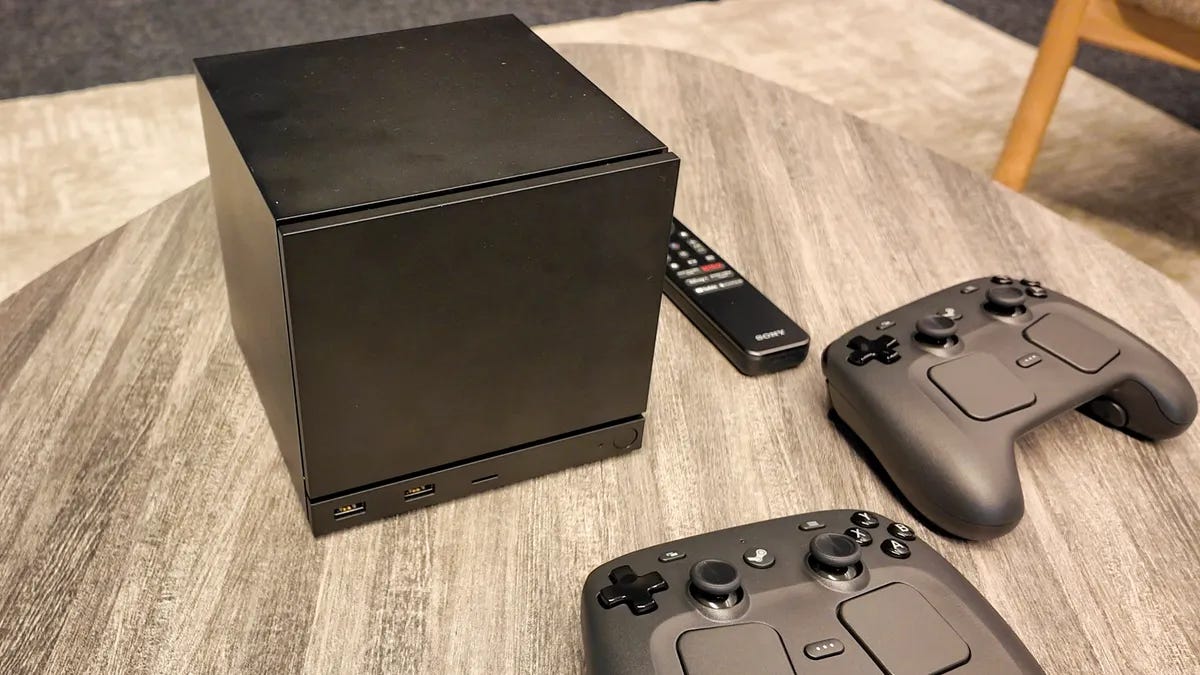
Valve announced the Steam Machine back in November 2025 alongside a new Steam Controller and the Steam Frame VR headset. It’s a compact gaming PC, roughly the size of a GameCube or a thick hardback book, running SteamOS 3. Same operating system as the Steam Deck, same Arch Linux base, same Big Picture mode you get on the handheld.
You plug it into your TV, pick up a controller, and it works exactly like a console. Except it’s a PC, so you can also drop into desktop mode and install whatever you want.
Digital Foundry called it “beautiful hardware” and “virtually silent.” Rock Paper Shotgun said it’s a “quiet triumph of hardware design.” Even PC Gamer, who gave it 62 out of 100, said it looked nice. Nobody is complaining about the actual box. The fight is entirely about what Valve is charging for it.
The Specs
Inside: a semi-custom AMD Zen 4 CPU, 6 cores and 12 threads, boosting up to 4.8 GHz at a 30W TDP. Valve says it performs close to a Ryzen 5 7600X. The GPU is a semi-custom RDNA 3 chip with 28 compute units at 2.45 GHz sustained, 110W TDP, 8GB of GDDR6 VRAM. System memory is 16GB DDR5. Storage is either 512GB or 2TB NVMe with a microSD slot for expansion.
Ports: DisplayPort 1.4, HDMI 2.0, two USB-A 2.0, one USB-C 3.2 Gen 2, and gigabit ethernet on the back. Two USB-A 3.2 ports on the front. Wi-Fi 6E. Bluetooth 5.3. 17 individually addressable RGB LEDs. The front panel is swappable for custom designs.
No HDMI 2.1. Valve explained this is because the HDMI Forum doesn’t share open documentation, which conflicts with their open-source driver approach on SteamOS. So if you want 4K at 120Hz you need DisplayPort. Most living room TVs don’t have DisplayPort. That’s a real problem for the audience this machine is targeting and I haven’t seen enough reviewers calling it out clearly.
The GPU compares most closely to a cut-down RX 7600. The full RX 7600 has 32 compute units, this has 28 and lower TDP. LTT Labs called the RDNA 3 package “decidedly last generation” for a mid-2026 release, and honestly that’s fair. RX 7600 came out in 2023.
The Part Most Reviews Are Rushing Past: What SteamOS Actually Does
So this is where I think Valve deserves more credit than it’s getting today.
The Steam Machine is not just a PC running SteamOS as a nice launcher. Valve has spent years building a software stack specifically so this hardware punches above its weight, and it’s worth understanding how that works.
SteamOS uses open-source AMD RADV Vulkan drivers. On some games those drivers outperform Windows AMD drivers by a noticeable margin. The reason is that RADV is built specifically for Vulkan from the ground up, while the Windows AMD driver has to support DirectX and a pile of legacy stuff on top of that. So in Vulkan-native games, the Steam Machine can actually pull ahead of what you would get running identical hardware on Windows. That’s a real advantage, not a marketing claim.
Then there’s Proton, which is Valve’s compatibility layer built on top of Wine. What it does is translate DirectX calls from Windows games into Vulkan in real time, so your Windows game runs on Linux without the developer doing anything. Proton 10.0 and the Proton 11 beta both dropped this year with serious improvements. Proton 11 adds Wine 11’s NTSync support, which moves Windows NT synchronization handling into the Linux kernel itself. In plain terms: less CPU overhead, smoother frame times, better 1% lows in games that used to stutter. Red Dead Redemption 2, which had issues in DirectX 12 mode, now runs properly.
SteamOS also ships with no background bloat. No Copilot eating RAM. No Windows Update restarting your session at 11pm. No shader compilation stutter from Windows-side DirectX 12 overhead. The whole OS is built for gaming and nothing else. Windows 11 reportedly now runs better with 32GB of RAM for a clean experience. The Steam Machine ships with 16GB and SteamOS uses maybe 2GB of that. So the full 14GB goes to your games.
The Vulkan certification story is also interesting. On May 23 this year, the Steam Machine appeared in the Khronos Group’s official Vulkan 1.4 conformant products database, listed as “AMD Steam Machine” running the Mesa/RADV driver on Valve’s own Neptune Linux kernel branch, the same kernel that powers the Steam Deck. That certification means the driver stack has passed mandatory compatibility testing. It guarantees predictable behavior across Vulkan games. And it was one of the last technical steps before launch, which is why the June 23 announcement was never really a surprise to people who were watching closely.
VKD3D-Proton 3.0 also got an update this year that added FSR 4 support to the DirectX 12 translation layer. FSR 4 is technically optimized for RDNA 4, but there’s now a fallback path for RDNA 3. It does come with a performance cost on older hardware, so Valve hasn’t put it in the main Proton build yet. But Valve told Aftermath that FSR 4.1 improvements from AMD are being extended backwards to RDNA 3, and when that arrives it will be a free upgrade delivered through a SteamOS update. No hardware change needed. No buying a new GPU. Just a software update one day and your 4K upscaling gets measurably better. Consoles can’t do that. PS5 Pro’s PSSR is baked into that hardware and can’t be upgraded.
That’s actually the strongest long-term argument for the Steam Machine that I’ve seen anyone make, and most review coverage today is skipping it because the benchmark numbers are more interesting to write about.
Performance Reality
Valve promised 4K gaming at 60fps. That’s achievable on some games and not on others.
Shadow of the Tomb Raider ran above 120fps at 4K. Good.
Cyberpunk 2077 with ray tracing on was at 15fps at 1080p. That’s basically unusable. Without ray tracing and with FSR on, IGN got it to 42fps. Digital Foundry said it “delivers what we’d call ballpark entry-level performance for a mainstream PC.” In God of War Ragnarok, the base PS5 hit 75 to 78fps at 4K. Steam Machine on matched settings got 60 to 63fps with FSR Quality mode.
At native 1440p it reached around 70fps but still behind the PS5. The PS5 Pro on the same settings was at 110fps.
That Cyberpunk number is kind of damning if you just look at it raw. But Cyberpunk with full ray tracing at 4K is a test that destroys far more expensive hardware too. The honest target for this machine is 1440p at high settings for demanding games, and 4K with FSR for everything else. That’s a fine place to be. Just not the “4K 60fps” Valve kept saying in marketing without the asterisk.
Noise and thermals are good though. Multiple reviewers confirmed 35 to 42 decibels at full load, which is quieter than a PS5 under pressure. Vapor chamber cooling works well for the form factor. The machine runs cool for its size.
Steam Machine vs PS5: More Complicated Than the Price Suggests
The PS5 digital edition is $599.99. PS5 Pro is $899.99. Steam Machine base is $1,049 with no controller.
So yes, the Steam Machine costs more than the PS5 Pro and in most current games performs worse. That’s the headline. Console optimization is real, PSSR is better than FSR 3, Sony’s first-party studios have spent years tuning code for that custom hardware. The numbers are the numbers.
But the price comparison looks different when you add five years.
PlayStation Plus Extra costs $135 a year. Over five years that’s $675 just for online multiplayer and cloud saves. Steam multiplayer is free. Zero. One survey of actual spending habits found people average about $180 a year on Steam vs $400 a year total on PS5 including subscriptions. On a five-year timeline, a PS5 Pro owner has spent about $1,575 not including games. Steam Machine owner has spent $1,049 plus whatever they spent on games, which on Steam is almost always less than PlayStation Store pricing.
New PS5 first-party games are $79.99 now. Steam games at launch are usually $59.99 and hit 50 to 75 percent off within a year. If you already own a Steam library, those games cost you nothing on the Steam Machine. You bought them already. The machine just plays them.
And it’s a full PC. You can install any software. Run mods. Use emulators. Use GOG, Epic, Heroic launcher, or whatever else you want. Connect any keyboard, mouse, or controller. You’re not locked into PlayStation’s store or PlayStation’s rules. Aftermath called it “an adult computer instead of a weird playpen.” That’s a bit harsh on PlayStation but the point is real.
The VR angle is also worth mentioning. Steam VR has thousands of titles. The Steam Frame headset that Valve announced alongside this connects to the Steam Machine. PSVR2 is good hardware but it’s a smaller library and you’re locked into what Sony approves. If VR is something you care about, the PC side has always been better for it.
So no, the Steam Machine isn’t better than PS5 Pro at face value right now. But if you play a lot, buy a lot of games, and think about total cost over time, the math starts shifting somewhere around year two or three.
What $1,100 Gets You If You Build a PC Instead
This is the part Valve can’t really answer.
For around $1,100 in June 2026, CyberPowerPC and iBUYPOWER both have prebuilt configs with an RTX 5060 Ti, 32GB DDR5, 1TB NVMe, Windows 11 included. The RTX 5060 Ti supports DLSS 4, which produces sharper images at 4K than FSR 3 does on the Steam Machine. Some configs in the $1,100 range are even hitting RTX 5070 territory. You get double the RAM, a better GPU, access to every game launcher, no anti-cheat compatibility worries.
You do give up the tiny form factor. A prebuilt tower is bigger. And setting up Windows for TV gaming is still annoying if I’m honest. I tried it last year with a mini-ITX build and spent the better part of two weekends sorting out controller support, Big Picture mode quirks, and random driver issues that kept crashing Bluetooth. SteamOS just works. That’s a real difference. But for $1,100 vs $1,049, the PC wins on raw performance.
The people who should buy the Steam Machine anyway are those who specifically want the SteamOS experience,the tiny form factor, and already own a big Steam library. That’s a smaller group than Valve hoped to reach at launch. But that group has an actually good reason to buy this thing.
Why the Price Ended Up Here
Valve didn’t want to charge $1,049. That’s pretty clear from the evidence.
Pierre-Loup Griffais, one of Valve’s lead hardware designers, said before launch they could build a system like this for $800 to $1,000 without storage and memory. Czech retailers were leaking prices around $950 to $1,070 in January.

DDR5 prices quadrupled between November 2025 and now because of AI data center demand consuming memory supply. An Xbox internal memo confirmed in June 2026 warned that storage costs have quadrupled since fall 2025 and could hit five times pre-shortage levels by 2027. This is hitting everyone. Sony raised PS5 prices. Steam Deck prices also went up. Valve published an FAQ in February 2026 explicitly saying the shortage “rapidly increased” and forced them to “revisit our exact shipping schedule and pricing.”
The $300 jump between 512GB and 2TB models is harder to justify though. A 2TB NVMe drive is under $90 right now. Even with current inflation that’s not $300 worth of storage. That one feels like Valve making up margin somewhere.
The Lottery and Limited Stock
Instead of regular pre-orders, Valve is running a registration lottery. Sign up before June 25 at 10am PT. Valve randomly selects buyers. Selected people get an email by June 29 with a purchase link. First batch is 20,000 units. One per customer. Your Steam account needs a purchase made before April 27, 2026 to be eligible.
This is a direct response to the Steam Controller launch in May which sold out in minutes and got flooded with scalpers. The lottery at least gives everyone a fair shot. New Steam Controller stock by the way won’t arrive until 2027, so if you want a controller with your Steam Machine and miss this batch, you’re waiting a while.
The Anti-Cheat Problem
Valorant doesn’t work. League of Legends doesn’t work. Call of Duty doesn’t work. Battlefield 6 doesn’t work. All EA Sports titles, GTA V Online — none of these run on SteamOS because their anti-cheat systems need kernel-level access that Linux doesn’t provide the same way Windows does. According to the database Are We Anti-Cheat Yet, more than 680 of the 1,136 games on Steam requiring anti-cheat remain unplayable on SteamOS as of this month.
Valve says they’re working on it. No timeline, no confirmed fix. If competitive shooters are your main thing, the Steam Machine is not for you right now and that’s just the honest answer.
For everything else, meaning most single-player games, indie games, most AAA titles, emulation, and basically anything without aggressive anti-cheat, it mostly works. The 2026 compatibility situation is a completely different world from the 2015 original Steam Machines, where almost nothing ran. Proton has been running since 2018 and has improved every year. The Steam Deck already proved this model works.
So Should You Buy It
If you have a big Steam library and want it on your TV in a quiet tiny box with zero setup friction, yes, this is the best version of that product that has ever existed.
If you’re comparing it to a PS5 on specs and price alone, wait. PS5 Pro gives you more raw gaming power for $150 less. The math on that is clear.
If you’re a PC gamer with a working desktop, you probably don’t need this. Your existing setup beats it.
If the $1,049 is too much right now, I think it actually will come down. Component prices won’t stay this bad forever. Valve has room to cut price on a refresh. And the SteamOS-on-any-hardware story is getting real too. Digital Trends confirmed last week that Valve wants SteamOS to work on standard PC hardware, not just their own devices. At that point you could build a Steam Machine yourself for less than $900 and install SteamOS free. That might be the move for a lot of people.
For now though, the Steam Machine is a good product at the wrong price for the wrong moment. Valve knows it. Linus said it on camera. And honestly, given the RAM situation, nobody was going to escape this year unscathed.
Register for the lottery before June 25 at 10am PT if you want in on this batch. Just go in knowing what you’re actually paying for.