So this happened today. Literally today — June 1, 2026 — Jensen Huang walked onto a stage at the Taipei Music Center for Computex 2026 and announced that Nvidia is now in the laptop chip business. Not the GPU business. Not the AI accelerator business. The actual, full CPU-plus-GPU-in-one-chip, powers-the-whole-computer business.
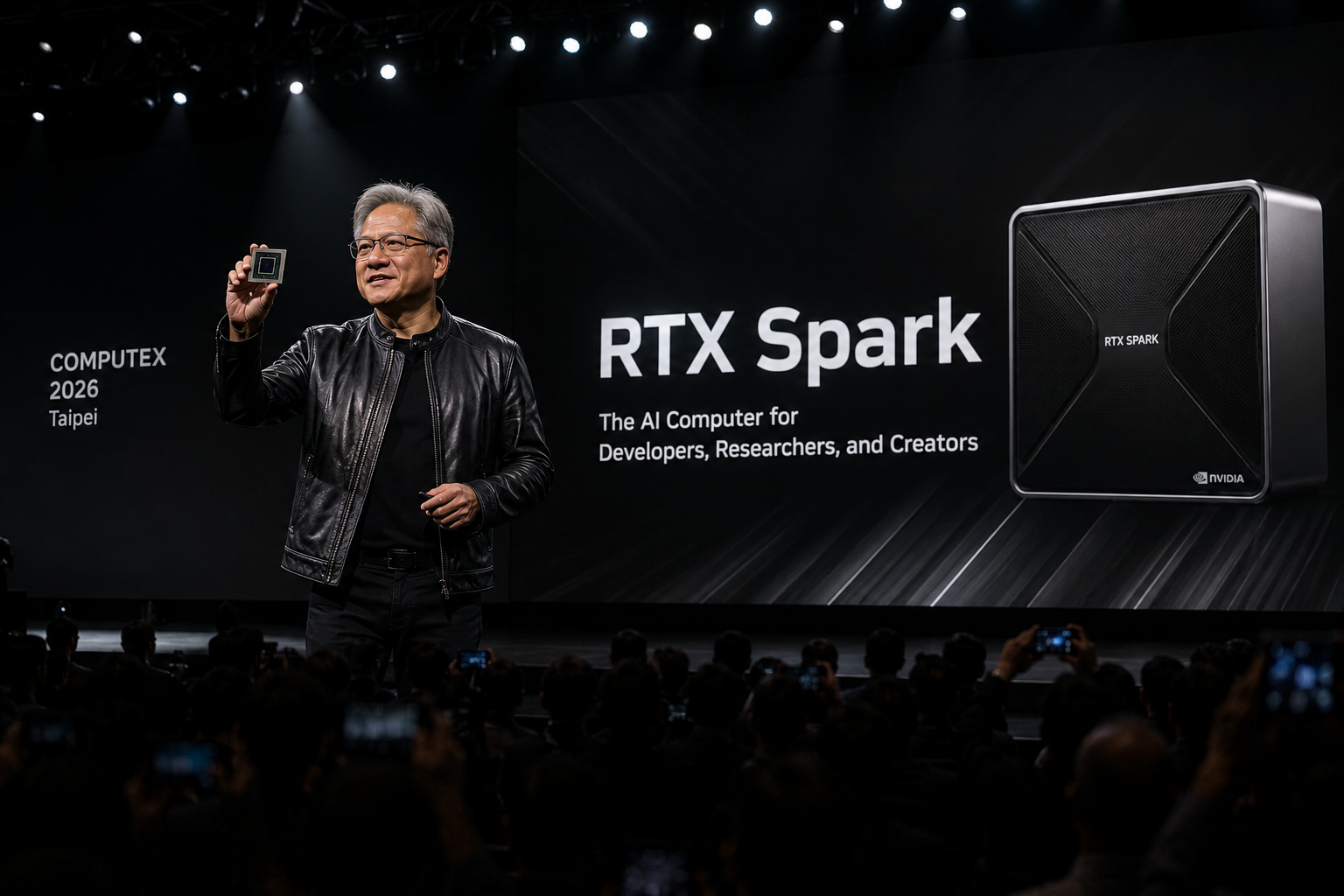
The chip is called RTX Spark, and it is honestly a weird thing to process. For most of us who grew up watching Nvidia make graphics cards, this feels like… I don’t know, like if Toyota suddenly said they’re making aircraft engines.Nvidia has always been the GPU company. The company that made your gaming rig faster. And now they’re building the brain of the laptop.
Huang called it “the most important reinvention of the PC in 40 years.” That’s a big claim. But once you look at the specs, you start to understand why the company believes that. And once you think about what this means for Apple the other company that figured out the ARM chip thing for laptops it gets even more interesting.
What Is the RTX Spark, Exactly
The RTX Spark is what Nvidia calls a “superchip.” It’s basically two chips fused together into one package. The RTX Spark combines a Blackwell GPU with 6,144 CUDA cores and a 20-core Grace CPU, connected through Nvidia’s NVLink chip-to-chip interconnect. That last part matters — NVLink is the same high-speed connection Nvidia uses in its data center hardware. NVIDIA lists 600 GB/s GPU-to-CPU bandwidth through NVLink-C2C, which the company compares to 5x PCIe Gen5 bandwidth.
The CPU part of the chip was built together with MediaTek, not designed fully in-house. That’s a detail that got a bit buried in the keynote, but it’s kind of important. Nvidia doesn’t have decades of CPU design experience the way Apple does. So they partnered. Smart move, probably, but also something to keep in mind when people start comparing this to Apple Silicon directly.
At full strength, the chip offers up to 20 Arm CPU cores, a Blackwell GPU with 6,144 CUDA cores, 128GB of LPDDR5X RAM, and up to 300 GB/s of memory bandwidth. The 128GB unified memory is the number that makes AI developers immediately interested. That’s the same ceiling Apple has on the M4 Max. For running large language models locally, memory capacity is basically everything.
The GPU side of this chip has 6,144 CUDA cores — same as the desktop RTX 5070. So in pure GPU terms, you’re getting a proper mid-to-high-end desktop graphics card, inside a laptop chip that also does the CPU work. For now, RTX Spark is “roughly equivalent” to Nvidia’s leading RTX 5070 laptop GPU, according to its spokesperson.
Beyond the current Grace Blackwell RTX Spark, Huang promised that every future generation of the company’s platforms will include a Spark chip — a Vera Rubin pair powered by LPDDR6 memory, and a future Rosa Feynman Spark with an even faster memory generation. So this isn’t a one-time experiment. Nvidia is committing to a multi-generation roadmap here.
Which Laptops Are Getting This Chip
This fall. Not now fall 2026. That’s when actual devices start shipping. Some of the laptops that will launch with the RTX Spark include the Asus ProArt P14, ProArt P15, Dell XPS 16, HP OmniBook X 14, HP OmniBook Ultra 16, Lenovo Yoga Pro 9n, Microsoft Surface Laptop Ultra, and MSI Prestige N16 Flip AI.
The Surface Laptop Ultra is the one getting the most attention, because Microsoft basically co-announced this thing with Nvidia. Nvidia CEO Jensen Huang unveiled the N1X processor alongside Microsoft, saying “Microsoft and Nvidia are going to reinvent the PC.” Jensen also said this reinvention is as big as what happened when phones turned into smartphones. Whether that’s true, we’ll see.
The first laptops powered by Nvidia’s new chip will be as thin as 14 millimeters, carrying a premium price tag, and are currently targeted toward creators, AI developers and gamers “looking for very thin and light laptops, slim laptops, portable laptops, or compact desktops.” So not budget machines. Starting prices seem to be around $1,499 for the Lenovo entry point, going up to $2,800+ for the high-spec Surface bundle.
The Tricky Part — Windows on ARM
Here is where I want to slow down, because the keynote made everything sound perfect and it is not.
Windows on ARM has been a problem for years. The Qualcomm Snapdragon X Elite laptops from last year showed real promise great battery life, decent performance but there were apps that just didn’t work right, games that refused to launch because of anti-cheat software, and random weirdness that x86 laptops never had. I had a friend who bought a Snapdragon X laptop in late 2024 and spent a weekend trying to get his work VPN client to run. It eventually worked, but still.
NVIDIA has confirmed at Computex that its upcoming RTX Spark SoC will be fully compatible with every Windows app ever made. CEO Jensen Huang was quick to confirm during the keynote that RTX Spark is compatible with any app or game you might want to run, though he did not provide technical details around how this is being ensured. “Every single application that Windows has ever run, meticulously optimized” is what he said. That’s a claim that needs real-world testing, not just a stage promise.
And honestly? There’s reason to be a bit skeptical. Back in early 2026, a prominent leaker claimed that the Nvidia N1X had tons of bugs and issues, which was believed to be the reason why there were no signs of N1X-powered notebooks launching at CES 2026 as originally expected. The chip was delayed from Q1 to later in the year. Software problems were the main reported cause. That’s not necessarily a disaster launch day software is always rough but it’s worth knowing that this chip has already had at least one slip.
Forum discussions on r/WindowsOnArm and the NVIDIA Developer Forum also flagged driver maturity. While CUDA 13.0 works, the OpenCL and Vulkan-on-Arm paths are less polished, with some professional CAD applications still failing to recognise the Spark GPU. Microsoft committed to monthly WDDM preview updates through December 2026, and NVIDIA plans a Studio Driver branch for RTX Spark, but early adopters should expect teething issues.
So if you’re thinking of buying one of these in October 2026 when they ship — I’d say wait a few months. Let other people hit the bugs first.
How Does It Compare to Apple M Series
This is the question everyone is actually asking. And the answer is: it depends on what you’re doing, and the numbers are still early.
In a Clang benchmark shared in the last 24 hours, the RTX Spark beat the Apple M5 by about 54%. The M5, which sports a 10-core CPU, achieved a score of 27,996, while the RTX Spark obtained 43,149. The RTX Spark was marginally slower than the 15-core M5 Pro. That makes some sense — the RTX Spark has 20 CPU cores, so in workloads that use all cores, it wins. In per-core performance, Apple’s architecture is still very efficient.
For AI workloads, the story gets more complicated. If the DGX Spark (which uses the same underlying chip) is anything to go by, the RTX Spark is competitive with Apple’s M5 and M5 Pro chips, and outclasses them in AI acceleration performance. The CUDA ecosystem is the big card here. Every AI developer on earth knows CUDA. It’s the software layer that makes Nvidia GPUs so useful for ML work. Apple’s Metal and CoreML are good, but the tooling around CUDA — TensorRT, cuDNN, all of that — is just more mature.
But Apple has a real advantage in memory bandwidth. The DGX Spark (same chip family) has roughly 273 GB/s memory bandwidth, while the M4 Max sits at 546 GB/s and the M5 Max reportedly hits around 614 GB/s. Memory bandwidth is what determines how fast a model can actually run, especially for inference. More bandwidth means faster token generation when you’re running an LLM locally. Nvidia wins on memory capacity at 128GB. Apple wins on memory bandwidth. Both support 128GB at the top end.
For video editing, photo work, creative stuff Apple’s software ecosystem on macOS is still ahead. Final Cut, Logic, the whole thing. DaVinci Resolve runs great on both, which is nice. But a lot of creative professionals on Mac aren’t going to switch just because the Windows version got faster.
Why This Is Weird and a Bit Dangerous for Apple
Nvidia entering the laptop chip business is the kind of thing that, five years ago, would have sounded like a joke. They make graphics cards. That’s what they do. Even today it feels a little surreal. But look at what’s actually happening here.
Apple had a genius insight in 2020: put a real GPU and a real CPU on the same die, share memory between them, and you get something that’s fast, power-efficient, and fits in a thin laptop. The M1 MacBook Air basically redefined what a laptop could be. Everyone was impressed. Intel and AMD scrambled.
Nvidia watched all of this, spent a few years building their own version, and now they’re coming for the same market. And they’re bringing something Apple cannot offer — CUDA.
For the average person buying a laptop to browse the web and write emails, CUDA means nothing. But for the growing number of people who run AI tools locally, who fine-tune models, who do ML development work — CUDA is everything. Apple Silicon is fast, but it doesn’t run PyTorch the same way. A developer at a AI startup told me recently they keep Macs for design work but keep a Windows machine for any actual model training. That kind of split workflow is exactly what Nvidia is trying to collapse into one device.
And the timing is interesting. Apple just released the M5 series. The M5 Max is genuinely excellent hardware. But Apple’s response to the AI wave has been pretty cautious — Apple Intelligence is fine, but it’s not what developers are actually using for serious AI work. Nvidia is explicitly positioning RTX Spark as an “agentic AI” platform. The large memory pool and Blackwell GPU are designed to give AI agents and 120-billion-parameter models plenty of space for long-running tasks with context lengths stretching to a million tokens. That’s not a use case Apple is publicly chasing right now.
The Bigger Picture — Nvidia Is Becoming Something New
This is the part that I think most people aren’t fully sitting with yet. Nvidia went from graphics card company to the most valuable company in the world by dominating data center AI chips. Now they’re in laptop CPUs. They also have their Vera CPU for servers, already in production and being used by OpenAI, Anthropic, and SpaceX. CEO Jensen Huang also announced the Vera CPU is in full production, with early adoption by OpenAI, Anthropic and SpaceX.
So in the span of a few years, Nvidia has gone from making GPUs for gamers to: data center AI chips, server CPUs, and now laptop chips. All of this running on ARM architecture, all of it deeply integrated with the AI software stack.
That’s actually the biggest competitive threat to Apple here — not just the hardware specs. Apple’s strength has always been that they own the whole thing. The chip, the OS, the software, the ecosystem. Nvidia is building something similar on the Windows side. They control the GPU architecture (Blackwell), they helped design the CPU (Grace/N1X with MediaTek), they have CUDA and the whole software stack, and they’re working directly with Microsoft on the OS integration. That’s a vertical stack. It’s not as tight as Apple’s, but it’s moving in that direction.
Will it actually reduce demand for M series chips? In the short term, probably not much. Most MacBook buyers are not choosing between macOS and Windows — they’re choosing macOS, and then asking what chip it runs on. But there’s a real chunk of buyers, especially in tech and AI, who are genuinely platform-agnostic and just want the best tool. For those people, an RTX Spark laptop with 128GB RAM and full CUDA support is going to be very attractive once the software matures.
The software maturity question is what’s holding this back right now. Give it a year — maybe two — and if the Windows on ARM experience actually becomes seamless and the driver stack settles down, this starts to look like a real problem for Apple’s MacBook Pro sales. Not a collapse. But a real dent in a market Apple has basically had to itself since 2020.
Jensen Huang’s “reinvention of the PC” claim might be premature. But it’s not wrong. Something shifted today.