If you feel like you have been losing your absolute mind over the past few days watching Claude Sonnet and Haiku completely drop the ball on basic tasks, I am here to tell you that you are not imagining it.
Across Reddit, GitHub, and X, the developer community is currently documenting a massive, highly visible drop in output quality from Anthropic’s flagship models. Systems that used to handle complex multi-step reasoning with surgical precision are suddenly hallucinating basic facts, forgetting simple instructions two prompts into a chat, and churning out repetitive, low-effort code blocks that look like they were written by an outdated model from four years ago.
The immediate, highly cynical thought hitting everyone’s mind right now is obvious. People are asking if Anthropic is intentionally tanking their free and mid-tier models to force everyone onto expensive paid subscriptions or premium API tiers. It is a classic corporate strategy pattern we have seen in other industries, so it makes total sense why users are suspicious.
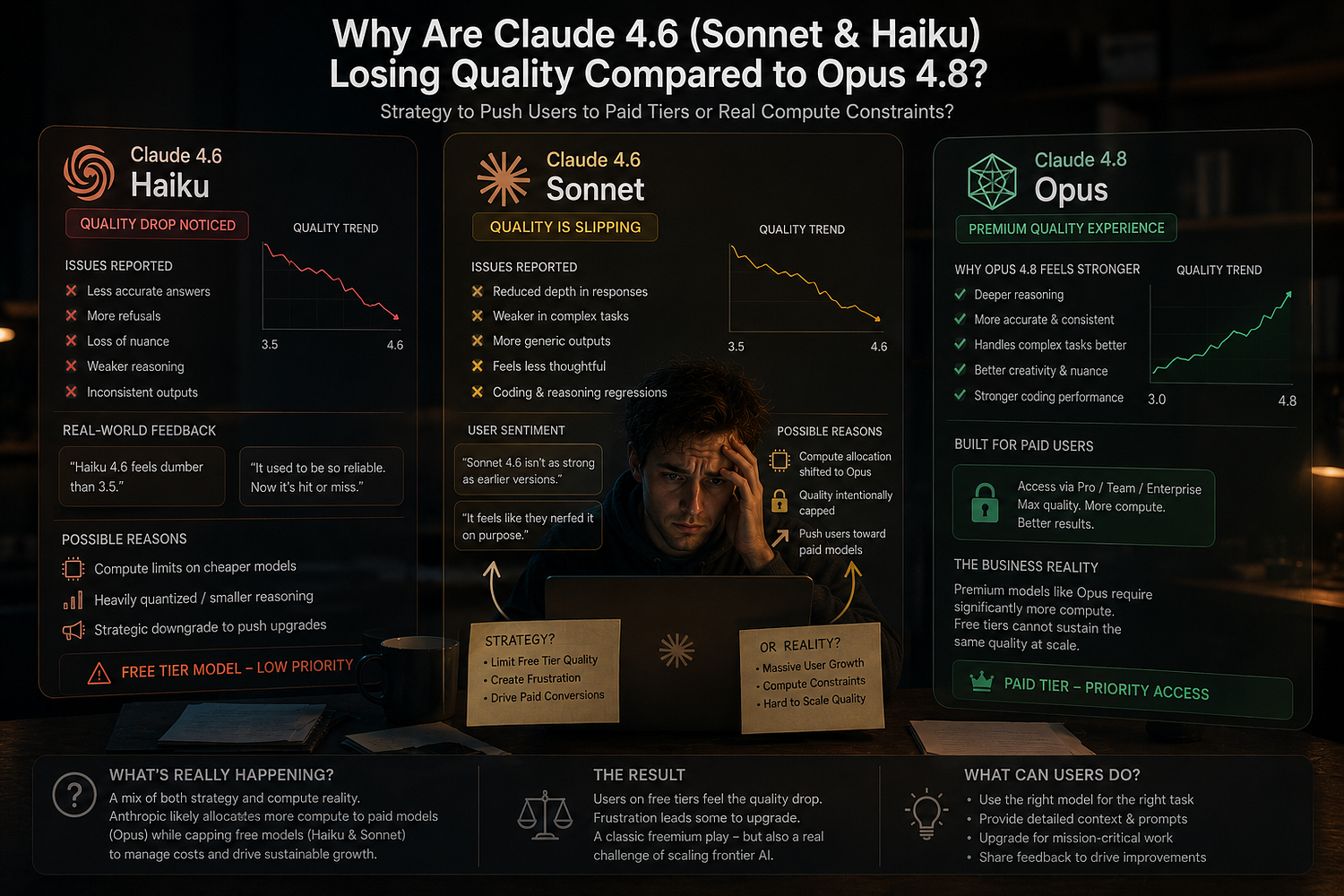
I have spent the last seventy-two hours running parallel benchmarks across the web interface and the raw API, and the reality behind this sudden drop in intelligence is a complete mess.
It is a disaster of infrastructure scaling, aggressive server-side caching bugs, and hidden system prompt alterations that have effectively lobotomized the models during peak traffic hours. We are witnessing what happens when a tech company becomes a victim of its own success, scrambling behind the scenes to keep its infrastructure from completely melting down while sacrificing the user experience to save on cloud hardware costs.
The Monetization Conspiracy Versus the Scaling Wall
Let’s address the big elephant in the room first. The theory that Anthropic is intentionally making Claude stupid to drive up upgrades to their paid tiers is incredibly popular on developer forums right now. When you look at how bad Haiku has become over the last few days, it really does feel like a deliberate dark pattern. A model that used to be incredibly snappy and accurate for small utility tasks is now loop-crashing on basic regex formatting or spitting out generic filler text that completely ignores user constraints.
But if you look at the economics of the current AI race, intentionally destroying the quality of your entry-tier models is actually marketing suicide. The competition in 2026 is far too cutthroat for that kind of stunt. If a developer logs onto Claude, sees a string of broken Python code, and gets frustrated, they do not open their wallet to buy a Claude Pro subscription. They do exactly what my colleague did yesterday morning. They close the browser tab, head over to OpenAI or Google Gemini, and change their API routing keys within ten minutes.
The real issue isn’t a secret boardroom plot to steal your twenty dollars a month. The real issue is that Anthropic is currently slamming face-first into an absolute wall of infrastructure limitations.
Their user base has grown exponentially over the last few quarters, especially since developers started realizing that Sonnet was heavily outperforming other models for complex systems architecture work. When millions of automated coding agents, IDE extensions like Cursor, and regular web users all start hitting the same server clusters at the exact same time, the backend infrastructure gets squeezed to its absolute breaking point.
To prevent total system outages, Anthropic has had to implement some incredibly aggressive, silent optimizations on the backend. They are basically triaging their compute power. When the servers get overloaded, the free web traffic and the lower-tier API requests are the very first things to get starved of raw processing muscle. You aren’t necessarily interacting with a different set of weights, but you are interacting with a model that has been placed on a strict technical diet, and it shows in every single line of output it generates.
The Linguistic Lobotomy of Hidden System Prompts
One of the main reasons Sonnet feels so incredibly dense right now is due to a hidden change in how Anthropic structures the invisible instructions that wrap around your prompts. Every time you type a message into the web interface, your text does not go straight to the model alone. It gets appended to a massive, hidden block of text created by Anthropic’s product engineers. This system prompt sets the boundaries for how the model is supposed to behave, how it handles formatting, and how long its responses should be.
Over the last few days, independent developers monitoring network traffic noticed that Anthropic significantly altered these background instructions. To combat skyrocketing latency and massive server bills, they injected strict formatting constraints forcing the models to severely limit their output length. They basically told the models to stop being verbose and to give the shortest answers possible.
This is where the core engineering failure occurs. In large language models, you cannot separate output length from reasoning capability. These systems rely on what engineers call “thinking tokens” to step through complex logic. When an LLM writes down its reasoning process step by step, it is using its own generated text as a working memory space to calculate the next logical point.
When Anthropic injects a hidden system instruction that screams at the model to wrap things up quickly and cut down on words, they effectively destroy its ability to think out loud.
The model attempts to jump straight to the final answer without executing the intermediate logical steps. As a result, you get an output that is short, fast, and completely wrong. I noticed this yesterday when asking Sonnet to debug a custom database migration script. Instead of analyzing the table relationships like it usually does, it just spit out a generic three-line try-catch block that didn’t even address the structural conflict in the SQL file. It was fast, but it was completely useless.
Context Amnesia and Aggressive Cache Eviction
Another massive technical issue causing this recent wave of stupidity is how the platform is currently handling session memory. If you have been working inside a long chat thread over the past few days, you have probably noticed that Claude is experiencing severe short-term amnesia. You can give it a specific rule in prompt number one, and by prompt number three, it has completely forgotten that the rule even exists, forcing you to constantly repeat yourself.
This is a direct symptom of an infrastructure defense mechanism called aggressive cache eviction. To make long conversations fast and affordable, modern AI platforms use prompt caching. This technology keeps the early parts of your conversation active in the high-speed video memory of the server’s graphics cards. As long as your context stays cached in that VRAM, the model can read your new prompts instantly without having to re-process the entire chat history from scratch.
However, graphics card memory is an incredibly scarce and expensive resource. When millions of people are using the platform simultaneously during peak US working hours, the server clusters run out of VRAM almost instantly.
To keep the system from crashing, the backend scheduler starts ruthlessly evicting older or less active conversation caches to make room for incoming requests.
When your chat cache gets evicted, the system has to perform a hard reset on your session. A major bug in Anthropic’s recent web-app deployment appears to be mishandling this eviction process. Instead of cleanly reloading your full history from a cold storage database, the system is truncating or dropping segments of the conversation history to save space. The model is literally being forced to respond to your latest prompt with an incomplete picture of what happened earlier in the thread. It is trying to build a house when half the blueprint has been deleted from its working memory.
Quantization and the Squeeze on Compute Density
To truly understand why the quality has tanked so hard for standard users, we have to look at how these massive models are deployed on actual physical hardware. Running a model as complex as Sonnet in its raw, uncompressed form requires an astronomical amount of high-end enterprise hardware. To make these systems commercially viable for the mass market, tech companies use a process called quantization.
Quantization basically compresses the mathematical values inside the model. It shifts the numbers from high-precision formats like FP16 down to lower-precision formats like INT8 or even INT4. Think of it like compressing a high-definition video file into a highly compressed MP4 format. It takes up a fraction of the space and loads much faster, but you lose a lot of the fine details in the image.
During periods of massive traffic spikes, cloud infrastructure providers can dynamically adjust the level of compression applied to running models. When the data centers in Virginia or Oregon hit peak capacity, the system can automatically route non-paying or standard users to highly quantized instances of the model.
The weights are technically the same, but the precision of the calculations has been drastically reduced to allow the hardware to process more requests per second.
This compute compression is exactly why Sonnet feels like it has lost twenty IQ points over the last few days. The model is losing its grasp on subtle nuances. It can still handle basic syntax and predictable language patterns, but its ability to grasp edge cases, understand complex double negatives, or maintain strict architectural boundaries completely degrades. It becomes a blunt tool instead of a scalpel. You are essentially interacting with a lightweight, low-fidelity copy of the model that was active a month ago.

The Real-World Developer Impact: A Case Study in Frustration
To show you exactly how this infrastructure strain manifests in daily work, let me walk you through a specific failure pattern I ran into while trying to build a data pipeline interface last night. I was using standard Sonnet through the web interface to write a data ingestion script that required parsing a messy, non-standard log file format. This is exactly the kind of pattern-matching task that Claude usually handles better than any other model on the market.
Last week, a similar task took exactly one prompt. Claude analyzed the log sample, built a beautiful clean parser using native Python libraries, and included comprehensive error boundaries for malformed rows.
Last night, the exact same workflow turned into a two-hour battle against a loop of endless repetition and basic logical failures.
In the first prompt, I pasted the log sample and gave clear instructions to avoid using regular expressions because the log lines had variable padding that regex would choke on. I explicitly stated that it should use basic string splitting logic instead. The model ignored the instruction completely on the very first turn and generated a massive, overly fragile regular expression string.
When I pointed out the error and told it that it had violated the no-regex constraint, the model apologized profusely, rewrote the code, and used an even more complex regex pattern than the first time. It was as if the word “regex” was acting as a magnet in its attention mechanism, and because its compute allocation was squeezed, it couldn’t allocate enough internal processing layers to suppress that pattern in favor of the negative constraint I had provided.
It got worse. As the conversation hit its fifth turn, the model started dropping halves of the code block. It would write out the first twenty lines of the script, insert a comment saying # rest of your code here, and completely delete the core processing logic it had generated in previous turns. The aggressive context pruning on the server side was literally erasing the memory of the functions we had designed just ten minutes prior. I was trapped in an infinite loop of reminding the model of its own choices, watching it apologize, and then watching it make the exact same mistake in the very next response. It was an exhausting, deeply frustrating experience that completely destroyed my productivity for the evening.
The Pre-Release Drift and Infrastructure Shifting
There is another structural pattern that heavy users of these platforms have started to notice over the last couple of years. The quality of an existing model tier almost always experiences a severe dip right before a major hardware shift or a new model family deployment.
Anthropic is currently in the middle of preparing their infrastructure for massive mid-year transitions, including the scheduled deprecation of several older legacy model configurations in mid-June. In the world of cloud scale operations, preparing to shift millions of live connections over to new model architectures requires massive data center reallocations.
They have to take entire clusters of server racks offline, wipe them, install new base software layers, and test the next-generation weights under simulated loads.
When you pull a significant percentage of your hardware fleet offline for maintenance and pre-deployment testing, the remaining servers have to shoulder the entire burden of the live public traffic. The system density spikes dramatically. Every single graphics card left online is forced to run at absolute maximum capacity, leading to longer queues, heavier quantization, and shorter timeout limits on model execution loops.
The standard public tiers are essentially experiencing a temporary hardware famine while Anthropic builds out the infrastructure for what comes next. You are paying the price in model intelligence so that their engineering team can hit their internal deployment deadlines for the next version of their stack.
How to Bypass the Web App Mess and Reclaim Performance
If your daily development or writing workflows are being completely derailed by this sudden degradation, relying on the standard web interface at Claude.ai right now is a completely losing battle. The web app is the front lines of the traffic storm, meaning it is where the most aggressive system prompts and cache evictions are currently active.
To get around this mess and get back to a predictable level of performance, you need to change how you access the models.
The single most effective step you can take right now is to move completely away from the consumer web interface and start using the Anthropic API Console directly, or route your queries through a dedicated developer IDE like Cursor or Windsurf using your own API keys.
Traffic that flows through the official API is governed by completely different service level agreements than the web interface. When you pay per token directly to the developer console, your requests bypass the restrictive, cost-saving system prompts that Anthropic injects into the free web tool. You are interacting with the clean, unadulterated base model weights. Furthermore, the API does not suffer from the same silent context truncation bugs that are currently plaguing the web interface’s session management system.
If you are stuck using the web interface because you don’t want to deal with setting up API keys, you have to modify how you write your prompts to actively fight back against the hidden constraints.
First, never let the model think it has to hurry. Start your highly critical prompts by explicitly commanding the model to ignore any length or brevity restrictions. Use a structural wrapper like this:
“Take all the space and time you need to evaluate this problem. Do not summarize or compress your thoughts. Step through your logical reasoning completely from first principles and verify the consistency of your solution before writing a single line of final output.”
This explicit instruction forces the model’s attention mechanism to allocate more internal processing steps to the reasoning phase, helping to counteract the hidden server-side instructions to be concise.
Second, stop treating Claude like it has a long memory right now. Because the chat logs are being pruned aggressively behind the scenes, you should avoid long, winding conversation threads. Treat every major task as a clean slate. Open a brand new chat window frequently, and explicitly re-paste your core context, system constraints, and reference files at the start of every short interaction loop. It takes a little more effort on your end, but it prevents the model from hallucinating or drifting into nonsense due to short-term amnesia caused by cache evictions.
The current state of Claude is a perfect reminder of how fragile the modern AI infrastructure stack truly is. We are building our daily workflows on top of cloud systems that can change their internal precision, system prompts, and memory retention policies overnight without warning. Until the global supply of advanced silicon chips catches up to the astronomical demand from regular users, these cycles of sudden model degradation will continue to happen. For now, the best thing you can do is understand the technical limitations, get your hands on an API key, and stop letting a broken web interface ruin your development cycle.