Apple’s biggest software event is seven weeks away. WWDC 2026 starts June 8, and if even half the leaks are accurate, iOS 27 is going to be a pretty different kind of update. Not bigger, not flashier — actually, kind of the opposite. After two straight years of heavy redesigns and AI promises that mostly didn’t land, Apple is reportedly stepping back and doing the boring-but-necessary work. Bug fixes. Performance. Stability. And one very delayed feature that was supposed to arrive back in 2024.
So what’s actually coming? And more importantly, should you care?
The honest answer is: it depends on which iPhone you have.
The Siri Story (Which Is a Bit Embarrassing, If You Think About It)
Here’s the thing — Apple announced a completely rebuilt version of Siri at WWDC 2024. That was almost two years ago. The whole pitch was that Siri would finally understand what’s on your screen, remember things from your emails and messages, handle multiple steps in one go, and basically stop being the assistant everyone quietly gave up on after getting burned too many times. People were excited. There were demo videos. Tim Cook looked very pleased with himself.
Then it didn’t ship.
Spring 2025 came and went. Apple said it needed more time, which, fair enough, getting AI stuff right is hard. But then they missed their iOS 26.4 target in March 2026. According to Bloomberg’s Mark Gurman, internal testing found that Siri sometimes doesn’t properly process queries and can take too long to respond. Gurman’s sources also said Siri has a tendency to cut speakers off when they talk too fast, or has difficulty processing complex queries. Then iOS 26.5 beta dropped a few weeks ago with no new Siri features in it at all.
So here we are. When Apple introduced the Apple Intelligence version of Siri in June 2024, it said the feature set would launch in an update coming in 2025. When spring 2025 rolled around, Apple announced a delay. After that setback, Apple made no promise other than saying the revamped version of Siri would launch in 2026.
And now, almost certainly, it’s iOS 27 or nothing. September 2026 at the earliest.
Some people in tech forums are joking about it. Others are genuinely annoyed. The comment that stood out on the MacRumors thread was someone writing, “So glad my iPhone 16 Pro was the first iPhone made for AI” — dripping with the kind of sarcasm that only comes from waiting 18 months for a feature you were told was almost ready.
What the New Siri Will Actually Look Like
OK so once it does arrive, what are we getting? According to Gurman, who seems to have pretty solid sources inside Apple right now, the redesign is more than just a software update. The whole visual approach is changing.
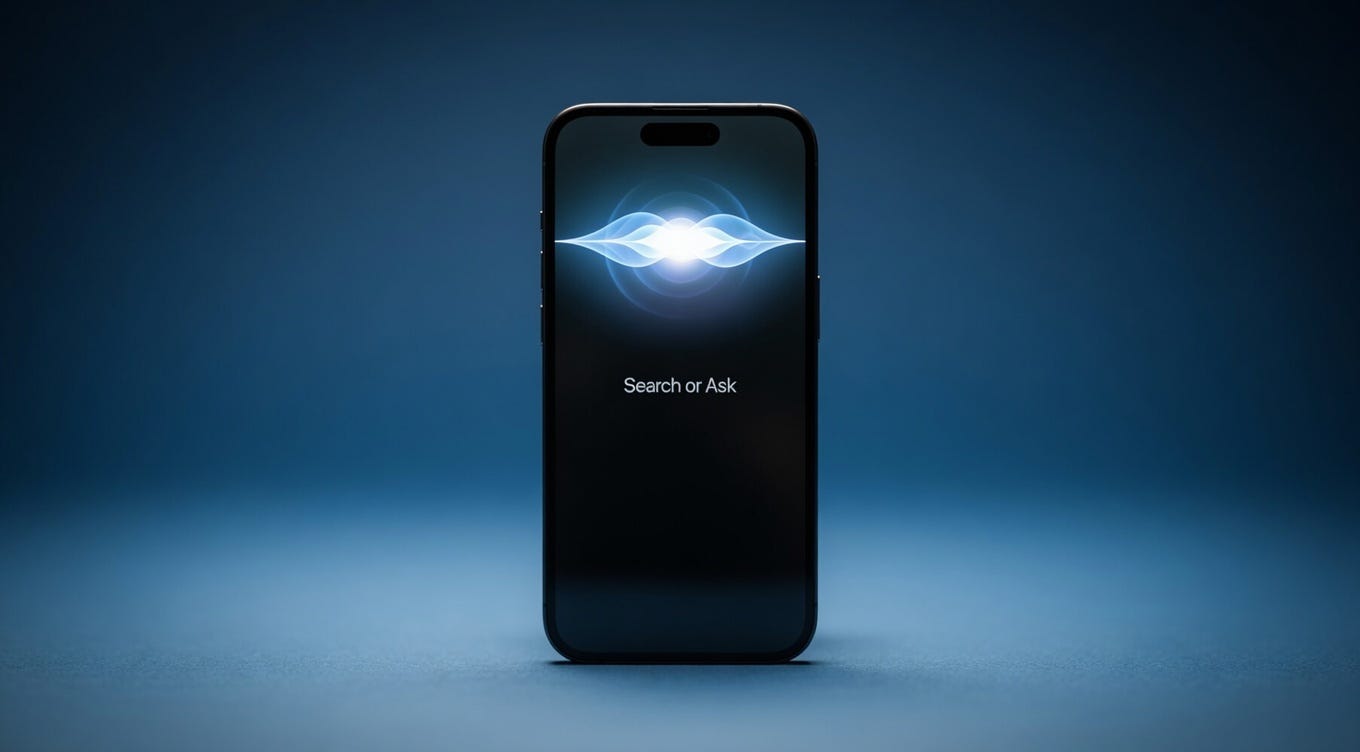
When activated, the redesigned Siri will expand outward from the iPhone’s Dynamic Island. The pill-shaped cutout will feature a glowing cursor and a prompt that reads “Search or Ask” — a visual treatment that looks especially striking when using dark mode. Gurman also believes Apple already hinted at this in plain sight. The WWDC 2026 invitation shows a glowing “26” with this exact kind of halo effect, and he confirmed it’s a direct visual preview of the new Siri interface — when you trigger Siri on a supported iPhone in iOS 27, the Dynamic Island will glow in exactly this way.
But the visual redesign is only part of it. The bigger change is what Siri can actually do.
The more capable version of Siri that Apple first unveiled at WWDC 2024 was part of a broader initiative called Apple Intelligence. Apple outlined three core abilities for the upgraded assistant: understanding personal context drawn from emails, messages and files; interacting directly with content visible on the iPhone screen; and performing actions inside apps without requiring users to open them manually.
All of that is still in the plan for iOS 27. Plus, in a major shift, Siri will also get its own dedicated app. This standalone application will feature a glowing text search bar, unify the currently separate Siri and Spotlight search interfaces, and store previous conversations with the assistant. So basically it becomes something that looks and works a lot more like ChatGPT or Gemini — but built into the system so you don’t have to switch apps.
The internal codename for this new Siri chatbot is “Campos,” by the way. The consensus among insiders is that Apple plans to deliver Siri 2.0 in iOS 27, alongside a full Siri chatbot with a standalone app in the style of ChatGPT or Gemini.
One more thing worth knowing: to help drive this next-generation intelligence, Apple has partnered with Google to incorporate a customized version of its Gemini AI models into the Apple ecosystem. So if you had been thinking of Siri as a purely Apple product — well, there’s Google running underneath it now. Whether that bothers you probably depends on how you feel about Google.
Four New Apple Intelligence Features Found in the Code
Beyond the Siri rebuild, researcher Nicolás Alvarez dug into Apple’s backend code and found references to at least four new Apple Intelligence features that are almost certainly heading to iOS 27. MacRumors confirmed the findings.
Visual Intelligence is getting at least two new capabilities. One will likely let you scan a food nutrition label to get more information, which could well integrate into the Health app. Another will offer to add printed phone numbers and addresses to your Contacts. Visual Intelligence already offers to add calendar dates to your Calendar, so an equivalent feature for contacts makes sense.
Apple’s Wallet app is likely to gain the ability to generate digital passes from scans of things like event tickets and gym membership cards. Google Wallet for Android already does something similar, using AI to determine the content of a pass.
And then there’s a small but actually useful one: in Safari, a new AI feature will automatically name Tab Groups for users based on the contents of the tabs within the group. Anyone who has ever opened Safari, looked at a list of unnamed tab groups from six months ago, and had zero idea what any of them were for — this one will make sense to you.
Worth saying clearly though: we can’t say with certainty that the above features will work as described, since they’re interpreted from the names of individual code strings. We also don’t know for sure they will appear in iOS 27 or a future point update. Apple could always delay or quietly drop something.
The Snow Leopard Plan
If you remember Mac OS X Snow Leopard from 2009, Apple is basically doing the same thing here. That release had almost no new features. It was all about cleaning up the mess that had accumulated in the system and making everything run properly. At the time it felt kind of underwhelming to announce. In practice it made Macs noticeably better.
With iOS 27 and macOS 27, the team will focus on software quality and core performance. Outside the chatbot shift, the operating systems will not see huge changes in 2026. Apple plans a cleanup across its platforms, which have grown heavy and show bugs in some areas.
Apple will refine the “Liquid Glass” interface introduced in iOS 26, giving users better control over transparency and readability. A system-wide slider for adjusting the opacity of Liquid Glass is apparently in testing, which is a direct response to complaints that iOS 26 could be hard to read in certain lighting conditions. Plus improved keyboard autocorrection, home screen undo and redo — small things that add up.
So don’t expect a big “wow” moment at the WWDC keynote in terms of visual changes. The interesting stuff is going to be Siri and performance, and honestly that’s the right call after the past two years. iOS 26’s Liquid Glass redesign was a big swing. Some people loved it, a lot of people found it janky on older hardware. The sensible move now is to stabilize.
Which iPhones Get iOS 27 (And Which Get Left Behind)
This is where things get a bit annoying for a chunk of users.
A leaker known as “Instant Digital” has said iOS 27 will drop support for the iPhone 11, iPhone 11 Pro, iPhone 11 Pro Max, and the second-generation iPhone SE. Apple hasn’t confirmed this officially — the real list comes at WWDC on June 8. But it lines up with the general expectation that devices with the A13 chip are at the end of their cycle. That’s seven years of software support, which is actually longer than most Android phones get. Still, if you’re on an iPhone 11 and were planning to hold out another year, this is probably not great news.
Even if you have a newer phone, that doesn’t automatically mean you get everything. Any new Apple Intelligence features introduced in iOS 27 will require an iPhone 15 Pro or newer. So if you have an iPhone 14, iPhone 13, or even a regular iPhone 15 — the device runs iOS 27 fine, but the AI stuff isn’t coming to you. That’s the same cutoff Apple used in iOS 26, and it’s still frustrating for people who bought an iPhone 14 Pro two or three years ago expecting it to be future-proof.
And there’s actually one more layer to this. The full Dynamic Island Siri experience is expected to be restricted to iPhone 15 Pro and newer. The Dynamic Island itself is available on iPhone 14 Pro models, but Apple Intelligence compatibility limits the new Siri features to the more recent hardware tier. Owners of iPhone 14 Pro will see the Dynamic Island but likely won’t get the complete visual redesign.
So to be really specific: you can have a Dynamic Island and still not get the new Siri interface. That’s a distinction Apple hasn’t been super loud about, and it’s worth knowing before you assume your phone qualifies.
The Foldable iPhone Angle
There’s a bigger hardware story hiding inside iOS 27 that doesn’t get talked about enough.
iOS 27 is expected to lay the technical groundwork for Apple’s first foldable iPhone, which is widely anticipated to launch later in 2026. To support this larger, flexible display format, iOS 27 will introduce multitasking and interface adjustments borrowed from conventions currently used in iPadOS.
The foldable is reportedly going to have a 7.8-inch inner display and a 5.5-inch outer one, priced somewhere around $2,400, which is — yeah. That’s a lot. But for iOS 27 to support it properly on day one, Apple basically has to build folding-phone software architecture into the OS months in advance. So some of what looks like “iPadOS-style multitasking coming to iPhone” in iOS 27 is actually Apple quietly laying track for a device most people won’t buy.
What Critics Are Saying
The reaction to everything around iOS 27 has been mixed, and not in a polite both-sides way.
The Siri delay situation has been genuinely bad optics. The initial attempt to smarten up Siri was, to put it bluntly, a train wreck. Gurman and others reported that what Apple actually showed off at WWDC 2024 was a “barely functional prototype” that it genuinely believed it could polish up and get ready in time. That’s a rough description of a product Apple put on a stage and told millions of people was coming.
There’s also a product bottleneck problem that goes beyond just software. Apple reportedly has several products that are actually ready to go, but for one missing piece — the new Siri. The company internally develops its own chips, hardware, software, and services, which gives it greater control of launch timing. And right now, Siri’s delays are reportedly holding back four new products. That’s a hard thing to explain to investors and customers.
On the device compatibility side, the complaint you see most often is about the hardware fragmentation. An iPhone 15 runs iOS 27. A 15 Pro gets full Apple Intelligence. A 15 (non-Pro) gets limited Apple Intelligence. And a 14 Pro — which was marketed two years ago as a pro device — gets iOS 27 but none of the new Siri stuff and no Dynamic Island redesign. For people who paid premium prices for those phones, the logic feels a bit thin.
Then there’s the Google partnership, which has not been universally welcomed. Apple’s whole privacy positioning for years has been that your data stays on your device and out of anyone else’s hands. Now they’re routing the AI assistant through Google’s models. The company says privacy is maintained, and maybe that’s true, but the optics of it are awkward. A lot of Apple users chose iPhone specifically to avoid Google.
And honestly, some of the criticism is just fatigue. Two years of “Siri is getting smarter, it’s almost here” messaging, and still nothing working properly in daily use. iOS 27 seems like it should fix that. But people have heard this before.
Is This Update Worth Getting Excited About?
Sort of. If you have an iPhone 15 Pro or newer, this is probably going to be the most genuinely useful iOS update in a couple of years — if Siri actually works this time. A chatbot-style assistant that remembers context, handles multiple steps, and pulls from your calendar and emails without having to open each app separately is something that would change how people actually use their phones. Not in a demo way, in a daily-use way.
But there’s a version of this where Apple shows Siri 2.0 at WWDC, the crowd cheers, developers go try it in June betas, and then by September launch it’s still a bit clunky and missing half the promised features. It has happened before. The question is whether “Campos” is actually working as claimed, or whether the leaks are still describing what people are hoping for.
iOS 27 will not have a moment. There is no feature Apple can put on a slide that makes the crowd react. What it has instead is a version of Siri that might finally feel like it is paying attention, a set of small camera and app improvements that remove real daily friction — the kind of under-the-hood work that makes a phone feel better for the next three years rather than just the first three days.
That’s probably the right way to think about it. The Snow Leopard approach won’t produce impressive screenshots. But if it works, iPhones will just feel more reliable and less frustrating by Christmas. For a lot of users, that’s more useful than anything else Apple could ship.
We’ll find out properly on June 8.