The community has been asking AMD this question for years now. If one 3D V-Cache chiplet makes a CPU faster, what happens when you put two of them in there? One for each CCD? Surely that doubles the benefit, right?
AMD finally answered that question on April 22, 2026 with the Ryzen 9 9950X3D2 Dual Edition. The name is a mouthful — KitGuru’s Leo Waldock called it “a clanger of a name” and honestly he’s not wrong. But the name is the least of this chip’s problems. At $899, with a 200W TDP, and performance gains that most reviews are calling “modest at best,” the 9950X3D2 has arrived into a rather hostile crowd.
Let’s look at what AMD actually built here, what the benchmarks say, and whether any of this makes sense for you as a buyer.
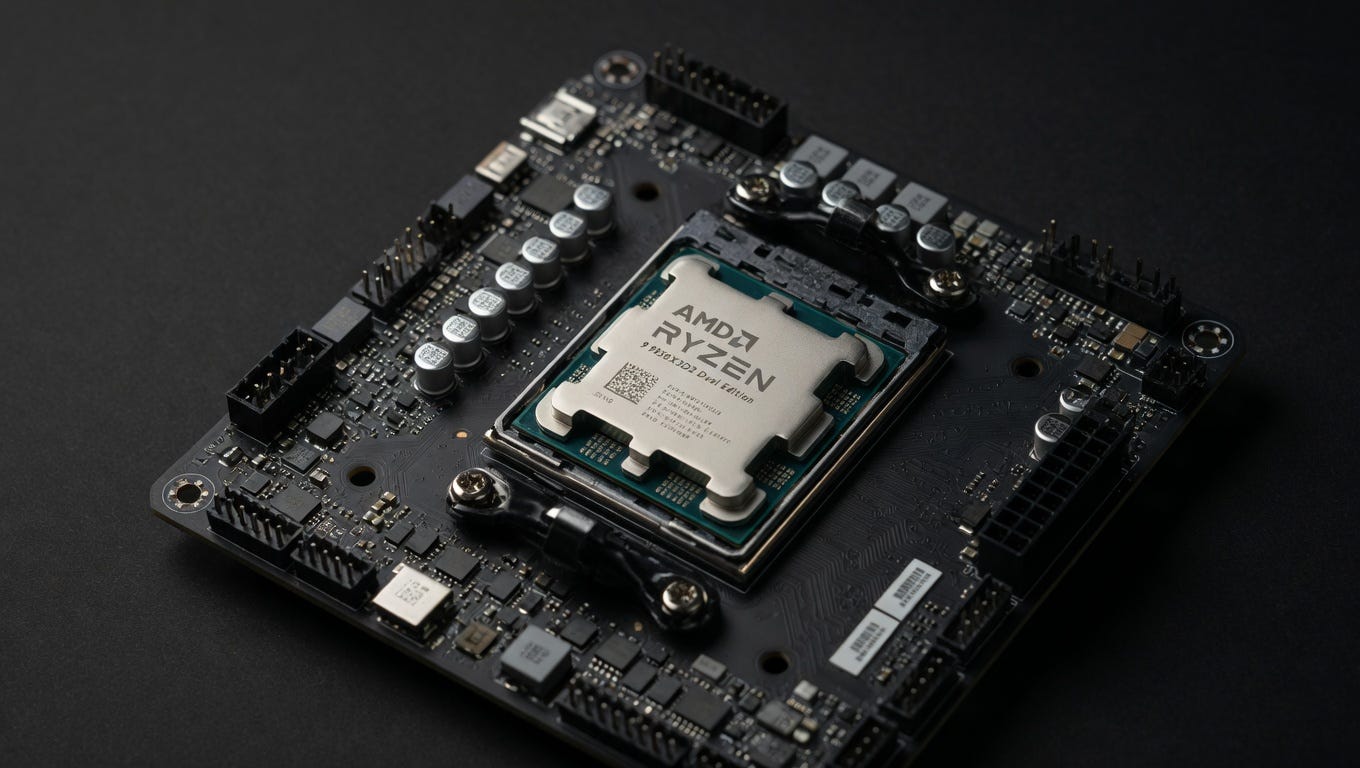
What’s Actually New Here
So the background: AMD’s 3D V-Cache technology is basically extra SRAM stacked directly onto the CPU chiplet using TSMC’s advanced packaging process. The idea is that more cache means the processor can hold more data close to the cores, which reduces the number of times it has to go all the way out to slower main memory. For workloads that are memory-latency sensitive — gaming, simulation, certain compile tasks — the speedup can be pretty big.
The original 5800X3D in early 2022 proved the concept worked. The gaming community went a little crazy about it. Then AMD brought it to Zen 4 with the 7000X3D series, and later to Zen 5 with the 9800X3D and 9950X3D. All of those chips have one CCD with the cache stack on it. The other CCD in dual-CCD chips like the 9950X3D runs without any extra cache.
The problem with that asymmetric layout is a pain that reviewers flagged from day one. With the 7950X3D, for example, disabling the non-cached CCD actually improved gaming performance by 8–25% depending on the game, because the scheduler kept sending gaming threads to the wrong chiplet. This was a known issue. TechSpot’s review confirmed this in their day-one testing — Rainbow Six Extraction specifically showed a 25% frame rate improvement when the non-cache CCD was disabled. People worked around it. AMD’s software improved over time to handle it better, but it was never fully clean.
Beyond the scheduling problem, the 1st-gen V-Cache design also had a thermal issue. Because the cache was stacked on top of the cores, it acted as an insulating layer between the cores and the heatspreader. Heat generated by the cores had to pass through the cache die before it could escape. This required AMD to run lower voltages and lower clock speeds to prevent overheating — which is why the first 3D V-Cache chips were always clocked lower than their non-cached counterparts. The CCD without cache could reach 5.7 GHz on the 7950X3D, while the CCD with cache topped out around 5.2 GHz.
The 9950X3D2 fixes the scheduling issue by putting a 64 MB 3D V-Cache tile on both CCDs. Now every core has the same cache advantage. No more “disable CCD1 in BIOS” workarounds for gaming. And AMD’s 2nd-gen V-Cache design, introduced in the Zen 5 X3D lineup, flips the position of the cache — it now goes under the cores instead of on top. This lets the cores make direct contact with the IHS, reducing thermal resistance by a reported 46% compared to the old design. That’s why Zen 5 X3D chips can boost higher.
So the 9950X3D2 gets 128 MB of total stacked cache across both CCDs, plus 64 MB of native L3. Add the 16 MB of L2 and you get 208 MB of total on-die cache. That’s more than most server chips. On a desktop consumer platform. In 2026.
The Specs
The chip has 16 cores, 32 threads, a base clock of 4.3 GHz, and boosts up to 5.6 GHz. It’s built on TSMC’s 4nm process and contains 16,630 million transistors. TDP is 200W, and the maximum socket power (PPT) goes up to 270W.
Compare that to the 9950X3D sitting one step below it: same cores, same threads, same base clock, but a 5.7 GHz boost (100 MHz faster), 128 MB of L3 cache (64 MB less), and a 170W TDP (30W less). The price difference? A chunky $200 premium. You get more cache for more cash, basically.
The increased PPT — going to 270W, which is 70W more than the 9950X3D’s 200W — isn’t fully explained by AMD. Cache needs power, yes, but reviewers at Puget Systems note that 70 extra watts seems like a lot just for cache. Their suspicion is that AMD is using the higher power budget to allow more aggressive boost behavior under all-core loads.
AMD recommends liquid cooling for optimal performance. The Register’s review notes that the chip works on any existing AM5 motherboard, so you don’t need a new platform. DDR5–6000 remains the sweet spot for these Zen 5 chips.
The chip also supports full overclocking. This is notable because first-gen 3D V-Cache parts were locked — the thermal situation didn’t allow it. Second-gen allows it. So you get Precision Boost Overdrive, Curve Optimizer, the whole AMD overclocking toolkit on a V-Cache chip. That’s genuinely new. An enthusiast already overclocked the 9950X3D2 to 5860 MHz within days of launch, which is kind of wild given the thermal constraints these chips usually operate under.
One last thing worth mentioning: AM5 compatibility is universal here. You don’t need a new motherboard. Any X670, B650, or X870 board that already runs Zen 5 will work with the 9950X3D2 after a BIOS update. That’s a real advantage AMD has over competitors who tend to require platform changes with major CPU launches.
Gaming: The Part Everyone’s Disappointed About
Here’s where most reviews get uncomfortable. The 9950X3D2 is not a gaming upgrade.
Tom’s Hardware’s 17-game geomean showed the dual-cache version is only 0.8% faster than the 9950X3D in average frame rates, with 1.3% better 1% lows. They called the gaming performance “identical.”
TechSpot points out this makes technical sense — most games don’t actually need more than eight Zen 5 cores with 3D V-Cache, and even if they did, the latency penalty when communicating between the two dies would hurt gaming performance anyway.
Club386 tested Cyberpunk 2077 and found the 9950X3D2 squeezed ahead of the 9950X3D by 4–6% across minimum and average results — but it was still 7–8% behind the Ryzen 7 9800X3D, which is half the price. In F1 25, the two chips were basically identical. And in some titles, minimum frame rates were actually worse on the 9950X3D2.
The value picture in gaming is not good. Tom’s Hardware’s per-dollar value calculation showed most chips near half a frame per dollar, while the 9950X3D2 couldn’t manage even a quarter frame per dollar.
So if gaming is your main reason for spending $899 on a processor, this is not your chip. The Ryzen 7 9800X3D at around $450 will beat it or match it in almost every game. The 9850X3D gives you an extra 8 cores for moderate extra cost and performs essentially the same in games. There is no gaming reason to buy the 9950X3D2.
AMD said this themselves at launch, which is… at least honest, I guess.
Productivity and Professional Workloads: Better, But Not Much
This is where the 9950X3D2 was supposed to shine. And it does — just not by as much as the $200 premium suggests.
Puget Systems found a 13% performance improvement over the 9950X3D in game development workflows — things like compiling Unreal Engine shaders and Chromium source code. For a studio that has developers doing this all day, 13% is actually meaningful. That’s an hour saved on every 7.7 hours of compile time.
In DaVinci Resolve and Blender, performance increases were in the 5–8% range compared to the 9950X3D in memory-intensive workloads. SPECworkstation 4 showed a healthy improvement too, according to KitGuru’s testing.
But here’s where it gets complicated. The gains are very workload-specific.
In Photoshop, the 9950X3D2 is only 0.6% faster than the 9950X3D. In Adobe Premiere Pro, the difference is less than 1%. These are extremely common creative tools. If you’re spending most of your day in Premiere, buying this chip over the 9950X3D would be spending $200 for something you cannot actually feel.
KitGuru describes the extra cache benefit as “very much a case of trial and error” — some software gets a clear boost, others don’t move at all. You really need to check whether your specific workflow is cache-sensitive before spending $899.
Tom’s Hardware noted that the performance improvements show up mainly in specialized workloads like data science, where large datasets fit better in 208 MB of L3 cache. They found performance increases as large as 25% in some of these edge cases. But edge cases are called that for a reason.
The Cinebench 2026 single-core result was a bit embarrassing, actually. Club386 noted that the 9950X3D2 earned a “proverbial bronze medal” in single-thread, and the cheaper 9950X without any cache stack was faster — albeit by just two points. The extra cache adds latency to some operations where raw clock speed matters more, and the 5.6 GHz ceiling (down from 5.7 on the 9950X3D) shows up there.
Power and Thermals: The Ugly Part
This is probably the biggest concrete downside of this chip.
200W TDP is a lot. 270W PPT is really a lot. Hardware Unboxed’s testing showed about 27% higher power draw in synthetic benchmarks for just 4% average performance uplift. That efficiency ratio is hard to defend.
The thermal situation improved compared to the old stacked-cache-on-top design — second-gen V-Cache under the cores reduces thermal resistance by 46% — but “improved compared to a hot chip” still means “hot chip.” AMD recommends liquid cooling. A 420mm AIO is probably the right starting point. A 360mm will work. A high-end air cooler might struggle under sustained all-core load.
Builders who already have a capable cooler for their existing Ryzen 7000 or 9000 setup should be fine. But if you’re buying everything fresh, budget for cooling.
The Local AI Angle
One area nobody saw coming a couple years ago: local AI inference. This chip is actually quite good at it.
In 2026, users routinely run large language models at the 7B–13B parameter scale locally — for private document processing, coding assistance, image generation, and real-time transcription. The critical insight for CPU-based inference is that L3 cache capacity directly determines how much of a model’s weight data can be accessed without touching DRAM. When model layers fit in cache, token generation throughput improves and latency per token drops. The 9950X3D2’s 192 MB of L3 is the largest available in any desktop consumer processor.
So if you’re running local LLMs — and a lot of people are in 2026, particularly for privacy reasons — the cache advantage is real and consistent. A 7B parameter model in 4-bit quantization fits comfortably in the 9950X3D2’s cache window in a way it doesn’t on any other consumer desktop chip.
Desktop AM5 systems also typically don’t have a dedicated NPU. Laptops in 2026 increasingly do, handling AI inference in hardware specifically designed for it. But on the desktop side, the CPU is doing that heavy lifting, so cache richness matters in a way it wouldn’t in a system with a proper neural processor sitting alongside it.
AMD’s own BOXX performance lab testing in February 2026 used benchmarks including SPEC Workstation 4.0 ONNX Inference and SPEC Workstation 4.0 NAMD, and showed meaningful improvement over the 9950X3D in these kinds of memory-bound workloads. The numbers aren’t broken down cleanly in the marketing materials, but Newegg’s editorial puts the AI inference improvement in the same neighborhood as rendering — around 5–13% depending on the specific task.
This isn’t AMD’s main marketing pitch, but it’s probably the most forward-looking argument for buying this chip today. As local AI inference tools get more popular and model sizes stay in the 7–13B range for edge deployment, large cache will keep mattering. Whether that makes the $200 premium worth it compared to the 9950X3D is still a stretch for most people.
The Review Embargo Controversy
This has to be mentioned because it’s been a big deal in the tech community this week.
AMD withheld review samples from major outlets including Gamers Nexus, TechPowerUp, Linus Tech Tips, JayzTwoCents, Hardware Canucks, and Paul’s Hardware ahead of launch. ComputerBase, HardwareLuxx, eTeknix, and PC Watch were also left out.
Gamers Nexus published a video titled “Blacklisted by AMD,” criticizing AMD and claiming that Team Red had offloaded communication with GN to a third-party PR agency, cutting off the direct access they’d had for years.
TechPowerUp noted that day-one reviews of the 9950X3D2 were being published mainly by sites “unlikely to do deep analysis” and that retail channels were restricted by AMD, preventing them from providing units to press before launch.
The situation between Hardware Unboxed and Gamers Nexus has since escalated into its own separate drama, with viewers accusing HUB of shadowbanning critical comments. It’s a mess.
The plain reading of all this is: AMD knew the chip would review poorly in gaming benchmarks, and they managed sample distribution accordingly. As one commenter on ResetEra put it, “The Occam’s Razor answer is that AMD knew the product was going to review poorly, so they didn’t send out many samples.” It’s hard to argue with that logic.
This is bad behavior from a company that built a lot of goodwill with the enthusiast community over the last decade. Gamers Nexus did critical coverage of AMD. AMD apparently stopped liking that. The result is a controversy that’s overshadowing what should have been a simpler conversation about a new high-end CPU.
Who Should Actually Buy This
The Register’s review put it well: today, Intel doesn’t have anything in this performance class or price bracket, which means AMD is really competing against itself.
So who’s the actual buyer?
Code developers who spend hours waiting for Unreal Engine or Chromium compilation — the 13% speedup is real and adds up over weeks. If a developer machine runs 4–6 Unreal shader compilation cycles per day, the time savings across a year of work might actually justify the $200 over the 9950X3D. Studios with tight iteration cycles can probably make this math work.
Data scientists running memory-bound simulations. If your models hit the L3 ceiling on a 9950X3D, the extra 64 MB is where the 9950X3D2 earns its keep. Same for fluid dynamics or molecular simulation workloads that showed up in AMD’s BOXX labs testing in February 2026 — things like LAMMPS and OpenFOAM benchmarks.
People running local LLMs at 7–13B scale who want the best CPU inference performance available right now, without going to Threadripper territory and its much higher price of entry.
And, yes, people who just want the fastest consumer desktop CPU money can buy, full stop. Whether that’s for 3D rendering that needs to be done in the absolute quickest time possible, or for bragging rights, or both.
But for gamers? No. For most content creators? The 9950X3D at $699 saves you $200 and you’ll basically never feel the difference in Premiere or Photoshop. Not even 1% in those specific tools, according to Club386’s testing.
People upgrading from something like a Ryzen 7 5800X3D or 7800X3D and trying to decide where to land — the 9800X3D at around $450 is almost certainly the better upgrade path unless your workflow is specifically cache-sensitive in the way described above.
Even Tom’s Hardware admits the value proposition here is poor and that AMD probably wouldn’t disagree — you buy the 9950X3D2 because it’s the best, not because of compute-per-dollar. That’s a very small group of buyers.
The Bigger Picture
AMD has done something technically interesting here. Getting symmetrical dual 3D V-Cache working on a consumer desktop chip, with full overclocking support, on AM5 with existing motherboards — that’s not easy. The 2nd-gen V-Cache design that puts the cache below the cores instead of above them is genuinely better engineering than what they had in 2022.
But “interesting engineering” and “good value purchase” are different things. Hardware Unboxed concluded the 9950X3D2 shouldn’t even exist as a product and doesn’t replace the 9950X3D. Wccftech argued that if AMD had priced it at $749, it would make more sense, but still wouldn’t beat cheaper X3D chips in gaming.
KitGuru gave it a 7/10 and said they “waited a year for the AMD Ryzen 9 9950X3D2 Dual Edition and have to confess we are disappointed.” That sentence kind of sums up the community mood.
The 9950X3D2 is AMD’s halo product. It’s not supposed to be good value — halo products never are. The Ferrari of desktop CPUs for a specific type of professional buyer who needs the absolute best and knows their workload is cache-sensitive. For everyone else, it’s a chip to admire from a distance and not buy.
The community controversy around review samples is a separate issue that AMD needs to address properly. Selective distribution to manage negative coverage is a bad look, and Gamers Nexus is not going to let it go. Given that GN already has a history of publishing uncomfortable findings about AMD products, and given that they were specifically excluded, the optics are not great.
For now: the 9950X3D2 is available at $899 from major retailers and in prebuilt systems like the Alienware Area-51 Desktop. If your workload is cache-sensitive and you have the budget, it’s the fastest consumer desktop chip available. If you’re gaming, just get a 9800X3D or wait for Zen 6, which is already being talked about in terms of AM5 compatibility and next-gen cache design.
The dual V-Cache experiment has given us answers. The cache scaling is real but diminishing. The use cases are narrow. The price is steep. And AMD’s handling of the launch has left a sour taste for people who have followed the company carefully for years.