“The best time to support a platform was six years ago. The second best time is 2026.”
There is a particular kind of frustration that only people who run Linux on ARM hardware understand deeply.
You watch a piece of software land on Windows first. Then macOS. Sometimes even ChromeOS gets a mention. And Linux? Linux gets a bug report labeled “Won’t Fix” and a forum thread full of workarounds that technically function but never quite feel legitimate.
That experience has defined Chrome on ARM64 Linux for the better part of a decade. You could run Chromium, the open-source version of Chrome that lives upstream of Google’s proprietary product. It looked almost identical. It ran websites. But it was not Chrome, and the difference mattered more than it sounds.
On March 12, 2026, Google confirmed that this changes.
Chrome is officially coming to ARM64 Linux in Q2 2026, somewhere between April and June. That is not a community build. Not a workaround. Not a stripped-down alternative. That is the actual product, the same one that three billion people use every day, finally arriving on a platform that has been waiting for it since 2020.

Part One — The Wait
The Six-Year Gap Nobody Talked About Enough
To understand why this announcement carries real weight, you need to understand the timeline.
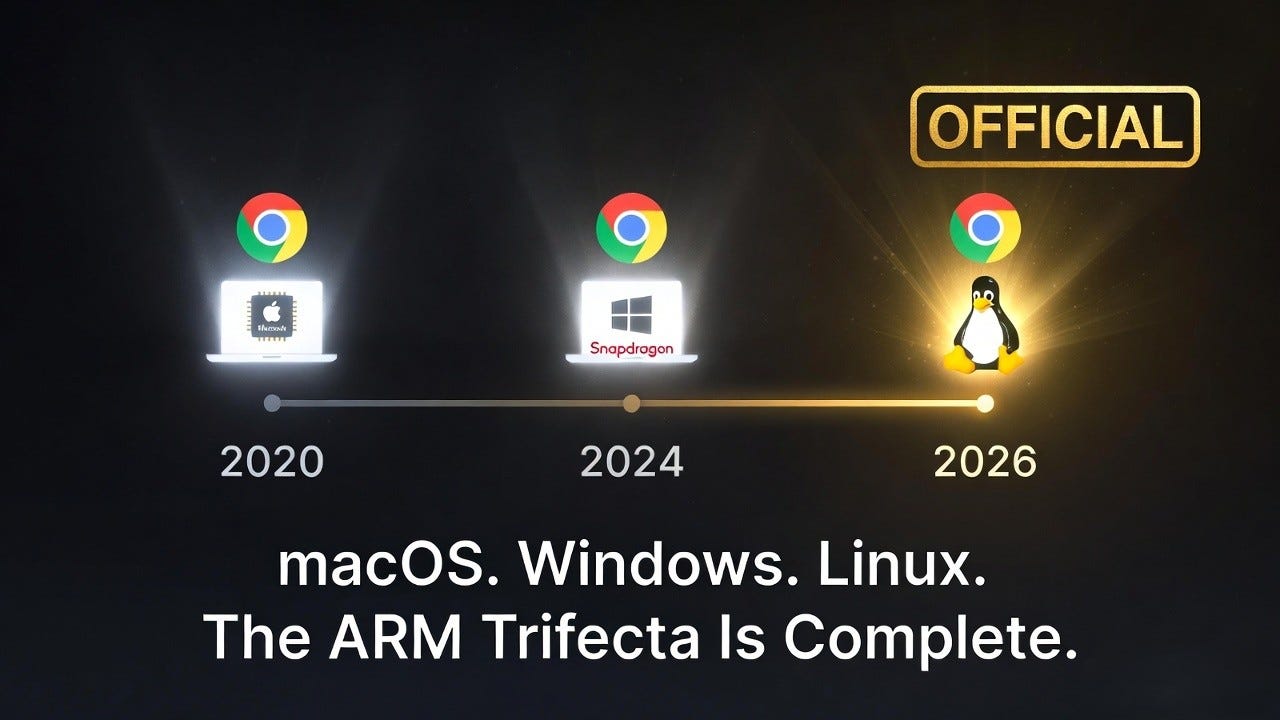
ARM-native Chrome arrived on macOS in late 2020, timed almost perfectly with Apple’s launch of the M1 chip. That made sense commercially. Apple Silicon represented a seismic shift in the laptop market, and Google moved quickly to support it.
Four years passed.
Chrome arrived on Windows on ARM in 2024, timed with the growing Qualcomm Snapdragon laptop market gaining commercial traction. Microsoft and Qualcomm had been pushing Windows on ARM for years, and Google eventually followed.
Linux waited.
The Chromium bug tracker even had a formal request for official ARM64 Linux support marked as “Won’t Fix” as recently as 2024. Not “in progress.” Not “planned.” Won’t fix.
That detail stings a little when you sit with it. Google’s own Linux requirements page historically specified processors with Intel’s SSE3 instruction set, which in practice made Chrome a purely x86-only product on Linux. There was no malice in it, presumably. There was simply no business priority large enough to push the work forward.
So ARM64 Linux users were left to build their own solutions on top of what the open-source community provided.
For six years, the M1 Mac users got Chrome. The Windows Snapdragon users eventually got Chrome. And the ARM64 Linux users got told to use Chromium and figure it out.
Why Chromium Was Never a Real Substitute
This is the part that people outside the Linux community often misunderstand.
Chromium is not a worse version of Chrome. It is a fundamentally different product in ways that matter enormously to how people actually work.
Chromium cannot sync with a Google account reliably across devices. Bookmark sync works inconsistently. Open tabs do not transfer cleanly. Your browsing history does not follow you between your Chromium install and the Chrome running on your phone or your work laptop.
For anyone embedded in Google’s ecosystem, and that is a genuinely enormous number of people, this makes Chromium an inconvenient substitute rather than a real replacement.
DRM content playback is the other major gap.
Netflix will not stream properly on standard Chromium. Spotify’s web player has limitations. Disney Plus, Amazon Prime Video, YouTube Premium content at higher resolutions… all of these depend on Widevine DRM, which Google distributes with Chrome but not with standard Chromium builds.
You can sometimes patch this in, through distribution-specific packages or manual installation steps, but it is the kind of patching that breaks with updates and requires ongoing maintenance to keep functional.
Google Pay does not work. The Chrome Web Store behaves differently. Google Password Manager’s deepest sync features are unavailable. Safe Browsing Enhanced Protection, the version that uses real-time AI-powered phishing detection, requires the full Chrome product.
None of these are obscure edge cases. They are the features that define what Chrome is as a product. Chromium removes them, and what remains is a browser that shares Chrome’s skeleton but lacks its nervous system.

Part Two — The Arrival
What the Official Build Actually Delivers
The Q2 2026 release closes all of those gaps at once.
Google account sync will work the way Chrome users on every other platform have taken for granted for years. Bookmarks, open tabs, saved passwords, browsing history, form autofill… all of it flowing between your ARM64 Linux machine and your Android phone and your Chromebook and your Windows desktop, continuously, without configuration.
That kind of seamless continuity sounds minor until you have spent years without it.
Safe Browsing Enhanced Protection arrives with real-time phishing and malware detection. Chrome’s AI-driven threat identification will now run natively on ARM64 Linux hardware rather than requiring users to rely on standard protection modes. For security-conscious developers and researchers, this matters in practical terms, not just philosophical ones.
Google Pay integration will work. Chrome extensions will behave identically to every other platform. Google Password Manager will sync completely. DRM content will play properly from Netflix, Spotify, and every other service using Widevine.
Downloads will be available directly through chrome.com. The download page will auto-detect that a visitor is running on ARM64 Linux and offer the correct binary automatically. For Debian and RPM-based distributions, official ARM64 packages will be available in the same format as the existing x86–64 Linux release.
No manual architecture selection. No hunting through release pages. No community scripts to download and trust.
The NVIDIA DGX Spark Partnership Changes the Story
Google called out one specific hardware partnership in the announcement, and it is not one that was expected.
Google is partnering with NVIDIA to streamline Chrome installation on the DGX Spark.
The DGX Spark is a device that sits outside conventional hardware categories. NVIDIA describes it as a personal AI supercomputer. It packs the Grace Blackwell architecture into a one-liter chassis. Grace Blackwell integrates NVIDIA’s GPU acceleration with an ARM-based CPU in a unified design, targeting AI inference, model development, and large-scale data processing. The device is designed to sit on a desk and deliver datacenter-class performance at human scale.
It runs Linux. Of course it runs Linux. The serious AI and machine learning research community runs Linux almost universally. And it runs on ARM64, because Grace Blackwell is an ARM-based architecture.
Google’s decision to partner with NVIDIA for DGX Spark support tells you something specific about who is actually running ARM64 Linux in 2026. This is not only hobbyists running Raspberry Pi clusters or enthusiasts who installed Asahi Linux on their Apple Silicon MacBook. There is a growing population of highly capable professionals, researchers, and engineers running ARM64 Linux on powerful hardware specifically because of the performance characteristics of that architecture.
DGX Spark users will be able to install Chrome directly through NVIDIA’s software package management service. That is a first-class integration, not an afterthought. Google and NVIDIA choosing to make this seamless suggests that both companies see this population of users as meaningful enough to invest in properly.
Part Three — The Ecosystem
The ARM64 Linux World Is Bigger Than You Think
There is a tendency in mainstream tech coverage to treat ARM64 Linux as a niche experiment, something hobbyists do for fun rather than a serious computing platform. The reality in 2026 is considerably more complex.
Ubuntu 25.04, released in April 2025, became the first standard Linux distribution to support Snapdragon X Elite laptops out of the box. Canonical named support for devices including the Acer Swift 14 AI, Asus Vivobook S15, Dell XPS 13, HP OmniBook X 14, Lenovo ThinkPad T14s, and Lenovo Yoga Slim 7x. These are not exotic development boards. These are consumer laptops that people buy at retail and take to work.
The Raspberry Pi 5 runs a 64-bit ARM processor and ships with Ubuntu and Raspberry Pi OS, both offering full 64-bit ARM support. Millions of these devices are in active use in education, development, home automation, and small-scale infrastructure.
Asahi Linux, the volunteer project bringing Linux to Apple Silicon Macs, runs on ARM64 by definition. The project has achieved remarkable hardware support for M1 and M2 generation devices, and a growing community of developers uses Asahi-powered MacBooks as their primary Linux machines specifically because Apple Silicon’s performance and battery life characteristics are exceptional. The M1 MacBook Air running Asahi Linux gets battery life that x86 Linux laptops genuinely cannot match.
Qualcomm’s Snapdragon X2 Elite is expected to become available in the first half of 2026, with improved Linux kernel support being upstreamed by Qualcomm engineers. The Linux kernel 6.5 and above already contains mainline support for Snapdragon X Elite chips, driven by work from Linaro, Qualcomm, and the broader ARM Linux community.
This is a platform with real users, real hardware, and real momentum. It has been underserved by software vendors for years not because the users were not there but because the commercial incentives to serve them lagged behind the community’s actual growth.
Firefox Got There First. That Matters.
Here is something the headline does not mention.
Mozilla shipped ARM64 Linux builds through its Nightly channel in April 2024 and promoted them to stable with Firefox 136 in March 2025. That is a full year ahead of Chrome’s planned Q2 2026 arrival.
Mozilla operates with dramatically fewer resources than Google. The Firefox team is smaller, its infrastructure budget is smaller, and its corporate backing is more precarious. And yet Mozilla found the ARM64 Linux community worth prioritizing a full year before Google did.
Other Chromium-based browsers have not followed Mozilla’s lead. Brave, which has a significant privacy-conscious user base with substantial overlap with the Linux community, does not have official ARM64 Linux builds as of this writing. Microsoft Edge, despite Microsoft’s heavy investment in Windows on ARM, has not shipped official ARM64 Linux binaries either.
Chrome’s arrival does not retroactively change the fact that Firefox moved faster, and it would be intellectually dishonest to ignore that. The open-source community has noted this pattern repeatedly. Google has the resources and the market position to move on virtually any platform immediately, and yet ARM64 Linux consistently waited while Firefox, a smaller organization, got there first.
What Chrome’s arrival does change is the overall ecosystem calculus. When the dominant browser on every other platform becomes available natively, distribution maintainers, application developers, and hardware vendors all gain a reason to invest more seriously in the platform.
Chrome holds roughly 65 percent of global browser market share. That weight changes how the rest of the software industry thinks about supporting a platform. Firefox’s presence mattered. Chrome’s presence validates.
Part Four — The Communities
What This Means for Raspberry Pi and Asahi Linux Users
The announcement does not specify exactly which ARM64 Linux hardware the Q2 2026 release will target, but the picture is encouraging.
Phoronix coverage confirmed official Debian and RPM packages, which covers Ubuntu, Debian, Fedora, Red Hat, and their derivatives. That is the vast majority of the Linux distribution landscape.
For Raspberry Pi 5 users running 64-bit Raspberry Pi OS, which is Debian-based, official Chrome packages should be installable directly. The Raspberry Pi is the most widely deployed ARM64 Linux device in the world, and its community has been running Chromium as the default browser for years. Native Chrome with full Google sync and DRM support changes what the Pi can do as a media device, a development machine, and an education platform.
For Asahi Linux users running Fedora Asahi Remix, the default flagship distribution, RPM packages cover that case directly. An Asahi Linux user on an M2 MacBook Air will be able to install Chrome from chrome.com, have it auto-detected and offered the correct ARM64 build, and have it work exactly like Chrome on their phone or their partner’s MacBook running macOS.
That kind of seamlessness has been genuinely absent for years.
The one genuine uncertainty is hardware-specific rendering. Asahi Linux still requires ARM64 builds that work correctly with Apple Silicon’s specific GPU pipeline. Standard ARM64 builds should function, but full hardware acceleration for graphics and video decode may depend on whether Chrome properly integrates with Asahi’s GPU drivers. This is a solvable problem, and the Asahi team is resourceful, but it is worth noting that “available for ARM64 Linux” and “fully optimized for every ARM64 Linux device” are different things.
For Snapdragon X Elite laptops running Ubuntu 25.04 or later, Chrome’s arrival fills one of the most prominent gaps in the daily workflow experience. The platform’s current rough edges, firmware extraction requirements, driver maturity variation across specific laptop models, and thermal management inconsistencies, remain to be worked through. But a browser this fundamental being officially unsupported was a real barrier for people considering these machines as primary workstations.
That barrier goes away in Q2.
Part Five — The Bigger Picture
The Broader Signal About Where Computing Is Going
The ARM architecture has won in mobile. It won so thoroughly that the question is no longer whether ARM dominates mobile but whether x86 will remain dominant anywhere.
Apple’s transition to ARM in its laptop and desktop lineup demonstrated that ARM could compete directly with Intel and AMD on raw performance. Apple Silicon Macs consistently outperform comparable x86 machines on performance per watt, and increasingly on absolute performance benchmarks as well.
Qualcomm’s Snapdragon X series represents the first serious ARM contender in the Windows laptop market with genuine mainstream commercial traction. Snapdragon X laptops are gaining quarterly market share despite the ecosystem challenges that Linux users have experienced firsthand. The x86 architecture is not going away, but it is no longer the automatic default it was for three decades.
For Google, completing its ARM trifecta, macOS in 2020, Windows in 2024, Linux in 2026, is not just about supporting a niche platform. It is about ensuring Chrome remains the dominant browser regardless of how the underlying hardware market evolves.
Allowing Firefox to be the only major browser with native ARM64 Linux support, even for a year, creates a real opening for alternative browsers to establish themselves among the developers and engineers who are most likely to influence how others think about software.
The AI hardware angle adds another dimension that deserves serious attention. The DGX Spark partnership is not accidental. NVIDIA is making the case that AI research and development can happen on compact ARM64 Linux devices sitting on a researcher’s desk. If that category of hardware grows… and the investment NVIDIA is making in Grace Blackwell suggests they believe it will… then Chrome’s presence on that platform from the beginning positions Google’s browser, and by extension Google’s broader product ecosystem, as the natural home for that workflow.
The Quiet Patience of the Linux Community
There is something worth acknowledging about how the Linux community has handled this wait.
The response to the announcement, across forums, developer communities, and social platforms, has been largely measured. There is genuine enthusiasm, but it is not the breathless excitement that consumer product launches typically generate. It reads more like the quiet satisfaction of someone who built a workaround years ago, maintained it through updates, explained it to others, and now gets to put it down.
That patience is not passivity. It reflects years of building real solutions in the absence of official support. The Chromium packages in distribution repositories work. The DRM workarounds that power users maintain work, mostly. The community-built ARM64 Chromium builds that predate even those packages worked, in their limited way.
The Linux ARM64 community did not wait helplessly. It built what it needed and waited for Google to catch up.
Google is catching up now. The Chromium blog post describing this as “a significant undertaking to ensure that ARM64 Linux users receive the same secure, stable, and rich Chrome experience found on other platforms” acknowledges, if diplomatically, that this work was real and that the absence of it mattered to real people doing real things.
A Few Things Worth Watching Before Q2
The release date is confirmed as Q2 2026, meaning sometime between April and June. Google has not given a specific date. Given Chrome’s two-week release cadence, confirmed with the cycle change announced in early March 2026, the ARM64 Linux build will likely land with a specific numbered Chrome release rather than as a separate announcement.
Users on Snapdragon X Elite laptops running Linux should understand that Chrome being available natively does not resolve every ecosystem issue. GPU driver maturity, firmware extraction requirements for non-ThinkPad Snapdragon devices, and thermal management inconsistencies are ongoing areas of work. Chrome will function. Other parts of the platform are still maturing.
For DGX Spark users, the NVIDIA package management integration means the install path should be genuinely smooth from day one. Google and NVIDIA coordinating on this reduces the chance of a rough launch experience for that specific community, which also happens to be one of the most technically capable user groups in the ARM64 Linux space.
For everyone else, visiting chrome.com on an ARM64 Linux machine starting sometime in April or May should simply work. Auto-detection, correct download offered, installation through standard package management. The kind of experience that every other platform has had for years.
The Line Between Workaround and Product
There is a philosophical point underneath all of this that is worth sitting with for a moment.
The Chromium workaround era for ARM64 Linux was never just a technical inconvenience. It was a signal about how the industry valued this community. Not explicitly. Not cruelly. Just through the simple logic of where resources go and where they do not.
ARM64 Linux users received that signal for years, clearly enough that “Won’t Fix” on the Chromium bug tracker could stand as a kind of summary of a position.
The Q2 2026 announcement does not erase that history. But it does mark an end to it. A company with three billion browser users and the engineering resources of Google has decided that ARM64 Linux is real enough, big enough, and important enough to invest in properly.
For the Raspberry Pi users, the Asahi Linux devotees, the Snapdragon laptop experimenters, and the Grace Blackwell researchers… that signal matters. Not because it changes what they were already doing. But because it finally confirms, officially, that what they were already doing was worth building for.
The browser war on ARM64 Linux is over.
Chrome arrives late, and it arrives properly. And Firefox, with far fewer resources and far less fanfare, got here twelve months ago.
Somehow that detail makes the whole story more human. And more interesting.