Samsung has done it again. February 25, 2026, in San Francisco, Galaxy Unpacked brought the world the Samsung Galaxy S26 series. Three phones — the S26, S26 Plus, and S26 Ultra — each carrying a refined design, a more powerful processor, and what Samsung is calling its most intuitive generation of Galaxy AI yet. It will be realising on March 11 2026

The headline, however, belongs almost entirely to the Galaxy S26 Ultra and one feature nobody expected to see built directly into a phone screen: a hardware-level privacy display that makes side-angle viewing physically impossible. More on that shortly. First, let us understand what is actually new here and what has quietly stayed the same.
What Is New in the Samsung Galaxy S26 Series?
The Galaxy S26 series represents Samsung’s third generation of AI-first phones. Every model in the lineup — S26, S26 Plus, S26 Ultra — ships with the Snapdragon 8 Elite Gen 5 for Galaxy processor in the US and the Exynos 2600 in select international markets including India. Both chips are built with a significantly improved NPU (Neural Processing Unit) that handles on-device AI tasks faster and with less thermal overhead than previous generations.
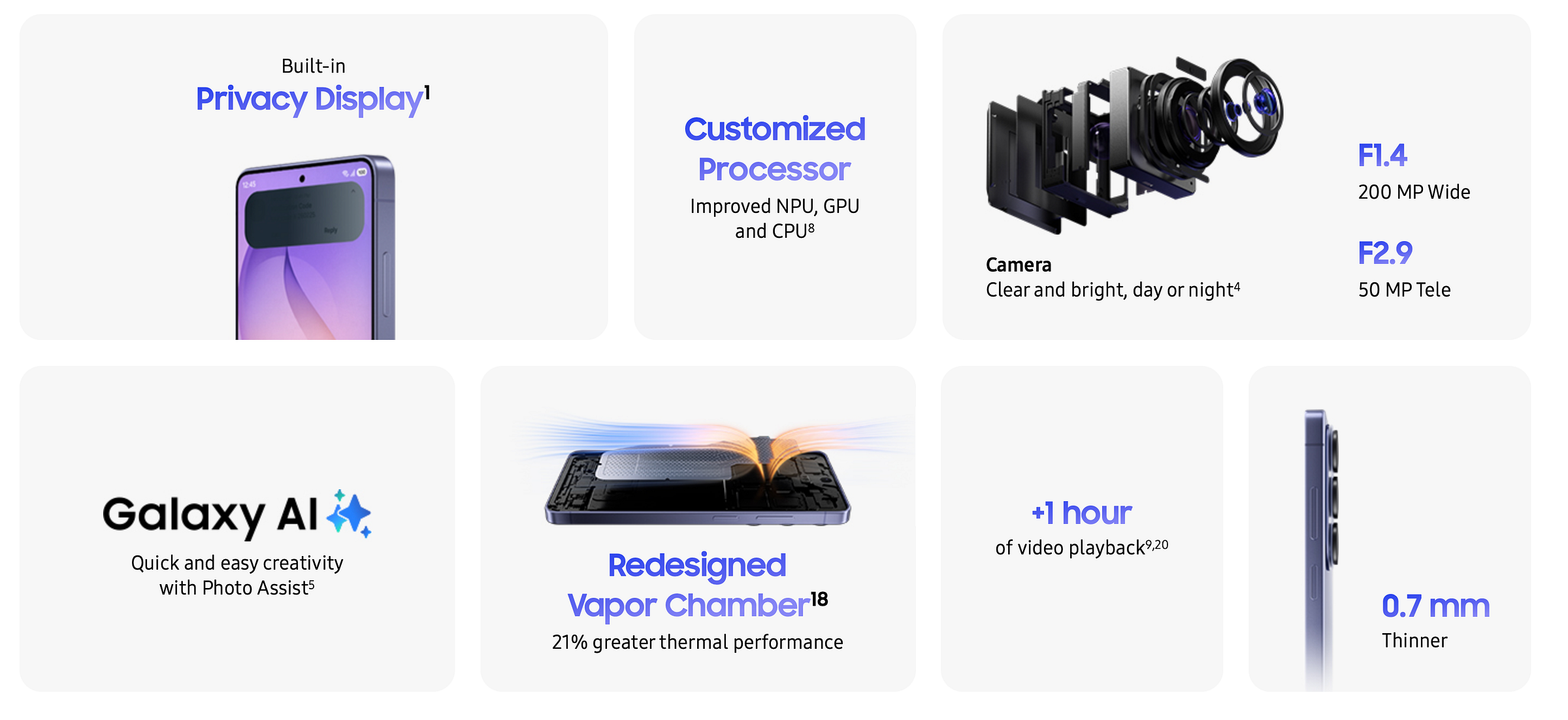
The S26 Ultra is also 3mm thinner than the previous Galaxy S25 Ultra and four grams lighter, which matters more than it sounds on a phone this large. Slim flagships have historically paid for their dimensions in thermal throttling — the Ultra’s redesigned cooling architecture directly addresses that tradeoff.
The Galaxy S26 now starts at $899, S26 Plus at $1,099, and S26 Ultra remains at $1,299. Both base models received a $100 price increase, while the Ultra held its price for the second consecutive year. Storage also received a quiet but meaningful upgrade — the Galaxy S26 is no longer available with 128 GB of storage, with 256 GB now the minimum across the entire lineup.
Understanding the New Privacy Display on Galaxy S26 Ultra
If one feature defines the S26 Ultra’s identity in 2026, this is it. Privacy Display is the result of more than five years of research and development, blocking views from the sides, above and below. This is not a software trick applied to brightness levels. It operates at the pixel level using Samsung’s Flex Magic Pixel technology, physically controlling the angle at which light exits the display.
How Does Privacy Display Hide Sensitive Content on Galaxy S26?
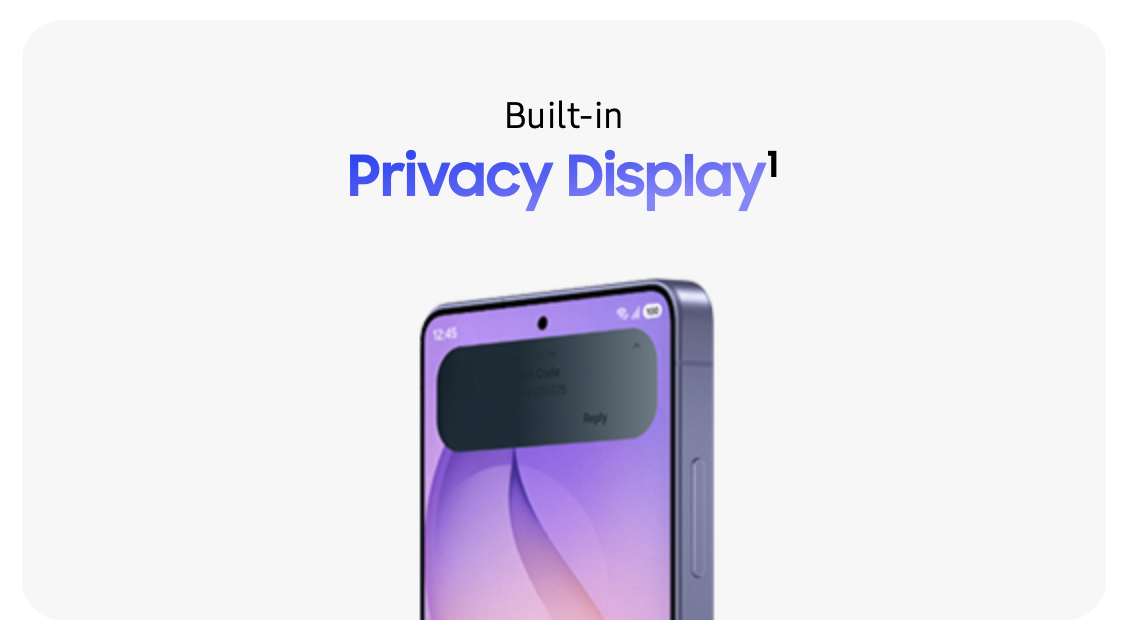
When activated, the screen appears completely normal from directly in front of the phone. Move more than a few degrees to either side and the display dims to an unreadable state. Users can adjust the level of privacy protection in the settings and apply it selectively when entering a PIN, pattern or password, or when notification pop-ups appear.
The practical implications are significant for anyone who regularly uses their phone on public transit, in open-plan offices, or at airports. There is no film to apply, no third-party accessory to buy, and no permanent reduction in screen brightness. The feature is easy to turn on and off and can be applied selectively — you can choose whether to apply it to specific apps, to notifications, or for when you are inputting PINs or passwords.
Users can also assign the Privacy Display to the side button’s double-press function for greater convenience,meaning toggling it in a crowded elevator takes less than a second. Neither the iPhone 17 Pro Max nor the Pixel 10 Pro XL offers anything comparable at the hardware level. For the first time in years, Samsung has built a display feature that its competitors cannot simply match with a software update.
How Galaxy AI Works on the Galaxy S26 Ultra
Galaxy AI on the S26 series has evolved from something that required user initiation into something that monitors context and acts proactively. Samsung’s TM Roh described the philosophy plainly at Unpacked: the goal is for AI to work quietly in the background so people can focus on results rather than on navigating a feature set.
What AI Photo Tools Does Galaxy S26 Ultra Offer?
As of March 2026, Galaxy AI’s Photo Assist and Creative Studio support 41 languages. Photo editing tools powered by Galaxy AI can identify subjects within images, adjust exposure and color independently per subject, and reconstruct missing background elements after cropping. These are not simple filters — they are contextual processing decisions made by the on-device NPU.
Now Brief has received an update to allow fewer steps for users. Where you would have to create an event in the past for Now Brief to monitor, it can now pull that information, like reservations or a meeting, directly from your notifications. This matters because it removes the friction of managing AI; the phone understands what is happening in your life without you needing to explicitly teach it.
Now Nudge takes that a step further. Now Nudge is a feature embedded in your keyboard, so apps like WhatsApp and Messenger can display prompts to streamline certain processes. For example, if someone suggests a meeting, it may prompt you to create an event, or if a friend asks you to find a photo from a specific event, your S26 will be able to find it for you instead of searching yourself.
How Does Galaxy AI Differ From Google’s AI Features?
The Galaxy S26 series further expands its AI ecosystem with Bixby, Gemini and Perplexity. Users can use natural language commands to adjust settings, allowing them to effortlessly control their device even without knowing exact setting names or specific commands. Saying “my eyes feel tired,” for instance, prompts Bixby to recommend activating the Eye Comfort Shield.
Google’s approach on the Pixel 10 series centers on Magic Cue and its tight integration with Google’s own cloud models. Samsung’s strategy is different — it layers Bixby, Gemini, and now Perplexity as collaborative agents rather than routing everything through a single assistant. Whether that multi-agent approach is more or less useful in daily life will depend on how much you already live inside Google’s ecosystem.
Galaxy S26 Ultra Camera AI: Photo and Video Features Explained
The camera specifications on the S26 and S26 Plus look nearly identical to last year on paper. Both carry a 50-megapixel main camera, 12-megapixel ultrawide, and a 10-megapixel telephoto with 3x optical zoom. The real story is the Ultra.
Last year saw a 200MP, f/1.7 wide lens. 2026 brings a 200MP, f/1.4 wide lens. That aperture change is meaningful — wider apertures collect more light, which translates directly to cleaner low-light images and faster shutter speeds in dim conditions. The Wide camera delivers clearer and more detailed videos even in low-light environments with a wider aperture for 47% improved brightness.
The S26 Ultra is also the first Galaxy to support the APV (Advanced Professional Video) format — a professional codec designed for high-quality production workflows. For videographers and content creators, this opens up post-production flexibility that was previously only available with dedicated cameras or the iPhone Pro line’s ProRes format. Samsung has also improved video stabilization using real-time gyroscope and accelerometer data to keep horizons level during handheld shooting.
Exynos 2600 and Snapdragon 8 Elite Gen 5: Chip and Thermal Management on Galaxy S26
This is where the Galaxy S26 Ultra separates itself from its siblings. While the S26 and S26 Plus use the standard Snapdragon 8 Elite Gen 5, the Ultra uses a customized version developed specifically for Samsung. The distinction matters for AI performance, where the tailored NPU configuration allows the Ultra to run on-device models faster without immediately saturating its thermal limits.
Is Galaxy S26 Overheating Only in Heavy Gaming?

Overheating on premium Android flagships has been an ongoing problem through the Snapdragon 8 Gen 3 era. The S26 Ultra’s redesigned vapor chamber and restructured heat dissipation layers address this at the architecture level rather than relying purely on software throttling. Early hands-on reporting from Galaxy Unpacked noted that sustained AI tasks — image generation, real-time translation, video processing — ran without the warmth that characterized the S25 Ultra under load.
In international markets where the Exynos 2600 replaces Snapdragon, the thermal profile will differ. Samsung’s in-house chipsets have historically run warmer under sustained loads, though the Exynos 2600 represents a major architectural revision compared to the Exynos 2500 that powered the S25 in those regions.
Galaxy S26 Ultra Camera AI: Night Photography and Video Deep Dive
The convergence of hardware and software on the S26 Ultra’s camera system deserves its own examination. The f/1.4 aperture on the 200-megapixel main sensor collects substantially more photons per frame than the f/1.7 lens it replaces. At the sensor level, this means images captured in restaurant lighting, indoor events, or nighttime urban environments will exhibit less digital noise before any AI processing begins.
Samsung’s Nightography video mode has been updated to use the improved aperture in combination with AI-based frame-stacking. The result, according to Samsung, is video that maintains clarity at exposure lengths that would previously introduce motion blur. Whether that holds up in real-world testing will be confirmed after March 11 reviews, but the hardware foundation is genuinely stronger than the S25 Ultra’s.
Battery, Charging and Everyday Usability of Galaxy S26
The standard Galaxy S26 does get a welcome battery capacity bump from 4,000 mAh to 4,300 mAh, which should hopefully lead to even more excellent battery life. The S26 Plus carries a 4,900 mAh cell. The S26 Ultra holds at 5,000 mAh, unchanged from the S25 Ultra.
Where Samsung has made a meaningful improvement is in charging speed. The S26 Ultra has seen an upgrade to charging, now allowing for 60W Super Fast Charging 3.0 and 25W Fast Wireless Charging, up from 2025’s 45W and 15W. The jump from 45W to 60W wired is not incremental — it changes what is possible in short windows. A ten-minute charge before leaving the house adds meaningfully more battery with 60W than it did with 45W.
The S26 Ultra supports 60W wired charging, hitting 75% in about 30 minutes. The iPhone 17 Pro Max, by comparison, reaches 50% in 20 minutes at 25W. Samsung’s absolute speed advantage is clear, even if Apple’s efficiency keeps pace in relative terms.
One UI 8.5 on Galaxy S26: AI Shortcuts, Writing Assist and Smart Features
The Galaxy S26 series ships with One UI 8.5, built on Android 16. Samsung promises seven years of OS and security updates across the full lineup, matching the commitment Google offers on Pixel devices and exceeding what most Android manufacturers deliver.
One UI 8.5 scores a new floating app bar at the bottom, which should improve readability. One UI 8.5 now offers even more customization options and lets you personalize the Quick Settings panel even more by reordering and removing existing controls. If you set a picture of a person or a pet as your lock screen wallpaper, the layout will automatically move around so that neither the clock nor the widgets obscure key parts of the image.
Writing Assist, Samsung’s AI-powered tool for reformatting and summarizing text across apps, has been extended to work within third-party applications rather than only Samsung’s own suite. This is a notable shift — previously, Galaxy AI’s most useful writing tools were only available inside Samsung’s Messages, Notes, and Email apps. Expanding them to WhatsApp, Gmail, and other commonly used applications makes the feature genuinely practical for daily use.
Galaxy S26 vs Previous Galaxy S Series: Key Feature Upgrades
S26 vs S25
The most honest summary of S26 versus S25 is this: the base models got a bigger display (6.3 inches, up from 6.2), a stronger processor, improved AI software, and a $100 price increase. The Ultra got a legitimately new display feature, faster charging, a brighter camera aperture, and held its price. If you own an S25 or S25 Plus, the upgrade rationale is thin unless the AI improvements or battery bump specifically address a pain point you have been living with. If you own an S25 Ultra, Privacy Display is the only compelling reason to move.
S26 vs S24
The generational gap between S24 and S26 is considerably more meaningful. Two full cycles of AI software development separate the two, the Snapdragon 8 Elite Gen 5 substantially outperforms the Snapdragon 8 Gen 3 in both CPU single-core and GPU sustained performance, and the Ultra’s camera aperture improvements compound across both upgrade cycles. S24 Ultra owners have a genuinely strong upgrade case, particularly those doing professional photography or working in secure environments where Privacy Display provides daily value.
S26 vs S23
This is where the conversation becomes straightforward. Three full processor generations, two complete UI overhauls, and the introduction of Galaxy AI as a core feature set. The S23 was an excellent phone for its time. It is simply a different device category now — the S26 handles tasks that the S23 either cannot perform at all or handles slowly enough to create friction.
Samsung Galaxy S26 vs Competitors: iPhone 17 Pro Max and Pixel 10 Pro XL
Display and Privacy
The S26 Ultra runs at 3,120 by 1,440, with a higher density of 498 PPI. The iPhone 17 Pro Max has a resolution of 2,868 by 1,320, giving it a pixel density of 460 PPI. In practical terms, both displays are too sharp for the human eye to perceive individual pixels at normal viewing distances. The privacy display, however, is entirely Samsung’s territory — neither Apple nor Google offers anything hardware-comparable.
Camera
Samsung leads on resolution with a 200MP main sensor backed by a wide f/1.4 aperture, which lets in significantly more light than previous Ultra models. On the video side, the S26 Ultra supports 4K at 120fps in Pro Video mode and 8K at 30fps.
Apple’s iPhone 17 Pro Max counters with a triple 48-megapixel system and an upgraded periscope telephoto offering 8x optical-quality zoom, up from 5x on the previous model. For users who primarily shoot at distance, Apple’s telephoto leap is significant. For anyone prioritizing low-light stills or high-resolution video production, Samsung’s system holds clear advantages.
The Pixel 10 Pro XL approaches photography differently, leaning on computational techniques and Google’s image processing models rather than raw sensor resolution. Its results in natural lighting are frequently praised for color accuracy, though its hardware ceiling is lower than either Samsung or Apple in terms of maximum resolution and aperture width.
Battery and Charging
The Pixel 10 Pro XL comes with the biggest battery at 5,200 mAh and supports both 45W wired and wireless charging. Samsung’s S26 Ultra has a 5,000 mAh battery but charges fastest with 60W wired charging. The iPhone 17 Pro Max supports wired and wireless charging, but Apple, as usual, keeps some of the details under wraps.
If your priority is absolute top-up speed, Samsung wins. If you want the longest passive battery life with the least anxiety about finding a charger, Pixel’s larger cell may edge ahead. Apple sits comfortably in the middle with strong efficiency tuning.
AI Ecosystems
Each of the three platforms has staked out a distinct AI identity. Samsung offers the broadest AI feature surface across the most apps, but distributes that intelligence across Bixby, Gemini, and Perplexity as competing agents. Google’s Pixel experience is deeper within its own ecosystem, with tighter integration between AI models and the operating system itself. Apple’s approach prioritizes privacy and on-device processing for personal data, with Apple Intelligence handling tasks locally and only routing to cloud processing when necessary.
None of these approaches is universally superior. The right answer depends on how much of your digital life runs inside a single company’s ecosystem.
Who Should Buy the Samsung Galaxy S26 Ultra in 2026?
The S26 Ultra is built for a specific kind of person. Someone who genuinely needs the highest-resolution camera system available on Android, regularly handles sensitive information in public spaces, wants the most powerful AI processing available on a flagship phone, and values keeping the same device for multiple years. Samsung’s seven-year update commitment means the hardware investment made at launch remains relevant through 2033.
For the general buyer who does not specifically need Privacy Display or the Ultra’s camera system, the standard Galaxy S26 represents considerably better value at $899 — especially given that both models now start with 256 GB of storage. The base model’s battery, display, and AI feature set are strong enough to compete against any phone in its price category.
What Samsung has built with the S26 Ultra is a phone that justifies its $1,299 price through genuinely novel hardware rather than incremental specification bumps.
Privacy Display may sound like a niche feature until the first time someone reads your banking app over your shoulder on a crowded train. Then it sounds essential.