A healthcare startup built a neural network that predicted heart disease with 94% accuracy. The model worked beautifully. Doctors loved it. Then someone asked the logical question. Why did your algorithm flag this patient as high risk? Nobody had an answer. The model predicted accurately but refused to explain itself.
This is the collision at the heart of modern machine learning. We build systems that predict remarkably well but understand dismally poorly. The more sophisticated the model, the deeper it vanishes into what researchers call the black box. Somewhere between perfect predictions and perfect understanding lies a problem haunting data scientists everywhere.
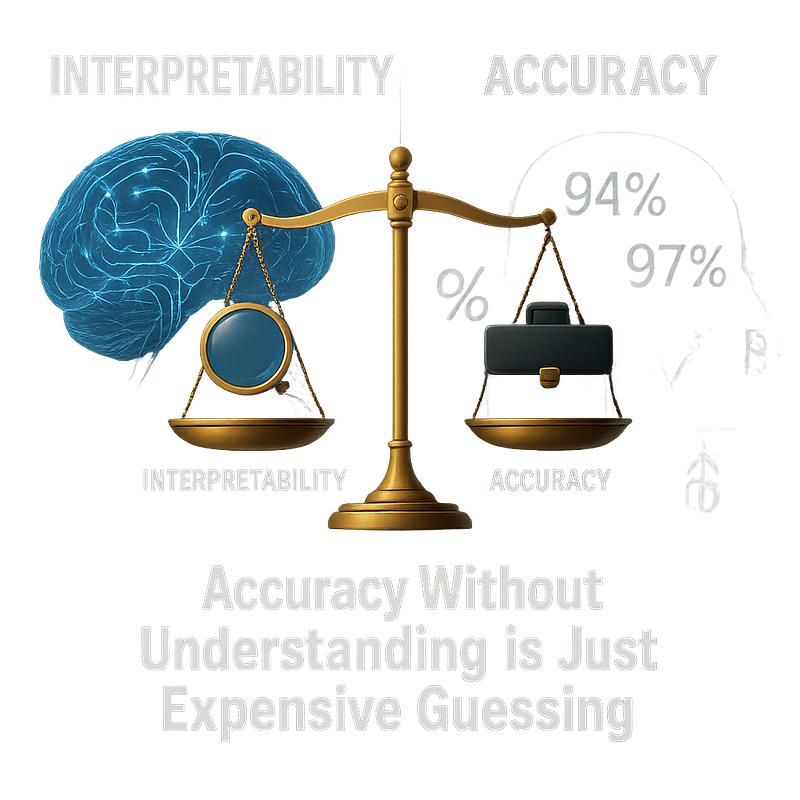
The stakes matter now. When a model denies someone a loan, regulators require an explanation for the decision. When an algorithm flags fraud, the applicant deserves an explanation. When a self-driving car crashes, investigators need to understand what the machine was thinking. Accuracy alone is not enough anymore.
The Accuracy-Interpretability Trade-Off
Simple models make clear, traceable decisions. Linear regression or decision trees follow a logic you can follow. “If credit score drops below 600 and debt ratio exceeds 40 per cent, reject.” A child could trace this reasoning.
But simple models fail in messy reality. Real patterns avoid linearity. Real relationships resist clean splits. So we reach for sophisticated tools. Random forests. Gradient boosted machines. Neural networks. Deep neural networks.
Each sophistication layer buys accuracy at transparency’s cost. The neural network predicting email spam might hit 97% accuracy across millions of messages. Ask it to explain any single decision? It cannot. Information lives somewhere in 50 million weights across hundreds of layers, locked away.
Research backs this pattern. A study comparing eight machine learning models on product rating prediction found something striking. As interpretability decreased, accuracy generally increased. Models you could understand were less accurate. Models that worked were harder to understand.
This trade-off is fundamental. It is not disappearing.
When Accuracy Stops Being Enough
For years, data science had a convenient story. If the model validates well, it is good. Accuracy was the north star. Everything else mattered less.
This thinking still dominates tech companies chasing engagement or recommendations. Netflix does not care why a model recommends a show, only that people watch. Amazon does not explain recommendations to customers. They optimise for revenue. Accuracy wins.
But the world shifted underneath this assumption.
Financial institutions learned this painfully in 2008. Their models were accurate right until they were catastrophically wrong. The problem was not the models themselves, but that nobody understood the assumptions powering them. When assumptions collapsed, models collapsed. Regulators learned this lesson hard. Now they require major lending decisions to be explainable.
Healthcare is stricter. Doctors cannot prescribe treatment without understanding why. An AI model recommending treatment but unable to explain its reasoning hits an institutional wall. Hospitals will not use it. Regulators will not allow it. Patients will demand to know why.
Criminal justice woke to this problem when jurisdictions discovered risk assessment algorithms used for parole and sentencing contained hidden biases. Not by design, but because training data was biased and nobody examined it. You cannot catch biases you cannot see.
Accuracy stops being enough when it suddenly becomes catastrophic.
Understanding Interpretability
Interpretability means understanding why a model made a specific decision. For simple rule systems, this is straightforward. For neural networks, it becomes philosophical.
Data scientists distinguish two types.
Global interpretability understands the model overall. How does this system generally work? What patterns did it learn? This helps validation and debugging. If analysis reveals your model identifies cats primarily by fur colour, that is concerning. Cats come in many colours. The model might fail in scenarios you did not consider.
Local interpretability focuses on specific predictions. Why did this algorithm classify this image as a cat? This matters enormously in high-stakes domains. When a credit model rejects an application, the applicant deserves an explanation.
Philosophers debate what counts as a real explanation. Some argue that feature importance suffices. The model was influenced 60 per cent by age, 30 per cent by income, and 10 per cent by credit history. Others argue this misses the point. Real explanations answer counterfactuals. If your age were three years higher, would rejection still happen? Without answering that, you have not really explained anything.
Practical Organisational Reality
Most organisations face this choice directly.
You have a business problem. Credit approval. Fraud detection. Default prediction. Your team builds models. The most accurate uses gradient boosted forests or neural networks.
Then compliance asks for documentation. Legal wants a decision-making explanation. Sales needs to explain rejections to customers.
Suddenly, accuracy is not your only problem.
A simple linear model you could explain to anyone only achieves 78 per cent accuracy. Your sophisticated model hits 89 per cent. That 11 per cent difference is 1,100 correct decisions per million applications. That is real money.
But compliance officers will not accept an unexplained advantage.
You face a choice. Downgrade to explainable models and accept worse performance. Or patch interpretability onto your black box.
The second path became an entire research field. SHAP and LIME are most famous. These methods approximate explanations by analysing how predictions change when inputs shift. It works surprisingly well.
SHAP specifically became a finance and healthcare standard. It provides theoretically sound, consistent explanations. The catch? SHAP is computationally expensive. For large datasets and real-time systems, this becomes a bottleneck.
Where Interpretability Wins
Some domains reject accuracy if interpretability suffers.
Clinical medicine is clearest. Doctors prescribe based on understood mechanisms. This patient has infection X. Antibiotic Y kills bacteria X, so use antibiotic Y. This is interpretable and effective.
An AI model predicting patient treatment response with 3 per cent better accuracy than current methods is interesting. But if doctors cannot understand or trust it, it stays on shelves.
Early product development faces similar constraints. Engineers need to understand why manufacturing defects occur. Your model predicts part failure? Useless without understanding failure mechanics. Is it a material defect? Tolerance issue? Manufacturing problem? Interpreted models explaining causes let engineers fix problems. Black boxes just prevent shipping.
Academic research values interpretability for itself. Models predicting earthquake magnitude with 8 per cent better accuracy matter. But models revealing new earthquake mechanics, even slightly less accurate, matter more.
The Honest Resolution
After years of research and industry experience, the honest answer emerges. You probably cannot have both.
You can optimise for accuracy and add interpretability afterwards using SHAP or LIME. This works reasonably, but adds complexity.
You can optimise for interpretability and accept lower accuracy. This works when accuracy requirements are not stringent or when domains demand understanding.
You can build custom solutions balancing both. This requires domain expertise and time.
You cannot have high accuracy and true native interpretability in complex domains.
Best organisations acknowledge this explicitly. They do not pretend black boxes are interpretable. They do not pretend that interpretable models are competitive on accuracy. They choose based on constraints and build accordingly.
A startup processing loan applications faces legal constraints. Interpretability matters. They choose 85 per cent accurate but fully explainable models.
A social media platform recommending content faces no constraints. Accuracy matters. They chose 94 per cent accurate but uninterpretable deep networks.
Neither choice is wrong.
Both are honest. But what do you prefer for your use case?