You build a model that achieves 95% accuracy in your testing environment. You deploy it to production. Within days, your team notices something is wrong. The model is slow. It is consuming more memory than expected. Its predictions seem less reliable than they were before.
You dive into the logs and discover the disconnect. What you optimised for during training was not what you needed during inference.
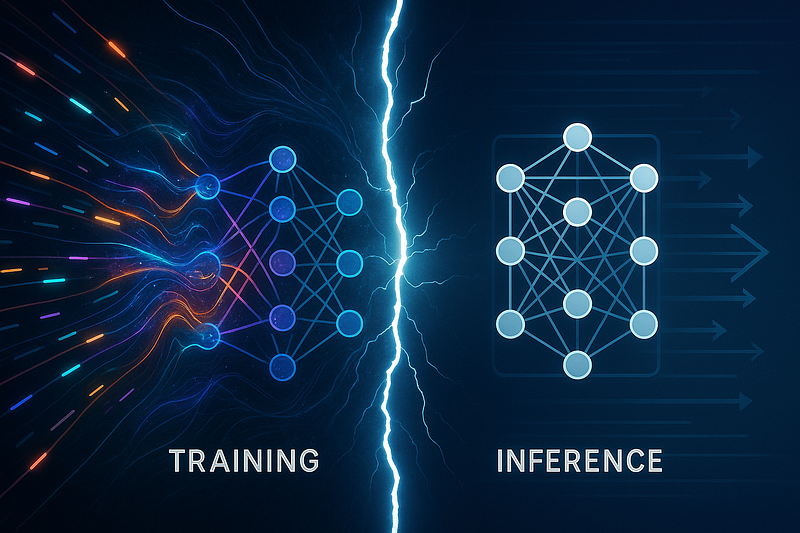
This is the story that plays out for countless machine learning engineers every single month. The gap between training and inference is not a small technical detail. It is a chasm that separates successful projects from expensive failures.
What Exactly Is Training and Inference
Let me be clear about what we are talking about here. Training is the process by which your model learns patterns from data. Imagine you are teaching someone to recognise different types of flowers. You show them thousands of examples. Here is a rose. Here is a tulip. Here is a daisy. Over time, the person learns the distinguishing features. Their ability to recognise flowers improves with each example.
Inference is the exact opposite direction. You now show that person a flower they have never seen before. They recognise it instantly. They do not need to learn anything new. They simply apply what they already know.
Your machine learning model works the same way. During training, the model adjusts its internal parameters billions of times. It tries different weights. It calculates gradients. It updates itself based on how wrong it was. This is computationally expensive and requires enormous amounts of memory and data.
During inference, the model is locked. No learning happens anymore. The weights are fixed. You simply feed in new data and get predictions. This should be faster and simpler. But here is where things get tricky.
Why They Are Actually Not Interchangeable
The first mistake most engineers make is assuming that optimising for training success automatically optimises for inference success. This assumption costs companies millions every year.
Consider batch normalisation, a technique used to speed up training by normalising inputs to each layer. During training, batch normalisation calculates statistics like mean and variance based on your current batch of data. But during inference, you cannot use batch statistics because you might only have one data point. You need to use running statistics that were calculated during training. If you forget to switch this behaviour, your model will make terrible predictions in production.
Or think about dropout, another common regularisation technique. During training, dropout randomly removes neurons to prevent overfitting. This forces the network to learn redundant representations. During inference, dropout is completely disabled because you want all of your learned capacity to contribute to predictions. If you leave dropout enabled during inference, your model becomes inconsistent and unreliable.
These are not edge cases. There are fundamental differences in how the same model behaves in two different contexts.
The Computational Reality Nobody Talks About
Here is something that textbooks rarely emphasise enough. Training and inference have completely different bottlenecks.
During training, you are doing backpropagation. This means you calculate gradients for every parameter in your network. If your model has 7 billion parameters, you are calculating gradients for all 7 billion. You need tremendous computational power. You need efficient memory access patterns. You need specialised hardware like GPUs or TPUs. Training is inherently parallel because you can batch multiple data points and process them simultaneously.
Inference has a different constraint. You are usually trying to make predictions on a single data point or a small batch. Backpropagation does not happen. Gradients are not needed. Your bottleneck shifts from computation to latency and memory efficiency.
This difference matters because it means the hardware you use for training might be completely wrong for inference. A GPU that excels at training might be overkill for inference. A model that takes 5 seconds per prediction might be trained beautifully but deployed disastrously.
Many teams do not realise this until they run into production issues that are incredibly expensive to fix.
How Model Architecture Changes Between Training and Inference
Here is something fascinating that most tutorials skip over. Your model architecture might need to change when you move from training to inference.
Consider a transformer model, like the ones that power large language models. During training, the transformer processes entire sequences in parallel. Every token attends to every other token simultaneously. This is beautiful for training because it uses GPU parallelism effectively. But during inference, you are generating tokens one at a time. You cannot parallelise what does not exist yet.
This means you might convert your training transformer into a streaming version for inference. You change how you cache activations. You change how you handle attention calculations. The model learns the same thing, but it behaves differently.
Or consider convolutional neural networks for image processing. During training, you might use full precision floating point numbers, storing every decimal. During inference, you might convert to lower precision, like INT8. This reduces memory requirements and speeds up computation without significantly hurting accuracy. But you cannot do this during training because the gradient calculations demand precision.
These architectural changes happen invisibly to many practitioners. They follow tutorials that work fine for teaching but fail in production.
The Inference Optimisation Challenge
Here is where the real complexity lives. Once you have trained a model, optimisation for inference becomes a separate art form entirely.
Quantisation is probably the most powerful technique. You take your model trained in 32-bit floating point and convert it to 8-bit integers. This reduces model size by 75 per cent. It speeds up computation. Memory bandwidth requirements drop dramatically. But quantisation introduces a tiny amount of error. You have to measure this carefully. Your 95 per cent accuracy might drop to 92 per cent. For some applications, this is unacceptable. For others, it is a small price to pay for 4x speedup.
Pruning is another approach. Many neural networks have connections that barely contribute to predictions. You can remove these connections entirely. A network with 100 million parameters might work just fine with 50 million parameters after careful pruning. But which connections should you remove? Removing the wrong ones crushes accuracy. Removing too many creates a fragile model that breaks on edge cases.
Knowledge distillation is perhaps the most elegant approach. You train a second, smaller model to imitate your large model. The small model learns to replicate the large model’s predictions exactly. This requires no architectural changes. You just trained a new model. The small model runs much faster while preserving most of the accuracy. But you now have two models to maintain.
All of these techniques work but require different expertise and tools than the training itself.
Batching and Latency in the Real World
Here is a practical scenario that reveals the training inference divide clearly.
During training, you process data in batches of 32, 64, or 128 examples simultaneously. Your GPU loves this. The math operations parallelise beautifully. Training is efficient and fast.
But in production, requests come in one at a time. A user makes a prediction request. Your system needs to respond within milliseconds. If you wait to batch 64 requests together, users will experience 10-second latencies. That is unacceptable.
But here is the problem. Your model might be significantly less efficient when processing single examples than when processing batches. Batch processing amortises overhead. Single requests suffer from that overhead disproportionately.
So you have to make a trade-off. Do you batch requests and accept latency? Do you process individually and accept lower throughput? Do you use a batching service with a fixed time window? These are questions that never come up during training but define whether your system succeeds or fails in production.
Why This Matters for Your Career and Your Projects
Understanding the training inference gap separates junior engineers from experienced ones.
Junior engineers optimise for training metrics and hope things work in production. They are surprised when they do not. They wonder why their beautiful model performs so poorly when users actually interact with it.
Senior engineers build with both perspectives in mind from day one. They ask questions during development. How will this batch normalisation behave during inference? How will this model perform with latency constraints? What happens if we need to quantise? Will the user experience be acceptable?
This perspective makes you invaluable to teams because you prevent expensive mistakes before they happen.
For machine learning teams, recognising this gap prevents deploying models that fail in production. It accelerates development because you are not debugging inference surprises after launch. It reduces operational costs because your models run efficiently without waste.
For businesses, this means faster model deployment, better user experience, and lower infrastructure costs. It means avoiding situations where a theoretically perfect model fails to create real value.
The Bottom Line
The training inference divide is not a theoretical concept. It shapes every practical machine learning system that exists. Models behave differently. Hardware requirements differ. Optimisation techniques change. Cost structures flip.
You can ignore this divide and hope for the best. Many people do. You will join the club of engineers debugging production failures that could have been prevented. Or you can internalise this perspective now and build systems that work beautifully from training all the way through to production.
The engineers who understand this distinction build systems that actually ship. That actually serves users. That actually creates value.
That knowledge is more valuable than any specific technique because it prevents a thousand mistakes before they happen.