The startup founder stared at her screen, her face growing increasingly panicked. She had trained a customer service chatbot on 500 real conversations from her users. The model performed well on the training set but struggled consistently in production. Real customers asked questions in unexpected ways. Edge cases emerged constantly. She needed thousands more examples to cover the variations, but collecting real conversations took weeks and cost money she did not have.
Then she discovered synthetic data generation. Within days, she had generated 50,000 artificial training examples using an LLM. The new model trained on this hybrid data performed 40 per cent better on the exact customers who had broken the previous version.
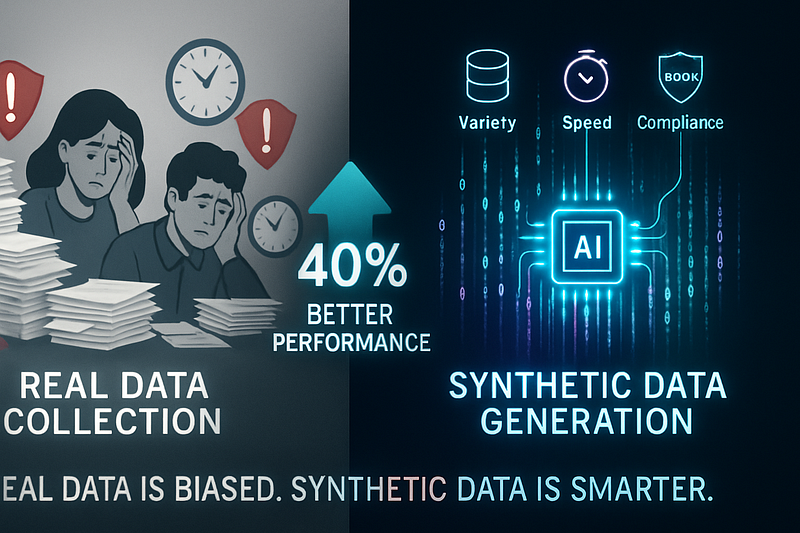
The synthetic examples captured patterns that the real data missed. Sometimes the artificial data performed better than the real thing.
This paradox defines 2025. Synthetic data generated by large language models is not just an alternative to real data anymore. It is becoming the preferred solution for many AI teams. Yet almost nobody understands why or how to do it right.
The Problem With Real Data That Nobody Talks About
Real data seems obvious. It comes from the real world. It must be better. But this logic breaks down in practice. Real datasets have silent limitations that only emerge under pressure.
First, they are expensive to collect. Hiring humans to annotate medical images costs thousands per hundred samples. Collecting labelled conversation data requires recruiting actual users. Privacy constraints make many datasets impossible to gather.
A healthcare company cannot share patient conversations for training even with permission from patients. Regulatory walls exist that no amount of money can overcome.
Second, real datasets are unbalanced. They contain what actually happened, not what you need to train. If customer complaints occur in 2 per cent of conversations, your dataset reflects this imbalance. Your model learns to ignore problems because ignoring them is statistically correct. Training on real data can actually make your model worse at rare but critical cases.
Third, real data disappears into legal tangles. GDPR mean European user data cannot leave Europe. HIPAA rules mean healthcare data requires a security infrastructure that startups lack. Venture capital goes to lawyers before data scientists. The cost of legally holding real data sometimes exceeds the value of the data itself.
Synthetic data solves all three problems simultaneously. It costs almost nothing after the initial prompt engineering. You can generate exactly the distribution you need. It contains no personal information to worry about. A company can generate healthcare-relevant scenarios without ever touching real patient data.
Why Synthetic Data Sometimes Works Better Than Real
This seems impossible, but the research confirms it repeatedly. A 2025 study found that an 80 per cent synthetic to 20 per cent real data ratio produced better results than either alone. Another study showed that synthetic data achieves 80 to 93 per cent of the performance of training on real historical user data, while costing 10x less.
The mechanism is surprisingly simple. Real data contains noise that is not useful for learning. A customer service conversation includes filler, small talk, and context that do not matter for classification. An LLM strips away this noise. It generates the essential structure.
Real data also reflects historical biases and quirks. Old systems made certain mistakes repeatedly. Customers adapted their language around these bugs. New data collected under old system constraints is already corrupted. Synthetic data can escape these local optima because it is not bound by historical accident.
Perhaps most importantly, you can customise synthetic data for your actual problem. Need more examples of customers asking in casual language? Generate them. Need edge cases? Ask the LLM explicitly. Need data in multiple dialects or languages? Synthetic generation handles this trivially. Real data collection would take months. Synthetic data takes minutes.
How To Generate Synthetic Data That Does Not Fail
The naive approach fails spectacularly. You cannot just ask an LLM “Generate customer service conversations” and expect good results. The model hallucinates unrealistic scenarios. It repeats the same phrases endlessly. The output lacks diversity.
Production-grade synthetic data generation requires three steps working together.
First, write precise prompt specifications. Your prompt must describe not just what you want but how to vary it. Instead of “Generate customer questions,” write “Generate customer questions about billing issues. Vary the tone from frustrated to confused to angry. Vary the problem from incorrect charges to double billing to mysterious fees. Vary the customer’s technical knowledge from confused about basics to highly technical.” This specificity forces the LLM to explore different corners of the space.
Second, control the generation parameters carefully. Temperature matters more than most people realise. Temperature set to 0.3 produces very consistent output but limited diversity. The model plays it safe. Temperature at 0.7 or above produces more creative variations but risks unrealistic hallucinations. The sweet spot for most applications sits around 0.55–0.65. You generate diversity without nonsense.
The number of examples you generate matters less than people think. Research shows 1,000 carefully generated synthetic examples can match the performance of models trained on 50,000 real examples. Quality beats quantity. Spend time on prompt engineering rather than volume.
Third, verify that your synthetic data actually represents your problem space. Run your generated data through basic quality checks. Check for n-gram repetition patterns that signal the model is copying itself. Check that the diversity of your synthetic set actually exceeds your real set. Measure perplexity to ensure the text has a reasonable structure. Do not just assume quality.
A practical framework combines human-in-the-loop verification with automated filtering. Generate synthetic data. Show samples to domain experts who confirm whether the examples are realistic. Use their feedback to refine prompts. Iterate this loop three or four times. The quality improvement compounds dramatically after each iteration.
The Real Cost: Hallucination and Bias Amplification
Synthetic data is not magic, and the tradeoffs deserve honest discussion. LLMs hallucinate. They confidently state false facts. When you use an LLM to generate medical training data, these hallucinations become permanent training examples. Models trained on hallucinated data learn to hallucinate. The bias gets locked in.
Real examples from 2025 research show this clearly. One team generated synthetic medical datasets and found the model confidently diagnosed rare diseases that do not exist. Another team generated financial data, and the model predicted stock prices. The synthetic data looked plausible. Only the expert review caught the errors.
Bias amplification poses a subtler risk. LLMs trained on internet data encode internet biases. Ask an LLM to generate customer service interactions, and it will skew toward certain communication styles. Generate a hiring scenario, and it will reflect gender and racial patterns from training data. You can accidentally amplify historical injustices at scale.
The solution requires treating synthetic data like real data with these specific risks in mind. Have domain experts review samples. Apply bias detection tools. Cross-check synthetic data against real data distribution when possible. Treat the first generation as a draft requiring expert curation. Do not assume synthetic means perfect.
When Synthetic Data Becomes Your Unfair Advantage
The real power of synthetic data generation emerges when you combine it with domain-specific knowledge. A healthcare company can generate diagnostic scenarios that real patients never experience, but medical textbooks describe. A financial firm can create edge case scenarios that historical data has never captured. You are not limited to what happened. You can imagine what should matter for your model.
One startup used this advantage to build a fraud detection model that caught an emerging scam pattern weeks before it appeared in real data. They had asked the LLM to generate variations of known fraud patterns, explicitly requesting creative reinterpretations. The model invented scams that did not exist yet but followed the logical structure of known fraud. When the real scam appeared days later, their model caught it immediately.
This is the genuine competitive advantage. Synthetic data generation puts you inside the problem rather than reacting to it. You can anticipate edge cases. You can test hypotheses. You can generate the training environment you wish you had.
The Implementation That Works
Every successful team started with a small proof of concept. They generated 100 synthetic examples for a specific subtask. They tested whether fine-tuning a small model on just this synthetic data improved performance. They measured carefully. Only after validation did they scale.
Then they built a feedback loop. Generate data, train model, evaluate on real holdout data, identify failure modes, generate new synthetic examples targeting those failures, repeat. This iterative process takes weeks, but the improvement is dramatic. Each iteration focuses on fixing what actually broke.
The teams that failed skipped validation. They generated millions of synthetic examples. They trained on all of them. Performance was sometimes worse than before because unvetted synthetic data introduced more noise than signal.
Temperature and diversity control matter more than volume. Prompt engineering requires iteration. Validation cannot be skipped. Domain expert review prevents hallucinations from embedding permanently. These practices feel obvious in retrospect but are consistently overlooked.
The Future: When Synthetic Becomes Default
The trend is unmistakable. By 2026, most AI models will be trained partially on synthetic data. The question becomes not whether to use it but how much and which types. Companies treating synthetic data as an afterthought will fall behind. Companies integrating it systematically into their training pipeline will build better models faster.
Privacy regulations accelerate this inevitably. Collecting real data becomes harder every year. Synthetic data becomes legally and ethically cleaner. The path of least resistance points directly toward synthetic data generation as the default training approach.
What matters right now in December 2025 is understanding that synthetic data is not a workaround for missing real data.
It is a fundamentally different approach to training that often produces better results. The teams that understand this will build the best models in 2026 and beyond.
Everyone else will be playing catch-up with inferior training data.