You answer a FaceTime call from your best friend. Their face fills the screen. The lighting looks perfect. Their facial expressions are natural. They’re talking about that coffee shop you both visited last week. Everything feels real. Then they ask you to verify a wire transfer “right now” to settle an investment opportunity. By the time you realize something is wrong, your money is gone. Your friend? They never called.
This isn’t a worst-case scenario anymore. This is January 2026. And it’s already happening.
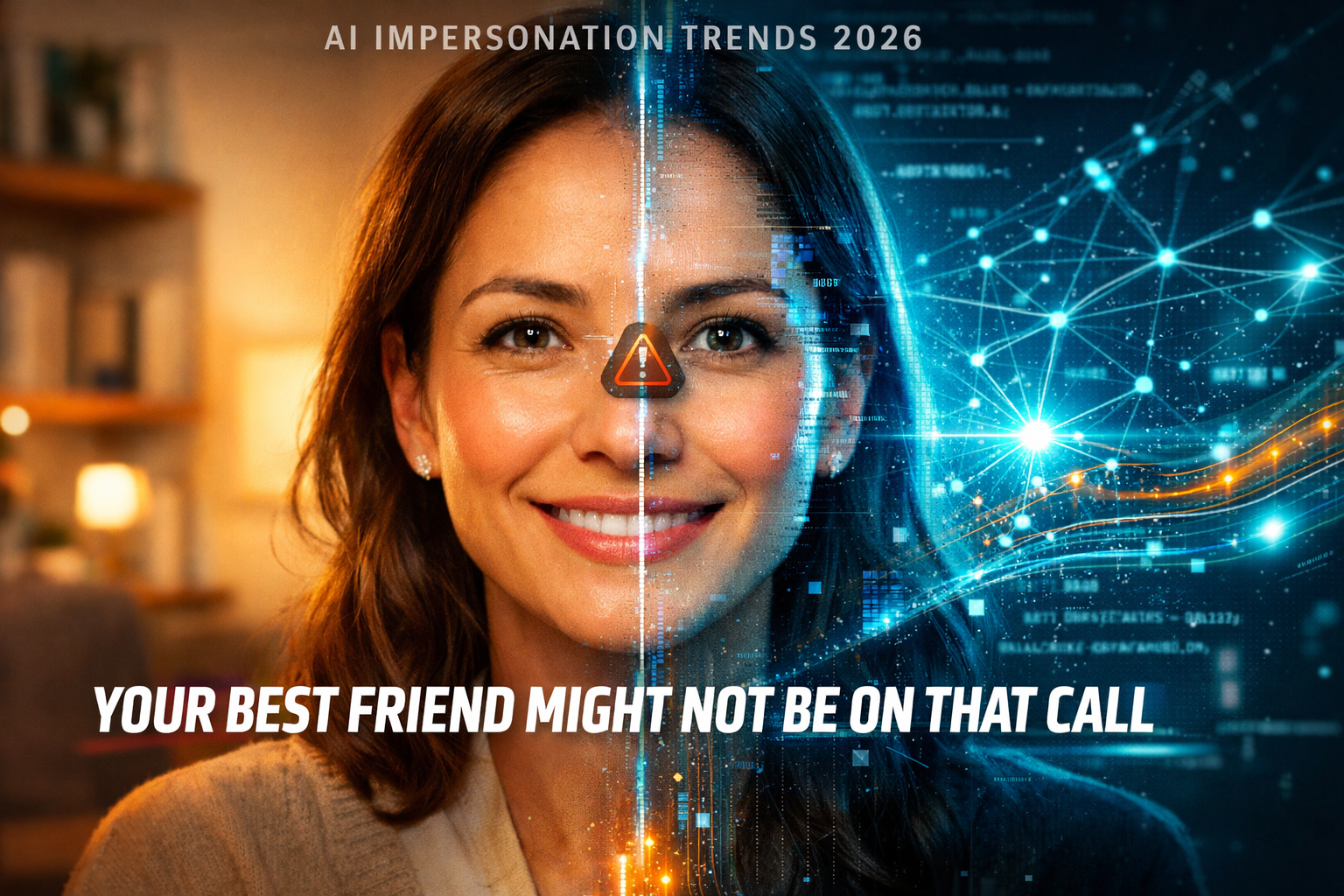
The world changed between 2025 and 2026, but not in the way most predicted. There was no single catastrophic deepfake that shocked the world. Instead, the barrier to entry for creating convincing synthetic media collapsed so completely that deepfakes went from curiosity to crisis in just one year.
What was once the domain of specialized engineers with expensive equipment is now a service anyone can buy. The technology didn’t just improve. It became invisible.
Why 2026 Is Different
The statistics tell a story of exponential acceleration. In 2023, roughly 500,000 deepfakes existed online. By 2025, that number swelled to approximately 8 million. The annual growth rate approaches 900 percent. But raw numbers miss the real shift. The important change happened in quality, accessibility, and intent.
Through 2024 and most of 2025, deepfakes carried a tell. A slight jitter in the eyes. Unnatural blinking patterns. Lighting that didn’t quite match the background. Skin textures that looked too smooth or too flat. These were the artifacts of imperfect synthesis. Security teams recognized them. Forensic experts could spot them. Vigilant users could sometimes catch them.
That changed in late 2025.
The evolution from Generative Adversarial Networks (GANs) to diffusion-based video models represents a fundamental shift in how synthetic media gets created. GANs worked through adversarial competition: a generator tried to fool a discriminator, creating an arms race within the neural network. This process was powerful but prone to collapse. Diffusion models flipped the approach entirely. Instead of competition, they embrace noise. During training, they gradually add noise to real images until they become unrecognizable. Then they learn to reverse this process, reconstructing images step by step.
The result produces fewer detectable artifacts. Forensic techniques that could identify GAN-generated content fail against diffusion-model deepfakes with alarming frequency.
The practical outcome is stark. Modern deepfake detectors, even state-of-the-art systems, now bypass detection with over 90 percent accuracy. The gap between synthetic and authentic media has narrowed to near imperceptibility for ordinary people viewing low-resolution video calls or media shared on social platforms.
The Infrastructure of Deception
Deepfake-as-a-Service platforms went mainstream in 2025. These aren’t underground tools anymore. They operate on the dark web and on marginally legitimate platforms.
They offer ready-made solutions for voice cloning, video synthesis, image generation, and persona simulation.
Attackers no longer need to understand the underlying technology. They no longer need expensive hardware.
They log in, upload a few seconds of reference audio or video, and the system does the rest.
Real-Time “Live” Deepfakes in Video Calls
The most unsettling development is the emergence of real-time deepfakes in live video conferencing. Zoom and Microsoft Teams released new capabilities throughout 2025 that, while designed for legitimate applications, created attack surfaces. Zoom’s Realtime Media Streams gives developers direct access to live audio and video data. Microsoft’s text-to-speech avatar systems can now synthesize talking heads in near-real time. These capabilities themselves are neutral.
But the underlying technology that powers them also powers something darker: attackers can now replace a video call participant’s face and voice in real time, creating perfect synchronization that fools the human eye.
The mechanics are straightforward. An attacker records just three seconds of a target’s voice. Microsoft’s VALL-E and similar systems only need this brief sample to replicate their voice with uncanny accuracy. Combine that with diffusion-based video synthesis, and you have a tool that can impersonate someone during a live video call, maintaining perfect lip sync and natural facial expressions.
The Hong Kong incident in 2024 foreshadowed this. Attackers used a deepfake video to impersonate a company’s CFO during a video call. Employees believed they were speaking to their leader. They authorized transfers totaling millions. That attack was sophisticated for its time. By 2026, it’s becoming routine.
High-Fidelity Voice Cloning from Minimal Samples
Voice cloning technology has crossed what researchers call the “indistinguishable threshold.” A three-second audio sample of someone’s voice is now enough to generate speech that captures not just the voice itself but emotional tone, speaking cadence, background noise, and speaking style.
If that sample comes from a phone call, the synthetic voice will sound like it’s being transmitted through a phone. If it comes from a quiet office, the synthetic output will maintain that sonic environment.
The implications extend beyond video impersonation. A criminal can call your bank claiming to be you, your business partner, or your family member. The voice sounds exactly right. Breathing patterns match. Emotional inflection is consistent. Your grandmother would believe it’s you. Your IT security team would believe it’s a authorized employee. Your accounting department would believe it’s your CFO.
The Rise of Deepfake-as-a-Service
The darknet has become a marketplace for synthetic identity creation. These platforms bundle voice cloning, video synthesis, image generation, and profile simulation. They operate like legitimate software-as-a-service companies, except their product is fraud at scale. Attackers combine deepfake video, voice cloning, and realistic personas to bypass security checks and exploit human trust.
In Singapore in 2025, attackers used DaaS tools to impersonate executives. They instructed employees to transfer funds to fraudulent accounts. The attacks succeeded because they exploited what technology cannot easily defend against: the human belief that seeing and hearing someone means that person is real.
In India, cybercriminals leveraged fake identities combined with phishing campaigns to trick employees into transferring sensitive information. These attacks didn’t fail. They worked.
U.S. financial fraud losses reached $12.5 billion in 2025, with AI-assisted deepfake attacks significantly contributing to that total. Organizations from finance to healthcare to government are now targets.
And detection spending is surging. Enterprises expect to increase investment in deepfake detection technology by 40 percent in 2026 alone.
The Technical Breakdown: How Modern Deepfakes Work
Understanding how deepfakes work helps explain why they’re so difficult to detect. The evolution matters because it shows why old defenses are failing.
The GAN Era (Pre-2024)
Generative Adversarial Networks worked through a clever game. A generator network tried to create fake images while a discriminator network tried to spot them. As the generator improved, the discriminator had to improve to catch it.
This created an escalating competition that eventually produced realistic synthetic media. But GANs had weaknesses. They struggled to maintain consistency over many frames in video. They left telltale frequency artifacts. They sometimes collapsed into repetitive outputs. They were also computationally expensive and required carefully balanced training.
The Diffusion Model Advantage (2024 Onward)
Diffusion models work differently. Imagine a photograph. Add noise to it gradually until it becomes pure static. A diffusion model learns to reverse this process, reconstructing the photograph by removing noise step by step. During training, this teaches the model how images are structured at different scales. When generating new content, the model starts with pure noise and gradually shapes it into an image by predicting what noise to remove at each step.
The advantage is profound. Diffusion models produce fewer detectable artifacts. They’re more stable during training. They generalize better across different types of content.
Most importantly for attackers, they’re harder to detect forensically because they don’t leave the characteristic grid-like frequency patterns that GANs do. A GAN detector trained on thousands of GAN-generated images will fail against diffusion model content. The artifacts are simply different.
The Integration: Real-Time Synthesis
The real breakthrough is speed. Early deepfakes required rendering hours of computation to synthesize even one minute of video. Modern systems synthesize video in real time or near-real time. This is possible because diffusion models, while slower during training, are faster during inference once optimized. It’s also possible because of algorithmic improvements that skip unnecessary denoising steps.
The result is that a deepfake video can be generated frame-by-frame during a live video call, adapted in real time to match the target’s natural movements and expressions.
This is not theoretical. Researchers have demonstrated real-time face synthesis systems that adapt to head position, gaze direction, and facial expression as if the synthetic person is actually present in the video call.
Key Trends Defining 2026
Real-Time “Live” Deepfakes
The most immediate threat in 2026 is the weaponization of video call technology. Attackers can now intercept or inject synthetic video feeds during Zoom, Teams, Google Meet, or Webex calls.
This doesn’t require the user to download anything or click a suspicious link. It happens at the network level or through compromised accounts. A CFO joins a call that looks authentic. A board member with a perfect video feed gives instructions to wire $5 million. The call ends. Then the CFO calls back asking why that wire hasn’t arrived yet.
This attack works not because the deepfake is perfect, but because it’s good enough. Most people see video at lower resolution during calls. Attention is divided. The voice is absolutely convincing. The minor imperfections that an expert might spot go unnoticed by people trying to do their jobs.
Voice Cloning from Minimal Samples
Three-second voice samples are now sufficient to create indistinguishable voice clones. This enables a specific and devastating attack: social engineering through voice. Attackers call help desks claiming to be executives who forgot their passwords. They call financial institutions claiming to be account holders. The voice is perfect.
The caller knows internal details. They know the account number or employee ID number. Security questions that relied on knowledge stored in databases can be answered because attackers researched publicly available information. The voice passes every test.
The technology supporting this is mature. Microsoft published VALL-E research in 2023 demonstrating three-second voice cloning. By 2025, similar or better systems were deployed in commercial tools. Systems like OpenVoice can clone voices across languages. They can adjust emotional tone and speaking style. They can replicate background noise. There is no meaningful distinction between a synthesized voice and an authentic one for most listening scenarios.
Deepfake-as-a-Service Goes Mainstream
In 2025, DaaS platforms moved from niche darknet services to established tools with predictable pricing, customer support, and feature roadmaps.
They accept cryptocurrency. They offer API access. They provide bulk processing.
They’ve created an ecosystem where the technical barrier to launching a sophisticated impersonation attack has collapsed to near-zero.
The criminals using these services are not sophisticated. They’re not nation-state actors with advanced technology teams. They’re ordinary fraudsters who can now do what previously required specialized expertise. One attack is worth thousands.
Volume is economical. Detection is difficult.
Law enforcement attribution is nearly impossible.
Three Immediate Actions You Can Take
The harsh reality is that perfect defense doesn’t exist.
Deepfakes will fool you sometimes. But you can dramatically reduce your risk by implementing basic verification practices.
Verify Through Secondary Channels
Never act on sensitive requests from video calls alone. If a CFO asks you to wire funds, hang up and call them back using a phone number you look up independently. If a colleague asks for credentials, tell them you’ll email them through established channels and verify the request separately.
This single practice stops most deepfake fraud. Attackers can create perfect video and voice. They cannot create perfect consistency across multiple channels.
The additional step takes 30 seconds. It’s inconvenient. It’s also the single most effective defense against synthetic impersonation.
Examine Facial Movement and Lighting
Deepfakes have improved dramatically, but imperfections remain visible if you know what to look for.
Pay attention to eyelids. Real humans blink about 15 to 20 times per minute. Blinking happens in smooth intervals. Deepfakes sometimes blink too rarely, too often, or in rigid, unnatural patterns. Look at the eyes themselves. Are they glossy with natural moisture? Do they reflect light naturally? Deepfake eyes sometimes have a flat, lifeless quality that doesn’t quite match authentic eyes.
Examine lighting consistency. If someone is lit by office fluorescent lights, their skin should have a particular color temperature. Their shadows should be sharp and consistent. If the lighting suddenly seems inconsistent, if highlights suggest studio lighting while the background shows softer natural light, that’s a red flag.
Real people generally don’t have lighting inconsistencies during video calls unless they’re in genuinely unusual environments.
Pay attention to skin texture as well. Real skin has natural variation, pores, and micro-imperfections. Deepfake skin sometimes looks unnaturally smooth or plastic.
The effect is subtle but visible when you look for it.
Check Audio-Visual Synchronization
Listen carefully to lip sync. In real video, speech matches lip movements with millisecond precision. There’s a natural delay of about 100 to 150 milliseconds where the brain syncs audio and video.
If that sync seems off, if lips move slightly after audio, or if there’s an unusual gap, that’s suspicious. This is one of the hardest aspects of deepfakes to perfect. Even minor imperfections create an uncanny valley effect that signals something is wrong.
Listen also for natural background noise. Authentic video calls contain background sounds. An office has ambient noise. Someone at home has household sounds. Artificial silence or generic background noise is suspicious.
Listen for breathing patterns during pauses. Natural speech includes breathing breaks. If someone speaks for too long without breath, or if breathing seems unnaturally placed, that’s worth noting.
Tomorrow’s Deep Dive: How AI Voice Cloning Really Works
This article is the first in a 30-day security series on MayhemCode. Later on, we explore the technical machinery behind voice cloning.
Key Takeaways
Deepfakes have become indistinguishable from authentic media for ordinary observers viewing standard resolution video or listening to audio. Real-time synthesis now enables live impersonation during video calls. Voice cloning requires only three-second samples to create convincing speech.
Deepfake-as-a-Service platforms have made synthetic impersonation accessible to any attacker willing to pay. Detection technology is falling behind synthesis technology. The most effective defense remains human skepticism: verify critical requests through secondary channels. Facial movement, lighting, and audio-visual sync anomalies remain detectable if you know what to examine.
Infrastructure-level protections using cryptographic media signatures will become necessary. Enterprises and individuals must assume they will eventually encounter convincing deepfakes and plan accordingly.
Join Us For the Series
This is day one of a 30-day deep dive into AI security, authentication, synthetic media detection.
Don’t forget to Subscribe to ensure you don’t miss articles.