ChatGPT learned from the internet up to a certain date. It does not know your internal documents, your API specifications, or the latest market research sitting in your company database. When you ask it questions about these things, it either confabulates (invents plausible-sounding but false information) or admits defeat. Neither is acceptable for production systems.
Retrieval-Augmented Generation — or RAG, as it is known — is the practical solution that fixes this fundamental problem. And in 2025, it will have become the standard approach for every serious AI application handling private or real-time data. Yet most teams implementing RAG are still getting it wrong.
What RAG Actually Does
RAG is the bridge between raw language models and your actual data.
Imagine you have 5,000 pages of technical documentation. You want your AI assistant to answer questions about your product based only on that documentation — not hallucinations, not external knowledge, just what you have written. RAG makes this possible.
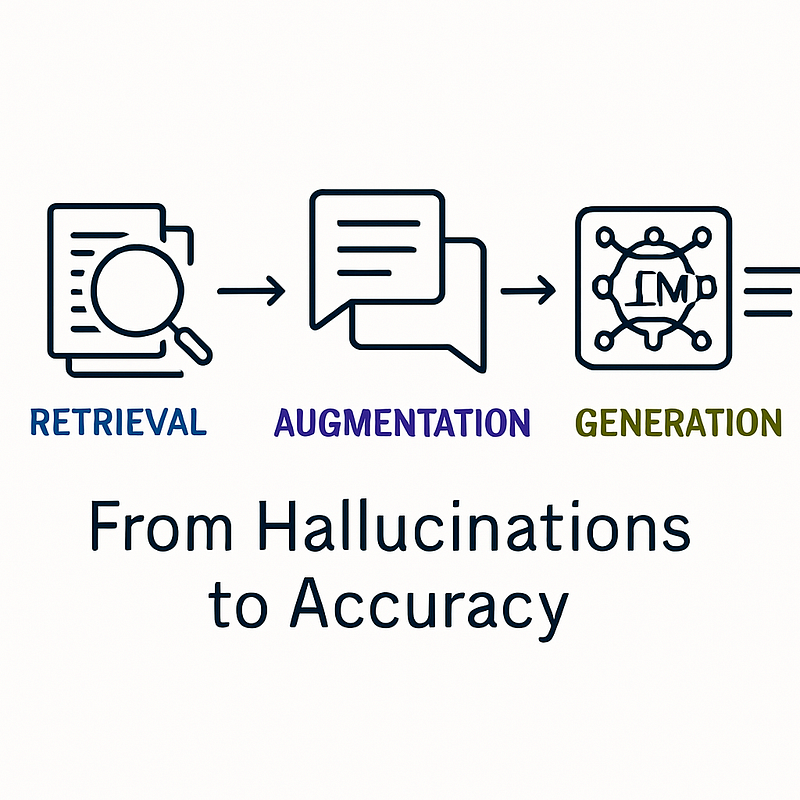
Here is the flow. When a user asks a question, RAG does not immediately send that question to the language model. Instead, it first searches through your documentation to find the most relevant sections. Then it says to the language model: “Here is what the user asked. Here are the relevant documents. Now generate a response based on these documents.”
This fundamentally changes what happens. The model still generates the response creatively, but it is grounded in your actual data. Hallucinations drop by 60–70% compared to asking raw ChatGPT. The model becomes honest. It says “this document does not contain that information” instead of inventing an answer. That is not a small difference. That is the difference between a prototype and something you can ship to production.
The three layers are simple. Retrieval (finding the right documents), Augmentation (packaging them with the query), and Generation (creating the response). Each layer has specific failure modes. Understanding them is how you build RAG systems that actually work.
Where Most RAG Systems Fail
The interesting thing about RAG is that retrieval is harder than it seems. Most teams understand generation. Language models are well understood. But retrieval… that is where most systems break.
Consider this real scenario. You have 10,000 support articles. A customer asks, “Why is my payment failing?” The system searches for relevant articles and returns documents about payment methods, transaction limits, and error codes. But it misses the specific article addressing declined credit cards, which is exactly what the customer needs. The AI generates a plausible but not quite right answer based on the less-relevant retrieved documents.
This happens because the retrieval step is doing basic similarity matching. It is looking for keyword overlap or semantic similarity. But semantic similarity and what humans actually need are sometimes different things. The customer needs specificity; the retrieval mechanism returns generality.
The fix requires thinking carefully about three specific decisions that most teams rush through. Get these wrong, and everything downstream suffers.
Chunking: Smaller Than You Think
Most developers make their chunks too large.
A chunk is a piece of your document that gets converted into embeddings (mathematical representations) and stored in a vector database. If chunks are too large — say, an entire 2,000-word article as one chunk — the embedding becomes diffuse. It represents everything and nothing. A query looking for specific information gets a chunk that contains that information, but also 1,900 words of irrelevant content.
Research from 2025 shows the sweet spot is typically 256–512 tokens (roughly 100–200 words for English text). Smaller chunks mean more precise retrieval. Yes, you index more chunks, which costs more storage and slightly slows retrieval. But precision gains are worth it. You retrieve exactly what you need, not a page that happens to contain what you need somewhere on it.
The overlooked detail is overlap. When you split documents into chunks, use 20–30% overlap with the previous chunk. This preserves context at boundaries and prevents information from falling between chunks. A fact mentioned across a page break should not disappear just because it crossed a chunk boundary. Overlap is cheap insurance against boundary artefacts.
Embedding Models: Not All Embeddings Are Equal
Not every language model embedding is appropriate for your domain.
OpenAI embeddings are solid for general-purpose queries. But if you are building a medical diagnosis system, a model trained on medical text will outperform a general-purpose model by 20–40% for retrieval accuracy. This is not theoretical. Research published in early 2025 demonstrates this across multiple languages and domains. The improvement is real and measurable.
The choice matters more than most people realise. An embedding model captures the semantic meaning of your text in a multi-dimensional vector space. If that model was trained on Wikipedia and Reddit, it understands those types of content well. If your documents are legal contracts or scientific papers, a specialised embedding model is worth considering.
The trade-off is simple: better embeddings increase retrieval cost (computation to generate them) but reduce downstream AI mistakes. For most production systems, this trade-off favours specialised embeddings. One mistake corrected per thousand queries pays for the cost difference within months.
Retrieval Scoring: Why Your Top Result Is Wrong
Vector similarity alone is not enough.
When you query a vector database, you get documents ranked by similarity to your query. This seems logical. But real-world information needs are more complex. A query might need recent documents ranked higher, even if they are not perfectly similar. Or documents should be pre-filtered by metadata (date, category, author) before similarity ranking happens.
Advanced RAG systems do two things most teams miss. First, they rerank retrieved documents using a smaller, more precise model. You get top-10 results from broad retrieval, then rerank them using a different scoring function. This two-stage approach significantly improves precision. It is computationally cheap at scale (you only rerank top results) but dramatically improves what the user sees.
Second, they use hybrid retrieval. Traditional keyword search plus vector similarity running in parallel. A user searching for “O₂ saturation levels” probably needs exact keyword matches more than semantic similarity. Hybrid search handles both. Research shows hybrid retrieval improves precision and recall by 15–25% compared to vector-only search.
Production Reality: Freshness Kills Retrieval Quality
Here is what nobody warns you about. Your RAG system will work beautifully for three months. Then your knowledge base becomes stale.
Documents get updated, new information arrives, and old information becomes outdated. But if you re-index everything from scratch, your system goes offline. Queries fail. The service stops.
Production RAG requires addressing this head-on. Most teams use batch re-indexing at scheduled times (3 AM on weekends). Pinecone, Weaviate, and similar vector database services support zero-downtime reindexing now, but you must implement it proactively.
The better approach is incremental updates. New documents get indexed immediately. Updated documents replace old entries. This requires careful versioning — you must track which version of each document is currently indexed — but it enables truly live knowledge bases. Your system stays fresh without ever going offline.
The Path Forward
Building production-ready RAG is straightforward if you are systematic.
First, define your chunk strategy. Start with 256–512 token chunks and 20% overlap. Test and adjust based on real retrieval quality, not theory.
Second, choose your embedding model intentionally. For specialised domains, invest time evaluating domain-specific embeddings. For general purposes, OpenAI embeddings work.
Third, implement hybrid retrieval with reranking. This is not complicated — LangChain and similar frameworks make it standard — but it requires intentional setup.
Fourth, plan for knowledge base freshness from day one. Zero-downtime reindexing is not optional in production.
Fifth, measure what matters. Not just retrieval speed, but retrieval accuracy. Whether the retrieved documents actually help the LLM generate correct answers.
RAG is not magic. It is a framework for making AI systems factual. But it only works when you sweat the details that everyone rushes through… chunking, embedding selection, retrieval scoring, knowledge base freshness.
The teams winning with AI are not the ones with the fanciest language models. They are the ones who obsess over data quality and retrieval precision. They understand that a mediocre LLM with great retrieval outperforms a brilliant LLM with bad retrieval every single time.
Your data is your competitive advantage. RAG is how you actually use it.