There is a strange asymmetry at the center of the “ASUS ROG NUC vs Mac Mini” debate that most comparison articles gloss over: as of mid-July 2026, only one of these machines actually exists in a form you can order. The ROG NUC 16 (2026) launched in China in May with real pricing, real specs, and a genuine RTX 5080 Laptop GPU crammed into a three-liter box. The Mac Mini M5, meanwhile, is still a rumor. Apple skipped it entirely at WWDC on June 8, and reporting since then points to a launch window sliding into late Q3 or Q4 2026, with some analysts hedging even further into 2027.
That does not make the comparison pointless. It makes it more interesting, because the honest version of this matchup is not “which chip wins,” it is “a $4,000-plus gaming and creator workstation from ASUS” against “the Mac Mini you can buy today, plus the one Apple keeps promising.” Both machines target the same shrinking desk space and the same buyer who wants desktop power without a desktop-sized tower. They just disagree completely on what that power should be used for.
This piece breaks down what each machine actually offers, where the ROG NUC pulls ahead, where the Mac Mini still wins on pure practicality, and why the “M5” half of this question is currently unanswerable in any way that matters for a purchase decision.
The ROG NUC 16 Is Real, and It Is Expensive
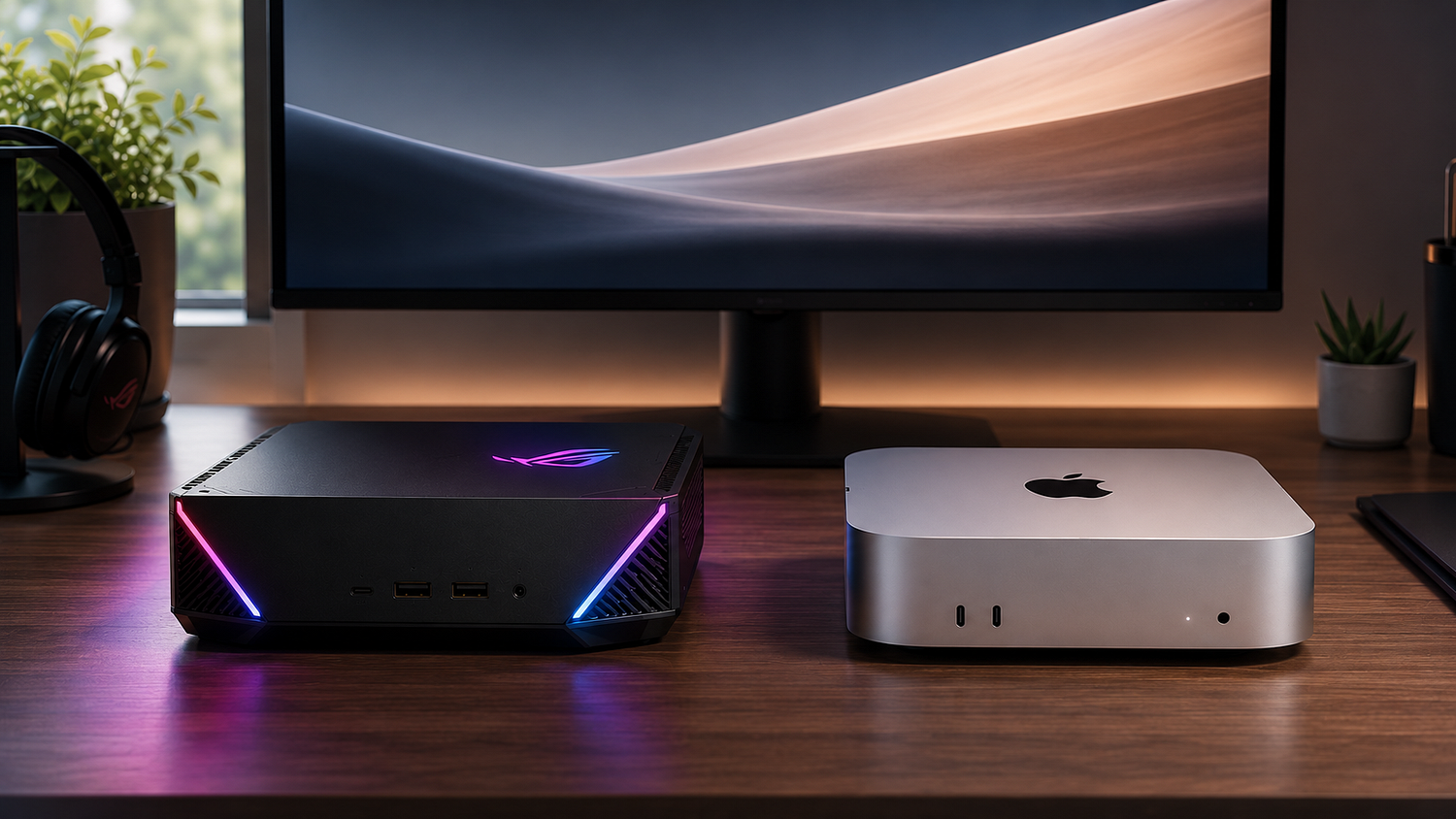
ASUS launched the ROG NUC 16 (2026) in China first, in black and white versions, keeping the same 3-liter chassis footprint the ROG NUC line has used since its 2024 debut. The headline change is the processor: a Core Ultra 9 290HX Plus, built on Intel’s Arrow Lake Refresh platform, with 24 cores and a boosted clock of 5.5 GHz on the flagship configuration. Paired GPU options run from an RTX 5060 Laptop GPU all the way up to the RTX 5080 Laptop GPU, all using the same CPU across every tier, which is a smart way to keep the bill of materials simple even if it means the entry configs are carrying more CPU than they probably need.
The China pricing is where things get uncomfortable. The black Obsidian model lists at 29,999 yuan, which works out to roughly $4,420. The white Moonlight version adds a bit more, landing closer to $4,490 to $4,570 depending on which outlet you check. No US or UK pricing has been confirmed yet, though most reporting expects a US figure somewhere around $4,000 once it lands, and UK buyers currently have no launch window at all. For context, the outgoing 2025 ROG NUC sold in the UK for £2,129 to £2,599, and in the US and EU for the equivalent of roughly $2,300 to $3,700. If the 2026 model tracks anywhere near its China price once it reaches Western markets, this is a significant jump.
What do you get for that money? Up to 128GB of DDR5–6400 CAMM memory, a 380W power adapter (15 percent more wattage than the 2025 unit), 16GB of GDDR7 video memory on the top GPU tier, and a claimed 1,334 AI TOPS across the combined CPU/GPU/NPU stack. ASUS is explicitly pitching this thing at three audiences at once: gamers who want console-killing frame rates in a box the size of a large lunchbox, creators doing video and image work, and increasingly, people who want to run local AI models without renting cloud GPU time. That’s a lot of jobs for one machine to claim it’s the best at, and it’s worth being skeptical of that framing rather than taking ASUS’s word for it.
The Mac Mini M4 Is What You Can Actually Buy
Here’s the part that gets lost in every “M4 vs M5” headline floating around right now: Apple has not shipped a Mac Mini with an M5 chip. The M5 exists, technically. It’s been in MacBook Pro since October 2025, and the M5 Pro landed in laptops in March 2026. But neither chip has reached a Mac Mini SKU, and Apple’s own WWDC keynote in June came and went without so much as a mention of the desktop.
So the real, buyable Mac Mini in July 2026 is still the M4 version, the one that got the major redesign back in October 2024, shrinking the whole machine down to a 5-by-5-inch footprint. That base model started at $599, and depending on who you ask, that entry tier has either been quietly discontinued or is simply hard to find in stock right now. Reporting since April has pointed to a sharp drop in availability of higher-end configurations, along with rising prices on RAM upgrades, both of which read like classic pre-refresh supply tightening.
As for the M5 itself, the leaked picture (credited mostly to Ming-Chi Kuo and Bloomberg’s Mark Gurman) suggests a standard M5 with 8 to 10 CPU cores and 10 to 12 GPU cores, plus an M5 Pro option with 12 to 14 CPU cores and a wider memory bus for creative and developer workloads. Wi-Fi 7 and Bluetooth 6 are expected across the board, matching what Apple already shipped on the March 2026 MacBook lineup, and Thunderbolt 5 is rumored for the Pro tier specifically. Pricing is genuinely unclear. Some reports expect the base model to climb to $699 to $799 if Apple doubles base storage to 512GB. Others think it holds at $599. Nobody outside Cupertino actually knows yet, and anyone telling you a firm number right now is guessing.
Performance: One of These Numbers Is Real
This is where the comparison gets lopsided, and not in the way most headlines suggest. The ROG NUC 16’s RTX 5080 Laptop GPU puts it in a completely different performance category than any Mac Mini, current or rumored. Apple has never put a discrete GPU in the Mac Mini, and there’s no indication the M5 generation changes that. The Mac Mini’s graphics have always come from the integrated GPU baked into the chip itself, which is efficient and genuinely capable for its power draw, but it was never built to compete with a laptop-class RTX 5080 running native PC games at high frame rates.
If gaming is the actual use case, the ROG NUC wins outright and it isn’t close. That’s the whole point of the machine. On the CPU side, the 24-core Core Ultra 9 290HX Plus also outmuscles anything Apple has shipped or rumored for the Mini in raw multi-threaded throughput, though Apple Silicon has historically punched above its core count in single-threaded and efficiency-per-watt terms, which matters a lot for anyone running the machine 10 hours a day rather than in short gaming bursts.
Where it gets more interesting is efficiency and noise. A 380W power adapter and a 24-core CPU paired with a 5080 Laptop GPU inside a 3-liter case is going to run hot, and it’s going to run loud under sustained load. That’s just physics. The Mac Mini, whatever chip ends up inside it, has always prioritized quiet operation and low power draw over peak performance. If your workflow involves sitting three feet from the machine for eight hours, that difference in fan noise and desk heat is not a minor footnote.
Local AI: The Category Nobody Quite Has Locked Down
Both machines are being pitched, at least partly, at people running local AI models, things like Ollama, LM Studio, Open WebUI, that kind of setup. ASUS’s own marketing for the ROG NUC 16 explicitly name-checks AI experiments as a use case, leaning on the 1,334 combined TOPS figure and the 16GB of dedicated GDDR7 on the top GPU tier. That VRAM number matters more than the TOPS figure does in practice, since running larger local language models is mostly a memory-capacity problem, and 16GB is enough for a lot of mid-sized quantized models but not the really large ones.
The Mac Mini’s advantage here has never been raw TOPS. It’s unified memory. Because the CPU, GPU, and Neural Engine all share the same pool of RAM, a Mac Mini configured with 32GB or more of unified memory can load models that would need a discrete GPU with equivalent VRAM on a Windows machine, and discrete GPUs with 32GB or more get very expensive very fast. Whether the M5 generation pushes unified memory higher on the Mini is one of the open questions in the rumor mill right now, and it’s arguably the single most important spec for anyone buying this machine specifically to run models locally rather than in the cloud.
Neither machine is a clean win for local AI. The ROG NUC has more raw compute and a real discrete GPU. The Mac Mini has memory architecture that plays nicer with larger models per dollar of RAM. Anyone buying either machine primarily for AI workloads should wait for actual benchmark numbers rather than trusting either company’s TOPS marketing, because TOPS figures notoriously don’t translate cleanly to real-world token generation speed.
There’s also the question of what you’re actually running. Someone fine-tuning small models or doing batch inference on quantized 7B and 13B models will be fine on either machine. Someone trying to load a 70B parameter model locally is going to hit VRAM or unified memory ceilings on both, and will likely end up looking at higher-tier configurations than the base pricing on either product suggests. The marketing copy for both machines tends to skip that part.
Competing Products Worth a Mention
Neither the ROG NUC nor the Mac Mini exists in a vacuum. On the Windows side, smaller manufacturers like Minisforum and Thunderobot have been shipping mini PCs with similar core counts and GPU tiers at noticeably lower prices, and reporting on the ROG NUC 16 has already flagged that ASUS will need to justify its premium against exactly those competitors. On the Apple side, there’s no real direct competitor: nothing else on the market pairs macOS with this form factor, which is part of why Apple can afford to sit on the M5 refresh without much competitive pressure forcing its hand.
Design, Ports and the Space on Your Desk
Both machines are compact by desktop standards, though “compact” means very different things here. The ROG NUC 16 keeps its 3-liter chassis and adds a removable stand that cradles the unit rather than just screwing on, along with the ability to sit the box vertically or horizontally depending on desk layout. Port-wise, ASUS is leaning into the gaming-PC connectivity playbook: multiple USB Type-A, USB-C, Wi-Fi 7, Bluetooth 5.4, and 2.5GbE wired networking, plus the memory expansion up to 128GB.
The Mac Mini’s 5-by-5-inch footprint is smaller still, and Apple’s design language hasn’t changed since the 2024 redesign, with the same aluminum body and port layout expected to carry over to M5. Thunderbolt 4 stays standard on the base tier, with Thunderbolt 5 rumored for M5 Pro specifically. If your setup already leans on Thunderbolt peripherals, that continuity matters more than any spec bump.
Neither machine is upgradeable in the way a full-size tower is. The ROG NUC gives you more headroom on memory and storage expansion than the Mac Mini ever has, but you’re still locked into whatever GPU tier you buy at purchase time on both machines. That’s the tradeoff every small-form-factor buyer signs up for, and it’s worth remembering before anyone tells you either box is “future-proof.”
Software: This Is Really the Question That Matters
Strip away the specs and this comparison stops being about silicon and starts being about which operating system and software ecosystem you actually want to live in. The ROG NUC runs Windows, full stop, which means access to the entire PC gaming library, every game launcher, and broad compatibility with Windows-only creative and engineering software. It also means Windows’ usual quirks: driver management, background bloatware depending on the OEM, and the general noisiness of a Windows install compared to macOS.
The Mac Mini runs macOS, which locks you into Apple’s ecosystem but gets you tighter integration with iPhone, iPad, and other Apple devices, plus access to the growing set of Apple Intelligence features Apple has been building into recent macOS releases. For local AI work specifically, Apple’s MLX framework has become a genuinely popular choice among people running models locally on Apple Silicon, and that software maturity is arguably more relevant to a buying decision than any single spec sheet number.
Gaming on macOS has improved but is still nowhere close to the Windows library. If gaming is even a secondary consideration, that alone probably settles the debate before pricing or performance even enters the conversation.
Price and Value: A Genuinely Uneven Fight
At a rumored $4,000-plus for the ROG NUC 16 once it reaches US shelves, this is not a budget purchase by any measure. It’s priced closer to a high-end gaming laptop or a small custom-built tower than to anything Apple has ever charged for a Mac Mini. The Mac Mini M4 currently starts at $599, and even a heavily configured M4 Pro model with maxed-out memory and storage typically lands well under $2,500. If the M5 pricing rumors hold and the base model climbs to $699 or $799, it still isn’t approaching ROG NUC territory.
That price gap isn’t really a flaw in either product. It’s a sign these two machines aren’t actually competing for the same buyer’s wallet in the first place. Someone deciding between a $600 Mac Mini and a $4,400 gaming mini PC almost certainly already knows which category of machine they need. The “vs” framing that gets used across YouTube thumbnails and blog headlines is mostly a hook, not a genuine dilemma most shoppers are facing.
Which One Should You Actually Buy
If gaming performance, a real discrete GPU, and Windows compatibility matter to you, the ROG NUC 16 is the more capable machine on paper, assuming you can stomach a price that’s edging into small-tower territory and you’re comfortable buying hardware where the US pricing and release date are both still unconfirmed. If quiet operation, macOS, tight Apple ecosystem integration, and a genuinely small footprint matter more, the Mac Mini remains the better fit, and right now that means the M4, not a chip that hasn’t shipped in this form factor yet.
The uncomfortable truth buried under all the spec sheets is that “Mac Mini M5” isn’t a product yet. It’s a rumor with increasingly specific leaked numbers attached to it, and anyone budgeting around a firm launch date or price this summer is planning around guesswork. The ROG NUC 16, whatever you think of its price tag, at least has the decency to actually exist.
For most people reading a headline that pits these two against each other, the honest answer is to buy for the operating system and the software you actually need, then let the chip generation sort itself out later. A gamer waiting on a Mac Mini refresh for frame rates is going to be disappointed no matter which chip eventually ships. A developer or local-AI tinkerer eyeing the ROG NUC purely for its unified-memory-style promises is comparing the wrong architecture entirely. Match the machine to the job first. The spec sheet argument can wait until Apple actually publishes one.