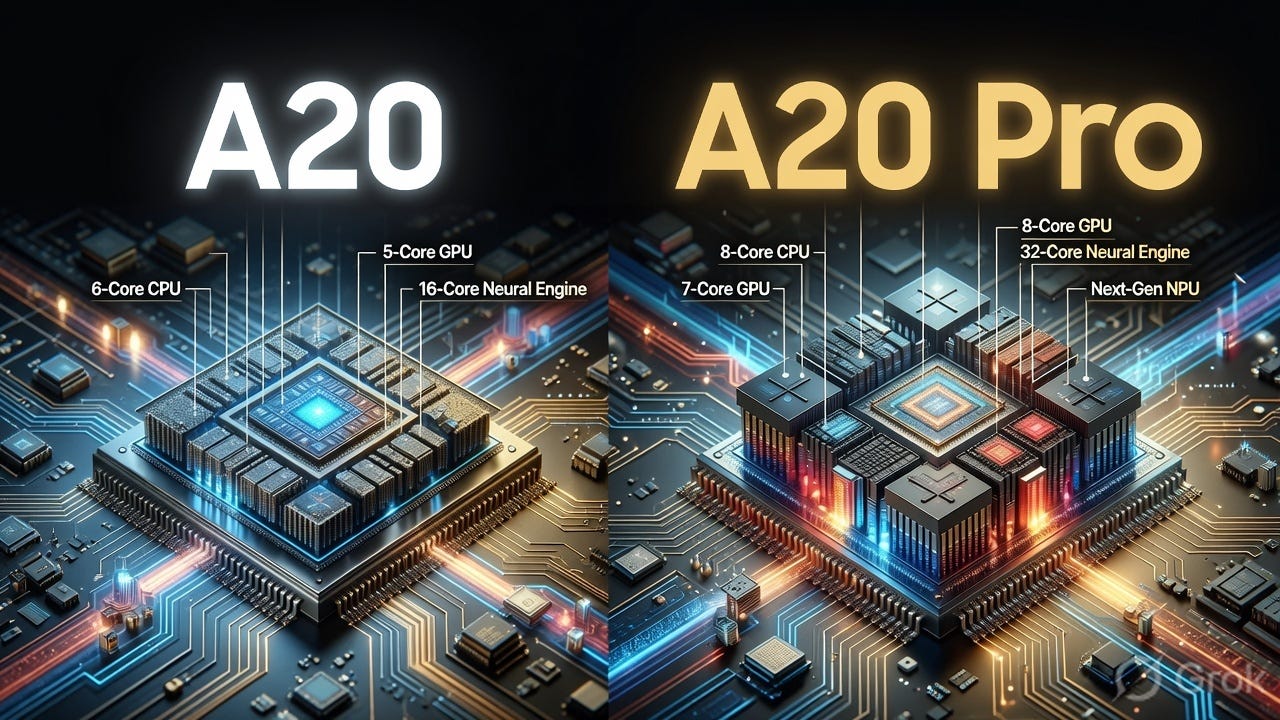
Every September, Apple puts a new chip on stage and calls it the fastest thing it has ever built. Most years, that claim is technically true and practically forgettable, a single-digit bump in a benchmark chart nobody outside a handful of tech forums actually reads. The A20 Pro, expected to arrive inside the iPhone 18 Pro and iPhone Ultra this fall, is being treated differently. It is Apple’s first chip built on TSMC’s 2-nanometer process, the first to use a new packaging method called Wafer-Level Multi-Chip Module, and reportedly the first Apple silicon in years where the Neural Engine, not the CPU, is getting the biggest share of new transistor budget.
That combination has produced two very different reactions online. One camp is calling the A20 Pro the most significant Apple chip since the original A11 Bionic introduced the Neural Engine back in 2017. The other camp points out that Apple says something similar every year, and that “first to 2nm” is a manufacturing footnote, not a feature anyone will notice while scrolling Instagram. Both arguments have real evidence behind them. This piece lays out what is actually known about the A20 Pro, why the claims of a generational leap are not just marketing noise this time, and why some of the skepticism is fair too.
Why 2 Nanometers Is a Bigger Deal Than It Sounds
Chip generations are usually described in nanometers, and most people have learned to tune that number out because it rarely correlates with a phone that feels obviously faster. The A19 Pro was built on TSMC’s N3E process, an evolution of the 3nm node Apple has used since 2023. The A20 Pro moves to N2, TSMC’s first commercial 2nm node, and the underlying transistor design changes along with it.
Up through 3nm, chipmakers used FinFET transistors, which control current flow from three sides of a fin-shaped channel. At 2nm, TSMC and Apple are switching to Gate-All-Around (GAA) transistors, where the gate wraps around the channel on all four sides. This isn’t a cosmetic change. GAA transistors leak less current when they’re supposed to be off, which is the main reason 2nm chips are expected to run cooler and pull less power for the same workload. Early estimates put the transistor density gain at roughly 15 percent over N3E, with efficiency improvements Apple will likely lean on hard given how much thermal headroom on-device AI processing eats up.
Apple didn’t get first access to N2 by accident. The company reportedly secured more than half of TSMC’s initial 2nm production capacity, which is exactly the kind of aggressive, years-ahead-of-launch move Apple made with 3nm and 5nm before it. Qualcomm and MediaTek, by contrast, are reportedly waiting for N2P, a refined version of the 2nm node arriving after N2, for their Snapdragon 8 Elite Gen 6 and Dimensity 9600 chips. N2P is expected to offer roughly 5 percent higher performance than N2 at the same power draw, so Apple’s rivals may technically launch on newer silicon than the A20 Pro despite arriving months later. That detail alone is going to fuel plenty of comment-section arguments about who actually “won” the 2026 chip race.
The Packaging Change Nobody Is Talking About Enough
If there is one part of the A20 Pro story getting buried under the 2nm headline, it’s the packaging. Apple has used package-on-package design for years, stacking RAM directly on top of the processor. It works, but it crams heat into a small area and limits how much bandwidth can move between the chip and memory.
The A20 Pro is expected to switch to Wafer-Level Multi-Chip Module packaging, or WMCM, a TSMC technique that integrates the processor and DRAM at the wafer level before the chip is even cut apart. There’s no interposer or substrate sitting between the components, which should mean lower latency, better signal integrity, and less concentrated heat. In plain terms: the memory sits closer to the processor and talks to it faster, without turning that corner of the phone into a hot spot during heavy workloads like on-device AI inference or sustained gaming.
This is the first time Apple has made a packaging change this significant on an iPhone chip, and it matters more than it sounds like it should, because raw transistor speed only helps if the surrounding architecture can actually deliver data to the processor fast enough to use it.
The Numbers Being Thrown Around
Leaked and predicted benchmark figures should always be read with some suspicion this far ahead of launch, but the numbers circulating for the A20 Pro are consistent enough across multiple sources to be worth mentioning. Single-core Geekbench scores are being predicted around 4,200, with multi-core scores exceeding 10,000. For context, that single-core number would keep Apple’s long-standing lead in single-thread performance, a category where the iPhone has beaten every Android flagship for close to a decade running.
Multi-core is where things get more interesting, and more contested. MediaTek’s Dimensity 9600 Pro, tested on an engineering sample, reportedly hit single-core scores of 4,200 to 4,300 and multi-core scores between 12,000 and 12,500, numbers that would put it ahead of the A20 Pro’s predicted multi-core figure by a real margin. The catch, according to the same leak, is thermal throttling. MediaTek is said to be targeting a 5.0GHz clock speed on the Dimensity 9600 Pro that the chip likely can’t sustain for more than a few minutes before it has to clock down, meaning those big benchmark wins might only show up in short synthetic tests rather than real gaming or video export sessions. Whether the A20 Pro’s efficiency advantage translates into a real-world win over a chip with a higher peak but worse sustain is exactly the kind of question that won’t get settled until independent reviewers get retail units in hand.
RAM is another area worth watching. Reports point to 12GB as the likely standard for the iPhone 18 Pro line, with some rumors suggesting up to 16GB for the higher-tier configurations, up from the 8GB Apple has shipped on recent Pro models. That jump matters less for day-to-day apps and more for running larger on-device AI models, which has become the thing every phone maker is racing toward in 2026.
Where the “Game Changer” Argument Actually Holds Up
The strongest case for calling the A20 Pro a genuine leap rather than a routine refresh comes down to timing and intent. Apple isn’t chasing 2nm for bragging rights. The Neural Engine is reportedly getting a disproportionate share of the die area increase, which lines up with what Apple has been signaling for the past two iOS cycles: more on-device processing for Apple Intelligence features, less reliance on sending data to a server. A chip that runs AI models locally, for longer, without overheating or draining the battery, is the actual product Apple is trying to ship. The silicon is just the mechanism.
There’s also a structural argument that gets less attention than the benchmark numbers. Apple has historically converted a manufacturing lead into a multi-year software advantage. When the A17 Pro brought 3nm to the iPhone 15 Pro in 2023, it took Qualcomm and MediaTek roughly two years to catch up on process node, and by the time they did, Apple had already built two more generations of software optimized around the assumption of that hardware headroom. If the A20 Pro repeats that pattern, and Apple’s rivals are indeed a full node behind for another cycle, the practical gap in sustained AI performance could be larger than the single-digit benchmark differences suggest.
Where the Skepticism Is Fair
None of that means the “just another chip” crowd is wrong to push back. A predicted 15 percent performance gain and 25 to 30 percent efficiency improvement, while solid, is roughly in line with what Apple has delivered on several previous node transitions. The A17 Pro’s jump from 4nm to 3nm produced similar percentage gains, and most people who upgraded from an iPhone 14 Pro to an iPhone 15 Pro would be hard pressed to describe the difference as transformative in daily use. Chip generations rarely feel as dramatic in your hand as they look in a bar chart.
There’s also the cost question. Component cost estimates for the iPhone 18 Pro Max have been circulating with per-unit chip costs around $280, a meaningful jump from previous generations, largely because 2nm wafers are reportedly running about 50 percent more expensive than 3nm. Some analysts are predicting that cost gets passed to buyers, with the iPhone 18 Pro potentially starting several hundred dollars higher in some markets than the outgoing model. A faster, cooler chip is a much less exciting headline if it also means a noticeably more expensive phone, and that tension between “best chip Apple has ever made” and “most expensive iPhone yet” is likely to be one of the bigger points of debate once pricing is confirmed.
Component pricing rarely stays contained to just one part of a phone’s bill of materials either. A more expensive processor tends to arrive alongside pricier RAM, a bigger battery, and camera upgrades bundled into the same launch, which is exactly what’s rumored here: 12GB of RAM as the new baseline, a 48-megapixel rear camera system, and Apple’s in-house C2 modem all reportedly shipping across the Pro and foldable lineup at once. Stack enough of those upgrades together and the chip stops being the only reason the phone costs more, but it’s usually the one that gets blamed in headlines because it’s the easiest number to point at.
And then there’s the competitive picture, which is genuinely closer than the “Apple always wins” narrative suggests. GSMArena’s recent chipset rankings noted that the flagship tier has compressed significantly over the past few years, with Snapdragon, Dimensity, Exynos, and Apple silicon now occupying roughly the same performance band rather than one company dominating outright. Qualcomm has closed much of the multi-core gap, and MediaTek’s GPU gains in particular have been aggressive enough that some leakers expect the Dimensity 9600 to beat the A20 Pro in graphics benchmarks outright. Apple’s advantage has increasingly narrowed to single-core performance and sustained efficiency rather than a blowout lead across every category, and that narrower advantage is a much harder story to sell as revolutionary.
Why This Chip Has Turned Into an Online Argument
Chip launches don’t usually generate this much back-and-forth before they happen, and it’s worth asking why the A20 Pro has become such a lightning rod months ahead of any official announcement. Part of it is timing. The comparison isn’t just Apple versus Apple’s own last generation anymore, it’s a three-way race, with Qualcomm’s Snapdragon 8 Elite Gen 6, MediaTek’s Dimensity 9600, and Apple’s A20 Pro all landing within weeks of each other on some version of a 2nm process, which almost never happens. That kind of alignment invites direct comparison in a way that a normal year, where Apple is on 3nm and everyone else is on 4nm, does not.
Part of it is also that AI performance has become the metric people actually argue about, more than raw CPU speed. A decade ago, chip debates were mostly about who could open apps faster or handle more browser tabs. Now the debate is about which company’s Neural Engine or NPU can run larger local AI models without cooking the phone, and that’s a harder thing to benchmark cleanly, which leaves more room for disagreement. MediaTek positioning the Dimensity 9600 as the chip behind a rumored OpenAI-branded phone has added another layer to the discourse, since it frames the chip race as partly an AI platform race and not just a specs race.
There’s also a pricing angle stoking the debate that has nothing to do with performance at all. If component cost estimates hold and the iPhone 18 Pro Max does end up costing significantly more to build, that cost either gets absorbed by Apple’s margins or passed to buyers, and neither outcome is going to sit quietly. A chip that’s genuinely better but attached to a genuinely more expensive phone tends to split opinion right down the middle, and that’s roughly the position the A20 Pro is in right now, months before launch.
What Reviewers and Buyers Will Actually Be Watching For
Assuming the September launch timeline holds, the real test for the A20 Pro won’t be Geekbench scores on stage. It will be three things reviewers can only measure with a retail unit in hand: sustained performance under load, meaning whether the chip can hold its peak clock speed through a 20-minute gaming session or a long 4K video export without throttling; real battery life gains, since Apple has paired efficiency claims with actual battery improvements in some years and not others; and how the extra Neural Engine capacity actually shows up in iOS 27’s Apple Intelligence features, since a bigger NPU is only a win if the software uses it for something people notice.
The WMCM packaging change is worth watching too, mostly because it’s new enough that nobody, including Apple’s own engineers, knows for certain how it behaves at scale until millions of units are in the field. Manufacturing changes this significant occasionally introduce unexpected issues that don’t show up until a chip has been running in real phones, in real pockets, for months.
The Honest Middle Ground
Calling the A20 Pro either a total game changer or a forgettable annual refresh both miss most of the actual story. The manufacturing achievement is real. Being first to a 2nm node with a new packaging architecture is a genuine engineering milestone, not marketing spin, and the fact that Qualcomm and MediaTek are reportedly waiting for a refined node to catch up says something about how far ahead Apple’s supply chain positioning still is. At the same time, the headline performance numbers being predicted are incremental by historical Apple standards, competitors are closing the multi-core and GPU gap faster than they have in years, and a likely price increase means the chip’s real-world value proposition is not as simple as “fastest phone ever, buy it.”
Where this lands for any individual reader probably depends on what they use a phone for. Someone doing sustained 4K editing or running local AI models on-device has real reasons to care about the packaging and Neural Engine changes specifically. Someone comparing spec sheets for the next upgrade cycle might reasonably conclude the gains look like every other year, just with a scarier price tag attached. Both readings are defensible, which is exactly why the A20 Pro has become one of the more argued-about Apple chips in recent memory before a single retail unit has shipped.
The final verdict will not come from a keynote slide. It will come in September, when independent reviewers run sustained benchmarks, drain batteries under real workloads, and find out whether Apple’s first 2nm chip changes how an iPhone actually feels to use, or just changes what number shows up in a spec comparison chart.