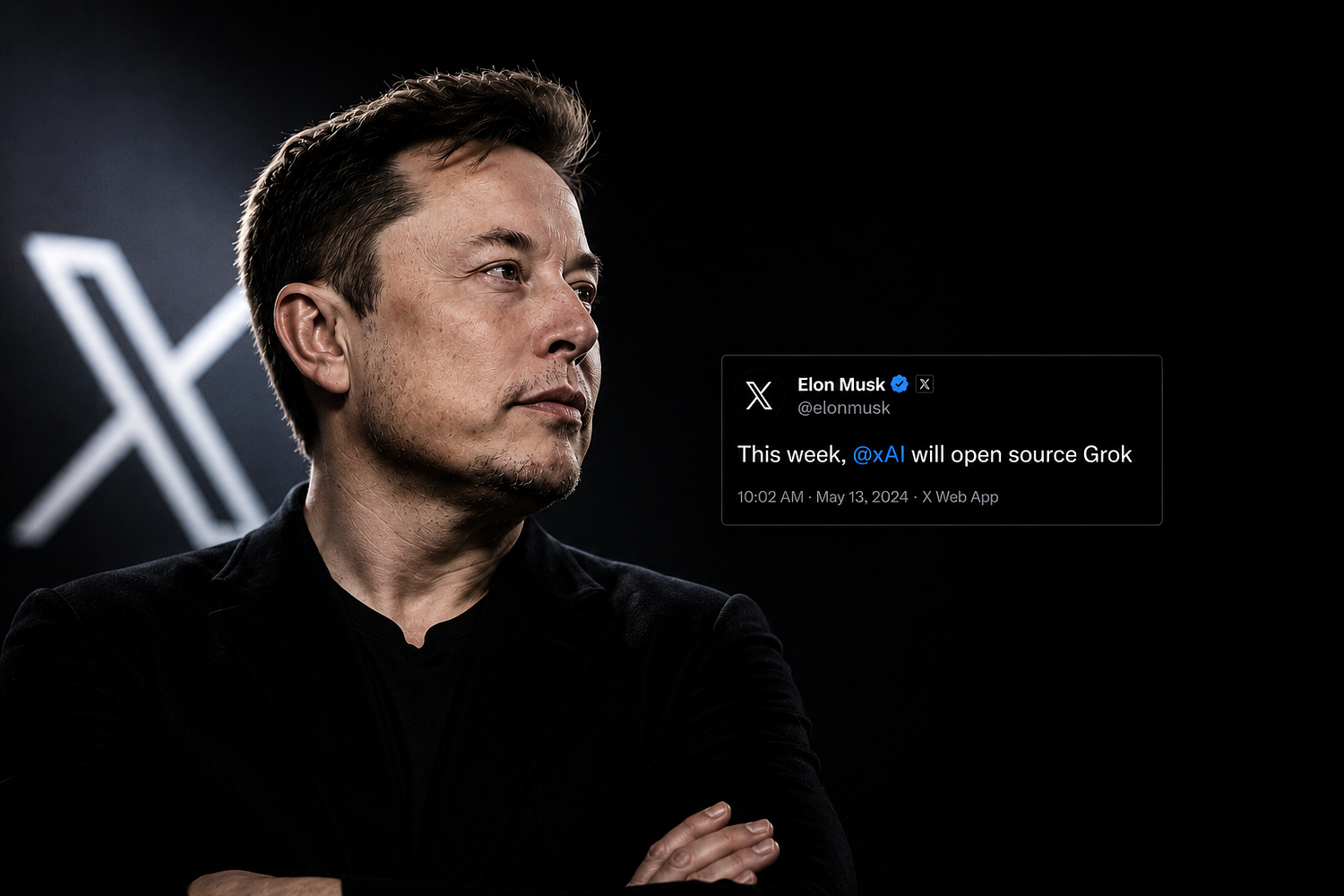
On a Wednesday in the middle of July 2026, Elon Musk posted a sentence on X that instantly traveled across every tech newsletter, developer forum and crypto Discord server that tracks him closely. He wrote that once the company finished reviewing its systems for security vulnerabilities, it would release the entire codebase of X publicly, with no exceptions. He followed it up with a second promise that sounded even bigger: outside reviewers would be invited to check that the code sitting in public actually matched what was running on X’s own servers.
Read quickly, it sounds like the most sweeping transparency move any major social platform has ever attempted. Read carefully, it raises a question that almost nobody covering the story has fully answered yet. What does “entire codebase” even mean for a company the size of X, and what happens to the platform’s business, its users and its rivals if Musk actually follows through this time.
This article walks through what was said, what has already happened before under similar promises, why the timing lines up suspiciously well with a recent privacy controversy involving X’s AI coding tool, and what technical and business hurdles stand between Wednesday’s post and an actual public repository that developers can clone.
What Musk Actually Said
The announcement did not arrive through a press release, a blog post, or a formal statement from X’s communications team. It came the same way most major decisions at the company have arrived since Musk took over in 2022: a post on X itself.
Musk wrote that once the internal review for security vulnerabilities was complete, X would make its entire codebase open source, with no exceptions. In a follow up line, he added that the company would invite independent third party reviewers to examine the live production system, confirming that the code published publicly is exactly what is running on X’s servers day to day.
That second part is the detail worth sitting with, because it addresses a criticism that has followed nearly every corporate open source announcement for the past decade. Companies frequently publish a version of their code on GitHub while running something different, patched, or extended internally. Researchers and developers have no reliable way of confirming that what they see in the public repository is the same thing actually serving requests to real users. By promising outside verification of the live system, Musk is not just offering to publish code. He is offering proof that the published code is honest.
He closed the post with a line that read almost like a mission statement rather than a technical announcement: trust through total transparency is the only thing that should be believed.
What the post did not include mattered just as much as what it did. There was no publication date. No mention of which license the code would be released under, whether permissive licenses like MIT or Apache, or something more restrictive. No definition of what counts as the full codebase for a platform that spans a recommendation engine, a real time messaging system, an AI assistant, ad infrastructure, moderation tooling, and payment systems tied to X Money. Reporters who covered the announcement noted this gap almost immediately, pointing out that a pledge without a technical scope or a date is closer to a direction than a plan.
This Is Not X’s First Open Source Promise
Musk’s history with open sourcing pieces of X did not start with this post. It goes back to March 2023, less than half a year after he completed his acquisition of the company, then still called Twitter. At that point, X released a partial snapshot of its recommendation algorithm on GitHub, giving outside developers their first real look at how the platform ranked and surfaced posts.
That release was limited. Large portions of the platform, including the systems governing content moderation and the finer mechanics of ranking, were left undisclosed. It offered a partial window rather than a full view, and critics at the time argued it functioned more as a public relations gesture than a genuine transparency initiative.
The next significant step came almost three years later. In January 2026, X released the full version of its Grok powered recommendation algorithm, the system responsible for deciding what shows up in a user’s For You feed. This went further than the 2023 release, giving developers and researchers a much clearer picture of how content gets surfaced and ranked. Musk said at the time that the company would publish updates to the algorithm every four weeks going forward, turning what had been a one time disclosure into something resembling an ongoing commitment.
Seen against that backdrop, the July announcement represents a considerable jump in scope. Instead of releasing one system, the recommendation engine, Musk is now describing a plan to release every system and functional module that makes the platform run. That includes code that touches infrastructure, security controls, and potentially sensitive operational details that have never been part of any previous disclosure.
The Timing Lines Up With a Privacy Controversy
Announcements like this rarely happen in a vacuum, and this one appears to have a fairly direct trigger. In the days before Musk’s post, security researchers reported that Grok Build, a coding tool built on X’s AI model Grok, had been uploading users’ private code repositories to Google Cloud servers controlled by xAI. Users had not been clearly informed that this was happening, and the discovery raised immediate concerns about data privacy and developer trust in X’s AI products.
The backlash reached beyond X’s usual circle of critics. OpenAI chief executive Sam Altman weighed in publicly, describing the behavior as concerning, a comment that carried extra weight given the ongoing rivalry between OpenAI and Musk’s companies. For a platform trying to position Grok as a serious competitor to tools like ChatGPT and GitHub Copilot, having a competitor’s CEO publicly question its handling of user code was a reputational problem that needed an answer.
Musk’s open source pledge followed shortly after, and multiple outlets covering the story connected the two events directly, framing the codebase announcement as a response built to rebuild confidence among developers rather than a plan that had been sitting ready to launch on its own timeline. Whether the review process was already underway before the Grok Build story broke or was accelerated because of it is not something Musk has clarified publicly.
This context matters for anyone trying to judge how seriously to take the announcement. A transparency pledge made proactively, as part of a long term roadmap, carries different weight than one made reactively, in the middle of a controversy about exactly the kind of transparency being promised. Neither possibility is confirmed, but the sequence of events is public record and worth including in any honest account of the story.
Why Open Sourcing an Entire Social Platform Is Harder Than It Sounds
There is a meaningful difference between open sourcing a single recommendation algorithm and open sourcing the operational backbone of a platform serving hundreds of millions of active users. Reporters covering the technical side of the story pointed out several obstacles that X will need to resolve before any of this becomes real.
The most immediate is credential exposure. Production codebases are full of references to internal systems, API keys, database connection strings, and infrastructure configuration that were never designed to be seen outside the company. Stripping all of that out of a system as large and interconnected as X’s without breaking functionality or leaving something exposed by accident is a substantial engineering task on its own, separate from any decision about what to release.
Then there is the question of private user data. Even code that does not directly store personal information often reveals a great deal about how that information is processed, retained, and shared, simply through its structure and comments. A security review thorough enough to catch every one of those exposures across a system this size is not something that happens quickly.
There is also the matter of security controls themselves. Publishing the exact mechanisms X uses to detect and block attacks, spam networks, and coordinated manipulation campaigns could hand a detailed playbook to the same actors those systems are designed to stop. Companies that have open sourced smaller components of their infrastructure in the past have generally had to redesign or abstract away the most sensitive defensive logic before publishing anything, a process that takes time and careful judgment about where the line sits between transparency and self sabotage.
Finally, there is scale itself. X’s systems touch advertising infrastructure, payment processing tied to its X Money product, real time chat, video, and an AI assistant, all interconnected in ways that are not always cleanly separable. Deciding what counts as the platform’s core codebase, and what can be safely extracted and shown to the public without exposing partner agreements or proprietary models licensed from elsewhere, is itself a significant decision that has not been addressed in any statement so far.
None of this means the plan is impossible. It means that between Wednesday’s post and a working public repository sits a body of engineering and legal work that has historically taken well resourced companies months or years to complete, when they have completed it at all.
A Track Record That Invites Caution
Journalists who have followed Musk’s public commitments closely, particularly those covering open source software specifically, have responded to the announcement with a mixture of interest and skepticism grounded in past experience rather than personal opinion about Musk himself.
The pattern they point to is straightforward. Musk has made sweeping public promises before, often through the same channel, a post on X rather than a formal company statement, and the follow through has varied. Some commitments, like the January 2026 release of the full recommendation algorithm, were delivered close to what was promised. Others have moved slower than announced, been scaled back, or quietly stalled without a clear public update on what happened.
This is not a claim that the current pledge will fail. It is an observation, supported by the public record of X’s own past announcements, that a promise phrased in absolute terms, with no exceptions, deserves the same scrutiny given to any other unverified corporate commitment, especially one that lacks a date, a license, or a defined technical scope.
Coverage of the announcement has generally reflected this. Reports have described the post accurately as a pledge or a plan rather than an accomplished fact, and several outlets have explicitly noted the missing details as the reason for treating it cautiously rather than celebrating it as done.
What Full Transparency Would Actually Change
If X does follow through on a release at the scale Musk described, the implications would extend well past a symbolic gesture. Full visibility into a major social platform’s codebase, including its moderation tooling and security systems, would be close to unprecedented among platforms operating at X’s scale. Researchers studying platform behavior, misinformation, and algorithmic bias would gain access to material they currently have to infer indirectly, often through limited API access or externally observed behavior.
Developers building tools that interact with X, from browser extensions to third party clients to research pipelines, would benefit from a far clearer understanding of how the platform actually functions internally, rather than relying on documentation, trial and error, or reverse engineering.
It would also set a public benchmark that other major platforms would face pressure to respond to, whether by matching it, explaining why they will not, or ignoring the comparison altogether. Given how much scrutiny large technology companies are currently facing over algorithmic transparency, particularly around AI systems and content ranking, a genuine full disclosure from a platform the size of X would likely become a reference point in that broader conversation, regardless of what any individual competitor decides to do about it.
None of that changes what is true right now. As of this writing, what exists is a public commitment, a description of the verification process that would accompany it, and a set of open questions about timeline, scope, and licensing that have not yet been answered by Musk or by X.
How Developers and Markets Reacted
The response inside developer communities was immediate and split roughly into two camps. One group treated the announcement as a genuinely significant moment for the industry, pointing out that no social platform operating at X’s scale has ever committed to releasing its full operational codebase, complete with third party verification of the live production system. For open source advocates who have spent years pushing large technology companies toward more disclosure, even a partial version of this plan would represent real progress.
The second camp focused less on what was promised and more on how it was promised. Commentators noted that the announcement carried the same informal, almost offhand tone as many of Musk’s other major declarations, made through a single post rather than a coordinated release involving legal review, a technical roadmap, or input from X’s engineering leadership. Some writers drew a direct comparison to the way major policy shifts have been announced during recent political cycles, where a single social media post substitutes for the kind of formal process that similar decisions would normally go through at other large companies.
Financial markets, for what it is worth, showed almost no reaction to the news. X is privately held, so there was no stock price to move, and the broader technology sector’s attention that week was occupied by other stories, including AI infrastructure spending and chip export policy. That lack of market response is itself a useful data point. It suggests that investors and analysts, at least in the short term, are treating the pledge the same way much of the press has, as a statement of intent rather than an event with immediate financial consequences.
Inside the open source community specifically, a recurring theme in the discussion was comparison to other companies that have taken partial steps toward releasing production code, including some cloud infrastructure providers and a handful of AI labs that have published model weights or training details without fully open sourcing their surrounding systems. Almost none of those precedents involved a platform promising to open every functional module at once, which is part of why X’s announcement, however uncertain its follow through may be, has continued to generate discussion well past its first day of coverage.
What Comes Next
The most useful thing anyone following this story can do right now is watch for three specific signals rather than react to the initial post alone. The first is a public timeline. A concrete date, even a rough one, would mark a shift from aspiration to plan. The second is a defined technical scope, some indication of which systems are actually included under the umbrella of entire codebase, since the term itself has not been defined in any statement so far. The third is the license under which any code gets released, since that single legal detail will determine how much developers, researchers, and rival companies can actually do with whatever gets published.
Until those three things appear, the honest description of where things stand is this. Elon Musk has publicly committed X to an ambitious transparency initiative, tied at least in timing to a recent controversy over how the platform’s AI tools handled private developer data, and building on a history of partial disclosures that stretches back to 2023. Whether that commitment becomes the most transparent move any major social platform has made, or joins a list of announcements that moved slower than promised, is not something the public record can answer yet. It is something only the next few months of actual releases can.