A few months back a clip of Lisa Su went around, holding up a mini PC roughly the size of a paperback novel and saying it could run a 235 billion parameter model. I remember watching it twice because I genuinely thought I misheard the number. A box that fits in one hand, running something that big, at home, no cloud bill. My first reaction was, okay this is marketing. My second reaction, after actually reading the specs, was less dismissive.
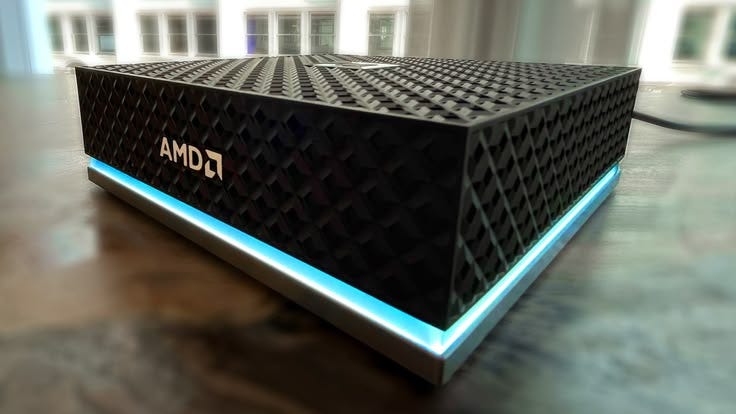
That box is built around AMD’s Ryzen AI Max+ 395, also called Strix Halo internally, and by mid-2026 it has become the thing every local-AI forum thread mentions in the first three comments. Not because it’s the fastest chip you can buy. It isn’t, not by a long shot. It’s because of one number: up to 128GB of memory that the CPU, GPU, and NPU all share. That single design choice is why this chip is being compared to Apple’s Mac Mini and Nvidia’s DGX Spark instead of to a normal gaming mini PC, and why this article exists.
I want to walk through what this thing is actually for, how it stacks up against the Mac Mini (and the M5 Mac mini that Apple still hasn’t shipped, more on that later) and Nvidia’s DGX Spark, and what the real throughput numbers look like once you get past the vendor slides. Some of this will disappoint people who watched that Lisa Su clip and started adding to cart immediately. That’s fine. Better you know now than after the box arrives.
What Strix Halo Actually Is, and Why AMD Built It This Way
Here’s the thing most coverage skips: the Ryzen AI Max+ 395 was not designed to be a fast chip. It was designed to solve one specific, boring problem running large AI models needs a lot of memory, and consumer GPUs don’t have much of it.
An RTX 5090, currently AMD and Nvidia’s best consumer gaming card, tops out at 32GB of VRAM. An RTX 4090 caps at 24GB. That’s plenty for gaming, and it’s fine for small AI models. But a 70 billion parameter language model at a reasonable quantization needs something like 40 to 45GB just to load the weights, before you even add space for context. So the model simply doesn’t fit. You either buy two or three GPUs and stitch them together (expensive, loud, needs a real power supply), or you accept you can’t run it locally.
AMD’s answer, so basically, is to stop treating the GPU’s memory as separate from the system’s memory. The Ryzen AI Max+ 395 packs 16 Zen 5 CPU cores, a 40-compute-unit RDNA 3.5 integrated GPU (branded the Radeon 8060S), and a 50 TOPS XDNA 2 NPU on one chip, and lets all three share up to 128GB of LPDDR5X-8000 memory over a 256-bit bus. Apple has been doing this with unified memory since the M1. AMD is doing it for the first time at this scale on x86.
What that buys you, concretely: a mini PC costing $1,500 to $2,500 that can load a model no single consumer GPU can touch. The GMKtec EVO-X2, probably the most widely bought implementation of this chip right now, runs Qwen3–235B (a mixture-of-experts model, I’ll get to why that matters in a second) on its 128GB configuration at around 11 tokens per second. Not fast. But it runs. On a box you could carry in a backpack.
TBH about one thing here, since this whole segment leans on it: that 235B number is doing a lot of marketing work it doesn’t fully deserve. Qwen3–235B only activates about 22 billion parameters per token, because it’s a mixture-of-experts architecture. The chip is moving the active slice through memory, not the whole 235B every time. That’s why 11 tok/s is even possible on 256 GB/s of bandwidth. A dense 235B model would crawl.
The Bandwidth Problem Nobody Puts on the Box
This is the part that actually determines whether you’ll enjoy using one of these machines day to day, and it rarely makes it into the spec sheet in a way that means anything to a normal buyer.
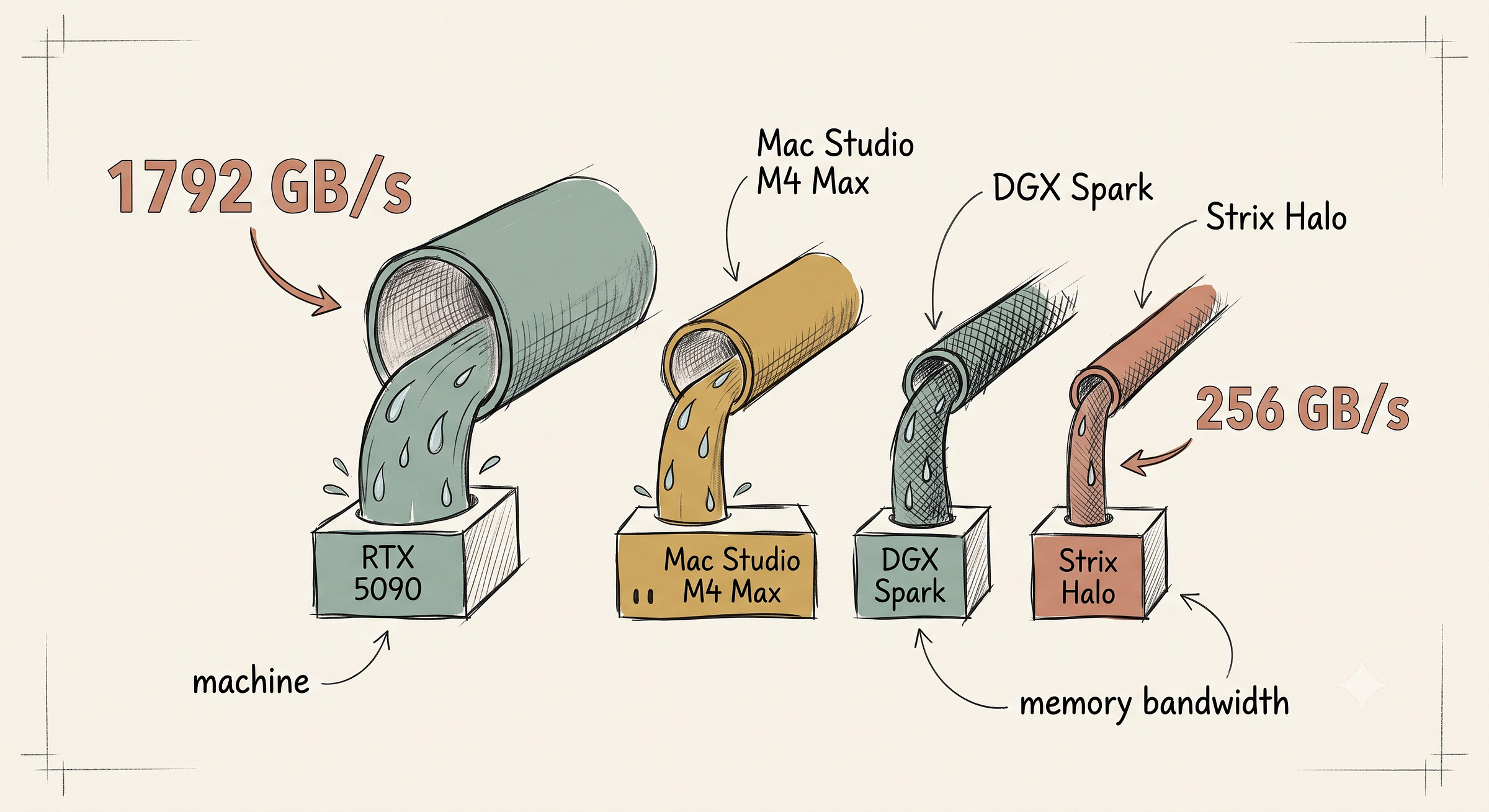
LLM inference, generating tokens one at a time, is mostly bound by memory bandwidth, not raw compute. Every token the model spits out requires reading the relevant weights from memory again. So the formula is roughly: tokens per second equals memory bandwidth divided by how much of the model has to move through that bandwidth per token.
The Ryzen AI Max+ 395 gives you 256 GB/s. An RTX 5090 gives you 1,792 GB/s, about seven times more. A Mac Studio with M4 Max gives you 546 GB/s, more than double. This is why, for models that fit comfortably on a 24GB discrete GPU, that GPU will beat Strix Halo every single time, sometimes by three or four times over. Strix Halo’s whole argument is capacity, not speed. You’re trading tokens-per-second for the ability to load something bigger in the first place.
And the trade gets worse the denser the model is. Dense Llama 3.3 70B, for instance, decodes at somewhere around 5 tokens a second on Strix Halo according to Level1Techs forum testing, though I’ve seen other community numbers as low as 2 to 3 tok/s once context grows past a few thousand tokens, and one vendor benchmark claiming 18 to 22 tok/s on a heavily optimized Ollama setup. That spread alone tells you something. Real-world numbers on this chip vary a lot depending on runtime, quantization, and how full your context window is, and I wouldn’t trust any single number you see on a YouTube thumbnail.
Where Strix Halo actually looks good is mixture-of-experts models in the 30B range, where you’re seeing close to 100 tokens per second, genuinely usable for daily chat and coding assistance. That’s the sweet spot this chip was built for, not the 235B demo everyone screenshots.
Mac Mini and the M5 That Isn’t Here Yet
If you’re shopping in this category, the natural comparison isn’t really the current Mac Mini, it’s whatever Mac Mini exists by the time you actually order one. So let’s deal with both.
The Mac Mini you can buy today runs on M4 or M4 Pro. The base M4 gives you 120 GB/s of bandwidth and tops out around 32GB of memory, fine for models under 8B parameters, not really a contender here. The M4 Pro is the relevant one: up to 64GB, 273 GB/s bandwidth, which is actually slightly faster than Strix Halo’s 256 GB/s despite being the “smaller” chip on paper. A Mac Mini M4 Pro at 64GB currently sells for around $2,400 after Apple’s recent price hikes, and it runs 30 to 40B class models comfortably at good speeds with far lower power draw, something like 20 to 30 watts under load versus 60 to 120 watts for a Strix Halo box.
Apple was supposed to refresh the Mac Mini with M5 silicon by now, honestly I expected it around WWDC in June. It didn’t happen. As of this writing in mid-July 2026, the Mac Mini is still stuck on M4, and Apple’s own supply chain issues, the same memory shortage that’s pushing up RAM prices everywhere, are the widely reported reason. Leaks point to a base M5 Mac Mini with 16GB starting memory and an M5 Pro variant with a 32GB build-to-order tier, but nothing is confirmed and Bloomberg’s Mark Gurman has reported the higher-memory Mac Studio M5 Max and Ultra refresh is delayed to October 2026 at the earliest. If you need a Mac for local AI in the next few months, buying an M4 Pro now, not waiting for M5, is what most people covering this space are telling readers.
For context on what M5 actually brings when it does show up, the M5 Max chip that’s already shipping in the MacBook Pro (since March 2026) delivers around 600 to 614 GB/s of bandwidth, close to 30 percent faster token generation than M4 Max across the board, and roughly four times faster prompt processing thanks to new Neural Accelerators built into every GPU core. If and when that lands in a Mac Studio or Mac Mini Pro, it changes the math considerably. Just don’t hold your breath for it landing in the compact Mac Mini chassis specifically, Apple has historically kept the Mini a generation or two behind the Studio on the biggest chips.
Where does a maxed-out Mac Studio M4 Max, 128GB, sit against Strix Halo? Faster token generation across the board thanks to that bandwidth advantage, quieter, way less power hungry, and running on Metal, which is genuinely more mature software than ROCm right now. But it costs upward of $3,500 for that configuration, roughly double a 128GB Strix Halo box. If your model fits in 48 to 64GB, the Mac wins on almost every axis except price. If you specifically need the full 96 to 128GB pool for 70B-class models, Strix Halo undercuts the Mac by a wide margin, at the cost of a rougher Linux setup experience.
Nvidia DGX Spark: The Same Memory Trick, With CUDA Attached
Nvidia’s version of this idea is the DGX Spark, built around a GB10 Grace Blackwell superchip, a 20-core Arm CPU welded to a Blackwell-generation GPU, sharing 128GB of unified LPDDR5X memory. Same fundamental idea as Strix Halo. Same 128GB ceiling. Slightly higher bandwidth at 273 GB/s versus 256 GB/s. And a price that’s genuinely hard to defend on spec sheet terms alone: it launched at $3,999 in October 2025, and Nvidia raised it to $4,699 in February 2026, citing the same memory supply crunch hitting everyone. An OEM variant, the Asus Ascent GX10, gets you the same GB10 chip with 1TB storage for around $2,999, which is closer to Strix Halo pricing but still a premium.
What you’re actually paying for is CUDA. Every major inference framework, llama.cpp, vLLM, Ollama, Hugging Face’s whole ecosystem, was built CUDA-first. ROCm support on AMD exists and it’s improving fast (ROCm 7.2 was the first release to properly support Strix Halo’s gfx1151 architecture, and that only shipped this year), but when something breaks on AMD, you’re often the first person to hit that bug. On the Spark, it just works, mostly.
The throughput numbers tell an interesting story once you actually dig into independent benchmarks rather than vendor slides. On the GPT-OSS 120B model in MXFP4 format, DGX Spark and Strix Halo land close on token generation, roughly 38 to 39 tok/s for Spark versus 34 tok/s for Strix Halo, basically a tie given both are bandwidth bound. But prompt processing, the speed at which the machine chews through your input before it starts replying, is where Spark completely runs away with it: around 1,723 tokens per second versus Strix Halo’s 340. That’s a five times gap. If you’re feeding long documents or running agentic coding workflows with big context windows, you will feel that difference constantly, waiting seconds versus tens of seconds before the first token even appears.
Dense 70B models humble both machines. Llama 3.3 70B decodes at somewhere around 2.7 to 5 tokens a second on either box, depending on the exact runtime and quantization, usable for batch jobs, not for a live conversation. And here’s a detail that basically never makes it into the review headlines: a single-stream benchmark massively understates what either box can do when you run many requests concurrently. One engineering write-up I read measured a DGX Spark hitting nearly 700 tokens per second in aggregate across 256 concurrent streams on the same hardware that does 2.7 tok/s single-stream. If your workload is batch processing rather than one live chat window, both these machines look completely different.
So Which One Do You Actually Buy
I’ll try to be direct instead of giving you the “it depends” non-answer, though there genuinely isn’t one universal winner here.
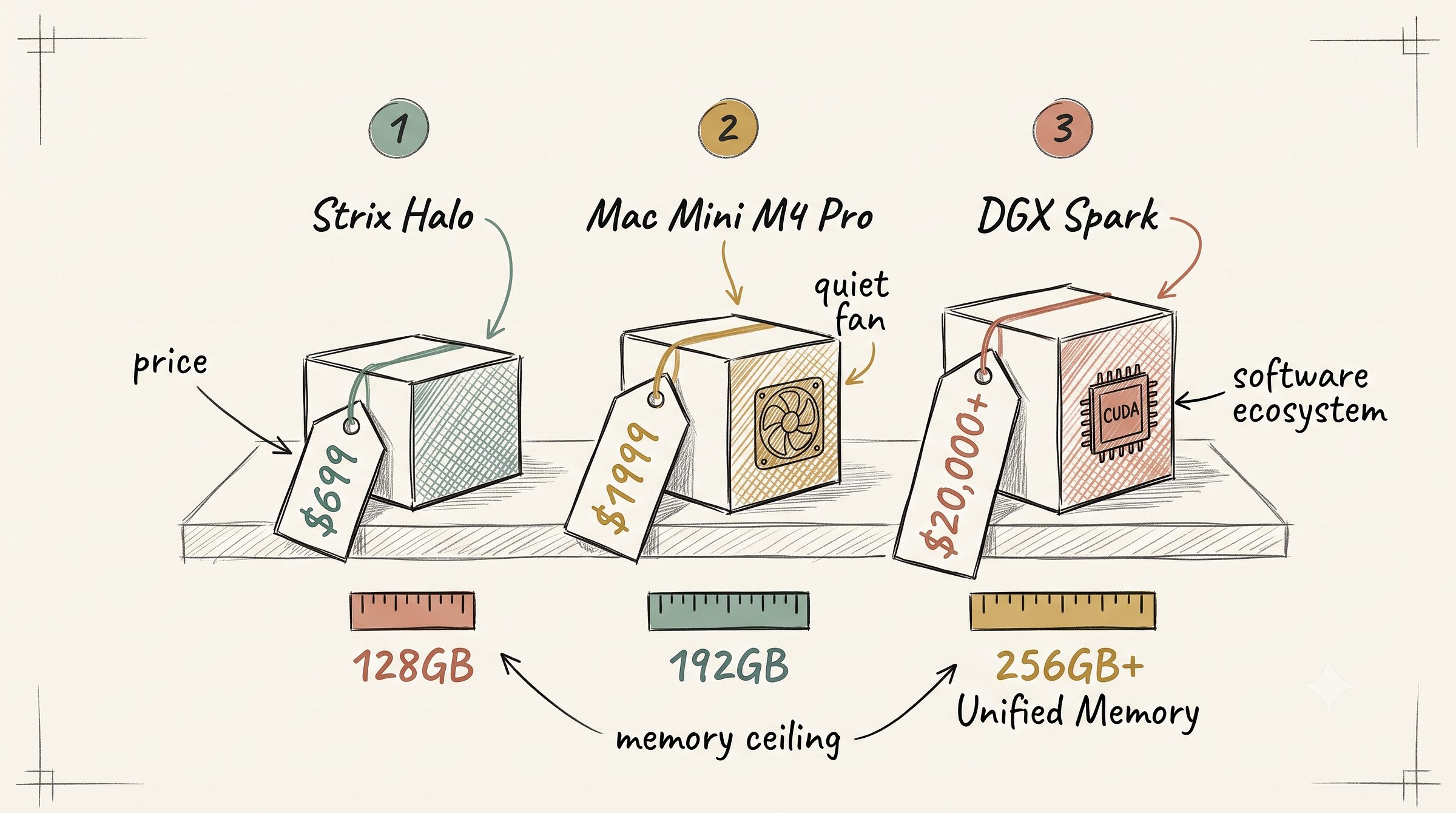
If your budget tops out around $1,500 to $2,200 and you want the most memory per dollar, period, a Strix Halo mini PC like the GMKtec EVO-X2 wins outright. Nothing else gets you 96 to 128GB of usable model memory this cheap. You’ll be on Linux for the best performance, ROCm setup takes an afternoon of fiddling (there’s a known kernel bug where rocm-smi under-reports memory, fixed in kernel 6.16.9 and later, and you’ll want to set the BIOS memory carve-out to the minimum, not the maximum, which is the opposite of what older guides tell you), and prompt processing will be your bottleneck on anything beyond short chats.
If you already live in the Apple ecosystem, want something quiet and low power, and your models fit under 64GB, the Mac Mini M4 Pro is the better daily driver, full stop. Better software, way less electricity, and honestly it just feels nicer to use. Wait on the M5 refresh only if you can afford to wait, since nobody knows exactly when it lands.
If you need CUDA specifically, are prototyping something you plan to eventually deploy on real Nvidia infrastructure, or you’re processing long documents where prompt speed actually matters to your workflow, the DGX Spark earns its price premium. For a straight local chatbot on a budget, it doesn’t.
And if raw speed on models under 30B is genuinely all you care about, none of these three win. A used RTX 3090 for $600, or three of them, will out-decode all of them for less money, you just can’t load anything past 24 to 72GB depending on how many cards you stack, and your electricity bill and desk noise go up a lot.
That Lisa Su clip that started this whole wave of interest wasn’t lying exactly, the box really can run a 235B model. It just left out that you need the $2,200 configuration, not the $1,499 one, and that 11 tokens a second is a demo pace, not a conversation pace. The category is real and it’s genuinely useful for a specific kind of buyer.
Just go in knowing which box you’re actually buying, because the marketing slide and the receipt rarely say the same number.