Nobody circled May 11th on their calendar. There was no event. No livestream. No product page with a countdown timer. Just a notification that appeared on millions of iPhones that week, in the same flat gray font Apple always uses for these things, saying a software update was available.
Most people tapped Install Later and went about their morning.
That was a mistake. Not a catastrophic one — nothing crashed, nothing was lost. But iOS 26.5 turned out to be one of those updates that looks small from the outside and is quietly significant from the inside. And now, less than two weeks after it landed, signs have emerged that iOS 26.5.1 is already in internal testing at Apple, potentially arriving before WWDC kicks off on June 8. So there are two updates worth understanding at once — one that already changed something real, and one that’s about to clean up after it.
Let’s start with the one that mattered.
What Even Is a Point-Five Release?
Apple’s numbering system can give the wrong impression. A .5 update sounds like half a version, like Apple got halfway to somewhere and stopped. In reality, point releases like iOS 26.5 often carry more meaningful changes than the marketing suggests. The number reflects development cadence, not ambition.
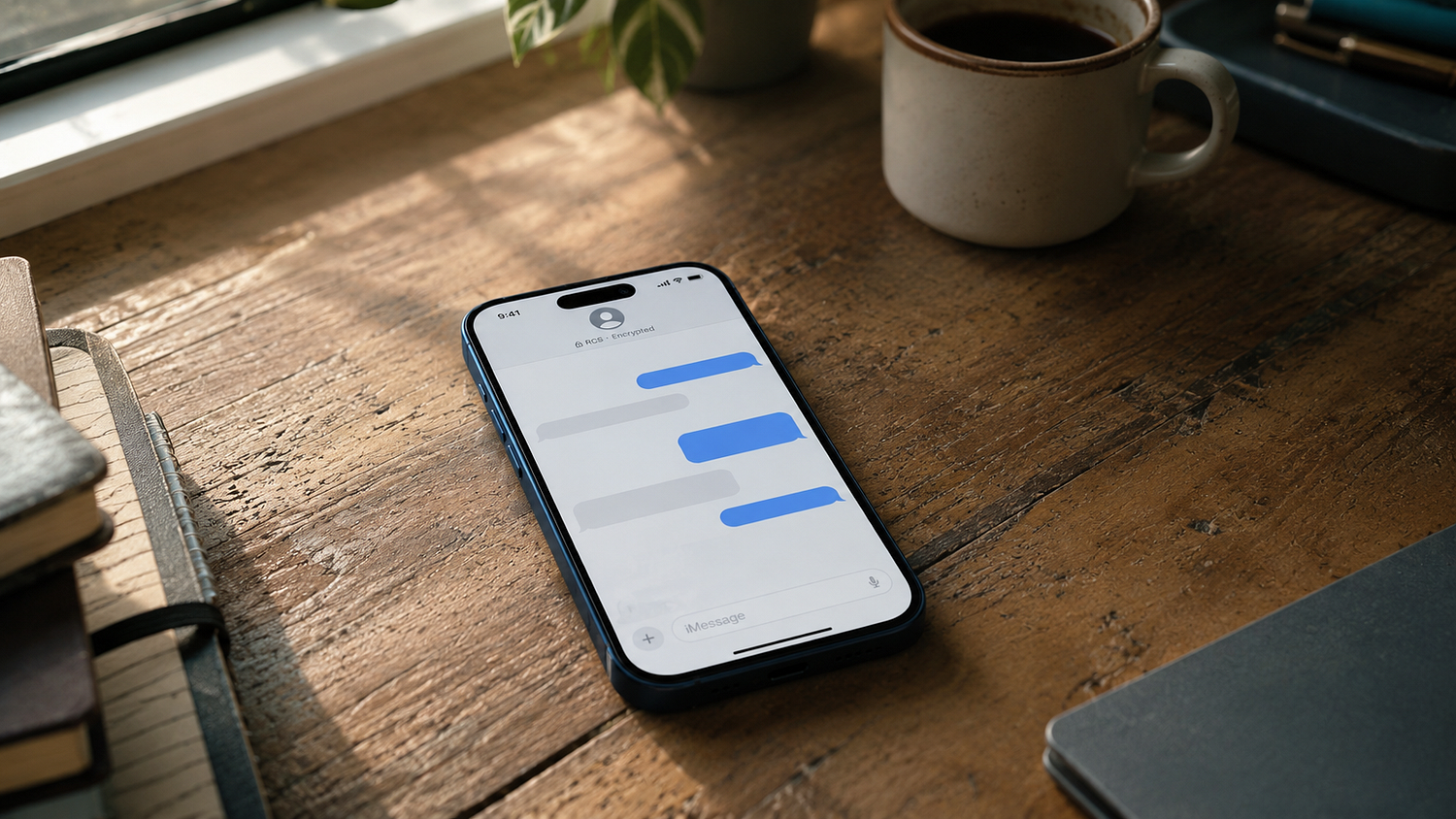
iOS 26.5 shipped with three headline items: a new Pride Luminance wallpaper, a Suggested Places feature in Apple Maps, and the beginning of end-to-end encryption for RCS messages between iPhones and Android devices.
Two of those are cosmetic. One of them is not.
It’s also worth noting what Apple quietly buried further down in the release notes: this update included fixes for over 50 security vulnerabilities. Not 5. Not 15. Fifty-plus, across components like AppleJPEG, ImageIO, the Kernel, mDNSResponder, and WebKit — some capable of being exploited to leak sensitive data or crash the system entirely. That number would be the headline for any other software vendor. For Apple, it sat below the wallpaper announcement.
Make of that what you will.
The Message That Changes Everything — And the One That Doesn’t
Here is the honest version of the RCS encryption story, which most coverage either oversimplified or buried in jargon.
For years — literally years — if you were an iPhone user texting someone on Android, your messages were not encrypted in transit. They traveled as RCS or plain SMS, readable in theory by carriers, by servers handling delivery, by anyone with the right access at the right point in the chain. Meanwhile, any two iPhones talking to each other have been protected by iMessage’s end-to-end encryption since 2011. WhatsApp added full encryption in 2016. Signal was built on it from the beginning in 2014. The native default messaging layer between the two dominant phone platforms on earth — the one that handles billions of conversations daily from people who’ve never heard of Signal and never will — had nothing. Not for over a decade.
That gap starts closing with iOS 26.5.
The encryption standard now deployed is called MLS — Messaging Layer Security — introduced as part of the RCS Universal Profile 3.0 specification published by the GSMA, the body that sets global mobile industry standards. Importantly, this isn’t Apple’s encryption or Google’s encryption. It’s an open, industry-agreed specification that the GSMA finalized in early 2025 after years of coordination between Apple, Google, and the wider mobile ecosystem. Building on an open standard is the right call here. A shared specification can be audited, extended, and adopted by carriers worldwide. A proprietary one can’t.
Alex Sinclair, the GSMA’s Chief Technology Officer, put it plainly when iOS 26.5 launched: the new secure services are being delivered on an open, globally recognised foundation, and the result of close, cross-industry collaboration. That kind of statement from a standards body doesn’t get written for incremental progress. This was a real milestone.
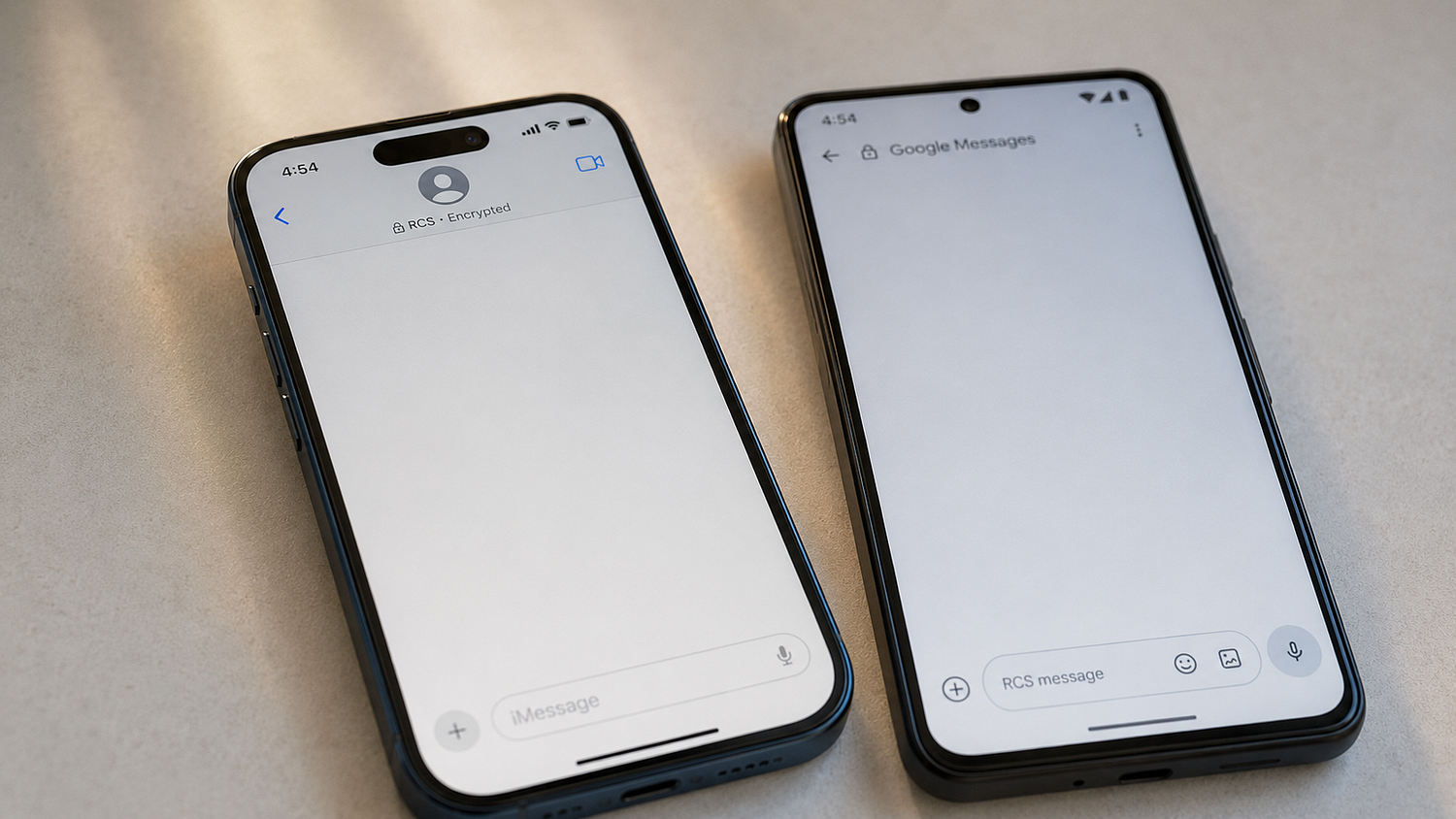
For users, what it means is simple. Messages exchanged over RCS between iPhone and Android devices are now encrypted on the sender’s device and can only be decrypted on the recipient’s device. No carrier. No server. Not Apple. Not Google. Just the two people in the conversation. The iOS Messages app signals this with a padlock icon and the label “Text Message · RCS | 🔒 Encrypted” visible in the thread. Google Messages users see the same lock they already recognise from Android-to-Android encrypted conversations.
Encryption is on by default. No setup. No opt-in. You don’t have to do anything.
The Part Apple’s PR Didn’t Emphasise
That said — and this is the part worth reading carefully — the feature works beautifully in theory and partially in practice.
Three requirements have to align simultaneously for the padlock to appear. You need iOS 26.5 or later. The other person needs the latest version of Google Messages. And both of your carriers — yours and theirs — need to have enabled support for RCS Universal Profile 3.0.
That last condition is the one that trips everything up. Your carrier is still the gatekeeper. Code first spotted in iOS 26.3 Beta 2 showed the carrier bundle settings that enable E2EE for RCS — but at that early stage, those settings had only been found in the individual carrier files for four French carriers: Bouygues, Orange, SFR, and Free. The rollout has expanded considerably since then, but globally, carrier adoption remains uneven. If your operator hasn’t updated their RCS configuration, you won’t see encryption regardless of what software you’re running.
Apple doesn’t surface any of this in the UI. You see the padlock or you don’t. There’s no status screen, no carrier compatibility checker, no explanation of why a particular conversation isn’t showing the lock. Compare that to how iMessage has always handled encryption: blue bubble means end-to-end encrypted, green bubble means it isn’t. Binary, always visible, impossible to miss. The RCS padlock is harder to spot and harder to understand when it’s absent.
That opacity is a real problem for a privacy feature. A user who checks their Messages app, doesn’t see the padlock, and assumes everything is fine anyway — that user is exactly who this feature is supposed to help. They deserve better information.
There’s one more caveat Apple noted in the release: the feature is technically still in beta, even inside the shipping software. That’s an unusual position. Apple pulled E2EE from iOS 26.4’s final release after testing it in that beta cycle — it showed up, then disappeared. The feature returned in iOS 26.5 beta and stayed, but the “beta” label on a production feature tells you something about Apple’s confidence level. It works. Trust it as a foundation, not a finished product.
The Pros, Listed Honestly
It’s worth stepping back for a moment and acknowledging what actually just happened, because the caveats can swallow the significance.
Hundreds of millions of people use their phone’s default messaging app to text across platforms every day. They’re not switching to Signal. They’re not downloading WhatsApp. They’re just texting. For those people — the majority — iOS 26.5 delivered a genuine, automatic, no-effort upgrade to their privacy. That’s rare. Software improvements that help people who aren’t paying attention are the ones that actually matter at scale.
The MLS protocol is also designed to handle group conversations, which is harder than it sounds and something competing proprietary systems have struggled with. A shared open standard means the encryption can extend to group chats as implementations mature on both sides, rather than being limited to one-on-one messages indefinitely. Crucially, MLS was designed from the ground up to support forward secrecy — meaning that even if someone somehow obtained an encryption key used in a past session, they couldn’t use it to decrypt earlier messages. That’s a meaningful security property that older messaging protocols didn’t offer.
The regulatory angle is worth naming too. Governments in multiple countries have been pushing for backdoors into encrypted messaging — the UK’s Online Safety Act, various EU proposals that have circulated in recent years. An industry-wide open standard for E2EE, backed jointly by Apple, Google, and the GSMA, is a stronger collective position against those pressures than each company fighting individually. When the GSMA speaks, it speaks for the entire mobile industry. The politics of encryption matter, and this strengthens the right side of that argument.
There’s a business dimension as well, though Apple won’t frame it this way. For years, the “green bubble” distinction in iMessage served as a soft lock-in for iPhone users. Your iMessage conversations were encrypted and feature-rich; your Android conversations were not. Some users stayed on iPhone partly because switching meant losing iMessage quality. RCS encryption erodes that distinction. Apple is voluntarily giving up a competitive advantage in the name of user privacy across the board — or at least, that’s the generous interpretation. Either way, the user benefits.
The Cons, Also Listed Honestly
The feature is in beta inside production software. That’s worth repeating because it’s genuinely unusual for Apple, and it means the implementation isn’t declared finished. Group chat behavior across mixed iPhone-Android threads is still inconsistent in practice. The padlock can be absent with no explanation. And the carrier dependency means global coverage is patchy — users in markets with slower carrier adoption may wait months before seeing encryption in conversations they’d assume are already private.
There’s also what this update doesn’t include. RCS still lacks message editing, undo send, higher-quality media transfers (those are coming in Universal Profile 3.1), and cross-platform video calls (proposed in UP 4.0). Encryption is the foundation. The rest of the feature set needed to make RCS genuinely competitive with iMessage isn’t there yet. You get the padlock. You don’t yet get the full experience.
The honest summary: this is a significant first step that will take 12 to 24 months to be fully meaningful for most users, depending on where they live and which carrier they’re on.
Now: iOS 26.5.1 Is Already on the Way
Apple released iOS 26.5 to everyone on May 11. Less than two weeks later, visitor logs at both 9to5Mac and MacRumors — which have historically been reliable early signals for upcoming releases — confirmed that iOS 26.5.1 is already being tested internally at Apple.
Historically, after visitor logs first detect evidence of a minor update being tested, Apple ships the new software not long after. That pattern suggests iOS 26.5.1 could arrive as early as this week, once the US holiday weekend clears. Memorial Day is Monday, so Tuesday or later is more likely.
Point-one releases are easy to dismiss. They shouldn’t be. iOS 26.3.1 earlier this year expanded external display support to the Studio Display and Studio Display XDR. iOS 26.2.1 added AirTag 2 compatibility. These aren’t nothing updates — they’re often the release where Apple quietly delivers something that didn’t make the previous cut, alongside whatever bug fixes and security patches the main release left behind.
For iOS 26.5.1, the most plausible contents are security patches and stability fixes for whatever issues have surfaced in the two weeks since 26.5 launched. It’s also worth watching whether Apple uses it to quietly refine the RCS encryption rollout — perhaps improving carrier detection, clarifying the padlock indicator behavior, or extending compatibility. None of that has been confirmed. But given that the E2EE feature is still officially in beta, a .1 release that nudges it forward would make sense.
The practical advice: if you haven’t updated to iOS 26.5 yet and have been waiting for a reason, 26.5.1 arriving within days makes it worth holding out a little longer. Installing the .1 version rather than the base release is almost always the wiser choice for anyone not in a rush.
What About iOS 26.6?
The same logs that spotted 26.5.1 also show Apple has ramped up testing of iOS 26.6, with a first beta likely to arrive sometime in June. The historical parallel: Apple seeded the first iOS 18.6 beta on June 16, 2025 — three days after WWDC 2025 ended.
iOS 26.6 will almost certainly be a minor update. It’s likely to be the final maintenance release in the iOS 26 lifecycle before the entire company’s attention shifts to shipping iOS 27 in the fall. Think of it as a clean exit — one last pass to close vulnerabilities, address lingering stability issues, and wrap up anything that didn’t fit in 26.5.1. Whether it carries any further RCS refinements is genuinely uncertain.
The Bigger Picture Before WWDC
WWDC 2026 opens on June 8. iOS 27 will be announced there, and it will get most of the coverage, the excitement, the concept screenshots, and the opinion pieces. That’s appropriate — it’s a major release, and early reports suggest significant Siri improvements and optimizations for the rumored foldable iPhone hardware Apple has been quietly preparing.
But the iOS 26.5 cycle deserves to be understood on its own terms. What happened in May 2026 wasn’t a holding pattern between big releases. Apple, Google, and the GSMA shipped the first cross-platform end-to-end encrypted messaging standard for the native SMS/RCS layer — the layer used by the vast majority of people who don’t think about messaging security at all. That’s not a minor footnote. It’s the kind of infrastructure improvement that makes every subsequent improvement possible.
Think of it this way: Signal and WhatsApp didn’t become trusted platforms overnight. They became trusted because the encryption was always on, always verifiable, and never wavered. RCS E2EE is at the very beginning of that trust-building process. The padlock appears. Carriers start enabling it. Users start noticing it. Over two or three years, “my texts to Android are encrypted” becomes something people assume rather than something they have to check. That’s the goal — and iOS 26.5 is where it started.
iOS 26.5.1 will clean things up. iOS 26.6 will close out the chapter. And iOS 27 will open a new one. But the chapter that matters most for everyday privacy — the one where your texts to Android users stopped being readable by everyone between you — started quietly on a Sunday morning in May, behind a gray notification banner most people dismissed without reading.
Worth knowing. Even retroactively.