I remember the exact moment I thought AI was going to save us. It was sometime in early 2023, and my team was stuck on a backlog that had been growing for six months. Someone on a call said, “what if we just use ChatGPT for the boilerplate stuff?” and we all nodded like it was the most obvious thing in the world. We were going to move so fast. Costs would drop. Headcount wouldn’t need to grow. The manager was practically glowing in the next all-hands.
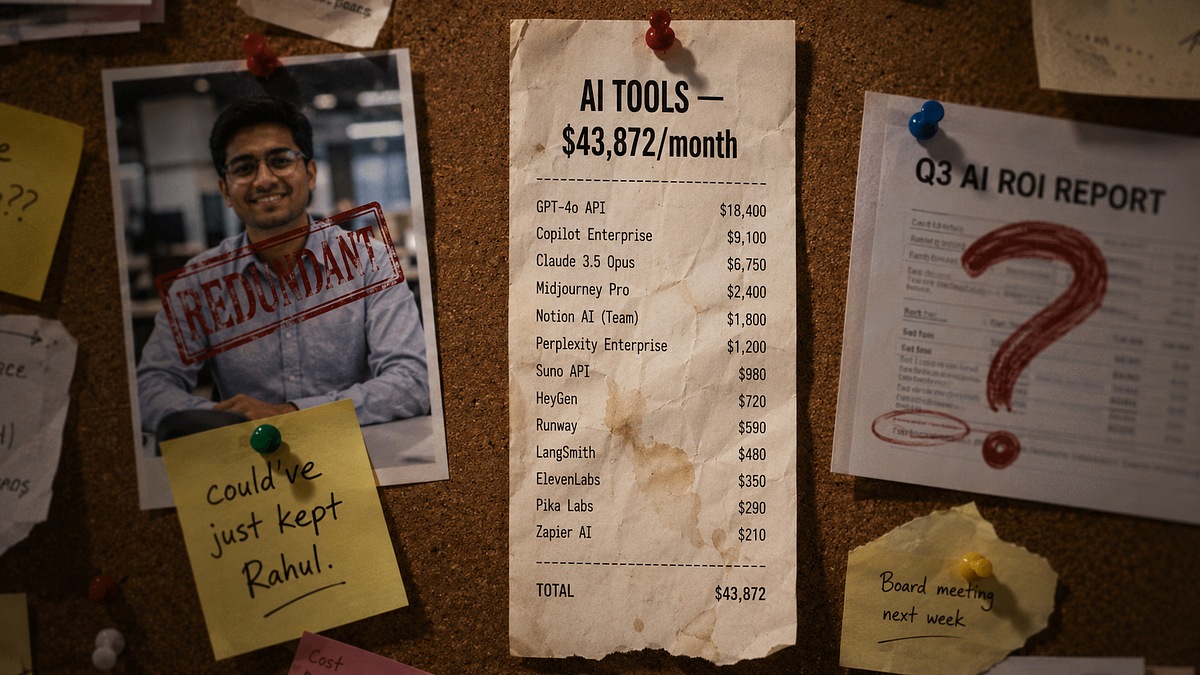
Two years later, our API bills are more than what we used to pay a mid-level backend engineer. The boilerplate still needs a human to review it. And three people from that original team got laid off — partly because leadership decided AI could “handle their scope.” It couldn’t. But by the time that was obvious, the budget was already gone.
I don’t think we’re alone in this. Actually, I know we’re not. The last six months have been full of these stories — companies quietly walking back their AI bets, CTOs explaining to boards why the productivity gains didn’t quite materialize, startups that were “AI-first” in 2024 suddenly re-hiring the junior engineers they fired in 2023. The wave is not crashing, exactly. But it’s definitely not the tsunami everyone promised.
The Bill Nobody Budgeted For
Here’s something that almost never comes up in the breathless coverage of AI adoption: the cost structure is genuinely weird, and not in a good way.
A decent junior developer in india costs maybe ₹6–8 lakh a year and around $70k-$90k in US. They learn your codebase. They remember what you told them last week. They push back when something is a bad idea. They don’t charge you per token.
Compare that to what teams are actually spending on AI tooling now. GitHub Copilot is $19 per seat per month that’s for the individual plan. Enterprise is $39. OpenAI’s API costs, especially if you’re running anything on GPT-4o or doing anything with context windows larger than 32k tokens, add up faster than most engineering managers expected when they wrote those initial proposals. I talked to someone at a mid-sized fintech in Bengaluru last month who said their AI infrastructure spend went from “basically zero” in January 2024 to roughly $40,000 a month by December. Their team size stayed the same. The output, he said, was “more or less what we had before, just with more debugging.”
And the prices keep going up. OpenAI raised API prices twice in 2024. Anthropic adjusted theirs. Microsoft quietly changed Copilot licensing terms in February 2025 and a lot of companies realized they’d been on promotional pricing that was expiring. This isn’t a secret — it’s just that nobody wanted to read the fine print when they were in the middle of an AI gold rush.
The thing is, software costs were supposed to go DOWN with AI. That was the whole pitch. Efficiency, automation, fewer human hours needed. Instead we got a new budget line that behaves like cloud infrastructure did in 2016 totally unpredictable, scales with usage in ways nobody planned for, and nobody wants to be the person who says “maybe we should slow down” because that sounds like you don’t believe in the future.
What Actually Happened to the Teams
So the costs went up. Fine, maybe that’s temporary. But what happened to the people?
The layoffs from 2023 to 2025 there were a lot of them framed as “AI transformation.” Meta, Google, Salesforce, SAP, UPS, all of them mentioned AI in the same breath as their headcount cuts. The message was pretty clear: AI is doing what humans used to do, so we need fewer humans. Investors loved it. Stock prices went up. Everyone nodded.
Except now we’re in mid-2026 and a lot of those same companies are struggling with things that AI was supposed to fix. Customer support queues that are longer, not shorter, because the AI chatbots can’t handle anything beyond the most basic queries and people have learned to just keep pressing zero until they get a human. Internal tools that are broken in weird new ways because the AI-generated code that went into them was fine in testing and completely wrong in production. Security incidents — and I’ll get to those that trace back to AI-written code that nobody fully understood.
The junior engineers who got laid off? Some of them got rehired. Some of them left the field entirely. And the institutional knowledge they had the kind that doesn’t sit in a GitHub repo, the kind that’s in someone’s head about why the payment service does that weird thing on the third Tuesday of every month — that’s just gone. You can’t prompt for that.
I know one guy, Rohit, used to be a junior dev at a logistics startup in Chennai. He got laid off in August 2024. The reason his manager gave was basically “we’re restructuring around AI capabilities.” By March 2025, they were posting a job for someone with his exact skill set. He didn’t apply. He’s doing freelance now, charging more than they paid him, and he has a three-month waitlist. So, good for him I guess, but that’s a weird outcome for a company that was trying to cut costs.
The Slop Problem Is Real and Getting Worse
I want to talk about AI slop because I think people are still underestimating how bad it is.
Search Google for almost any technical topic right now and a huge chunk of the results are AI-generated articles that are technically coherent and mostly wrong. Or they’re correct for a version of the library that came out 18 months ago. Or they hallucinate a function that doesn’t exist. Stack Overflow is full of it too there was a wave of AI-generated answers that looked plausible, got upvoted by people who didn’t test them, and then caused confusion for months before moderators caught up. Reddit has pockets of it. LinkedIn is basically a slop factory at this point, I almost never open it anymore.
This is not a small thing. The reason AI tools are useful is that they can quickly find and synthesize information. But if the information ecosystem they’re drawing from is increasingly polluted with AI-generated content, the outputs get worse. There’s a term for this — “model collapse” — and the research on it is not reassuring. A 2024 paper from researchers at Oxford and Cambridge showed that when models are trained on AI-generated data, their performance on edge cases degrades pretty quickly. We’re not at catastrophe levels yet, but the trajectory is uncomfortable.
For software teams specifically: code review got harder, not easier. Developers who rely heavily on AI assistance often lose the instinct for reading code carefully, and then they’re also reviewing code they didn’t fully write. This is actually well, sort of a systems failure that nobody wants to discuss publicly because everyone is invested in AI being good.
The Security Stuff Is Not Getting Enough Attention
Okay this is the part I find genuinely concerning and I don’t think enough people are talking about it clearly.
AI-generated code has a specific problem: it produces code that looks right but contains security vulnerabilities that are subtle enough to pass basic review. Not “obviously broken” bugs. The kind where the logic is fine, the tests pass, but there’s an injection surface or a race condition or an improper access check that only shows up under specific conditions.
A study from Stanford in late 2023 found that about 40% of code suggestions from GitHub Copilot contained at least one security flaw. That number is probably better now but “better” is not zero. And the teams using these tools most aggressively are often the ones with less rigorous review processes, because the whole point was to move faster with less oversight.
There were at least four publicly disclosed incidents in 2026 that traced back partly to AI-generated code in the chain. I’m not going to name companies here because the details are still contested in some cases and I don’t want to get that wrong. But the pattern security researchers describe is consistent: code written quickly with AI assistance, reviewed quickly because that’s the whole point, deployed to production, and then exploited months later when someone finally probed the edge cases.
And then there are the service outages. This one is harder to pin directly on AI, but the correlation is uncomfortable. Several major cloud providers had significant downtime in 2025 and early 2026, and in more than one postmortem the phrase “automated remediation” appeared — which is a polite way of saying a system made an autonomous decision that made things much worse. CrowdStrike’s incident wasn’t AI in the strict sense, but it illustrated exactly how automated, widely-deployed code changes can cascade into global infrastructure failures in hours.
So Are We Just Supposed to Stop?
No, that’s also not the right answer, and I want to be clear about that.
AI tools are genuinely useful for specific things. Writing boilerplate. Explaining unfamiliar code. First-pass test generation. Getting unstuck at 11pm when you can’t figure out why the regex isn’t working. I use them. Most people I know use them. The productivity gains in those narrow contexts are real.
But there’s a big difference between “this is a useful tool in my workflow” and “this justifies eliminating headcount and restructuring our entire engineering org.” One of those is sensible. The other is what actually happened at dozens of companies between 2022 and 2024, and those companies are now quietly dealing with the consequences.
The regret is showing up in surveys too. Gartner’s 2025 CIO report (from April 2025) noted that a majority of enterprises that had “significantly restructured” roles around AI in 2023–2024 reported that they had either reversed those changes or were planning to. The number of companies publicly announcing new AI-driven headcount cuts has also dropped sharply since Q3 2024 — not because AI got worse, but because the people making those decisions now have case studies to look at, and the case studies are not flattering.
Where Does This Leave Us
I came back to that original moment — the call in early 2023 where everyone got excited a lot over the past few months. I don’t think anyone in that room was stupid or reckless. We were responding to real signals. The demos were genuinely impressive. The early results were promising. And honestly there was also pressure: if you weren’t moving on AI, you were going to be left behind. That fear was real.
But there’s a difference between adopting a tool and reorganizing your entire operation around a tool that’s still under rapid development, whose costs are controlled by a small number of companies with their own incentive structures, and whose failure modes are still being understood. We kind of skipped the boring middle part — the “let’s actually test this carefully” part — and went straight to “let’s fire the junior devs and put AI in their seat.”
So here we are. The costs are high and going higher. The people who got laid off are not all coming back. The slop is everywhere. The security risks are real. And the companies that moved fastest are not necessarily the ones winning — a lot of them are quietly rebuilding the human capacity they shed, just without the institutional knowledge that left with it.
I think AI will be a genuinely transformative part of software development eventually. I do. But “eventually” is doing a lot of work in that sentence, and “transformative” doesn’t have to mean “replaces humans wholesale.” Right now, in May 2026, the honest picture is messier than the pitch decks suggested. And the companies figuring that out the hard way are paying for it in more ways than just the API bill.