There was a time when opening the internet felt like stepping into a city you had never visited before. You rarely knew where you would end up. A search could begin with a movie review and somehow lead to a photography blog written by someone living thousands of miles away. A random forum discussion could introduce you to a hobby you never knew existed. Entire evenings disappeared because one interesting link led to another, and then another after that.
The internet felt endless.
Not because it was larger than it is today, but because it felt unpredictable.
Today the situation appears completely different. The internet is larger than it has ever been in human history. Every minute, thousands of hours of video are uploaded. Millions of social media posts are published. New websites appear every day. Artificial intelligence systems generate content at unprecedented speed. More information exists online than any person could consume in a thousand lifetimes.
Yet despite all this growth, many people share the same feeling. The internet somehow feels smaller.
At first glance, that sounds impossible. How can something become dramatically larger while feeling smaller at the same time?
The answer lies not in the size of the internet itself but in the way people experience it. The modern internet is no longer built primarily around exploration. It is built around prediction. That change happened gradually over many years, making it difficult to notice. Yet it may be one of the most significant transformations in the history of the web.

Remember When Getting Lost Online Was Normal?
The early internet was far from perfect. Connections were slower. Websites often looked terrible by modern standards. Search engines were less accurate. Finding useful information sometimes required patience.
Despite those limitations, the internet offered something many users now miss.
It rewarded curiosity.
People frequently discovered things by accident. Someone searching for software advice could end up reading personal blogs. A gaming forum might lead to recommendations for books, music, films, or niche communities. A single evening online often involved moving through dozens of completely different websites.
There was very little predictability involved.
The internet felt like a collection of neighborhoods connected by curiosity. Every website had its own personality. Forums developed unique cultures. Independent blogs reflected individual voices. Small communities thrived around specific interests.
Users were not constantly guided toward a predetermined destination. Instead, they wandered.
That wandering was important because many of the most memorable discoveries happened unexpectedly. People found favorite creators, lifelong hobbies, and online communities through chance encounters rather than intentional searches.
The web felt less efficient, but it often felt more alive.
The Web Used To Be Built Around Links
One reason the early internet felt expansive was the importance of links. Websites constantly pointed users toward other websites. Blogs linked to articles written by different authors. Forums referenced useful resources. Creators openly recommended other creators.
The internet functioned like a giant interconnected map.
A person could spend hours moving from one corner of the web to another simply by following recommendations from real people. Those recommendations were imperfect, but they felt authentic because they reflected human interests rather than machine optimization.
Today many platforms operate differently.
Large technology companies increasingly encourage users to stay inside their ecosystems. Social media platforms, video services, and content networks are designed to maximize time spent within the platform itself. Instead of encouraging movement across the wider web, they encourage deeper engagement inside a controlled environment.
This shift created enormous convenience. Users no longer need to search extensively for interesting content because content arrives automatically.
However, something important disappeared during this transition.
The feeling of traveling through the internet.
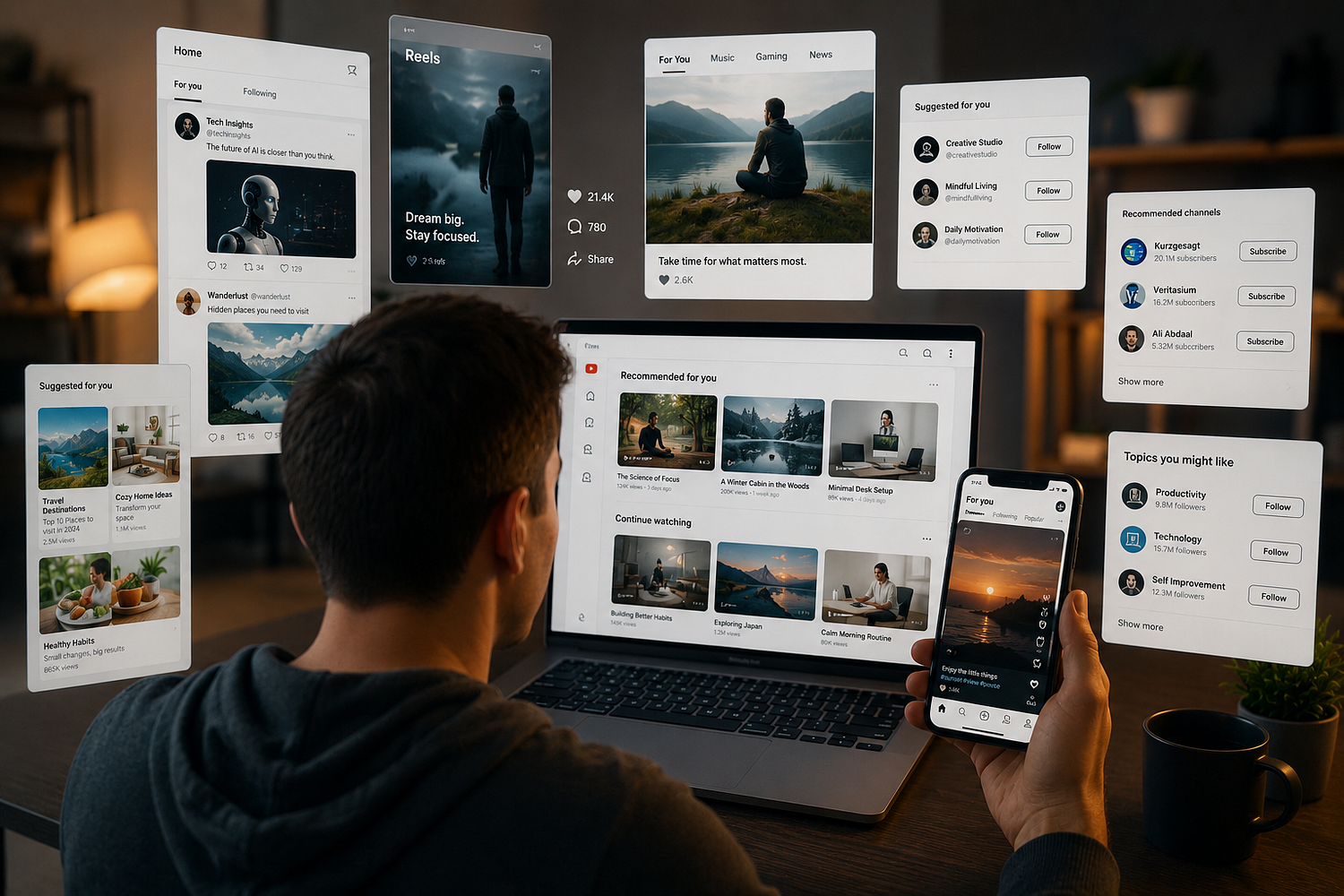
The web gradually stopped feeling like a world and started feeling like a personalized feed.
Algorithms Solved One Problem And Created Another
It is important to acknowledge that algorithms exist for a good reason.
The internet became too large for manual discovery alone. Without recommendation systems, modern platforms would feel overwhelming. Imagine opening YouTube and attempting to manually search through billions of videos. Imagine browsing social media without any ranking system determining what appears first.
Algorithms solved this problem by filtering information.
They learned user preferences. They analyzed behavior patterns. They tracked engagement. They predicted interests. Over time, recommendation systems became remarkably effective at understanding what people wanted to consume.
That success created an unintended consequence.
The better algorithms became at predicting interests, the less likely users were to encounter something unexpected.
Someone who watches technology videos receives more technology videos. Someone interested in fitness receives more fitness content. Someone who follows certain creators sees increasingly similar creators.
The experience becomes highly relevant.
It also becomes highly predictable.
The internet starts showing people what they already enjoy instead of exposing them to things they never knew they might enjoy.
That subtle change fundamentally alters the experience of discovery.
We Have More Content Than Ever But Discover Less
This may be the strangest contradiction of the modern web.
The amount of available content has exploded beyond imagination. Yet the amount of content any individual actually encounters may have become narrower.
Most people spend large portions of their online lives inside a handful of platforms. The same social networks. The same video platforms. The same recommendation engines.
As a result, people often encounter the same conversations repeatedly.
The same creators.
The same trends.
The same opinions.
The same content formats.
The same viral topics.
The internet itself continues expanding, but personal experiences of the internet become increasingly concentrated.
Personalization creates convenience. Unfortunately, it can also create limitations.
Recommendation systems are designed to maximize engagement. They are not necessarily designed to maximize exploration. Sometimes the most valuable discoveries are things users would never intentionally search for.
Algorithms excel at serving known interests.
They are less effective at introducing entirely new ones.
Everybody Lives Inside A Different Internet Now
Another reason the internet feels smaller is that people no longer experience the same web.
In earlier eras, large portions of internet culture were shared. Millions of people visited similar websites. Popular blogs attracted broad audiences. Large forums became gathering places for diverse communities.
Today feeds are personalized at an individual level.
Two people can open the same platform and encounter completely different realities. Their recommendations differ. Their creators differ. Their news differs. Their trends differ. Their conversations differ.
The internet has effectively fragmented into millions of personalized versions of itself.
This fragmentation provides relevance but reduces shared experiences. People increasingly inhabit separate algorithmic neighborhoods rather than a common digital world.
The result is a strange paradox. The internet feels simultaneously more connected and more isolated.
Social Media Turned Discovery Into Consumption
One of the biggest changes involves how people interact with online content.
Early internet experiences often felt active. Users searched, clicked, explored, joined communities, and navigated discussions.
Modern social platforms increasingly emphasize passive consumption.
Content arrives automatically. Recommendations appear continuously. Feeds refresh endlessly.
The experience requires less effort.
It also requires less curiosity.
When content is delivered directly to users, there is less incentive to explore beyond what appears on screen. Discovery becomes something that happens to people rather than something they actively pursue.
This model is incredibly effective for engagement. It keeps users entertained and informed.
However, it also transforms the internet from a place people explore into a stream people consume.
That distinction matters more than many realize.
The Death Of Serendipity
Perhaps the biggest loss is something difficult to measure.
Serendipity.
The internet once felt full of happy accidents. People stumbled across strange websites late at night. They discovered niche communities discussing obscure interests. They found fascinating blogs written by people they had never heard of before.
These experiences still exist.
They are simply harder to encounter.
Modern platforms prioritize relevance over randomness. Every recommendation aims to increase the probability of engagement. Every feed attempts to become more personalized.
Ironically, the better technology becomes at understanding users, the harder it becomes for users to escape themselves.
The internet gives people exactly what they want.
Sometimes that means they stop discovering what they never knew they wanted.
AI Could Make This Even More Extreme
Artificial intelligence is beginning to influence online discovery in ways that may accelerate existing trends.
AI systems increasingly summarize information, recommend content, answer questions, and filter search results. These tools provide enormous convenience. They save time and reduce effort.
However, they also introduce another layer between users and the wider internet.
Historically, answering a question often required visiting multiple websites. People encountered different viewpoints, communities, and resources during the process.
Today an AI system may provide a concise answer immediately.
Efficient? Absolutely.
Exploratory? Not necessarily.
As AI becomes more integrated into everyday browsing, the challenge will be preserving opportunities for discovery while benefiting from greater convenience.
The internet may become even more personalized than it already is.
The Rise Of The Same Internet
Another reason the internet feels smaller today is that people are increasingly consuming the same content, even when they believe they are seeing something unique.
A decade ago, different corners of the internet often felt genuinely different. A photography forum had its own culture. A technology blog had its own voice. Gaming communities developed inside their own ecosystems. Even social networks felt distinct from one another.
Today, many platforms seem to be feeding off each other constantly.
A trend starts on TikTok and appears on Instagram within hours. A viral tweet becomes a YouTube video. A YouTube video becomes a newsletter topic. A Reddit discussion becomes a LinkedIn post. The same ideas often travel across every major platform until they dominate online conversation for days or even weeks.
This creates the illusion of variety while reducing actual diversity of experience.
People may use different apps throughout the day, but they are often consuming variations of the same content. The internet appears large because there are countless platforms available, yet many of those platforms are increasingly discussing the same subjects, promoting the same creators, and reacting to the same trends.
The result is a strange cultural compression.
Millions of people receive information from slightly different sources, but the overall conversation becomes narrower. Certain topics dominate attention while thousands of interesting communities remain hidden beneath the surface.
This is partly why older internet experiences often feel more memorable. People were not simply consuming content. They were discovering entirely different worlds.
One person could spend weeks exploring independent music blogs while another disappeared into niche programming forums. Someone else might become fascinated by obscure history websites or small online communities dedicated to unusual hobbies. Those experiences felt personal because they were difficult to replicate.
Today, recommendation systems tend to push users toward content that already performs well. Success attracts more visibility, which attracts even more visibility. Over time, attention naturally concentrates around fewer creators, fewer conversations, and fewer platforms.
The internet still contains extraordinary diversity.
The challenge is that much of it now exists outside the places where most people spend their time.
That is why many users describe the modern web as feeling repetitive. It is not that there is less content available. It is that the same content reaches more people than ever before.
The Internet Is Bigger Than Ever
Despite these concerns, it is important to remember that the internet itself has not become smaller.
Independent creators still exist.
Niche communities still exist.
Personal blogs still exist.
Forums still exist.
Interesting websites still exist.
The problem is not that these places disappeared. The problem is that they are increasingly hidden behind layers of algorithms, feeds, and recommendation systems.
The wider web remains available.
Most people simply spend less time exploring it.
Can We Get That Feeling Back?
The good news is that rediscovering exploration remains possible.
Many users are returning to newsletters, independent blogs, niche forums, RSS feeds, and smaller online communities. Others intentionally search beyond major platforms. Some deliberately avoid algorithmic feeds for portions of their online time.
These habits cannot recreate the early internet exactly.
Nor should they.
The internet of the past had many flaws.
But they can restore something valuable: intentional discovery.
The feeling that there might still be something unexpected waiting beyond the next link.
The Internet Did Not Become Smaller. It Became Filtered.
Perhaps that is the simplest way to understand what happened.
The internet did not shrink.
It expanded beyond imagination.
What changed was the number of layers standing between people and the wider web.
Algorithms became gatekeepers. Feeds became destinations. Personalization became default. Convenience became priority.
The result is an internet that often feels smaller despite being larger than ever.
And perhaps that is the real irony of modern technology.
The more perfectly the internet learns what we want, the fewer opportunities we have to discover what we never knew we were looking for.