You were born with roughly 37 trillion cells. Right now, as you read this, some of them are dividing, some are dying, and a quiet but significant number are doing something stranger — just sitting there, alive but switched off, refusing to do their jobs. Scientists call these senescent cells. The rest of us, if we knew they were there, might just call them a problem.
Cellular aging isn’t a single event. It’s not like a battery running flat. It’s more like a crowded apartment building where some tenants start hanging around in the hallway, blocking traffic, complaining loudly, and making the whole place feel older than it is. The biology underneath all of this is genuinely surprising, and the science has moved far enough in the last decade that treating aging at the cellular level no longer sounds like science fiction. It sounds like a clinical trial — because increasingly, it is one.
Here’s what’s actually happening inside your cells as the years pass, why it matters more than most health conversations give it credit for, and what researchers are doing about it right now.
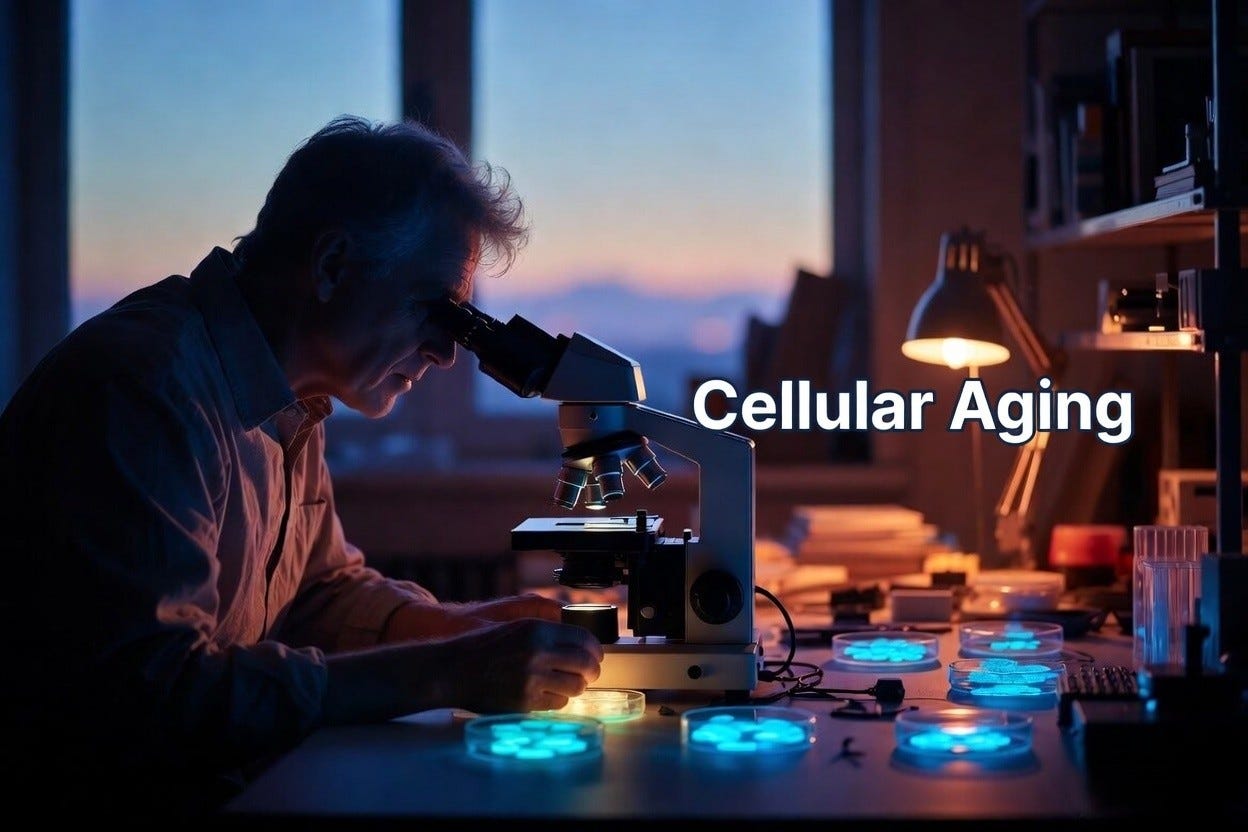
What Cellular Aging Actually Means
When most people hear “aging,” they picture wrinkles, grey hair, slower recovery after exercise. Fair enough. But those are downstream effects. The real story is happening at a scale you can’t see without an electron microscope.
Every time a cell divides, it has to copy its DNA — about 3 billion base pairs, in full. The machinery that does this is extraordinarily accurate, but it has one known flaw: it can’t quite copy the very ends of chromosomes. These ends are capped by protective sequences called telomeres, and they shorten a little with each division. Think of them like the plastic tips on shoelaces. As long as the tip is intact, the lace — the chromosome — is protected. Shorten the tip enough, and things start to fray.
When telomeres shrink past a critical threshold, the cell gets a signal: stop dividing. This is actually a protective mechanism. A cell that divides without limits is a tumor. Senescence is the body’s circuit breaker. The trouble is that once enough cells hit that wall, tissues lose their ability to repair themselves. Muscle regenerates more slowly. The lining of blood vessels becomes patchier. The immune system’s refresh rate drops.
That’s not all that’s going wrong, though. DNA also accumulates damage from UV radiation, from normal metabolic byproducts, from environmental toxins, and just from the entropy of being alive. Cells have repair crews — proteins like PARP and enzymes that stitch broken strands back together — but those crews can’t keep up forever. Over time, the errors accumulate. Some lead to cell death. Some lead to dysfunction. And a small fraction lead to cancer.
There’s another piece of this that rarely gets enough attention: the epigenome. DNA is the instruction manual, but the epigenome is the sticky-note system layered on top of it — chemical marks that tell the cell which genes to read and which to ignore. In young cells, this system is well-organized. As cells age, those marks drift. Genes that should be quiet start whispering. Genes that should be active go silent. The cell doesn’t lose its instructions; it loses the ability to read them correctly.
David Sinclair at Harvard has argued, somewhat controversially, that this epigenetic drift is actually the root cause of aging — that the DNA itself is mostly fine, and it’s the information system on top of it that degrades. His lab published work in 2023 showing that deliberately disrupting the epigenome in mice caused rapid aging, while restoring it reversed measurable biological age markers. The debate among researchers is very much ongoing, but it’s a striking finding.
The Senescent Cell Problem
Back to those cells hanging in the hallway. Senescent cells don’t just sit quietly. This was the discovery that genuinely shook the field about fifteen years ago: they secrete a cocktail of inflammatory proteins, enzymes, and signaling molecules that researchers now call the SASP — the senescence-associated secretory phenotype. It’s an evocative term for a genuinely destructive process.
SASP signals are, in small doses, useful. They recruit immune cells to the site of damage and help coordinate repair. In young bodies with healthy immune systems, senescent cells get cleared out before they cause much trouble. The problem is that immune clearance slows with age, so senescent cells accumulate. And as they accumulate, the chronic low-level inflammation they generate — sometimes called “inflammaging” — starts damaging surrounding tissue. It’s a feedback loop. More senescent cells create more inflammation; inflammation accelerates further cellular damage; more cells go senescent.
This mechanism has now been linked to an almost uncomfortable number of age-related conditions. Osteoarthritis, cardiovascular disease, type 2 diabetes, pulmonary fibrosis, neurodegeneration. When researchers at the Mayo Clinic cleared senescent cells from aged mice using a genetic trick back in 2016, the animals showed delayed onset of age-related diseases, better physical function, and lived measurably longer. Not slightly longer. Notably longer, in some cohorts by over 25%.
The obvious next question: can you do that in people?
Senolytics — The Drugs That Clear Old Cells
The class of drugs being developed to kill senescent cells is called senolytics. The term has been around since about 2015, when a Mayo Clinic team led by James Kirkland identified that certain compounds could selectively trigger cell death in senescent cells while leaving healthy cells unharmed. The first candidates were dasatinib (a leukemia drug) and quercetin (a plant compound found in onions and capers, of all things). Together, they’re often abbreviated as D+Q.
Since then, the field has expanded significantly. Navitoclax, fisetin, piperlongumine — there’s a growing list of compounds that show senolytic properties in lab models. Some are already approved for other uses. Others are early-stage. The challenge is selectivity: senescent cells don’t all look the same, and killing too broadly risks damaging tissue the body needs.
Clinical trials in humans are underway. As of early 2025, there were over 30 registered trials involving senolytics for conditions including Alzheimer’s disease, chronic kidney disease, and COVID-19-related lung damage. Early human data from a 2019 pilot trial in idiopathic pulmonary fibrosis showed that D+Q improved physical function in just a few weeks. Small sample size, yes. But the direction of the result caught serious attention.
To be fair — and this is worth saying plainly — we don’t yet know whether the benefits seen in mice will translate cleanly to humans at scale. Mice are not people. Their telomere biology is different. Their lifespans are different. The history of medicine has a long list of interventions that looked spectacular in rodents and disappointing in people. Senolytics might be different; the mechanism is compelling and the early human signals are promising. But warranted optimism is still different from certainty.
Mitochondria and the Energy Equation
There’s another storyline running parallel to all of this: the slow degradation of mitochondria as cells age.
Mitochondria are often described simply as the cell’s power plants, but that undersells them. They’re dynamic organelles that constantly fuse and split, communicate with the nucleus, regulate cell death signals, and produce the ATP that drives almost everything a cell does. They also produce reactive oxygen species as a byproduct of energy generation — free radicals, essentially — which can damage proteins, lipids, and DNA if not neutralized.
Young cells have efficient mitochondria and robust antioxidant systems. Aged cells accumulate mitochondria that are damaged or dysfunctional, partly because the quality control systems that normally eliminate faulty mitochondria — a process called mitophagy — slow down over time. When mitochondria malfunction, energy production drops, oxidative damage increases, and cells struggle to perform their specialized functions.
This is where NAD+ enters the conversation. NAD+ is a coenzyme involved in hundreds of metabolic reactions and is essential for mitochondrial function. Its levels decline substantially with age — by some estimates, by 50% between youth and middle age. Researchers including Johan Auwerx at EPFL have shown that boosting NAD+ levels in aged mice restores aspects of mitochondrial function and muscle performance. Precursors like NMN (nicotinamide mononucleotide) and NR (nicotinamide riboside) have become some of the most widely discussed supplements in longevity circles, despite human evidence still being relatively thin compared to animal data.
That gap between compelling lab science and confirmed human benefit is honestly the story of much of this field right now. The mechanisms are real. The question is always whether the intervention, at a dose that’s tolerable and safe for people, produces the effect seen in controlled animal experiments. Sometimes it does. Sometimes the translation is partial. Sometimes it doesn’t work at all.
Epigenetic Reprogramming — The Boldest Idea in the Field
Of all the approaches to cellular aging currently being explored, epigenetic reprogramming may be the one that will define the next decade of biogerontology — or turn out to be far more complicated than anyone hoped.
The idea builds on the work of Shinya Yamanaka, who won the 2012 Nobel Prize for discovering that adult cells could be reprogrammed back to a pluripotent, embryonic-like state using just four transcription factors, now called the Yamanaka factors (OCT4, SOX2, KLF4, MYC). This was revolutionary. It showed that cell identity is not fixed. It’s a program, and like any program, it can be rewritten.
The problem with full reprogramming is that it erases not just the epigenetic aging marks but also the cell’s identity — and cells that lose their identity can become tumors. That’s obviously not what anyone wants.
The more refined goal is partial reprogramming: applying the Yamanaka factors briefly, resetting the epigenetic clock without making the cell forget what it is. Several labs, including Sinclair’s at Harvard and the Salk Institute’s under Juan Carlos Izpisua Belmonte, have shown that this can work in mice, restoring aspects of vision in aged animals, improving muscle regeneration, and reversing epigenetic age markers. Altos Labs, a biotech company backed by significant investment from Amazon founder Jeff Bezos among others, was founded in 2022 specifically to pursue this approach at scale. That’s a meaningful signal that people with access to serious information and resources believe this direction has real potential.
Whether it will translate to a therapy for humans, and on what timeline, nobody honestly knows. The safety questions alone are immense. You’re talking about temporarily switching cells into a rejuvenated state while ensuring they don’t slide into malignancy. The margin for error is not generous.
What You Can Do Right Now
Given that most of the genuinely exciting interventions are still in laboratories, clinical trials, or the careful minds of researchers who don’t want to oversell their own data, what does any of this mean practically?
More than you might think — because several lifestyle factors have been shown to directly affect the cellular processes described above, sometimes with a specificity that’s striking.
Exercise is probably the single most well-documented intervention for mitochondrial health. Aerobic exercise stimulates mitophagy, promotes the growth of new mitochondria (mitogenesis), and has been shown in multiple studies to attenuate telomere shortening. A 2017 study in the European Heart Journal found that endurance athletes in their 50s had telomere lengths and cell regenerative capacity comparable to people in their 20s. That’s not a small effect.
Caloric restriction and intermittent fasting activate pathways — particularly involving a protein called AMPK and a regulator called mTOR — that slow cellular aging processes and enhance autophagy, the cellular recycling system. Continuous caloric restriction is not practical or enjoyable for most people over a lifetime, but time-restricted eating has shown some of the same pathway effects with considerably less sacrifice.
Sleep is where many people who are otherwise health-conscious lose ground. During deep sleep, the glymphatic system flushes waste products from the brain, and cells across the body carry out repair processes that simply don’t happen efficiently when sleep is cut short. Consistently sleeping fewer than seven hours is associated in epidemiological data with faster telomere attrition and higher levels of inflammatory markers — the exact biological profile you don’t want.
Chronic stress — not the short-term kind that’s actually useful, but the prolonged, unresolved kind — elevates cortisol and creates a systemic inflammatory state that closely mimics the SASP environment. Elissa Epel at UCSF, who has studied telomere biology extensively, has linked perceived psychological stress to measurably shorter telomeres in caregivers of chronically ill children, among other groups. The mind-body connection here is not metaphorical. It shows up in the biology.
None of these are secrets. But context changes how you think about them. Exercise isn’t just good for your cardiovascular system; it’s directly preserving the functional lifespan of your cells. Sleep isn’t just rest; it’s when cellular maintenance happens. Framing matters — not to make these habits feel more virtuous, but because understanding the mechanism makes it easier to take seriously.
The Biological Age Question
One development that has made this field feel suddenly more legible to non-specialists is the rise of epigenetic clocks — mathematical models that estimate biological age from patterns of DNA methylation, the chemical marks that regulate gene expression. Steve Horvath at UCLA developed the first widely used version of this in 2013, and the field has since produced more refined models: the GrimAge clock, the DunedinPACE clock, and others that predict not just biological age but the rate at which someone is aging at a given moment.
These tools have made it possible to actually measure whether an intervention is changing cellular age, rather than relying only on downstream health outcomes that take years or decades to observe. That’s a significant methodological leap. Clinical trials for aging interventions used to have an obvious problem: how do you measure “slowing aging” in a five-year trial? Now there’s a biological readout, imperfect but meaningful, that can show up in months.
Several consumer tests already offer biological age assessments based on these clocks. Some are reasonably rigorous; others are not. If you’re curious, look for ones based on validated methylation-based models rather than cheaper proxies. The variation in quality in that market is substantial.
Where This Is Heading
The honest answer is that nobody in this field talks about “curing aging” without qualification anymore. The framing has shifted toward treating aging as a medical condition — one with identifiable mechanisms, measurable biomarkers, and, increasingly, targetable interventions. That’s a conceptual change with real consequences for how research gets funded, how regulators think about drug approval, and how clinicians might one day advise patients.
What seems genuinely plausible in the next ten to fifteen years: senolytic drugs that are routinely used to reduce the burden of senescent cells in specific tissues, particularly in diseases like osteoarthritis and pulmonary fibrosis where the senescent cell contribution is clearest. NAD+ precursors with better-characterized human dosing. Partial reprogramming protocols moving into early-phase human safety trials.
What remains genuinely uncertain: whether any of these will add decades to healthy human life, or whether they’ll primarily compress morbidity — helping people stay healthier closer to the end of their natural lifespan rather than extending that lifespan dramatically.
That second outcome, honestly, might be the more important one. Living longer while spending more years in decline has never been the goal. The ambition driving most serious researchers in this space is what’s usually called healthspan — the portion of life spent in good health, with functional independence and cognitive clarity. If the science delivers that, it will have done something extraordinary, even if it doesn’t deliver immortality.
Your cells are already keeping score. The question isn’t whether time passes — it’s whether the science we’re building right now gets precise enough, fast enough, to give those cells a fighting chance.