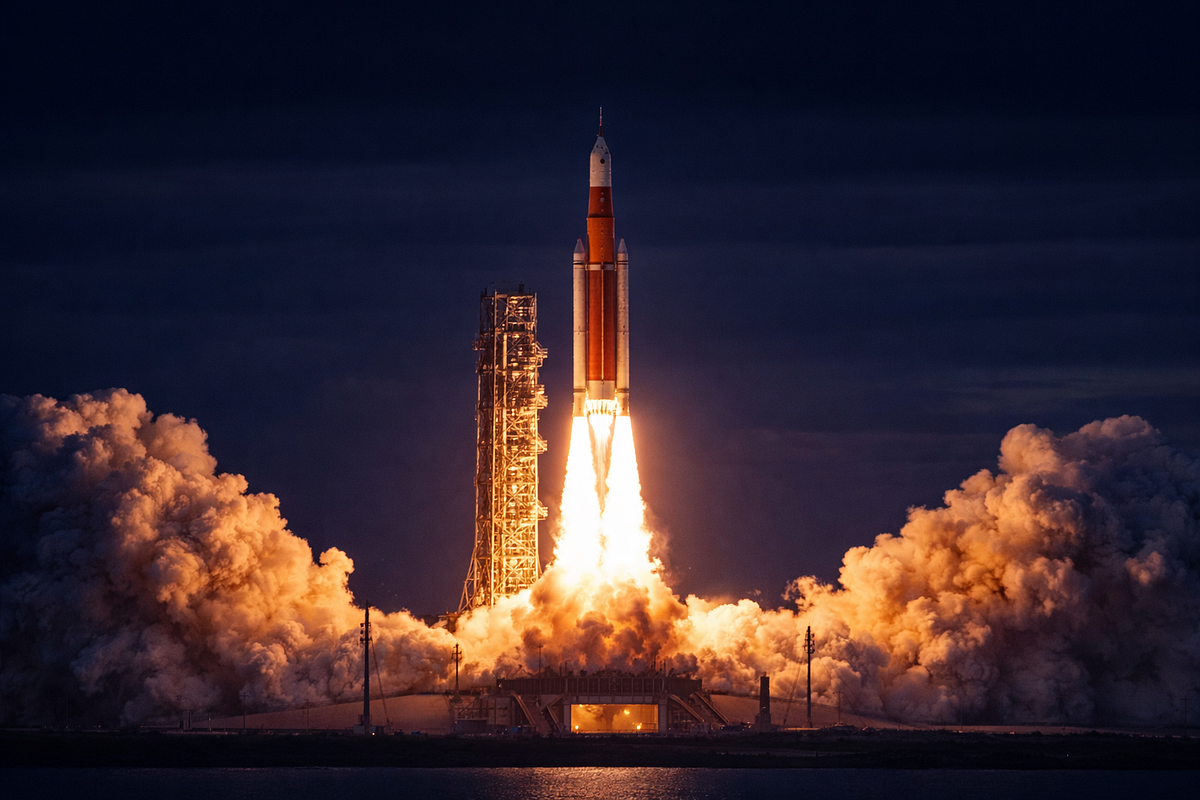
Two days ago, four people strapped into a spacecraft and headed toward the Moon. April 1, 2026. Kennedy Space Center, Florida. 6:35 in the evening. I had to check the date twice because NASA launching on April Fool’s Day felt like someone’s idea of a joke. But the rocket lit up for real, and now those four people are about a day away from flying past the Moon as you read this. First time humans have gone that far from Earth since 1972.
Fifty-four years. That’s how long we’ve been waiting for this.
If you’re confused about what the Artemis program actually is, why this took so long, or why we’re just doing a flyby and not actually landing, I’ll try to explain it all. I’ve spent a lot of time reading about this over the past few weeks and some of the history here is kind of surprising.
Why Nobody Went Back for 54 Years
This is the part most people don’t know. It wasn’t a technology problem. The US had everything needed to keep going back to the Moon after 1972. The problem was that the government decided it was too expensive and nobody was that interested anymore.
The last mission, Apollo 17, landed in December 1972. Between 1969 and 1972, twelve men walked on the Moon across six missions. Then the budget got cut, the Vietnam War was eating money, public excitement had died down after the first landing, and NASA was told to wind things down. So they did.
For the next five decades, no human went farther than low Earth orbit, which is roughly 400 km above the surface. The ISS sits there. So does the Chinese space station. It sounds far until you realize the Moon is 384,000 km away. We basically stopped at the end of the driveway.
There were multiple attempts to restart Moon missions over the years. George W. Bush announced something called the Constellation program in 2004. Obama cancelled it in 2010 saying it was over budget and behind schedule. Trump came in 2017 and announced what is now called Artemis. Biden kept it going. Trump is back in office and it’s still going. So at least this one survived the political rotation, which previous programs did not.
What Artemis Actually Is
Artemis is the official name for NASA’s Moon return program. The name comes from Greek mythology: Artemis is the twin sister of Apollo, so the naming is kind of obvious once you know that.
The rocket launching these missions is the SLS, Space Launch System. It generated about 9 million pounds of thrust at liftoff on April 1, making it the most powerful rocket currently in use anywhere. The capsule on top is called Orion, made by Lockheed Martin. The service module attached to Orion, the part that provides electricity and propulsion, was built by the European Space Agency. So this is not entirely an American rocket, which I find interesting.
The whole program is designed to go step by step rather than attempt a dramatic landing on the first try. Step one was Artemis I in November 2022, a completely uncrewed test flight. Just mannequins with sensors, no people. The mission flew around the Moon and came back. Most of it went well. But after it came back, engineers found a problem that ended up costing over a year of delays.
The Heat Shield Problem That Caused All the Delays
After Artemis I splashed down in December 2022, the ground team pulled the heat shield off Orion for inspection. What they found was not what they expected.
The heat shield is a 16-foot wide protective plate on the bottom of the capsule. When Orion comes screaming back into Earth’s atmosphere at around 25,000 miles per hour, the temperatures on the outer surface hit 5,000 degrees Fahrenheit. The shield is made of a material called Avcoat, same material used in Apollo capsules decades ago. It’s supposed to burn away slowly and evenly, protecting the inside. But during Artemis I’s return, chunks of it broke off in more than 100 locations. Not little flakes. Proper chunks, leaving gaps in the surface.
When engineers figured out why, the explanation was actually pretty interesting in a bad way. As Orion was doing what’s called a “skip reentry,” where the capsule dips into the atmosphere, bounces back out briefly, then comes back in, gases formed inside the Avcoat material. Those gases couldn’t vent out fast enough because the material wasn’t porous enough. Pressure built up. Cracks formed. Chunks broke off. It’s basically like water freezing inside a rock and splitting it.
Now, they said the temperature inside the crew compartment was fine and astronauts would have been okay. But “okay during that mission” and “definitely safe for humans on future missions” are two different things. And nobody wanted to find out what happens if the damage gets worse with people on board.
NASA spent over a year investigating this. Their eventual solution was controversial. Rather than replacing the heat shield entirely, which would have taken years and a lot of money, they decided to change how Orion reenters the atmosphere. They made the descent steeper and more direct, cutting out the skip maneuver. This reduces the time the heat builds up inside the Avcoat and prevents the gas pressure problem.
Some people were not happy with this. A blog post by Maciej Cegłowski, published about three days before the April 1 launch, laid out in very detailed technical terms why he thought Orion had come back from Artemis I with damage that should have grounded the program until fixed properly. He wrote that “NASA is going to fly Artemis II based on vibes.” That’s a very harsh way to put it, but it summarized what some critics were saying. Multiple former astronauts also raised concerns. After meeting with NASA’s independent review team in January 2026, they apparently accepted the decision to fly. But the review team itself was only formed in April 2024, which means the process of actually investigating this issue took almost two years.
I’ll be honest — this part still doesn’t sit fully right with me. The crew apparently knew everything and said they trusted the engineers. Commander Wiseman praised the review team publicly. Victor Glover said the crew was “comfortable because of that team.” So I’ll leave it there. But if you’ve been following this program closely, the heat shield situation has been a source of background anxiety for a while.
On top of all the heat shield delays, there were hydrogen fuel leaks in February 2026 that pushed the launch back from the original February date, and then a problem with the upper stage propellant pressurization system that caused more slipping. So the April 1 launch date came after years of: heat shield investigation, life support system fixes, fuel leaks, pressurization problems, and whatever else broke that week. The program’s original very early planning documents had Artemis II launching somewhere between 2019 and 2021. So they’re about five or six years behind schedule overall.
The Crew Flying Right Now
Four people are in that spacecraft, named Integrity by the crew.
Reid Wiseman is commander, a US Navy test pilot who flew to the ISS in 2014. Victor Glover is pilot, also a Navy test pilot and the first Black astronaut to do a long-duration stay on the International Space Station, back in 2020–21. Christina Koch has the record for the longest single spaceflight by a woman and has done multiple spacewalks. And then there’s Jeremy Hansen, from the Canadian Space Agency. Jeremy has never flown to space before in his life. This is his first mission, and instead of starting with a trip to the ISS like most new astronauts do, he’s going straight to the Moon’s neighborhood. Must be quite an experience.
Worth mentioning: the crew has been dealing with real-time problems since launch. Mission control and the crew had to fix the toilet on Orion after it stopped working normally following one of their early maneuvering tests. They got it working again, but that detail was reported publicly. I bring it up only because it’s a good reminder that space travel involves a lot of very unglamorous problem-solving. Glover was on a live event from space on Thursday and said the launch day was “surprisingly” smooth. Apparently even they weren’t expecting it to go off that cleanly.
The crew is expected to travel about 252,021 miles from Earth at their farthest point during the lunar flyby. This breaks the record previously held by Apollo 13. The reason Apollo 13 holds that record is because their oxygen tank exploded and they had to loop around the Moon without landing just to use its gravity to slingshot home. So yes, Artemis II is breaking the record, but under much better circumstances.
What They’re Actually Doing Out There
Not landing. This is a test flight, not the Moon landing mission.
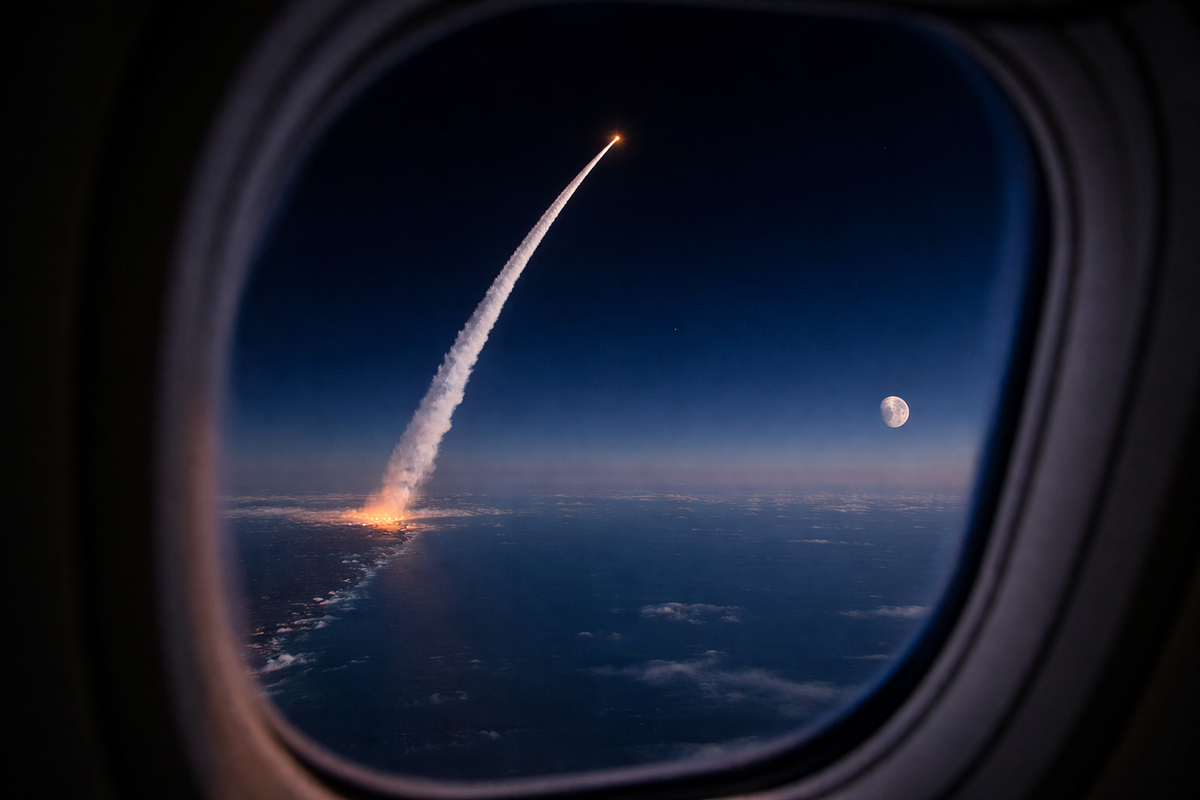
The main purpose is to test whether Orion’s full life support systems actually work with humans inside. On Artemis I there were no people, so the breathing, water recycling, temperature control, and all that never got tested with real bodies inside. That’s what Artemis II is checking. They’re also testing Orion’s manual controls, communication systems, and all the software that has never been used in deep space with a crew.
Four days after launch, they’ll fly around the far side of the Moon, parts of it that almost no human has seen up close before. Then they turn around and come home. The reentry uses that modified steeper trajectory. Splashdown is planned in the Pacific Ocean near San Diego. The US Navy will recover them.
Ten days total. No moonwalk, no landing, no staying. If something goes wrong out there, the worst case is that they don’t reach the Moon and come home early. Much better to figure that out now than when a crew is trying to dock with a landing vehicle 250,000 miles away.
So When Do Humans Actually Land on the Moon
Here is where the story gets a bit complicated.
The original plan was Artemis III as the landing mission, the first humans on the lunar surface since 1972, landing near the south pole. SpaceX was hired to build a lunar lander version of Starship, called the Human Landing System. The plan sounded straightforward enough.
But SpaceX’s Starship development ran into serious delays. Multiple test flights exploded before they got the full system working reliably. Between that and NASA’s own Orion delays, it became obvious by 2023–2024 that Artemis III as a landing wasn’t happening on any reasonable schedule. On top of that, the Lunar Gateway, a planned small space station in lunar orbit that was going to be a staging point for Moon missions, was cancelled entirely in March 2026. Just removed from the plan.
So NASA administrator Jared Isaacman confirmed in February 2026 that Artemis III, now targeting sometime in 2027, will not land on the Moon. Instead it will test docking procedures with the SpaceX lander and Blue Origin’s Blue Moon lander in low Earth orbit. Kind of like what Apollo 9 did in 1969 before Apollo 11 actually went to the Moon, just practicing the critical maneuvers without actually committing to the big trip.
The actual landing is now Artemis IV, targeting 2028. Some officials have said they hope to do Artemis IV and Artemis V, a second landing, both within 2028. Given the history of this program, I’ll believe it when I see the rocket actually leave Earth. But that’s what the current plan says.
Why the Sudden Pressure to Move Faster
China has announced they want to land their own astronauts, called taikonauts, on the Moon by 2030. Unlike some space agency timelines, China’s program has been fairly consistent at hitting targets. They landed the Chang’e 5 rover and brought back lunar samples in 2020. Their Tiangong space station became operational in 2022. They’re moving steadily.
The reason the south pole specifically matters is water ice. There’s quite a lot of it frozen in permanently shadowed craters near the lunar south pole, locked there because sunlight never reaches those areas. Water ice is not just water. It can be broken into oxygen for breathing and hydrogen for rocket fuel. Whoever establishes a permanent base at the south pole first has a massive resource advantage for any long-term presence on the Moon, and for missions going further out toward Mars.
So there is real urgency here beyond just exploration. This is about which country gets to be the dominant presence on the most valuable piece of real estate near Earth. That geopolitical pressure is why you’re hearing NASA people talk about landing in 2028 with some urgency rather than being relaxed about timelines.
The Cost Problem Nobody Really Talks About
Here is a contrarian observation that I think is worth putting out there. Each SLS launch costs NASA roughly $4 billion. Not the whole program, just one launch. For comparison, SpaceX is developing Starship which, if it reaches full operational status, is supposed to be reusable and cost a small fraction of that per flight.
A lot of space engineers and writers have pointed out that SLS is basically a jobs program for the aerospace industry: expensive, mostly non-reusable, built from Space Shuttle components and Constellation-era parts, and kept alive through political connections in states where the manufacturing happens. That’s a rough way to say it and NASA would push back on that framing. But the cost per launch being that high is why we can’t just do these missions every few months. Each one is a massive budgetary commitment.
I’m not an aerospace engineer, so I won’t pretend I fully understand the trade-offs. But when you read that one launch costs more than NASA’s entire annual budget for certain programs, it gives you a different picture of why the Moon landing keeps getting pushed back.
Where This All Actually Ends Up
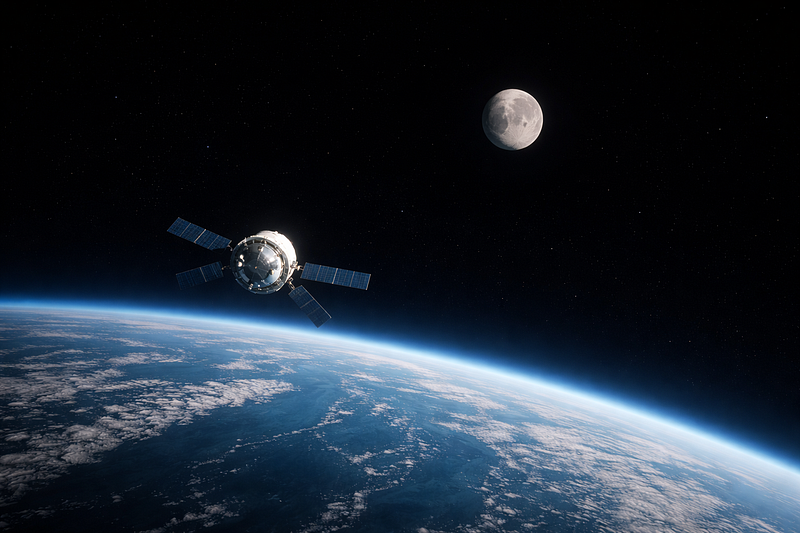
If Artemis IV lands in 2028, the long-term plan is roughly annual missions after that. Eventually, NASA wants to build what they’re calling Artemis Base Camp, a permanent surface outpost at the south pole, similar in concept to what countries operate in Antarctica. They want it operational sometime in the 2030s. And the idea is that everything learned there, about keeping humans alive for weeks or months in a harsh environment and using local resources like water ice, will feed into eventually attempting a crewed mission to Mars.
Mars is still a long way off. But Artemis II, happening right now in real time, is the first crewed step of that journey.
And after 54 years, three cancelled Moon programs, a crumbling heat shield, political changes, budget fights, fuel leaks, and a broken toilet, the fact that four people are out there heading toward the Moon right now is something. Those four people are moving at about 5 miles per second toward Earth’s closest neighbor as you read this sentence. Commander Wiseman said on the day of launch: “Sending four humans 250 thousand miles away is a herculean effort, and we are now just realizing the gravity of that.”
Yeah. I think he got that right.