The Wire Transfer That Changed Everything
March 11, 2026.
Somewhere inside Google’s financial infrastructure, $32 billion moved. In cash. Not stock. Not a phased payout. Not a complicated earn-out tied to future milestones.
Cash.
That single transaction completed the largest acquisition in Google’s entire history — bigger than Motorola Mobility in 2012, bigger than Mandiant in 2022, bigger than anything Alphabet has ever done. And on the morning it closed, most people scrolling their feeds barely paused on the headline.
That is worth sitting with for a moment.
Thirty-two billion dollars. Gone. To buy a cloud security company that did not exist six years ago. And the world mostly shrugged.
That shrug tells you two things. First, our collective attention is in a strange place right now. Second — and more importantly — most people genuinely do not understand what is at stake in cloud security in 2026. They do not understand why Google just made the biggest bet of its existence on a company called Wiz.
By the end of this piece, you will.
The Founder Who Looked at $23 Billion and Said “Not Enough”
Let us start with the story, because it is genuinely one of the more remarkable things that has happened in tech in recent memory.
In 2024, Google approached Wiz with an acquisition offer.
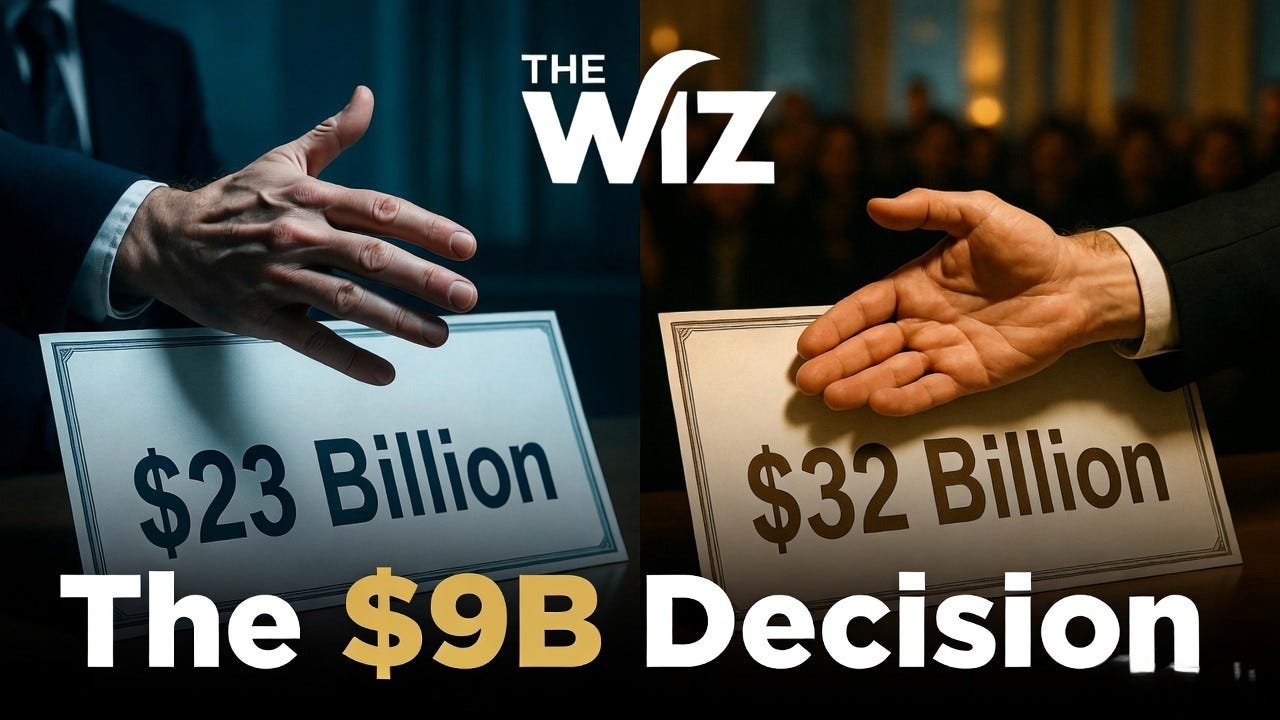
The number on the table was $23 billion.
For nearly any founder on earth, that is a conversation-ending figure. Twenty-three billion dollars does not require deliberation. It requires a signature. Most people would not lose a single night of sleep over that decision.
Assaf Rappaport, Wiz’s co-founder and CEO, did not sign.
He walked away.
His reasoning was not arrogance. It was math. Rappaport looked at Wiz’s growth trajectory, at the size of the problem it was solving, at how early the company still was in capturing that market — and concluded that $23 billion was pricing the present while ignoring the future. He believed Wiz would be worth significantly more within twelve months.
He told his team. He told his board. He told the world he was turning down the offer.
Most observers assumed this was a negotiating posture. That he would come back to the table quietly and settle somewhere in the mid-twenties. That is usually how these things work.
It is not how this worked.
By 2025, Wiz had crossed $1 billion in annual recurring revenue. The platform had grown substantially. Enterprise adoption was accelerating. Google came back.
This time, the offer was $32 billion.
Rappaport said yes.
That $9 billion difference is not just a negotiation win. It is a precise, documented measurement of how much more urgent the cloud security problem became in twelve months. Rappaport understood the depth of the problem better than the buyers did. He priced accordingly. And he was right.
Six years from founding to a $32 billion exit. Wiz did in six years what most security companies spend decades attempting. That timeline is not luck. It is a signal about how badly the market needed what Wiz was building.
Security Was Broken. Here Is How Wiz Fixed It.
Here is where most coverage loses people. The moment technical jargon enters the room, eyes glaze over. So let us do this differently.
Picture your company’s data as a house.
A few years ago, that house had walls, locks, and a single front door. Security meant guarding the door. If someone wanted your data, they had to get through that door. Traditional security tools were built for exactly that model.
Then the cloud happened.
Suddenly, your house has no walls. Your data lives across dozens of rooms spread across different buildings in different cities. Some rooms belong to Amazon. Some to Microsoft. Some to Google. Your employees walk in and out of all of them, from their home offices, their phones, their laptops in airport lounges. Contractors come and go. Automated systems open doors you did not know existed.
Guarding one front door no longer means anything.
Most security companies responded to this by specializing. One tool watches the Amazon rooms. Another watches the Microsoft rooms. A third scans for unlocked windows. A fourth monitors who is walking in. Each tool sends alerts. Thousands of them per day. Your security team spends its time sorting through noise, trying to figure out which alerts actually matter, manually cross-referencing data across five different dashboards.
The gaps between those tools are where attackers live.
Wiz built something different. Instead of adding another specialized tool to the pile, it built a platform that reads the entire house — all the rooms, all the clouds, all the connections between them — and creates a single, real-time map of where the actual risks are. Not theoretical risks. Real, exploitable paths that an attacker could use right now.
It then tells your team, in plain terms, which ones to fix first and exactly where to go to fix them.
The result is not just better security. It is a completely different experience for the people doing the work. Instead of ten thousand alerts, you get fifty that actually matter. Instead of three separate workflows across three separate tools, you get one.
That is the product. That is what Google just paid $32 billion for.
And critically — Wiz was built from day one to work across every major cloud. AWS, Azure, Google Cloud, Oracle. It does not pick sides. It sees everything. That neutrality is not incidental. It is the entire strategic foundation of the company.

AI Is Not Just Changing Business. It Is Changing the Attack.
Here is the part that gives this acquisition genuine urgency. Not just market positioning urgency. Real-world urgency.
Artificial intelligence is changing two things simultaneously.
It is changing what companies need to protect. And it is changing what attackers are capable of.
On the first point — companies are now building AI agents into their core operations. These are not simple chatbots. These are systems that access your customer database, read your internal documents, make decisions, execute transactions, and talk to other systems on your behalf. They are extraordinarily powerful. They also need to be fed data to function. Sensitive data. Business-critical data.
Think about what that means for a moment.
You have a system with access to your customer records, your financial data, your internal communications — and it is making decisions autonomously, at machine speed, without a human checking every step.
That system is not just a productivity tool. It is an extraordinarily valuable target.
If an attacker can manipulate what that agent sees — through a technique called prompt injection, essentially tricking the AI with carefully crafted inputs — they can influence its decisions without ever touching your underlying systems directly. No firewall catches it. No traditional intrusion detection tool flags it. The attack happens inside the logic of the AI itself.
This class of threat did not exist three years ago. The security frameworks most companies rely on were not designed for it.
On the second point — attackers are using the same AI tools to become dramatically more dangerous. Phishing emails that used to require skilled writers are now generated at scale, perfectly personalized, indistinguishable from real correspondence. Vulnerability scanning that used to take weeks of expert analysis now happens in hours. The speed and sophistication of attacks are rising in direct proportion to how accessible powerful AI has become.
Google Cloud’s announcement on closing day named this directly. The combined Google-Wiz platform will protect against threats created by AI, protect against threats targeting AI, and use AI to accelerate how fast security teams can respond.
That three-part framing is not marketing language. It is an accurate description of where the battlefield actually is.
Wiz spent the year before the acquisition aggressively expanding its AI security capabilities — new tools to monitor what AI applications are doing, new detection for AI-native attack patterns, new runtime protection for generative AI workloads. All of that now lives inside Google, with Gemini’s capabilities and Google’s threat intelligence network behind it.
The timing is not coincidental. We are at the very beginning of the enterprise AI deployment wave. The threat landscape is still taking shape. Building the security infrastructure now — before the attacks fully materialize — is exactly the right move. And it is a large part of why $32 billion, as staggering as it sounds, starts to make sense.
Google Did Not Buy a Product. It Bought a Position.
Here is the part most business coverage misses entirely.
Google is not buying a security product. It is buying a position.
Google Cloud has always been the technically excellent third option in the cloud infrastructure market. AWS got there first. Azure rode Microsoft’s existing enterprise relationships. Google Cloud built genuinely impressive technology and still found itself in third place, struggling to close the gap in enterprise adoption.
The reason is trust. Not capability — trust.
When a company decides where to run its infrastructure, that decision is extraordinarily sticky. Switching cloud providers is expensive, risky, and time-consuming. Most enterprises stay with whoever they chose first, as long as things work reasonably well.
Breaking into that dynamic requires either being dramatically cheaper, dramatically better, or becoming indispensable through a relationship that already exists.
Wiz already has that relationship with thousands of enterprise security teams. Across every cloud. Including companies that have never run a single workload on Google Cloud.
Those companies are now, in a very real sense, Google customers. The platform protecting their most sensitive infrastructure belongs to Google. Google’s engineers are maintaining it. Google’s roadmap is shaping where it goes next.
That changes the conversation in every future enterprise procurement cycle. Not dramatically at first. But consistently, over years, in a direction that favors Google Cloud.
And because Wiz remains available on AWS and Azure — which Google has explicitly committed to — this is not a hostile takeover of a neutral tool. It is something more elegant. Google now owns the security layer that sits above the entire cloud market, regardless of who customers choose for their primary infrastructure.
That is a $32 billion strategic move. Not a product acquisition.
One Year, Two Regulators, Zero Conditions
One aspect of this story that deserves more attention is how long the regulatory process took.
Google announced the deal in March 2025. It did not close until March 2026. A full twelve months of antitrust review.
The U.S. Department of Justice cleared the transaction in November 2025. The European Commission granted unconditional approval in February 2026.
That timeline matters for two reasons.
First, it reflects how seriously regulators are scrutinizing large technology acquisitions right now. Google was already navigating active antitrust cases in the United States during this same period. The bar for approval was not low.
Second — and this is the part worth paying attention to — both the DOJ and the EU approved this deal without conditions. No divestitures. No behavioral remedies. No mandated access requirements for competitors.
Regulators looked at Google owning the most widely-used multicloud security platform on the market and concluded it did not constitute anticompetitive consolidation.
That judgment rests entirely on the credibility of the multicloud commitment. Regulators believed that Wiz’s value — and therefore Google’s incentive to maintain it — depends on staying neutral across clouds. A Wiz that only works on Google Cloud is worth a fraction of what it is worth today.
That structural logic is real. Whether it holds over a ten-year horizon, as integration pressure builds, is the question worth watching.
Amazon and Microsoft Are Watching. And Worried.
Neither of Google’s two main competitors is sitting quietly with this news.
Microsoft’s security portfolio is enormous. Defender for Cloud, Sentinel, Entra, and a growing stack of AI-powered tools built on Azure OpenAI infrastructure. Microsoft’s security business has reportedly crossed $20 billion in annual revenue. They are formidable.
Amazon has GuardDuty, Security Hub, Inspector, and a robust ecosystem of third-party security partners deeply integrated into the AWS environment. AWS customers have strong reasons to stay within that ecosystem.
Both companies will respond to this acquisition with accelerated investment. Both will scan the remaining independent security landscape for acquisition targets. The list of companies with the scale and market position to fill the Wiz-sized gap is short — Orca Security, Lacework, Sysdig surface most frequently in analyst conversations — but none of them commands the market presence Wiz had.
For enterprise customers, the short-term outcome of this competition is actually positive. Three well-capitalized giants competing aggressively on security capability produces better tools, faster innovation, and real pricing pressure in a market that has historically been expensive and fragmented.
The longer-term risk is a world where security is so deeply embedded in cloud infrastructure choices that switching providers becomes nearly impossible. That world may be three to five years away. But it is worth thinking about now, before you are locked in.
$1.5 Billion to Keep the People Who Built It
Google committed $1.5 billion in retention bonuses for Wiz’s roughly 1,800 employees.
That works out to an average of $833,000 per person. Not distributed equally — senior engineers, product leaders, and key executives will hold most of that value — but the aggregate signal is clear.
Google is not buying code. Code can be replicated. What cannot be easily replicated is six years of institutional knowledge about one of the hardest problems in enterprise technology — the people who understand why specific architectural decisions were made, what customer pain those decisions were designed to solve, and where the product needs to go next.
Post-acquisition retention is one of the most consistently difficult challenges in technology M&A. The money is a strong incentive to stay. The cultural shift from a fast-moving startup to a massive corporation is a strong incentive to leave. Those forces work against each other, and the outcome is rarely predictable.
Google navigated this reasonably well with Mandiant in 2022. The frontline threat intelligence culture — the incident responders, the malware analysts, the intelligence researchers — was preserved. The brand survived. The expertise remained intact. The Wiz integration will be benchmarked against that example.
Whether it succeeds will become clear over the next two to three years. For now, $1.5 billion is Google’s best argument that the people who built this thing should stick around to see where it goes.
They Kept the Name. That Decision Tells You Everything.
Google kept the name. This matters more than it sounds.
The Wiz brand carries something that cannot be purchased directly — trust earned in a technical community that is deeply skeptical of large-company marketing. Enterprise security teams trusted Wiz because it was built by people who understood the problem, not by a corporation adding security as a product line to a slide deck.
That reputation is fragile. Rename it “Google Cloud Security Platform” and the trust erodes. The community knows what that kind of rebrand means — it means the product is now a line item in a quarterly earnings call, not a mission.
By keeping the name, Google is signaling that it understands what it actually bought. The same logic applied to Mandiant. Keeping distinct brands for acquired security companies is Google’s way of saying: we know the trust lives in the name, and we are not going to destroy it for the sake of brand consistency.
Whether that commitment survives five years of integration pressure — from marketing teams wanting unified messaging, from sales teams wanting simplified packaging — is genuinely uncertain. But the intention is clear. And for now, it is the right call.
This Is Not Just Google’s Problem. It Is Yours.
The $32 billion headline is interesting. The actual implication is urgent.
Cloud security is no longer a checkbox you hand to an IT team and review once a year. It is a foundational business decision that touches every part of how your organization operates. The fact that the three largest cloud providers on earth are spending tens of billions of dollars competing on security capability is the most direct possible signal about where the risk actually lives.
If your company uses AI agents — and increasingly, most do — those agents represent an attack surface your current security framework was almost certainly not designed to cover. If your data lives across multiple clouds — and increasingly, most does — the patchwork of specialized tools that served you in 2021 is not adequate for the threat landscape of 2026.
The Wiz acquisition is the technology industry’s largest single bet that unified, AI-native, multicloud security is not optional anymore. It is the baseline. Google does not write a $32 billion check to explore a hypothesis. It writes that check when the evidence is overwhelming and the window to act is closing.
If you are a security leader and you have not yet had a real conversation with your leadership team about AI agent risk exposure or multicloud visibility gaps… this deal is your prompt.
The Man Was Right. The Market Just Took Twelve Months to Agree.
Assaf Rappaport turned down $23 billion because he understood something fundamental about the problem Wiz was solving.
It does not plateau.
Cloud security in the AI era is not a market that reaches maturity and levels off. Every new AI deployment adds attack surface. Every new cloud workload adds complexity. Every new AI-powered attack tool raises the baseline of sophistication required to defend against it. The problem compounds. Year over year. Without a ceiling in sight.
Rappaport built a company designed for a compounding problem. He priced it to reflect that compounding reality. And he held his position long enough for the market to catch up with his conviction.
The $9 billion difference between what he refused and what he accepted is not just a negotiating victory. It is a documented record of how much more urgent this problem became in twelve months.
That urgency is not slowing down.
Google understands that now.
Thirty-two billion dollars says so.