The Quiet Revolution: How RAG is Unlocking the True Potential of LLMs
The digital world vibrates with the hum of artificial intelligence. Large Language Models, or LLMs, stand at the forefront, amazing us with their ability to generate humanlike text, answer complex questions, and even craft poetry. Yet, anyone who has spent time with these powerful algorithms knows their limitations. They sometimes hallucinate, providing convincing but inaccurate information. Their knowledge, while vast, is often frozen at the point of their last training update, leaving them blind to the freshest developments. This is where a quiet revolution is unfolding, spearheaded by a technique called Retrieval Augmented Generation, or RAG. It is a fundamental shift in how LLMs operate, moving them from isolated geniuses to informed scholars, constantly referencing the world around them.
Imagine a brilliant student who has read every book in a massive library. This student can answer almost any question. However, if asked about a very recent event, something published just yesterday, they would be stumped. Their knowledge is extensive but not current. Now, imagine giving that same student a super power: the ability to instantly search and read any new book, article, or document published up to the very second they are asked a question. This is, in essence, what RAG does for LLMs. It equips them with a dynamic, ever evolving memory.
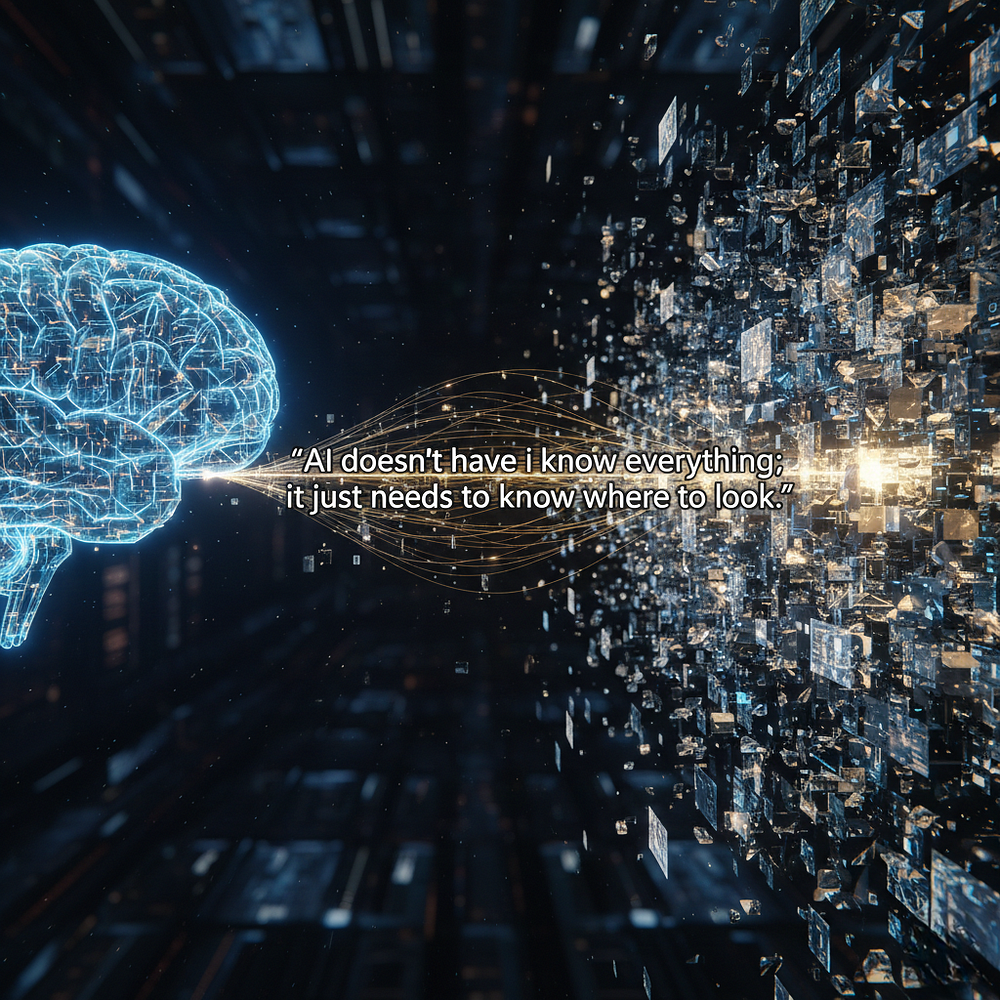
“AI doesn’t have to know everything; it just needs to know where to look.” — Anonymous AI Researcher
The Genesis of a Problem: LLMs and the Knowledge Gap
The foundational challenge with traditional LLMs lies in their training process. These models learn by ingesting gargantuan datasets of text and code. During this process, they develop a complex statistical understanding of language, patterns, and relationships. This understanding allows them to predict the next word in a sequence with astonishing accuracy. However, their knowledge is implicit. It is baked into the weights and biases of their neural network. When they “recall” information, they are not looking it up in a database; they are generating it based on the patterns they learned during training.
This implicit knowledge creates several hurdles:
- Factuality Issues (Hallucinations): Without an external source of truth, LLMs can sometimes confidently generate plausible but entirely false information. This is not malicious intent; it is a consequence of their generative nature. They are excellent at making things sound right, even if they are factually incorrect.
- Outdated Information: The training of an LLM is a massive undertaking, requiring immense computational resources and time. Consequently, their knowledge cutoff points can lag significantly behind current events. Asking a several month old LLM about the latest scientific breakthrough or political development will often yield outdated or blank responses.
- Lack of Explainability: When an LLM provides an answer, it is difficult to trace the source of that information. There is no bibliography, no footnote. This opacity makes it challenging to verify the accuracy of its output, especially in critical applications.
- Domain Specificity Limitations: While LLMs are generalists, they might struggle with highly specialized domains unless explicitly trained on a vast amount of domain specific data. This can be cost prohibitive and time consuming for every niche application.
These challenges highlight a fundamental truth: while LLMs are incredible at language generation, they are not always reliable knowledge bases on their own.
The RAG Paradigm: A New Way to Think About AI Knowledge
RAG addresses these limitations by augmenting the LLM’s generative capabilities with a robust retrieval mechanism. The core idea is simple yet profound: before an LLM generates a response, it first retrieves relevant information from an external knowledge base. This retrieved information then serves as a context for the LLM, guiding its generation and anchoring it to verifiable facts.
Let us break down the process into its key components:
1. The Query and the Retriever:
When a user poses a question or prompt, it first goes to the retriever component of the RAG system. The retriever’s job is to intelligently search a vast, up to date knowledge base and pull out documents or passages most relevant to the user’s query.
How does it do this? This is where embeddings come into play.
2. The Power of Embeddings:
Imagine every piece of information in your knowledge base, every paragraph, every sentence, being converted into a dense numerical vector. These vectors, called embeddings, capture the semantic meaning of the text. Text with similar meanings will have vectors that are numerically “close” to each other in a multi dimensional space.
When a user’s query comes in, it is also converted into an embedding. The retriever then performs a vector similarity search. It looks for document embeddings in its knowledge base that are closest to the query embedding. This is incredibly efficient and powerful, allowing the system to quickly find semantically related information, even if the exact keywords are not present.
Let us look at a simplified conceptual code snippet for generating an embedding:
from sentence_transformers import SentenceTransformer

# Load a pre-trained embedding model
# This model converts text into numerical vectors
model = SentenceTransformer('all-MiniLM-L6-v2')
# Example text
text_corpus = [
    "The quick brown fox jumps over the lazy dog.",
    "A speedy reddish brown canine leaps over a lethargic hound.",
    "Artificial intelligence is transforming industries.",
    "The cat sat on the mat."
]
# Generate embeddings for the corpus
embeddings = model.encode(text_corpus)
# Now, generate an embedding for a query
query = "Tell me about animals jumping."
query_embedding = model.encode(query)
print("Embedding for 'The quick brown fox jumps over the lazy dog.' (first 5 dimensions):")
print(embeddings[0][:5])
print("\nEmbedding for 'Tell me about animals jumping.' (first 5 dimensions):")
print(query_embedding[:5])
# In a real system, you would then compare query_embedding to all other embeddings
# to find the most similar ones.
This snippet illustrates how a model takes text and turns it into numbers. The proximity of these numbers in a high dimensional space represents their semantic similarity.
3. The Intrusion Method: Injecting Context:
Once the retriever has identified the most relevant chunks of information, these pieces are then “intruded” into the LLM’s prompt. This is not simply dumping raw text. The retrieved information is carefully formatted and presented as context, usually prefixed with instructions like “Here is some relevant information…” or “Based on the following documents…”
The LLM then receives this enriched prompt, which now includes both the original query and the retrieved, factual context. With this additional information, the LLM is no longer guessing or relying solely on its internal, potentially outdated knowledge. It has fresh, pertinent data at its disposal.
# Assuming 'retrieved_context' is a list of relevant text passages
retrieved_context = [
    "RAG systems enhance LLMs by providing external, up-to-date information.",
    "The core idea involves a retriever fetching relevant documents before generation.",
    "Embeddings are crucial for semantic similarity search in RAG."
]
user_query = "How does RAG improve LLM accuracy?"
# Constructing the augmented prompt
context_str = "\n".join([f"Document {i+1}: {doc}" for i, doc in enumerate(retrieved_context)])
augmented_prompt = f"""
Based on the following information:
{context_str}
Please answer the question: {user_query}
"""
print(augmented_prompt)
# In a full RAG system, this augmented_prompt would then be sent to the LLM for generation.
This augmented_prompt is then fed into the LLM. The LLM processes this information, synthesizes an answer, and generates a response that is not only coherent but also grounded in the provided facts.
4. The Generative Powerhouse (LLM):
With the relevant context in hand, the LLM can now perform its primary function: generation. However, this generation is now significantly improved:
- Accuracy Boost: The LLM is guided by factual information, dramatically reducing the likelihood of hallucinations. It can cite its sources implicitly by incorporating details from the retrieved documents.
- Currency: The knowledge base can be updated continuously, ensuring the LLM always has access to the most recent information.
- Domain Specificity: By swapping out the external knowledge base, the same RAG system can be adapted to highly specialized domains without retraining the entire LLM.
- Reduced Training Costs: Instead of retraining massive LLMs for every knowledge update, only the external knowledge base needs to be refreshed.
Advanced RAG Add-ons (The 2026 Toolkit)
The transition from “Naive RAG” to the sophisticated systems of 2026 involves several critical upgrades that solve early reliability issues.
- Hybrid Retrieval (Semantic + Lexical): While embeddings are great for meaning, they sometimes miss exact product codes or names. Hybrid systems combine vector search with keyword algorithms like BM25 to ensure nothing slips through the cracks.
- Multi-Hop Reasoning: Standard RAG is often one-and-done. Multi-hop systems allow an agent to retrieve data, realize it needs more information to answer a complex question, and perform a second or third search based on its initial findings.
- Reranking Models: Just because a document is semantically similar doesn’t mean it’s useful. Advanced pipelines use a secondary “Reranker” model to score the retrieved results, ensuring only the most high-quality evidence reaches the LLM.
“Truth is not found in the volume of data, but in the precision of the filter.” — Dr. Elena Vance, AI Ethicist
The Two Sides: Pros and Cons of RAG
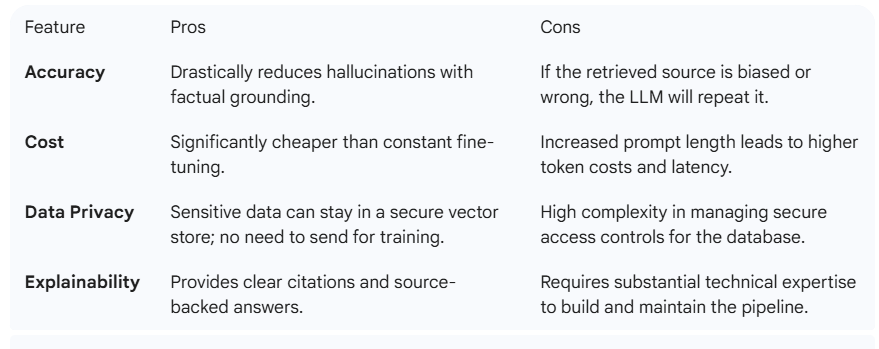
FeatureProsConsAccuracyDrastically reduces hallucinations with factual grounding.If the retrieved source is biased or wrong, the LLM will repeat it.CostSignificantly cheaper than constant fine-tuning.Increased prompt length leads to higher token costs and latency.Data PrivacySensitive data can stay in a secure vector store; no need to send for training.High complexity in managing secure access controls for the database.ExplainabilityProvides clear citations and source-backed answers.Requires substantial technical expertise to build and maintain the pipeline.
The Human Element: Why RAG Resonates with Our Quest for Truth
The beauty of RAG lies not just in its technical elegance, but in its resonance with how humans acquire and process information. When we are faced with a complex question, we do not just rely on our memory. We consult books, search the internet, ask experts. We retrieve relevant information, synthesize it, and then articulate our understanding. RAG mirrors this natural process.
Consider a doctor diagnosing a rare disease. They do not just pull an answer from thin air. They consult medical journals, patient records, and expert databases. They retrieve relevant information, combine it with their existing knowledge, and then formulate a diagnosis. RAG is empowering LLMs to adopt a similar, more responsible approach to information processing.
“I think of an out-of-the-box LLM as a med student… even the expert oncologist needs the patient’s chart and relevant academic literature. RAG is that open-book exam for AI.” — Douwe Kiela, CEO of Contextual AI
This ability to consult external sources also instills a greater sense of trust. When an LLM, powered by RAG, provides an answer, we can often infer that it has referenced verifiable information. This transparency, even if indirect, is crucial for widespread adoption and confidence in AI systems. The answers feel less like magic and more like well researched responses.
Real World Impact: Beyond the Hype
The implications of RAG are far reaching, touching various industries and applications:
- Customer Support: Imagine an AI chatbot that can not only understand customer queries but also retrieve the latest product manuals, troubleshooting guides, and policy documents to provide accurate, up to date solutions. This means faster resolution times and happier customers.
- Legal Research: Lawyers can use RAG powered systems to quickly sift through vast legal databases, find relevant case law, statutes, and legal precedents, significantly streamlining their research process. The system can then summarize findings and even draft initial legal documents, all backed by verified sources.
- Scientific Discovery: Researchers can leverage RAG to stay abreast of the latest scientific papers, extract critical data, and even identify gaps in current knowledge. An LLM could summarize complex research papers, linking back to original sources for verification.
- Personalized Education: Educational platforms can use RAG to provide students with personalized learning materials, explanations, and answers to their questions, always pulling from the most current and relevant curriculum. This allows for dynamic learning experiences tailored to individual needs.
- Enterprise Knowledge Management: Companies possess immense internal knowledge spread across countless documents, emails, and databases. RAG systems can act as an intelligent layer over this enterprise data, allowing employees to quickly find precise answers to internal policy questions, project details, or historical data.
“Frankenstein’s monsters are coupled together and can walk, but they don’t really have a ‘soul’ until they are grounded in truth.” — Douwe Kiela
The keyword idea “RAG in Enterprise AI” could have significant future search potential. As businesses increasingly integrate AI, the need for reliable, domain specific, and up to date LLMs will only grow. This concept, combining the technical innovation of RAG with its practical business application, is ripe for long form content that provides both insight and actionable value.
The Road Ahead: Evolving RAG and the Future of AI
RAG is not a static solution; it is a continuously evolving field. Researchers are exploring various enhancements:
- Hybrid Retrieval: Combining traditional keyword based search with semantic vector search for even more robust retrieval.
- Multi Hop Reasoning: Allowing the retriever to perform multiple searches and synthesize information from different sources to answer complex, multi stage questions.
- Adaptive Retrieval: Dynamically adjusting the retrieval strategy based on the nature of the query and the confidence of the initial retrieved results.
- Generative Retrieval: Instead of just finding existing documents, imagine a retriever that can generate new, highly specific documents to answer a query if no perfect match exists, still grounding itself in broader factual understanding.
The journey of RAG illustrates a critical lesson in AI development: the most powerful systems are often those that leverage the strengths of different approaches. LLMs are extraordinary at generating coherent text, but they benefit immensely from external knowledge. Retrieval systems excel at finding precise information, but they lack the generative power of LLMs. RAG brings these two worlds together, creating a symbiotic relationship that pushes the boundaries of what AI can achieve.
The future of LLMs is not just about bigger models or more training data. It is about smarter integration, more responsible knowledge handling, and a deeper understanding of how AI can truly augment human intelligence. RAG is a pivotal step in this direction, quietly but profoundly reshaping the landscape of artificial intelligence, one accurate, well sourced answer at a time. It is moving us closer to an AI that is not just fluent, but truly informed.