The Ghost in the Rental: Why Biological Immortality Will Break Our Hearts
The room smelled of ozone and sterile linen… the kind of scent that clings to the back of your throat and refuses to leave. I sat across from a man who looked twenty five but spoke with the weary cadence of someone who had seen the turn of the century. He was on his third body. The first had succumbed to a failing heart at eighty. The second was a custom-grown clone that lasted forty years until a mountain climbing accident. Now… he sat in a synthetic ‘sleeve’ that felt more like a high end appliance than a human being. This is not science fiction anymore. As we stand in 2026, the conversation has shifted from if we can live forever to whether we should.
The Heavy Price of a New Lease on Life
We have spent millennia viewing death as the ultimate period at the end of a long sentence. It provided a rhythm to our existence. It gave us a deadline that forced us to create… to love… and to say the things that mattered. But the rise of biological immortality ethics has turned that period into a comma. When we talk about longevity today… we are not just talking about eating more kale or taking Metformin. We are talking about the systematic replacement of the self.
Biological immortality is a term that sounds shimmering and hopeful. It suggests a world where a mother never has to say goodbye to her child… where wisdom is never buried in the earth. Yet the reality of consciousness transfer is far messier. If you move your memories and your ‘spark’ into a cloned version of yourself… do you actually survive?
Consider the “Ship of Theseus” paradox applied to the human soul. If we replace every plank of a ship… is it still the same ship? If we port your neural map into a fresh organic vessel… is it you… or is it a very convincing actor playing your part while the original version of you vanished into the dark during the transition? The psychological weight of this question is driving the first generation of ‘transferred’ individuals into deep existential crises. They look in the mirror and see a face that is theirs… but the eyes feel like they belong to a stranger.
Use Case: The “Legacy Pilot” and Corporate Continuity
In the high-stakes world of 2026 global finance… “Corporate Continuity” has become the primary driver for body-swapping technology. Imagine a CEO whose vision is worth billions. When their natural body begins to fail… the board of directors does not look for a successor… they look for a new vessel.
The “Legacy Pilot” program is a real-world application where executives undergo incremental neural mapping from age fifty. By the time they reach eighty… a biological clone is ready. The transfer is not a single “upload”… but a slow… years-long synchronization where the digital and biological minds merge.
- The Benefit: Unprecedented stability for global markets. Knowledge is never lost.
- The Reality: The individual becomes a slave to their own legacy. They can never retire because the technology makes retirement “irresponsible” to the shareholders.
The Architecture of the Body Swap
Technologically… we are closer than we have ever been. Neural mapping has reached a resolution where we can track the synaptic fire of a single thought. We can grow organs in vats. We can even suppress the immune system of a clone so it accepts a foreign consciousness without ‘rejection syndrome.’ But the practical examples of this tech reveal a terrifying divide.
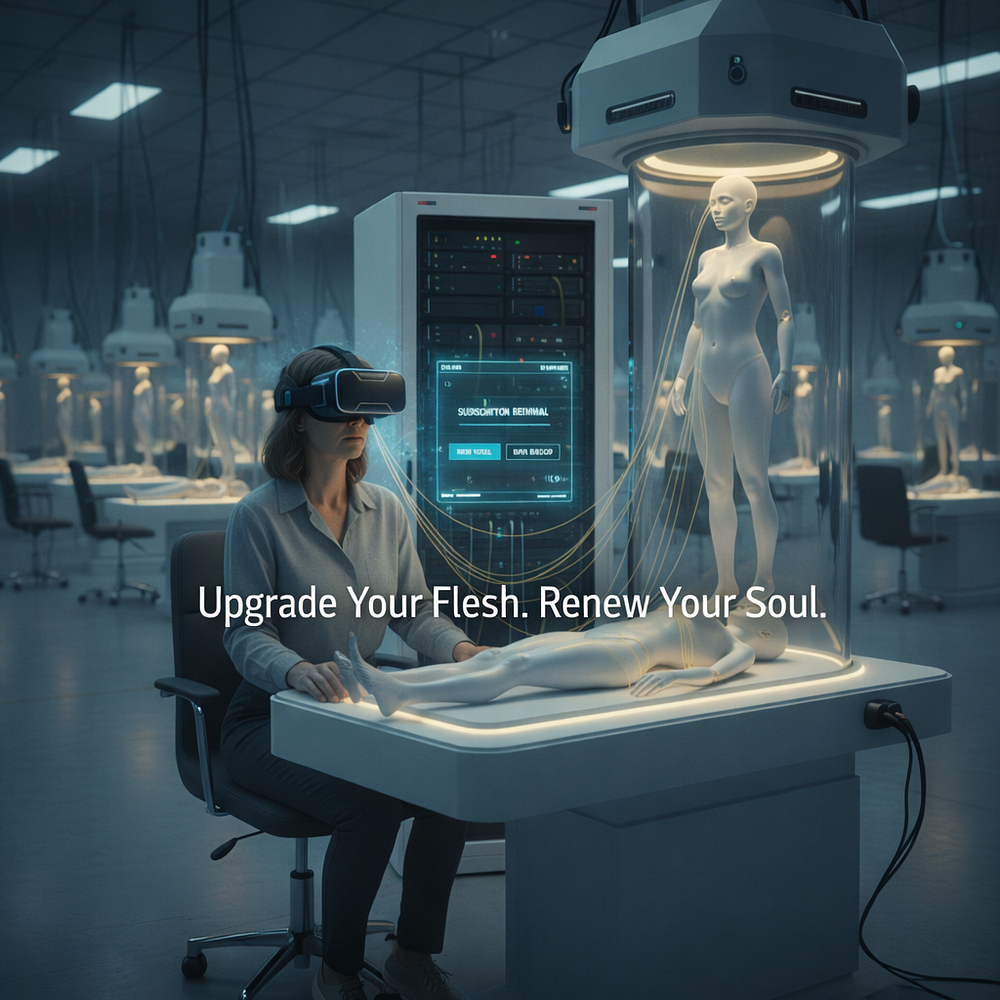
Imagine a world where your physical form is a subscription service. You rent a youthful body for a decade… and when the lease is up or the maintenance becomes too high… you port your data to a newer model. This creates a psychological fracture. The people I have interviewed who have undergone early-stage neural preservation report a strange ‘detachment’ from their hands… a feeling that their skin is just a well-fitted glove. They lose the visceral connection to their biological history.
One subject… a former athlete who transitioned into a synthetic-organic hybrid body… told me he misses the way his original knees used to ache. That ache was a reminder of the marathon he ran in his twenties. It was a physical map of his achievements. In his new… perfect body… he feels like he is living in a hotel room. It is clean… it is functional… but it has no soul.
The Wealth Gap of the Soul
If living forever becomes a product… then death becomes a mark of poverty. This is the most pressing ethical concern of our era. We are looking at a future where the elite can iterate through centuries… accumulating wealth and power that never resets… while the rest of the world remains bound by the natural laws of decay.
How does a society function when the CEO of a company has been in power for one hundred and fifty years? There is no room for new ideas… no space for the next generation to breathe. The natural cycle of ‘out with the old’ is broken. We risk becoming a stagnant species… trapped in the preferences and prejudices of the immortals who can afford the transfer fees.
In the 2026 landscape… we see the emergence of ‘Legacy Dynasties.’ These are families where the patriarch or matriarch never truly dies. They simply cycle through bodies… maintaining control of their assets and influence. This creates a permanent upper class that is not just economically superior… but biologically superior. The ‘under-dwellers’… those who cannot afford the rejuvenation… are left to face the traditional ravages of time. It is a new form of feudalism… where the lords are literally immortal.
The Loneliness of the Long Run
There is a specific kind of grief that comes with radical life extension. I call it the ‘Witness Burden.’ When you choose to bypass the natural end… you often find yourself standing on a shore while everyone you love drifts out to sea. Even with cloning technology… the people around you may not share your desire to linger.
I met a woman in Zurich who had undergone experimental telomere restoration. She was physically thirty… but chronologically ninety two. She described the horror of watching her great-grandchildren grow old and frail while she remained frozen in a porcelain youth. She was a ghost haunting her own lineage… a person out of time.
She told me about her husband… who had refused the treatment on religious grounds. She watched him wither. She held his hand as he took his last breath… and then she walked out of the hospital into a body that felt like a betrayal of their shared history. “We were supposed to go together,” she whispered. Now… she is condemned to centuries of remembering a man whose face she will eventually forget the feel of… because her new fingers never touched his skin.
The Practical Reality of Cloning Ethics
We must ask ourselves what a clone actually is. In the current legal framework… a clone is a biological entity with the same rights as any human. But in the ‘body swapping’ industry… clones are often treated as ‘blank slates’ or vessels. There is a dark corner of the market where consciousness-suppressed clones are grown specifically for harvest or inhabitation.
This reduces the human form to hardware. If we begin to see the body as something that can be discarded… we lose the sacredness of the physical experience. Every scar on your current body tells a story. The way your knees ache when it rains or the specific way your eyes crinkle when you laugh… these are not bugs in the system. They are the system.
The legal battles of 2026 are focused on ‘Vessel Rights.’ If a clone is grown without a functioning neo-cortex… is it a person? The industry says no. They call them ‘Biologics.’ But activists argue that any human organism has the potential for sentience… and that growing a body just to inhabit it is a form of high-tech slavery. We are playing with the building blocks of life… and we are doing it with the grace of a toddler playing with a loaded gun.
Pros: The Tantalizing Promise of the Infinite
It is easy to paint this technology as purely villainous… but the benefits are undeniable. Imagine a world where we no longer lose our greatest minds to the fragility of the brain.
- Scientific Acceleration: A physicist can spend three hundred years working on a single unified theory… without the interruption of cognitive decline.
- Interstellar Exploration: We cannot reach the stars in eighty years. But we can reach them if we can “pause” a consciousness or transfer it into a body designed for deep-space radiation.
- The End of Grief: For parents who lose a child… the ability to bridge that gap (even if ethically murky) offers a psychological lifeline that was previously unimaginable.
Cons: The Erosion of the Human Essence
The trade-off is the “Flattening” of emotion. Human memory is not a video recording… it is an emotional reconstruct. In the process of transfer… we often lose the “metadata” of our feelings.
- The Emotional Null: Transferred individuals often report a lack of empathy. Without the biological hormones and the specific gut-brain connection of their original form… they feel “mathematical.”
- The Stagnation Risk: If the same people run the world for five hundred years… innovation dies. We need the “death-rebirth” cycle of culture to stay vibrant.
- The Security Nightmare: If your soul is data… it can be hacked. It can be duplicated. It can be held for ransom. In 2026… “Identity Theft” takes on a literal… terrifying meaning.
The Memory Paradox: Storage vs. Experience
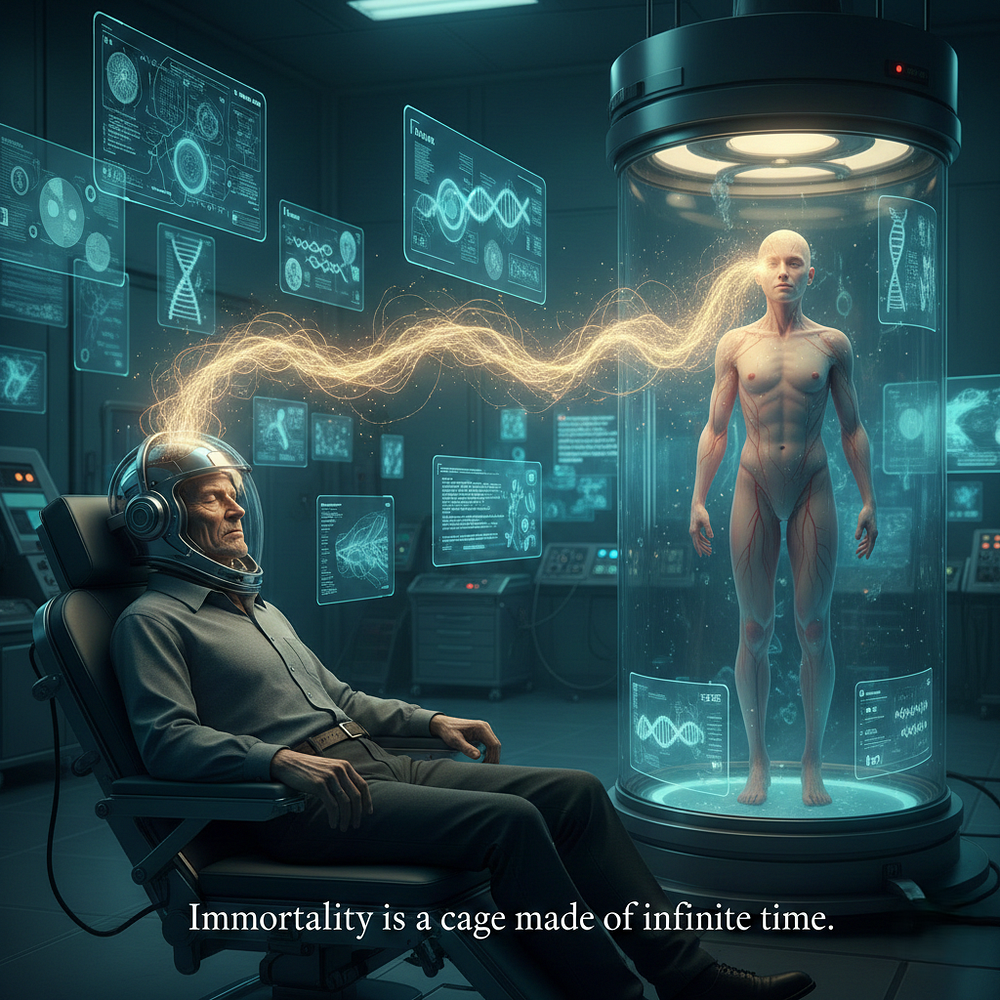
One of the greatest hurdles in consciousness transfer is the ‘Data Compression’ problem. Our brains do not store memories like a hard drive. We store them as a series of emotional resonances and biochemical states. When we ‘upload’ a mind… we are often just capturing the metadata of a life.
The early adopters of neural migration often complain of ‘flatness.’ They remember their wedding day… but they can no longer feel the heat of the sun on the back of their neck or the specific… fluttering anxiety in their stomach. The data is there… but the experience is gone. They become libraries of their own lives… rather than the authors of them.
This leads to a desperate search for ‘New Highs.’ If you cannot feel the subtle nuances of human emotion… you seek out extreme stimuli to feel anything at all. We are seeing a rise in ‘Sensory Hacking’… where immortal individuals use neural implants to artificially boost their pleasure centers. It is a hollow existence… a digital ghost trying to feel the warmth of a fire that isn’t there.
The Social Contract of the Post-Death Era
We need a new social contract. If we are going to allow radical life extension… we have to figure out how to manage the population and the distribution of resources. We cannot have a world of ten billion immortals.
Some have suggested ‘Term Limits on Life.’ The idea that you can have two hundred years… but then you must step aside to let someone else be born. It sounds logical on paper… but who is going to enforce it? Who is going to tell a man who looks twenty five and feels great that it is his time to die?
This leads us to the ‘Birth Lottery.’ In some jurisdictions… for every person who chooses immortality… one new birth is prohibited. We are literally trading the lives of the future for the comfort of the past. It is a staggering moral failure.
Impact on Future Society: The Two-Species Divide
By 2050… if this trend continues… we will not be one humanity. We will be two.
- The Chronos: Those who have achieved biological immortality through constant body-swapping and cellular maintenance. They are wealthy… ancient… and emotionally detached.
- The Naturals: Those who live… age… and die within the natural eighty-year span. They are the source of art… culture… and innovation… but they lack the accumulated power of the Chronos.
This divide will lead to a new type of civil unrest. The Naturals will see the Chronos as parasites who hog the planet’s resources forever… while the Chronos will see the Naturals as “temporary software” that isn’t worth investing in.
Finding the Middle Path
We do not have to choose between a painful death and a synthetic immortality. The value in every line of this debate lies in finding a way to extend health… not just duration. We should be focusing on ‘Compression of Morbidity’… the idea that we live a vibrant… healthy life until the very end… rather than stretching a faded existence over several centuries.
Practical longevity should be about quality. It should be about curing the diseases that rob us of our dignity… not about trying to outrun the universe. We are finite creatures… and there is a profound beauty in that finitude. It is the reason we write poetry… the reason we rush to tell someone we love them… and the reason we savor a sunset.
We should invest in cellular rejuvenation that keeps our original bodies healthy… rather than consciousness transfer that seeks to abandon them. We should celebrate the wisdom of the aged… while still making room for the fire of the young.
The Final Transfer
As we move deeper into 2026… the pressure to ‘upgrade’ will grow. The marketing will be slick. They will promise you a version of yourself that never tires and never fails. They will show you images of beautiful… ageless people living in pristine towers. But before you sign the contract for a new body… look in the mirror.
Look at the person who has traveled through every joy and every heartbreak in that specific skin. Look at the gray hairs that represent years of laughter and worry. These things are not flaws. They are the evidence of a life well lived.
The ghost in the machine is only as real as the life it has lived. If we abandon our biology for a digital or cloned perfection… we might find that we have achieved immortality… but lost the very thing that made us worth saving… our humanity. Death is not the enemy. The enemy is a life that is so afraid of ending that it forgets to begin.
I spent an evening recently with a man who had decided to decline the transfer. He was eighty six… and his body was failing. But as he spoke… his eyes were full of a light I hadn’t seen in the body-swappers. He told me he was ready. He had loved… he had lost… and he was satisfied. “The music is beautiful,” he said… “but it’s the silence at the end that makes the song.”
We are at a crossroads. We can choose to be the generation that conquered death… or we can be the generation that learned to live with grace. I know which one I would rather be. The rental body might be shiny… but the original… with all its cracks and leaks… is the only one that truly knows my name.
Epilogue: The Reality of 2026
To the reader in 2026… this technology is already in the clinics. It is being sold as a “luxury health procedure.” But as you read this… remember that you are more than your data. You are the sum of your struggles. If you take away the struggle… you take away the soul. Choose wisely before you trade your ghost for a rental.