You have probably trained a machine learning model before. You gathered data into a central location, cleaned it, fed it to your algorithm, and waited for convergence. It works. Billions of AI systems run this way right now.
However, a problem lies hidden within that process.
When you centralise data, you create a vulnerability. One massive database of everything. Hospitals are stacking patient records. Banks have a combined financial history. Tech companies are collecting user behaviour. GDPR exists partly because governments looked at centralised data and said We cannot do this anymore. Privacy disasters are built into the architecture.
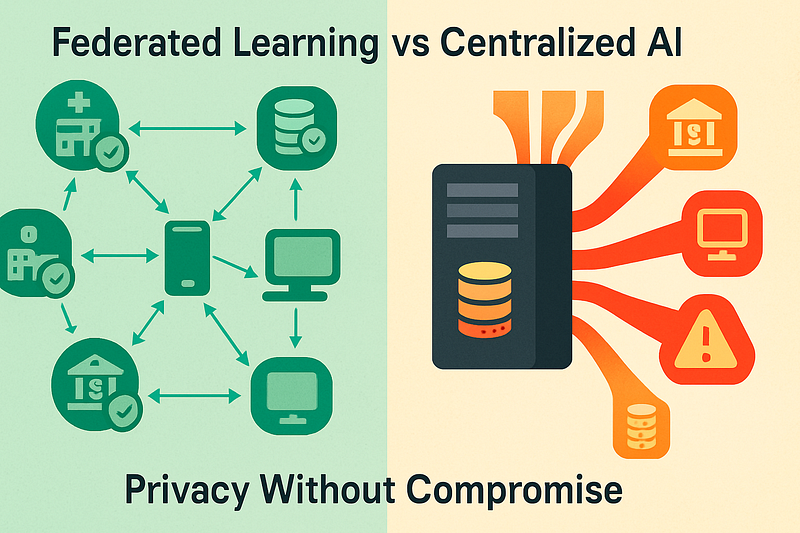
Then something interesting happened in 2025. Federated learning stopped being a research paper and became a production reality. And suddenly, organisations faced a choice they had never had before… do you want to train AI the old way, or do you want to train it without centralising sensitive data at all?
This is not a small shift. This is infrastructure changing how organisations think about machine learning from the ground up.
The Moment That Changed Everything
Imagine you are a hospital system. Your team discovered that 30 institutions globally can collaborate on cancer detection AI. Better training data. Better model. Better patient outcomes.
Problem: You cannot share patient records. HIPAA says no. GDPR says no. Ethics say no.
The traditional solution was to beg for permission, spend millions on legal compliance, and maybe — maybe — get it done.
Federated learning deleted that problem. The model comes to the data instead of the data going to the model.
Here is how it actually works. The central server trains a model, then sends it to Hospitals A, B, and C. Hospital A trains it on local patient data (data never leaves the hospital). Only the updated model weights go back to the server. Hospital B does the same. Hospital C does the same. The server merges all three updates into a better global model. That improved model gets sent back to each hospital. Repeat 20 times. Suddenly, you have a cancer detection AI that learned from tens of thousands of patient records… without anyone ever creating a centralised database. No data breach risk. No regulatory nightmare. No privacy violation.
This is happening right now. The Federated Tumour Segmentation initiative involves 30 institutions worldwide. They trained cancer detection models across patient data that legally could never be combined. COVID-19 researchers did something similar… 20+ hospitals collaborating on prediction models during the pandemic. It worked. Patients got better outcomes because of AI that technically never “saw” their data.
NVIDIA built an entire platform around this called FLARE, specifically for autonomous vehicle companies. They train driving models across different countries (Germany, Japan, the United States) without centralising any regional data. Different countries, different privacy laws, different regulations. Federated learning makes it work.
This is what production-grade privacy looks like.
Why Your Phone Already Does This
You have probably used federated learning without knowing it. Google uses it in Gboard (the keyboard app). Your next-word prediction is trained on your phone… not on Google’s servers. Billions of typing interactions train the model, and Google never sees any of your actual messages or words.
Think about what that means. Normally, text prediction requires sending what you type to central servers. Google would see every message, every password you mistype, every search query. Now… nothing leaves your phone. The model improves on the device. Only the mathematical changes (gradients) get sent back to improve the global model that all Gboard users share.
Your iPhone unlock uses the same approach for face recognition. Your fingerprint stays local. Only the model refinements sync to Apple’s servers. Your private biometric data never leaves your device… but your local model learns and improves from millions of global devices doing the same thing.
This is already the norm in consumer AI. It is just now spreading to healthcare, finance, and enterprise infrastructure.
The Market Is About to Explode
Right now, federated learning is worth around $155 million globally. By 2030, every analyst expects it to reach $300–400 million or more. That is 12–16% annual growth. Not “steady growth.” “We are building new infrastructure, and nobody knows it yet” growth.
The market shifted because of compliance. GDPR violations cost companies millions. HIPAA breaches destroy trust. China and Europe passed regulations requiring data localisation (data cannot leave the country). Suddenly, centralised AI is not just ethically questionable… it is illegal in major markets.
Federated learning makes it legal. Hospitals can collaborate. Banks can share intelligence. Countries can participate without violating data residency laws. Organisations can train better models without the regulatory risk.
Enterprise adoption is accelerating. In 2025, major pharmaceutical companies are using FL for drug discovery. Manufacturing plants are using it for predictive maintenance across factories without sharing proprietary data. Financial institutions are building fraud detection models across competitors without centralising sensitive information.
This is not bleeding-edge research anymore. This is operational infrastructure.
The Honest Problems (And How They Are Getting Solved)
Federated learning is not perfect. Three major challenges exist, and they are being solved.
Communication overhead is real. Sending model updates across networks costs bandwidth. Solution: compression algorithms are reducing communication overhead by 30–50%. Asynchronous training protocols let updates flow at different speeds.
Data heterogeneity matters. Hospital A might see more diabetic patients. Hospital B sees more cardiac patients. Different data distributions cause model drift. Solution: New optimisation algorithms (FedProx, SCAFFOLD) handle heterogeneous data better than traditional federated averaging.
Privacy is still evolving. Model weights can leak information through sophisticated attacks (membership inference). Solution: Differential privacy adds mathematical noise, making it statistically impossible to extract individual information. Secure aggregation combines updates using cryptography. Homomorphic encryption lets servers combine encrypted updates without decryption.
Real solutions exist for real problems. The field is moving from “this might work someday” to “this works, here is how to make it better.”
Why 2025 Is The Inflection Point
Three things happened simultaneously in 2025, and the combination changed everything.
First, frameworks became mature. NVIDIA FLARE, FedML, OpenFL, and IBM Federated Learning went from research projects to production systems. Developers could actually build with FL without inventing new infrastructure.
Second, enough real-world deployments succeeded that companies could point to outcomes. Better cancer detection. Faster drug discovery. Fraud prevented without privacy violations. Proof points matter. Companies stopped asking “will it work?” and started asking “when can we implement it?”
Third, regulations forced attention. GDPR penalties hit. HIPAA breaches made headlines. Data residency laws passed. Suddenly, federated learning was not a nice-to-have privacy improvement, it was an operational necessity for regulated industries.
That is the moment systems go from emerging to inevitable.
What This Means For Developers
Federated learning is creating entirely new engineering challenges. Not the math, the infrastructure. How do you orchestrate training across thousands of devices with intermittent connectivity? How do you debug distributed systems when data is private? How do you ensure models converge when data is heterogeneous?
These are new problems. Which means new jobs. FL engineers are in short supply. Salaries are 10–15% higher than standard machine learning roles because demand exceeds supply.
Early adopters of federated learning skills have massive career advantage. Five years from now, federated learning will be standard. ML engineers not understanding it will be like web developers not understanding HTTP today, weird.
The Privacy Revolution Is Here
Federated learning is not the future of AI. It is the present. Hospitals are training models on data they cannot legally centralise. Banks are collaborating on fraud detection across competitors.
NVIDIA is building entire platforms around it. Google is running it on billions of devices. Your keyboard is using it right now.
The infrastructure is in place. The frameworks work. The regulatory incentive is enormous. The market is growing 12–16% annually.
In 2–3 years, centralised AI will look as obsolete as building servers without load balancing. Privacy-preserving, decentralised learning will be table stakes.
And if you understand federated learning now… you are standing exactly where inflexion points happen.
That position is not given to you often.