The Quiet Machines That Keep the World From Overheating
I remember standing on a plant floor for the first time, staring at a long steel cylinder wrapped in insulation. The surface was warm to the touch, not hot enough to warn you, but warm enough to remind you that energy was moving inside. The air smelled of metal, oil, and time. Nothing about the machine asked for attention. There were no screens nearby and no blinking indicators. It simply existed, steady and indifferent.
Someone beside me said this machine keeps the whole system alive. At the time, I did not fully understand what that meant. Years later, when a similar exchanger failed during peak operation, I finally did. Production stopped. Temperatures climbed. Pressure alarms followed. What had been invisible became the centre of every conversation.
That machine was a heat exchanger. It did not shout. It did not impress. But every decision behind it shaped the fate of the system for decades.
Why Heat Exchangers Exist At All
Every system that does useful work produces heat. It is not a flaw in design or a sign of inefficiency. It is the unavoidable cost of converting energy into motion, computation, or chemical change. Engines burn fuel and release heat. Batteries resist current and warm internally. Servers process information and radiate heat continuously. Industrial reactions release energy whether we plan for it or not.
When heat is ignored, systems betray themselves slowly. Efficiency drops first. Energy consumption rises quietly. Materials age faster than predicted. Failures eventually appear, and when they do, they feel sudden and unfair. In reality, the damage has been accumulating for a long time.
Heat exchangers exist to bring order to this process. They give heat a controlled path to follow. They move thermal energy without contaminating fluids or destabilizing operation. When they work well, no one notices them. When they fail, everything stops.
Engineering Begins With Decisions, Not Equations
Many engineers believe design begins with calculations. In practice, it begins with choices. The numbers come later to justify or challenge those choices.
The first decision is intent. Are you optimizing for efficiency, capital cost, reliability, operational flexibility, or ease of maintenance. Every project claims to want all of them. Every project eventually learns that tradeoffs are unavoidable.
The second decision is uncertainty. Will operating conditions remain stable, or will loads change over time. Will future expansions push limits that do not exist today. How much deviation can the system tolerate before it becomes fragile.
Only after these questions are answered do equations become useful. Without them, calculations are precise but meaningless.
Heat Transfer Is Never a Single Phenomenon
Heat transfer is often taught as separate mechanisms, but in reality they act together at all times. Conduction moves heat through solid materials such as metal walls. Convection carries heat through the motion of fluids. Radiation transfers energy without contact, contributing quietly even when it feels insignificant.
Every heat exchanger depends on all three. The metal must conduct heat efficiently without failing. The fluids must flow in a way that encourages mixing without excessive resistance. Surfaces exchange radiant energy continuously.
Good design balances these mechanisms. Poor design forces one to compensate for weaknesses elsewhere, and that compensation always has a cost.
The Equation That Forces Honest Thinking
At the heart of heat exchanger design lies a deceptively simple relationship:
Formulae for the heat transfer : Q = U × A × ΔT
Here, Q is the rate of heat transfer. U is the overall heat transfer coefficient, representing how effectively heat moves through materials and fluids. A is the heat transfer area. ΔT is the temperature difference driving the process.
This equation does not provide comfort. It provides truth.
Increasing area increases size, weight, and cost. Increasing temperature difference may violate material limits or control requirements. Increasing U often requires higher flow velocity, which increases pressure drop and energy consumption.
Every improvement demands payment elsewhere. Design is the discipline of choosing which payment you can afford over the lifetime of the system.
Why Temperature Difference Deserves Respect
The temperature difference is not constant along a heat exchanger. Fluids enter at one temperature and leave at another. The driving force changes continuously as energy is exchanged. To account for this, engineers use the log mean temperature difference, which represents the true average driving force.
This concept exists to protect engineers from false confidence. Designs that ignore it often look elegant on paper and fail during commissioning. Designs that respect it behave predictably during startup, shutdown, and upset conditions.
Good decisions here prevent long nights later.
Flow Arrangement Is a Strategic Decision
Choosing how fluids flow relative to each other shapes performance more than many expect. In parallel flow arrangements, both fluids enter from the same end and move together. The initial temperature difference is high, but it decays rapidly. Control feels gentle, but efficiency suffers.
In counterflow arrangements, fluids move in opposite directions. The temperature difference remains effective along the entire length. Heat transfer improves, and outlet temperatures can cross intuitive expectations.
Counterflow designs often reduce equipment size and operating cost. But they demand careful control strategy. Choosing flow arrangement is not about preference. It is about understanding consequences.
Pressure Drop and the Cost That Never Goes Away
Heat transfer improves with turbulence. Pumps and fans pay for turbulence with energy. Increasing flow velocity increases pressure drop, and pressure drop translates directly into operating cost.
This cost never stops. It accumulates every hour the system runs.
Designers sometimes accept high pressure drop to reduce exchanger size. The capital cost looks better. The utility bill tells a different story over ten or twenty years. The best designs sit quietly in the middle, where heat transfer is sufficient and energy consumption remains reasonable.
Materials and the Reality of Time
Material selection defines how long a heat exchanger survives. Carbon steel handles pressure but corrodes. Stainless steel resists corrosion but raises cost. Copper transfers heat efficiently but reacts chemically in some environments. Aluminum saves weight but sacrifices strength.
Temperature cycling causes fatigue. Chemical exposure accelerates degradation. Vibration creates cracks where analysis predicted none. Material choice is not just technical. It reflects how an organization thinks about longevity and responsibility.
Fouling and the Slow Drift Toward Failure
As systems operate, deposits form. Minerals precipitate from water. Dirt accumulates from process fluids. Biological growth thrives where temperatures allow it. Fouling reduces heat transfer slowly and silently.
Operators compensate by increasing flow or temperature. Energy costs rise. Margins shrink. Designers include fouling factors not because they want inefficiency, but because experience demands humility. Maintenance begins during design, not during failure.
Decision Making in the Age of Artificial Intelligence
Modern thermal systems are no longer static. Data centers shift loads minute by minute. Electric vehicles experience rapid thermal cycling. Smart factories reconfigure production continuously. Heat exchangers now operate in environments that change faster than human intuition.
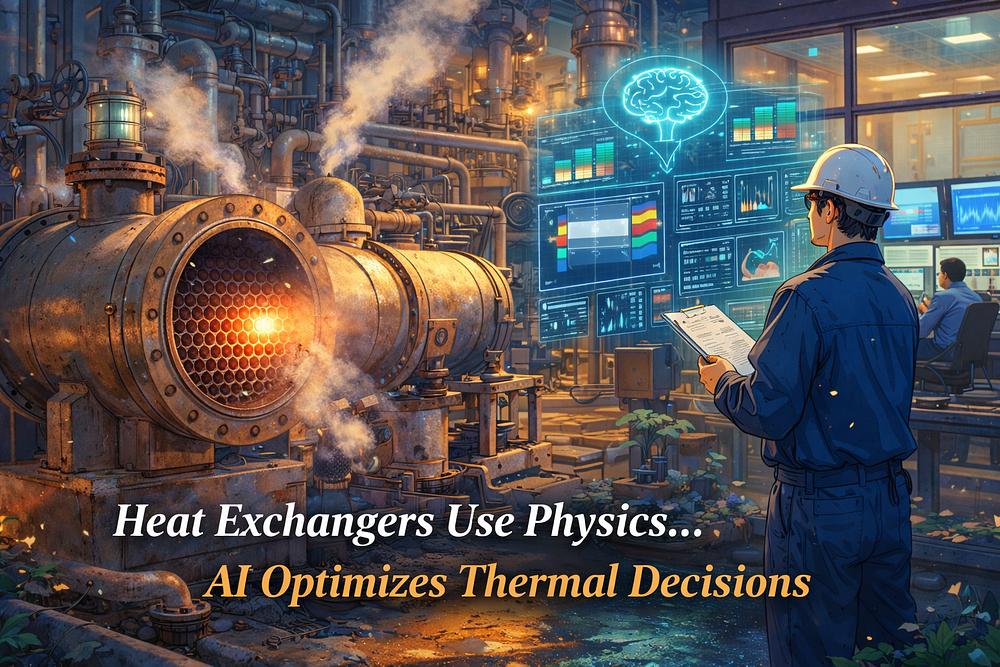
Artificial intelligence has begun to influence both design and operation. Machine learning models analyze sensor data to detect early signs of fouling before performance drops. Predictive models estimate remaining thermal margin under changing conditions. Digital twins simulate thousands of operating scenarios, allowing engineers to test decisions virtually.
AI driven control systems adjust flow rates and temperatures in real time, balancing efficiency, wear, and reliability. In data centers, this can reduce cooling energy dramatically. In electric vehicles, it extends battery life while protecting safety.
AI does not replace fundamentals. It amplifies them. Without understanding equations, flow behavior, and material limits, intelligent optimization becomes confident guesswork.
How AI Improves Heat Transfer Decisions
AI helps where human intuition struggles. It recognizes patterns across massive datasets. It predicts fouling trends based on subtle temperature changes. It recommends cleaning schedules before efficiency collapses. It evaluates tradeoffs continuously instead of periodically.
But AI depends on good design. Poorly placed sensors produce misleading data. Weak assumptions produce confident but wrong recommendations. AI rewards engineers who understand physics and punishes those who outsource thinking.
Designing for the People Who Will Live With It
A heat exchanger that performs perfectly but cannot be cleaned is a liability. Tube spacing, access covers, removable bundles, and isolation valves feel unimportant during early design reviews. They become critical during outages.
Designing for maintainability is a decision rooted in empathy. It assumes someone else will face pressure, time constraints, and safety risks years later. Good engineers design for people they will never meet.
The Quiet Discipline That Shapes the Future
As systems grow more powerful, heat becomes the dominant constraint. Electric vehicles, data centers, hydrogen infrastructure, and aerospace platforms all rise or fall on thermal discipline.
The engineers who shape the future will not be those who chase complexity. They will be those who make calm, grounded decisions under uncertainty. They will understand heat transfer deeply and use AI as a tool, not a crutch.
A senior engineer once told that heat exchangers are agreements between physics and patience. Decision making is the language of that agreement. When you learn to speak it well, you do more than move heat. You design stability, trust, and quiet resilience in a world that keeps getting hotter…