Last week my mother called me to say the lights in her flat “just knew” she had walked in and switched on by itself. She was only half joking when she asked if the house was watching her. I laughed it off on the phone, but later that night I realized I do the exact same thing every single day and never once stopped to think about it. My phone quietly reorders my most used apps depending on the time of day. My email sorts itself before I even open the inbox. My smartwatch tells me to sleep earlier than I planned, and honestly, it’s usually right.
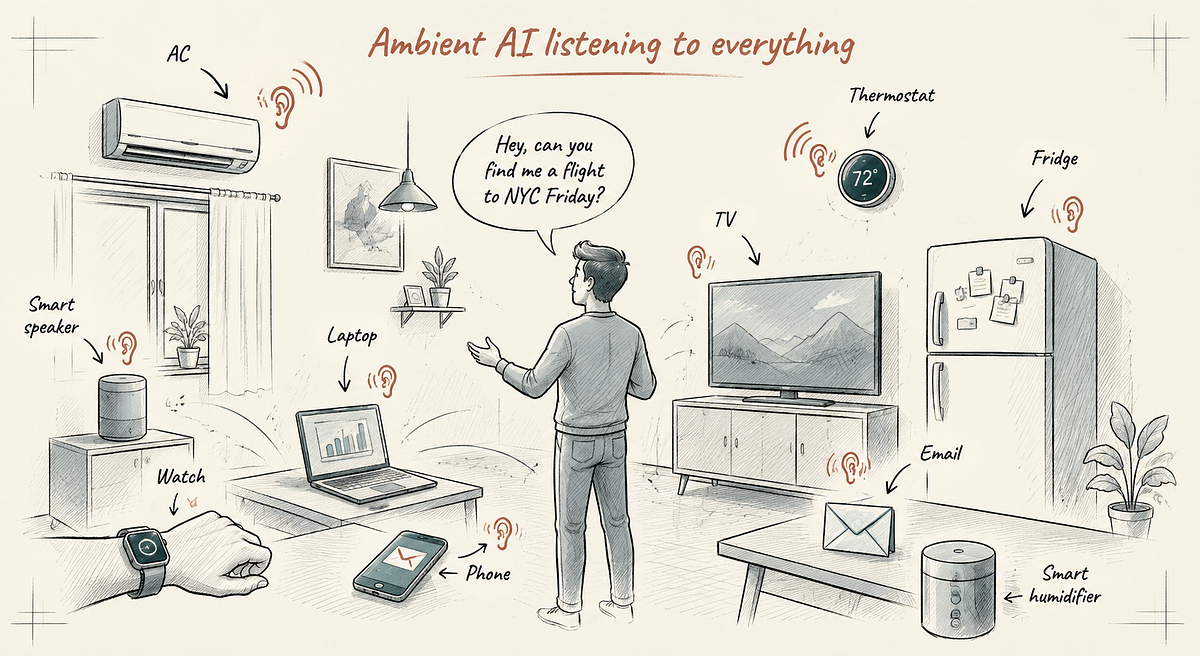
That’s the thing about ambient AI. It doesn’t announce itself. There’s no popup saying “hey, I just made a decision for you.” It just sits there, in the background, watching patterns, and acting. And because it never interrupts us the way a chatbot or an app notification does, we’ve stopped treating it like AI at all. We just call it “the phone being smart” or “the house being modern.”
What Ambient AI Means (In Plain Words)
Forget the fancy definitions for a second. Ambient AI is basically technology that works without you asking it to. Zapier put out a piece just last week making the same basic point, that regular AI sits and waits for you to type a prompt, while ambient tools just keep running on their own and take action whenever something needs doing. That’s really the whole difference in one line. A chatbot needs you to type something. Ambient AI needs nothing. It’s already looking.
Compare that to how we used technology even five years back. You wanted music, you opened Spotify and picked a song. You wanted the AC on, you got up and pressed a button. Now? My AC in India basically knows the pattern of my day better than I do. It starts cooling the room ten minutes before I usually get home from work, based on nothing more than my phone’s location and past habits. I never told it to do this. It just… started doing it.
There’s also a more technical way researchers describe it, using sensors, motion detection, and biometric data fused together to build what’s called situational context. One explainer I read went into this, saying the whole point of contextual AI is figuring out the reason behind an action, not just the action itself, by looking at your surroundings, your old habits, and what’s happening right now, all mixed together. Sounds a bit much for a thermostat, I know. But that’s the tech running under the hood.
Where This Is Already Happening Around Us
Here’s where it gets interesting, because chances are you’re using at least three ambient AI systems today without calling them that.
Take your inbox. If you use Gmail or Outlook, you’ve probably noticed emails already sorted into “important” and “everything else” before you open the app. That’s ambient AI reading patterns of who you reply to fast and who you ignore. Zapier’s blog covered this too, pointing out that these inbox tools can summarize whole threads on their own, decide which mail matters more, and even draft or send replies for certain kinds of messages if you let them. I use something similar for client emails and honestly it saved me from missing two important messages last month that would’ve gone straight into the “later” pile otherwise.
Then there’s the meeting assistant thing, which has become almost normal at work now. You join a call, and somewhere in the background a tool like Fireflies or Otter is already transcribing, tagging action items, and in some setups even pushing notes straight into your CRM. Zapier described these tools as hooking into your calendar once and after that they just show up on their own for every call, write everything down, pull out the action items, and even send a follow up to everyone who attended. My manager uses this for every single sales call now. Nobody types notes anymore. It’s just there, doing the job, and half the team doesn’t even remember what taking manual notes felt like.
Healthcare is doing something similar but with higher stakes. Ambient scribes now sit in on doctor consultations and turn the conversation directly into clinical notes. One overview I found described these scribes as tools that just keep listening through the whole appointment and turn the back and forth talk into a proper medical record on their own. My cousin works at a hospital in Hyderabad and she told me doctors there have started trusting these tools more than typing notes themselves during a consultation, though she also said it still messes up medical terms sometimes and someone has to go back and correct it. So it’s not perfect. Nobody really talks about that part.
And then there’s the home stuff, which is probably the most visible to regular people. Lights, AC, music, all adjusting based on who walked in and what time it is. One tech blog described this exact scene, someone walking home after work and the house recognizing them, cooling itself to the right temperature and starting their usual playlist, with no switch or button ever touched. This used to sound like science fiction ten years back. Now it’s just Tuesday.
Why We’ve Become So Dependent, Almost Without Noticing
TBH, when I sat down to write this article I genuinely tried to go one full day without letting any ambient system make a decision for me. I lasted about four hours. My smartwatch buzzed to tell me to stand up, my phone auto brightened based on the room light, and my banking app flagged an unusual transaction before I even checked my statement. I didn’t ask for any of it.
The dependency isn’t really about laziness, though that’s part of it too. It’s more that these systems remove tiny decisions we didn’t realize were decisions in the first place. Should I check my email now or later? The AI already surfaced the important one. Should I dim the lights? Already done. Is this a normal spending pattern? Already flagged. Research and Markets put out a report saying the whole ambient computing industry is on track to touch around 85 billion dollars this year, growing at over 26 percent a year. That’s not a small niche trend anymore. That’s basically the whole tech industry quietly betting on invisible AI.
What worries me a little, and I say this as someone who genuinely likes using these tools, is how much trust we’re handing over without really thinking about it. A driver monitoring system that watches your face for tiredness is genuinely useful and probably saves lives. But it also means a camera is constantly reading your face while you drive, and most people signed up for that without reading a single line about what happens to that footage. Zapier flagged this too, saying straight up that being always on basically means these systems are watching you round the clock, and that brings up real questions about who gave consent and who’s actually in control. Nobody talks about this part at dinner parties, but maybe we should.
The Ordinary, Everyday Version of This
Let me give you the most basic example I can think of, because sometimes the small stuff explains this better than the big hospital or workplace examples.
My phone’s keyboard predicts what I’m about to type based on who I’m messaging. If I’m texting my mother it suggests different words than when I’m messaging a client. Nobody trained it on purpose. It just learned. My photo gallery already grouped pictures of my nephew into one album without me tagging a single photo. My food delivery app already knows I order biryani on Friday nights, and honestly the suggestion pops up right on time, every single Friday, like it’s reading my mind.
None of this feels like “using AI” in the way typing a prompt into ChatGPT feels like using AI. That’s kind of the whole point of ambient AI actually working well. The less you notice it, the better it’s doing its job. Which is a strange thing when you think about it, because usually we judge a tool by how visible and impressive it is. Ambient AI is judged by the opposite. The best version of it is the one you forget exists.
So where does that leave us? I don’t think the answer is to reject all of this and go back to manually adjusting every light switch, that would be a bit dramatic and honestly impractical at this point. But it’s worth pausing once in a while and actually noticing what’s making decisions around you. Check what your apps are quietly doing in the background. Look at what permissions your smart devices actually have. Not because ambient AI is bad, most of the time it genuinely makes life smoother, but because the moment technology stops asking for permission is exactly the moment we should start paying a little more attention, not less.
My mother’s lights are still switching on by themselves every evening in that flat. She’s stopped being surprised by it now. Give it a few more months and she probably won’t even mention it on our calls anymore. That’s ambient AI working exactly as intended, quietly becoming part of the furniture.