How the Nvidia RTX Spark chip is moving AI out of the cloud and straight to your laptop.
For forty years, the fundamental agreement between you and your personal computer has remained completely unchanged. You boot the machine, you look at an operating system, you double-click a self-contained icon, and you use a keyboard and mouse to force an isolated application to do your bidding. The computer is a passive workspace. It is a digital typewriter, a filing cabinet with a backlit screen, an incredibly fast calculator that waits for you to steer. You are the conductor, and the software programs are rigid, dumb instruments that only play when struck. The user interface remains an exercise in translation: you think of an abstract goal, break it down into the specific steps a piece of software requires, and click your way through menus until you get the output.
At Computex 2026 in Taipei, NVIDIA CEO Jensen Huang and Microsoft CEO Satya Nadella essentially set fire to that contract.
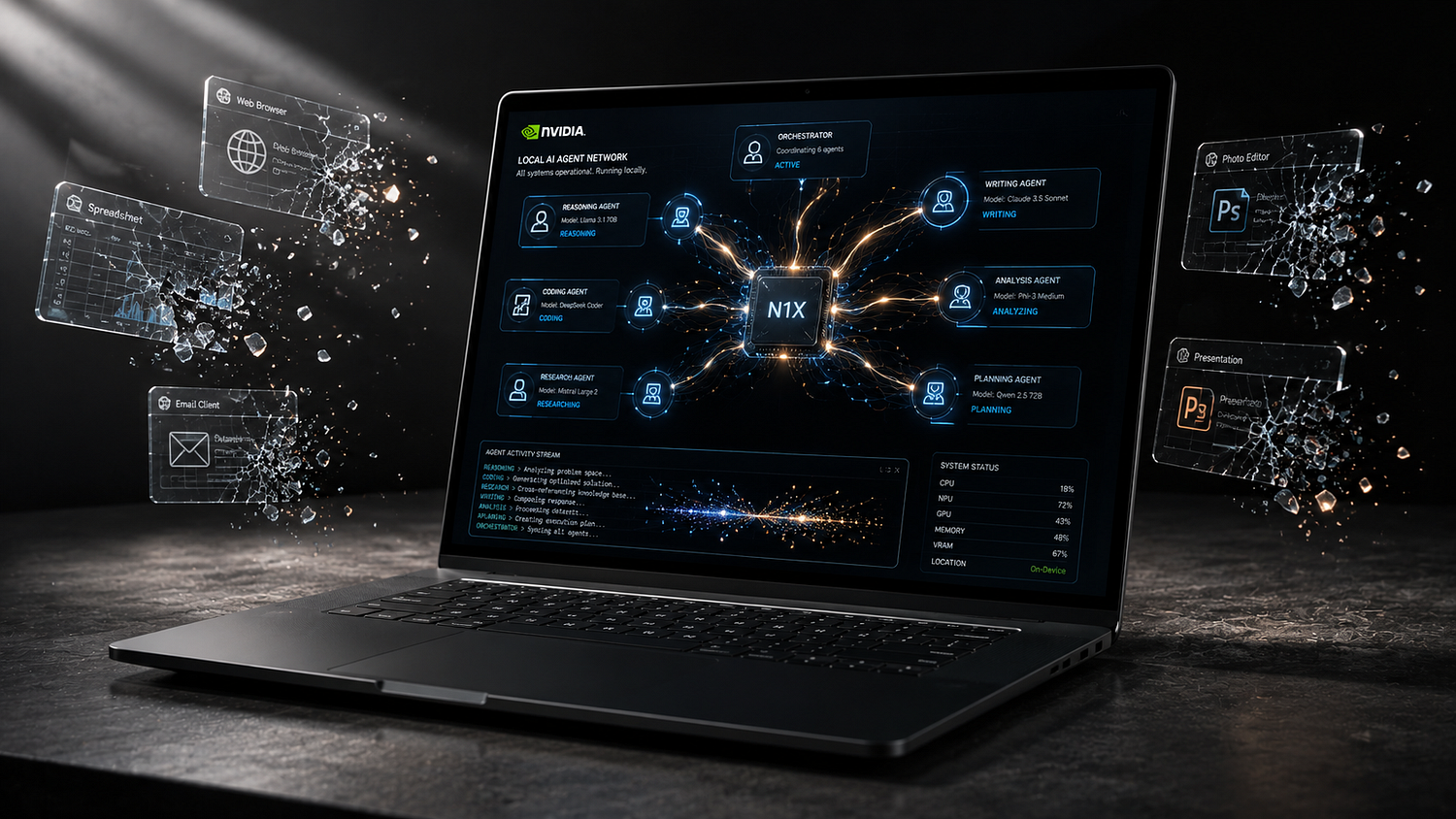
The unveiling of the NVIDIA RTX Spark superchip — developed in a quiet, multi-year alliance with MediaTek — alongside Microsoft’s flagship Surface Laptop Ultra isn’t just another incremental upgrade cycle. It isn’t another “AI PC” marketing campaign wrapped around a mediocre Neural Processing Unit that can barely blur your background on a video call or auto-transcribe a meeting. This is a violent architectural pivot. By combining an enterprise-grade Arm CPU, a massive Blackwell-generation graphics engine, and up to 128GB of high-bandwidth unified memory into a single consumer-grade platform, they are trying to strip the application layer out of the driver’s seat entirely.
The new goal is simple: your computer is no longer a tool. It is a teammate. You don’t launch apps; you instruct local agents that interpret intent, orchestrate deep file structures, manipulate local software tools, and execute workflows without ever asking a cloud server for permission.
But behind the high-gloss keynotes and the jaw-dropping promise of a local 1-petaflop workstation stuffed into an ultra-thin laptop chassis lies a massive structural gamble. NVIDIA is attempting to reshape the consumer silicon hierarchy into a GPU-first world, betting that developers will abandon x86 and standard Windows conventions to build for local CUDA environments. If they succeed, they will break the Intel, AMD, and Qualcomm chokehold on the premium PC market. If they fail, we are left with the most expensive, hyper-engineered paperweight in computing history.
The Silicon Lie of the “AI PC”
To understand why the RTX Spark matters, you have to look at why current “AI PCs” are fundamentally broken for actual developer, creator, and engineering workflows. For the last two years, the market has been flooded with chips boasting 40 to 50 Trillions of Operations Per Second of NPU performance. While that sounds impressive on a retail spec sheet, NPUs are highly specialized, rigid engines. They are great at running low-parameter, low-precision background tasks efficiently — like tracking your eyes during a call or running a basic local dictation tool — but they completely choke the moment you try to load a massive local large language model, compile a complex multi-layered codebase, or render a heavy 3D scene.
The NPU was a stopgap measure designed to save battery life on legacy operating system designs, not a foundational engine for autonomous computing.
NVIDIA’s approach with the RTX Spark bypasses the NPU bottleneck entirely by treating the GPU as the primary computational engine and scaling the surrounding architecture to match. The industry tried to treat AI as a secondary feature, a little coprocessor bolted onto the side of an old x86 processor layout. The RTX Spark flips that relationship on its head. The GPU is the core of the system; the CPU and the memory are just there to feed it data fast enough to keep the tensor cores saturated.
The RTX Spark is a consumer-facing translation of the data-center silicon architectures that made NVIDIA a multi-trillion-dollar company. It brings together an ultra-efficient Arm CPU architecture — heavily influenced by NVIDIA’s enterprise Grace designs — and fuses it directly with consumer-optimized Blackwell RTX graphics processing. MediaTek’s role here was critical: fine-tuning the system-on-chip integration, optimizing power management integrated circuits, and leveraging their advanced mobile silicon designs to ensure this massive processor could run within the strict thermal limits of thin notebooks and compact desktops without melting the chassis.
Instead of waiting for a central processor to hand off tasks to an isolated graphics card over a constrained PCIe lane, the components are tied together using a consumer optimization of NVIDIA’s NVLink-C2C chip-to-chip interconnect. This allows the 20-core Grace CPU and the Blackwell GPU — sporting an astonishing 6,144 CUDA cores — to talk to each other with almost zero latency and massive bi-directional bandwidth.
By using TSMC’s cutting-edge manufacturing processes, the RTX Spark achieves something that previously required an absolute desktop monster: 1 petaflop of AI compute on a single consumer platform. This isn’t just about raw speed; it’s about a fundamental shift in how instructions are processed. The chip features fifth-generation Tensor Cores engineered with native FP4 precision. This low-precision inference capability allows the system to compress and execute highly complex deep learning models at a fraction of the energy cost of older architectures, providing the raw physical muscle required to run autonomous systems locally without turning the laptop into a space heater.
The 128GB Unified Memory Trick: Killing VRAM Anxiety Forever
Ask any engineer who has tried to run frontier-class models locally on a standard Windows laptop what their biggest frustration is, and they will give you a one-word answer: VRAM.
Traditional PC architecture splits memory into two distinct sandboxes: system RAM for the CPU and dedicated Video RAM for the GPU. If you buy a high-end gaming laptop, you might get 32GB of system RAM but find yourself capped at 8GB or 12GB of VRAM. The moment you try to load a highly quantized 70-billion-parameter model, the system grinds to a screaming halt because the model weights cannot fit inside the GPU’s isolated memory pool. You are forced to offload layers back to the sluggish system RAM across a bottlenecked bus, destroying token generation speeds and rendering the local model effectively useless.
The RTX Spark completely obliterates this limitation by implementing a proprietary high-bandwidth unified memory interface that supports up to 128GB of ultra-high-speed LPDDR5X memory.
This isn’t a new concept — Apple has used unified memory architecture in its Silicon chips for years to dominate local AI development — but this is the first time the Windows ecosystem has a native, hyper-scaled equivalent paired with full CUDA support. In an RTX Spark system, there are no artificial walls. The CPU and the Blackwell GPU share a single, massive pool of high-speed memory. If you are writing code or running standard databases, the system allocates memory to your environment. If you suddenly launch a local agentic workflow that requires loading a 120-billion-parameter model with a massive context window, the system can instantly hand almost the entire 128GB pool directly to the GPU’s tensor cores.
The practical implications of this shift for creators and developers cannot be overstated. We are talking about the ability to render massive 90GB+ 3D scenes, edit uncompressed 12K video streams, and run complex multi-model agent systems simultaneously on a mobile machine. You no longer have to carefully calculate whether your model weights will spill over your graphics card’s limits. The unified memory architecture turns the laptop into a fluid, elastic canvas for local AI execution, fundamentally altering how software handles memory allocation.
The Cure for Token Anxiety: Dissecting the Surface Laptop Ultra
The absolute physical manifestation of this architectural shift is Microsoft’s newly announced Surface Laptop Ultra. Marketed aggressively toward what Microsoft calls “world makers” — the developers, data scientists, and creative professionals who have historically been forced to anchor themselves to noisy desktop rigs or burning cloud instances — the machine’s positioning leaves no room for ambiguity. It is built to bypass the cloud entirely.
Measuring exceptionally slim and weighing just around two kilograms, the Surface Laptop Ultra looks like a premium ultraportable on the outside, finished in a striking new dark matte tone called “Nightfall.” It features a stunning 15-inch mini-LED PixelSense Ultra touchscreen blasting out 2,000 nits of peak HDR brightness with a dense 262 PPI resolution. But the real magic is the custom thermal system hidden inside. Microsoft has deployed a heavy-duty dual-fan vapor chamber setup designed to keep the machine quiet and cool even when the Blackwell GPU is pulling maximum power during sustained local inference or heavy compiling tasks.
Microsoft’s positioning of the Surface Laptop Ultra reveals their broader strategic goal: they are selling this hardware as the ultimate cure for token anxiety.
For the past few years, building AI-powered applications or running heavy automated data pipelines meant paying continuous tax to cloud providers. Every API call, every token generated, and every experimental prompt iteration chipped away at a development budget. If an automated agent got stuck in a recursive loop in the cloud, you woke up to a catastrophic invoice from your cloud infrastructure provider.
By moving frontier-scale intelligence directly onto the device, the economic calculation changes completely. The Surface Laptop Ultra can execute 120-billion-parameter models entirely offline. You can feed an entire repository of sensitive enterprise code, a decade’s worth of financial ledgers, or hundreds of high-resolution design assets into your local agent without a single byte of data leaving your machine. The latency drops to near-zero because you aren’t waiting on a round-trip to a data center, and the privacy guarantees become absolute. You buy the silicon once, and your operational cost for running inference drops to the price of the electricity coming out of your wall.
The Strategic Panic: Why Intel, AMD, and Qualcomm are Sweating
To grasp the magnitude of what NVIDIA and Microsoft are pulling off here, you have to look at the competitive debris left in their wake. For decades, Intel and AMD have fought a brutal x86 war of attrition, incrementally nudging core counts, clock speeds, and thermal efficiency. Then Qualcomm disrupted the ecosystem with its Snapdragon X series, proving that Arm architecture could deliver incredible battery life and competitive performance on Windows.
The RTX Spark completely bypasses that entire battlefield. NVIDIA is not trying to sell a slightly faster laptop processor; they are introducing an entirely separate class of computer.
For Intel and AMD, the danger is existential. Their architectures are fundamentally built around a CPU-centric universe where the graphics card is an auxiliary helper. Even their latest processors with integrated graphics cannot compete with the sheer raw power of a Blackwell-derived GPU core mapped directly to massive unified memory. While Intel is scrambling to prepare its new Xe3P “Crescent Island” graphics architecture to combat this wave, they are fighting an uphill battle against thirty years of established developer loyalty to NVIDIA’s proprietary CUDA ecosystem.
Qualcomm, on the other hand, faces a different kind of threat. They proved that Windows on Arm was viable and forced Microsoft to optimize the operating system for efficiency, but their chips lack the heavy-duty graphical grunt and deep integration with AI development frameworks required by power users. NVIDIA and MediaTek have essentially taken Qualcomm’s core value proposition — ultra-efficient Arm processing with all-day battery life — and supercharged it with an elite tier of graphics and AI acceleration that Qualcomm simply cannot match right now.
By capturing the high-margin, premium enthusiast and developer segment, NVIDIA is effectively cornering the market of people who actually build the future of software, leaving its competitors to fight over mainstream corporate fleets.
The Software Catch: Windows OpenShell and Native Agent Frameworks
Of course, incredible hardware means absolutely nothing if the software environment is a nightmare to navigate. The historic Achilles’ heel of Windows on Arm has always been application compatibility and developer friction. Developers do not want to jump through hoops, manage unstable translation layers, or fight with broken dependencies just to get their environment up and running.
To solve this, Microsoft and NVIDIA are shipping a native Windows environment purpose-built for personal agents, anchored by a new system primitive called Windows OpenShell.
OpenShell is designed to act as a secure, hyper-isolated execution environment where local AI agents can interact directly with the operating system’s underlying APIs without compromising user security. Instead of an agent simply guessing screen coordinates or using fragile visual scraping to click buttons, OpenShell provides a structured, semantic interface. A local agent running on the RTX Spark can securely read your file systems, track your active application state, interact with local developer tools, and coordinate complex multi-step workflows natively. It works alongside tools like NVIDIA NemoClaw and the NVIDIA Agent Toolkit to establish strict privacy and security guardrails on top of autonomous systems.
Furthermore, industry giants are already rearchitecting their software to take advantage of this new hardware paradigm. Adobe has optimized Photoshop and Premiere for the RTX Spark architecture, promising massive leaps in both AI processing and graphical rendering speeds by utilizing the unified memory pipeline directly. Other critical industry applications — including Blender, DaVinci Resolve, Maxon Cinema4D, and MATLAB — run natively or leverage Microsoft’s upgraded Prism emulator to execute with near-native performance.
More importantly, because the platform brings full, native CUDA support to a slim Windows laptop for the first time, standard AI engineering tools work right out of the box. PyTorch, TensorRT, and local Ollama deployments map directly to the hardware without needing complex workarounds, making the transition painless for engineers switching from Unix-based setups.
The Verdict: Is This an iPhone Moment or a Highly Engineered Sandbox?
At COMPUTEX 2026, tech analysts immediately started comparing the “RTX Spark moment” to historic industry shifts like the launch of the original iPhone or the sudden explosion of consumer web browsers. It’s an easy comparison to make when you look at the raw specs and the sheer ambition behind the partnership. Shifting the computing paradigm from an app-centric world to an agent-centric world is a beautiful, compelling vision.
But let’s inject some serious candor into the hype cycle: this transition will not be seamless, and it will not happen overnight.
The success of the RTX Spark and devices like the Surface Laptop Ultra depends entirely on whether developers can build agents that are genuinely useful, reliable, and safe. If local agents turn out to be prone to hallucination, slow to respond, or easily confused by complex user environments, then all of this incredible, expensive hardware becomes overkill for tasks that a cheaper, standard laptop could handle. Furthermore, while pricing has not yet been officially announced for the fall rollouts from partners like ASUS, Dell, HP, Lenovo, and MSI, you can bet that a machine carrying a Blackwell GPU and 128GB of unified memory will demand a massive financial premium.
Yet, despite the inevitable early-adopter friction, it is impossible to ignore the sheer gravity of what NVIDIA and Microsoft have built here. They have systematically identified every major bottleneck facing local AI development — VRAM allocation walls, cloud token costs, data privacy liabilities, and NPU performance ceilings — and engineered a comprehensive, silicon-level answer.
The personal computer is officially being reinvented. The era of hitting a button, typing a command, and waiting for an app to load is drawing to a close. From here on out, the hardware is ready to act on intent rather than just instructions.