I run a 20B parameter model on my PC — AMD RX 9060 XT, 16GB VRAM. It works. Mostly. But after about an hour of continuous inference, the whole thing becomes a problem: the GPU fan sounds like it’s about to leave the case, the room gets warm, and my electricity meter is basically crying. I have a decent setup by home standards. And it still can’t handle this kind of load for long.
That got me thinking. If my one GPU struggles this much with one 20B model for one hour, what the hell is happening at the infrastructure level when millions of people send queries to Claude or GPT or Gemini every single day? I started digging, and honestly the numbers I found were hard to sit with.
This is not a doom post. But it’s also not going to pretend that none of this matters.
Your “Simple Query” Isn’t So Simple
Here’s how most people think about asking an AI something: you type, it responds, done. Like sending a WhatsApp message.
The reality is more like turning on a small factory for two seconds.
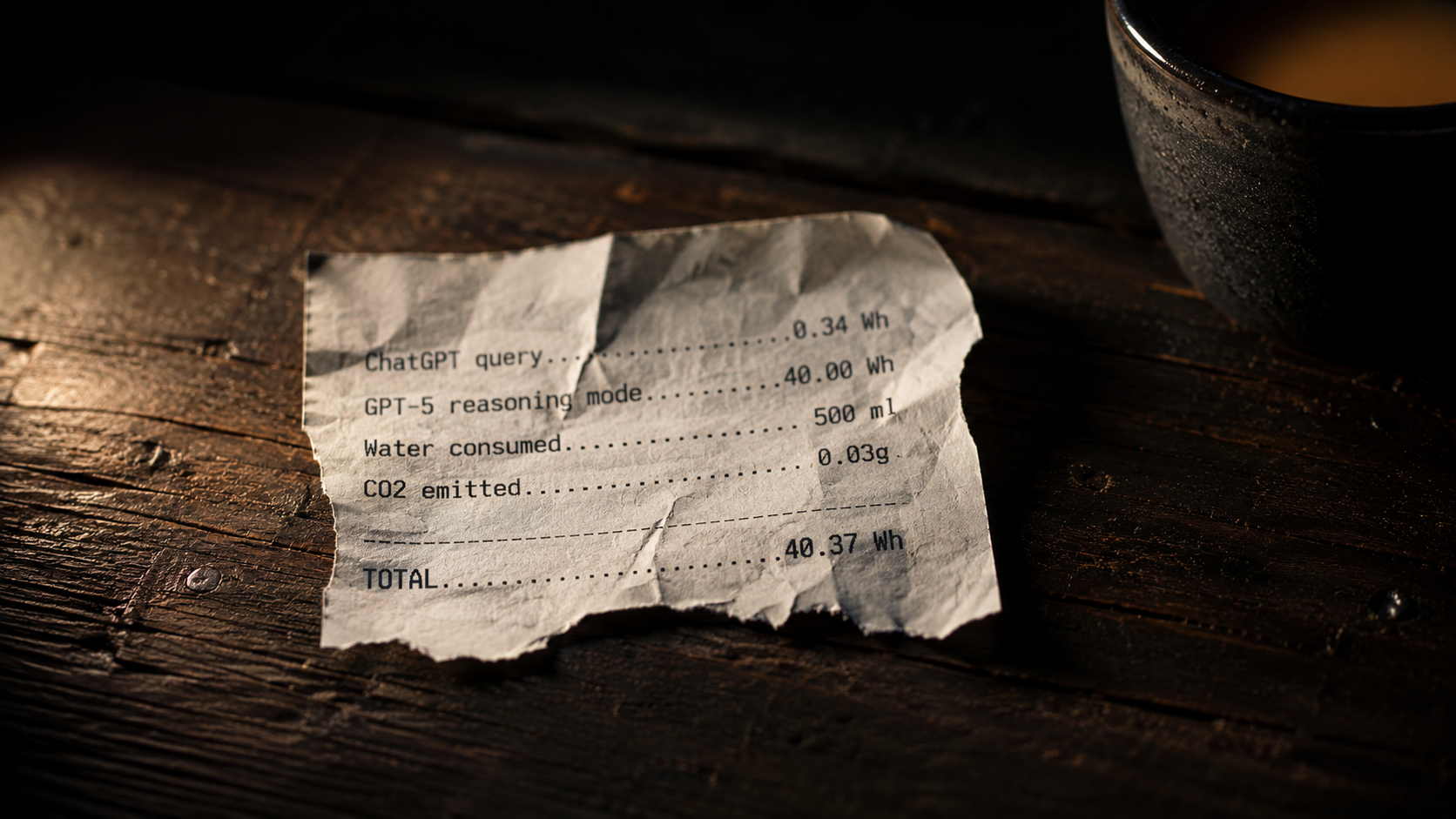
A standard ChatGPT query uses around 0.34 watt-hours of electricity, according to Sam Altman himself in a 2025 blog post. Compare that to a Google search, which uses about 0.0003 kWh — that’s roughly 0.3 watt-hours. So on the surface they seem almost the same now, right? Well, sort of. But that 0.34 Wh figure is for a simple, short text query on a current model with good hardware. Switch to GPT-5 in reasoning mode, and researchers at the University of Rhode Island’s AI lab estimated each query at around 18 watt-hours on average — and up to 40 Wh when it’s doing extended thinking. That’s 8.6 times more than GPT-4 used, according to their August 2025 analysis. Shaolei Ren at UC Riverside, who studies this stuff specifically, says that reasoning mode can push power draw five to ten times higher than a standard response.
And here’s the thing nobody talks about much: the models keep getting bigger and more capable, and people keep asking them harder questions. A 2026 IEA report says that video generation, reasoning, and agentic tasks can use hundreds to thousands of times more energy per query than basic text. Your “help me plan this trip with flights and hotels and restaurants and maps” is not a simple query anymore. It’s an agent running multiple tools in a loop.
I asked Claude to help me build a Python script last week. The conversation went back and forth for maybe 20 minutes. I didn’t think about power once. But it was burning through inference cycles the whole time.
The Data Center You Never See
When you send that query from your phone, it lands somewhere. That somewhere is a building the size of a mall, filled with racks of GPU clusters, running at temperatures that require constant cooling, connected to power lines that draw from the grid 24/7.
The IEA said global data center electricity consumption hit around 460–490 TWh in 2025. It’s expected to roughly double to 945 TWh by 2030. A January 2026 report from Bloom Energy said US data center energy demand alone could jump from 80 to 150 gigawatts between 2025 and 2028 — which, for scale, is like adding the entire electricity consumption of Spain in three years. Data centers already consumed somewhere between 4% and 7% of all US electricity in 2025.
And the AI portion of that is growing faster than everything else. AI-focused data center electricity use grew 50% in 2025 alone, per the IEA.
But electricity is not the only thing these buildings eat.
The Water Part — Which Almost Nobody Is Talking About
This one surprised me more than the electricity numbers. I genuinely did not connect AI with water consumption until I started reading about cooling systems.
Data centers get hot. Extremely hot. The GPUs and chips inside them generate heat continuously, and that heat has to go somewhere. The most common approach for large-scale facilities is evaporative cooling — basically, you use water to absorb the heat, and then that water evaporates into the air. It works well, and it’s cheaper than purely mechanical cooling. But it burns through enormous amounts of water.
Researchers at UC Riverside found that roughly every 5 to 50 prompts you send to ChatGPT, the system uses about 500 milliliters of water for cooling around one bottle. That number varies depending on the data center location and outside temperature, so it’s not a precise per-query figure. But scaled up: Google’s data centers alone consumed 27 billion liters of potable water in 2024. Their total company water consumption went from 24 billion liters in 2023 to 30 billion liters in 2024 — a 28% increase in one year.
Training GPT-3 in Microsoft’s US data centers directly evaporated an estimated 700,000 liters of clean freshwater. Just for training. One model. That was back in 2020-era infrastructure. Current models are much larger.
A February 2026 AGU Advances paper found that most of this water use is barely tracked or disclosed. Companies report different things in different ways, making it almost impossible to compare or verify. Amazon, as of that writing, doesn’t disclose how much water its data centers use in its sustainability reports at all.
There’s also a location problem. Many data centers are built in areas that are already dealing with water stress — parts of the US Southwest, parts of Europe. Indiana state officials were still investigating in June 2025 whether Amazon’s dewatering process for its Rainier AI data center campus (being built for Anthropic, among others) caused wells to dry up for local residents.
So Where Does All That Electricity Come From?
This is where it starts to feel complicated, because the answer is: all over the place, and not always from clean sources.
Google called its 2030 carbon-neutral goal a “moonshot” in early 2026. Microsoft said its carbon-negative goal is “a marathon, not a sprint.” Both are still trying, to be fair, but both have also admitted that the AI build-out has made it much harder to hit the targets they set before the AI boom.
Natural gas provides over 40% of electricity for US data centers right now. Renewables are around 24%. Coal is still about 15%. Nuclear is 15–20%.
The Homer City coal plant in Pennsylvania closed in 2023. It was one of the biggest coal plants in the state, and its closure was supposed to be a step forward. Then developers announced in 2025 that they’re turning it into the Homer City Energy Campus a massive AI data center complex powered by the largest natural gas plant in the country, planned to open in 2027.
So a retired coal plant is being replaced not by solar or wind, but by gas, to feed AI workloads. That’s where we are.
The tech industry’s response to the power problem has been nuclear. Microsoft signed a $16 billion deal to restart Three Mile Island — yes, that Three Mile Island — for 835 megawatts of power, targeting 2028. Google signed a deal with Kairos Power for a fleet of small modular reactors (SMRs) starting around 2030. Meta issued an RFP for 1 to 4 gigawatts of new nuclear capacity. The Palisades nuclear plant in Michigan, shut down in 2022, received $1.52 billion in federal loans to restart and was targeting an early 2026 restart date.
SMRs are genuinely interesting, and probably the right long-term move. But the optimistic estimates put commercial SMR deployment in the early 2030s. Between now and then, the gap gets filled with gas.
The Carbon Side
ScienceDirect published a paper in December 2025 that tried to estimate AI’s carbon footprint. Their finding: AI systems may have a carbon footprint equivalent to that of all of New York City in 2025. The range was 32.6 to 79.7 million metric tons of CO2. On top of that, AI could add 24 to 44 million more metric tons of CO2 annually by 2030 if current growth continues without major efficiency improvements.
And here’s something worth sitting with. Data center emissions now exceed those of the entire aviation industry. I did not believe that when I first read it, so I went and looked it up. It checks out.
The Agentic Problem — And Why It Gets Worse
Everything above assumes you’re sending individual text queries. But the direction the industry is moving toward is agentic AI — where you give an AI a task, and it runs for minutes or hours, making decisions, using tools, calling other systems, writing and executing code, browsing the web.
Claude Code, for example which Anthropic just released is a command-line tool that can take a whole coding task, break it down, and execute it step by step. That’s not one query. That’s dozens or hundreds of inference calls in sequence. A 2026 survey paper from arXiv on agentic AI energy use found that these systems are moving the bottleneck from raw computation to memory bandwidth and memory-intensive operations are extraordinarily power-hungry at the hardware level.
The IEA said it clearly: simple AI text queries replacing all conventional internet searches would use less than 4 TWh per year. But video generation, reasoning, and agentic tasks can use hundreds or thousands of times more energy per query. If agentic AI becomes the default way people interact with computers — and that seems to be where things are heading — the energy math changes completely.
Running It on Your Own Machine
My experience with the 9060 XT running a 20B model locally is actually a good mirror for all of this. The GPU pulls around 150–180W under heavy load. In an hour of continuous inference, that’s 150–180 watt-hours of electricity, plus the cooling load, plus whatever else the system is doing. For one user. One model. One hour.
A single data center AI cluster might be running hundreds of simultaneous sessions at that level or beyond, across thousands of GPUs, around the clock. The RX 9060 XT is a consumer card with a 130W TDP in most workloads honestly pretty efficient for what it does. The data centers are using H100s and H200s that draw 700W each, in clusters of thousands.
I couldn’t sustain my 20B model run because of heat and power draw at home. The same physics problem, just scaled up by about six orders of magnitude, is what the entire industry is wrestling with right now.
What’s Actually Being Done About It
The most honest answer is: not enough yet, but some things are happening.
Microsoft announced in 2025 that they developed a new data center design for AI workloads that uses zero water for cooling. That’s a real thing, using direct-to-chip liquid cooling instead of evaporative cooling. The problem is it costs more to build and isn’t everywhere yet.
A paper from researchers in France in October 2025 found that just using smaller, more efficient models where they’re sufficient — instead of always reaching for the biggest model — could reduce global AI energy consumption by 27.8%, saving 31.9 TWh per year. That’s the equivalent of five nuclear reactor outputs. The fix isn’t even new technology. It’s just model selection. Using Haiku instead of Opus when Haiku is enough. Using a smaller local model instead of a frontier API when the task doesn’t need it.
Model compression techniques like quantization can cut energy use by around 50% with minimal performance loss, according to a March 2026 ScienceDirect review. Knowledge distillation can deliver roughly 60% faster inference with about 40% fewer parameters while keeping 97% of baseline performance.
There’s also the IEA’s 2026 update finding that AI energy efficiency improved a lot in 2024–2025, so per-query costs have come down significantly even as total usage grew. The problem is Jevons Paradox — as things get cheaper and easier to use, people use them more. Total consumption keeps rising even when efficiency improves.
Google and Microsoft have both pledged to become water-positive by 2030, meaning they want to put back more water than they take. Whether they hit that goal in a world where their water use keeps growing is honestly unclear at this point.
What This Means, Practically
I’m not saying stop using AI. I use it constantly. But there are a few things worth being aware of.
When you use a reasoning model for a task that doesn’t need reasoning, you’re spending 5–10x more energy than the same query on a standard model. When you use a frontier model like GPT-5 or Claude Opus for something a smaller model could handle, the cost difference isn’t just your API bill — it’s real electricity and real water somewhere.
The current energy consumption trajectory for AI is not sustainable on its current path. Data centers consuming 4–7% of US electricity now, and potentially 10–12% by 2028, while also drawing billions of liters of water from regions that are increasingly dry — that’s a problem that compound over time. It doesn’t end catastrophically tomorrow. But it doesn’t fix itself either.
The good news, if there is good news here: efficiency is improving fast, nuclear is finally being taken seriously, and there’s genuine research effort going into green AI. The bad news is that efficiency gains keep getting eaten by usage growth, the nuclear plants everyone is counting on won’t be ready until the early 2030s, and right now gas and grid power with no guarantees about source is filling the gap.
My GPU runs hot for an hour and I have to stop. The data centers don’t get to stop.
That’s sort of the whole thing.