Something Quietly Broke in the Assembly Line
Picture a factory floor where robots build a thousand cars a day. Humans used to build twenty. The assembly line is faster now, more powerful, almost magical in its speed. But someone still needs to inspect every car before it drives off the lot. And if the inspection team did not grow at the same rate as the production floor? You ship defective cars. You just do not know it yet.
That is not a metaphor about manufacturing. That is the exact situation software engineering walked into when AI coding tools went mainstream.
Developers at companies like Uber, Salesforce, and Accenture began shipping code at speeds that felt genuinely surreal. One pull request a week became five a day. A codebase that once grew incrementally now expanded in great lurching waves. The code kept coming, fast and confident and in enormous volume, and somewhere deep in that flood, bugs started slipping through quietly… like carbon monoxide. Invisible until the damage was already done.
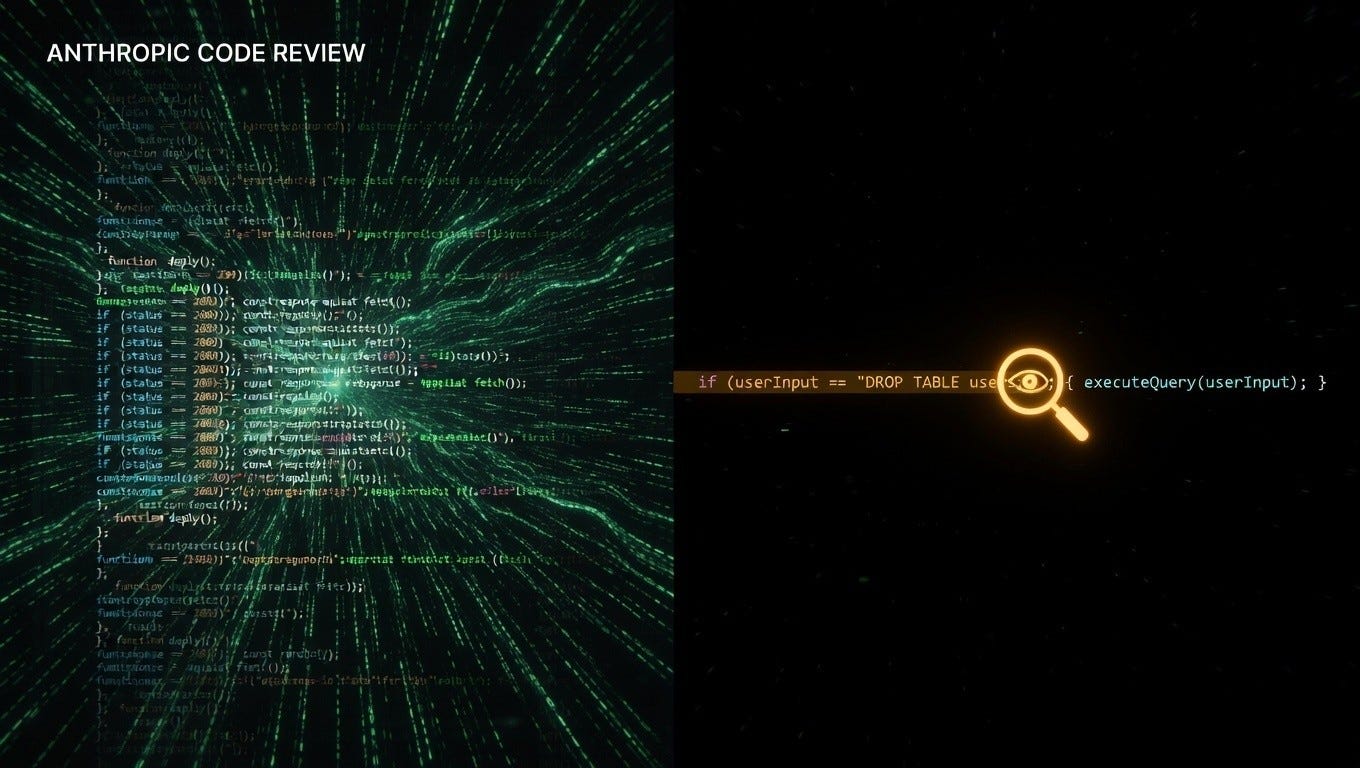
On March 9, 2026, Anthropic launched Code Review inside Claude Code. It is a multi-agent AI system built specifically to scrutinize every pull request before human eyes touch it. It is not a linter. It is not a spell-checker for code. It is something far more ambitious and, if the early data holds, far more consequential.
The Problem Has a Name, and That Name Is Vibe Coding
You have probably heard the phrase. Vibe coding sounds like something a startup founder coined in a WeWork after three espresso shots, and maybe it was. But the phenomenon it describes is real, documented, and reshaping how software gets built.
Vibe coding means telling an AI assistant what you want in plain language and watching it generate working code in seconds. Not pseudocode. Not a rough sketch. Actual, runnable, deployable code that passes tests and looks professionally written. The friction that used to exist between having an idea and having working software has largely collapsed.
The productivity numbers are staggering. Anthropic’s own engineers increased code output by roughly 200 percent year over year as Claude Code became central to their workflow. At that rate, a team that used to merge a hundred pull requests a month is now merging three hundred. The work is not harder. It is just vastly more voluminous.
But here is what the productivity metrics do not capture. Studies from Stanford University have shown developers using AI coding aids can introduce more security vulnerabilities while feeling more confident in their answers. Read that slowly. More confident. More vulnerable. The combination is not just risky. It is the specific profile of a disaster waiting to happen, because the developer who feels confident does not go looking for the bug. They ship.
Stack Overflow survey data indicates a strong majority of developers are now using or planning to use AI tools in their workflows. That translates directly into more code landing in pull request queues and more human bottlenecks in review. The humans did not get faster. The machines did. And the gap between how fast code gets written and how fast it gets reviewed has been widening for the better part of two years.
This is the problem Anthropic set out to solve.

What Code Review Actually Does, Under the Hood
When a developer opens a pull request on GitHub, something interesting happens. Code Review does not dispatch a single agent to read through the changes. The system dispatches multiple AI agents that operate in parallel. These agents independently search for bugs, then cross-verify each other’s findings to filter out false positives, and finally rank the remaining issues by severity and impact.
The architecture is worth understanding, because it is what separates Code Review from the category of tools it superficially resembles. Traditional static analysis tools, the kind that have existed for decades, work through pattern matching. They look for known bad patterns in code and flag them. They are fast, cheap, and generate enormous amounts of noise. Developers learn to ignore them.
Unlike traditional Static Analysis Security Testing tools that rely on rigid pattern matching, Claude Code operates as a stateful agent. It uses a specialized CLAUDE.md file, essentially a project manual for the AI, to understand project-specific conventions, data pipeline dependencies, and infrastructure quirks. This is not a tool reading your code in isolation. It is a system that learns the context of your project and then evaluates whether a given change makes sense within that broader context.
The output appears as a single overview comment on the pull request along with inline annotations for specific bugs. Reviews typically complete in about 20 minutes, and in demos the system can generate suggested fixes that Claude Code can implement on request.
The 20-minute figure deserves attention. That is not instant. But compare it to the realistic alternative in a stretched engineering organization. A senior engineer with three meetings in the afternoon and a production issue from the previous week sitting on their mental stack. A pull request that sits in the queue for two days before anyone looks at it seriously. Two days versus twenty minutes. For a team shipping multiple pull requests per developer per day, that compression changes how fast things move.
Anthropic’s latest internal benchmarks show the model can chain together an average of 21.2 independent tool calls, things like editing files, running terminal commands, and navigating directories, without needing human intervention. That represents a 116 percent increase in autonomy over the last six months. The model is not just looking at a single file in a pull request. It is reasoning across your entire repository.
The Numbers Anthropic Collected Internally
Anthropic did not launch Code Review as a theory. They ran it on their own codebase and collected real performance data before releasing it to the public. The results are specific enough to be credible and surprising enough to warrant serious attention.
Before deploying the agents, developers received substantive feedback on about 16 percent of pull requests. With Code Review active, substantive comments rose to 54 percent.
Sit with that for a moment. Before Code Review, more than eight out of ten pull requests at Anthropic, a company staffed with highly skilled and motivated engineers working on technology they clearly care about, were being merged without meaningful review feedback. Not because anyone was lazy. Because there is not enough time. Because code volume had outpaced human capacity. Because the flood was real, and 16 percent is what you get when humans are trying to inspect a thousand cars with the same number of eyes they used for twenty.
Find rates also scale with pull request size. Changesets over 1,000 lines showed findings 84 percent of the time, while small pull requests under 50 lines had findings 31 percent of the time. The system scales dynamically, applying deeper analysis to larger and more complex changes, which reflects a sensible prioritization of where review effort matters most.
Engineers internally disagreed with fewer than 1 percent of surfaced findings.
That last number is the one that matters most to skeptics. Every automated code analysis tool generates false positives. That is not a criticism, it is a mathematical reality of trying to identify bugs without executing code in all possible contexts. Tools that flag too many false positives get turned off. Developers learn to batch-dismiss the warnings without reading them. The tool becomes friction without value.
One percent disagreement is an extraordinarily low false-positive rate. It means the verification layer, where agents cross-check each other’s findings before surfacing them, is actually working. Developers are receiving real issues, not noise. That distinction is what makes the difference between a tool that gets used and a tool that gets disabled in the first sprint.

Two Bugs That Tell the Whole Story
Data is convincing. Stories are memorable. Anthropic shared two examples that make the abstract value of Code Review viscerally concrete.
In one case, a single-line tweak, the kind that would typically be rubber-stamped in a busy review queue, would have broken a service’s entire authentication mechanism. The agents flagged it as critical before merge.
One line. Authentication broken. That is the kind of incident that generates an emergency all-hands, a post-mortem document running forty pages, an on-call engineer who misses their kid’s recital, and a user-facing communication that the security team will nervously edit for hours. The IBM Cost of a Data Breach Report consistently places average breach costs above four million dollars. The cost of catching that bug, at the twenty-dollar midpoint of Code Review’s pricing, was twenty dollars.
The second story comes from the open-source world. TrueNAS, while refactoring ZFS encryption for its open-source middleware, found that Code Review spotted a bug in adjacent code that could cause a type mismatch to erase the encryption key cache during sync operations.
This is a more instructive example in some ways, because the bug was not in the code being changed. It was in adjacent code, disturbed by the refactor, that would have behaved differently in ways the author did not anticipate. Human reviewers would have focused on the refactored section. The agents reasoned across the repository and found the interaction. That is the difference between reading a change and understanding a system.
The Mozilla Firefox Pilot: 22 Vulnerabilities in Two Weeks
The TrueNAS example was compelling. The Firefox story is extraordinary.
In a recent pilot with Mozilla’s Firefox, Claude Opus 4.6 scanned the browser’s massive codebase and surfaced 22 vulnerabilities in just two weeks.
Firefox is one of the most scrutinized codebases in existence. It is open source, maintained by an experienced team, and has been the subject of professional security audits for decades. The idea that an AI system scanning it for two weeks would surface 22 previously unknown vulnerabilities is not just impressive. It raises a more uncomfortable question.
How many vulnerabilities are sitting right now in codebases that are less scrutinized than Firefox? How many in the internal tooling at mid-size companies that have never commissioned a professional audit? How many in the infrastructure that processes financial transactions, stores medical records, manages power distribution? We do not have a reliable answer to that question, and the absence of that answer is precisely the point.
Code Review is not just a productivity tool. It is an argument that the security posture of software in general is worse than we realize, and that the combination of AI code generation and AI code review might be the only mechanism that scales to address a problem that AI code generation helped create.
What It Costs and How to Think About the Price
Code Review is not free, and the pricing will be the first friction point many engineering leaders encounter.
At $15 to $25 per review, billed on token usage and scaling with pull request size, Code Review is substantially more expensive than alternatives. GitHub Copilot offers code review natively as part of its existing subscription. Startups like CodeRabbit operate at significantly lower price points. Anthropic’s own open-source GitHub Action provides a lighter-weight option.
For a team of 100 developers averaging one pull request per workday, that is roughly 2,000 pull requests a month. At a $20 midpoint, the bill approaches $40,000 monthly.
Forty thousand dollars a month is a real line item. It requires justification. It invites comparison. Anthropic has anticipated this, and the company’s framing of the cost is worth examining carefully, because it reframes the entire conversation.
Anthropic frames the cost not as a productivity expense but as an insurance product. The argument is simple. For teams shipping to production, the cost of a shipped bug dwarfs $20 per review. A single production incident, a rollback, a hotfix, a cascading failure, can consume more in engineer hours alone than months of Code Review subscriptions. And that calculation does not include the brand damage, the customer churn, the regulatory scrutiny, or the three weeks of focused engineering time that disappears into incident cleanup.
The comparison to CodeRabbit deserves a direct answer. CodeRabbit is capable and priced accessibly. The architectural difference is depth and verification. Anthropic’s multi-agent approach, where multiple specialized agents analyze code in parallel and cross-verify their findings before surfacing anything, is computationally expensive. That expense is why the price is higher, and it is also why the false-positive rate is under one percent while many cheaper tools generate noise that developers eventually learn to ignore. A tool with a 30 percent false-positive rate costs nothing per review and still ends up being turned off within a quarter because it creates more friction than value.
The Day Anthropic Launched Everything at Once
March 9, 2026 will likely be studied in business schools someday as an example of a company operating under extraordinary simultaneous pressure.
On the same morning Code Review launched, Anthropic filed two lawsuits against the Trump administration over a Pentagon blacklisting, while Microsoft announced a new partnership embedding Claude into Microsoft 365 Copilot.
The DoD had designated Anthropic as a supply chain risk to national security. The dispute stemmed from Anthropic’s refusal to allow its AI systems to be used for fully autonomous weapons or mass domestic surveillance, positions the company has held since its founding and published repeatedly in its research and policy documents. The designation threatened Anthropic’s ability to work with federal contractors and introduced significant commercial uncertainty at a moment when the company’s enterprise revenue growth was accelerating fastest.
Most companies facing that level of government pressure on a Monday morning would postpone everything non-essential and go quiet. Anthropic filed two federal lawsuits, launched a major product, and announced a landmark distribution deal with the largest software company in the world on the same day. Whatever one thinks about the legal dispute, the operational posture was unmistakable.
Claude Code’s run-rate revenue has surpassed $2.5 billion since launch. Business subscriptions have quadrupled since the start of 2026. Enterprise customers now account for more than half of Claude Code’s total revenue. These numbers explain the aggressive product direction. Code Review is not a feature added for completeness. It is a direct response to the most consistent question Anthropic hears from the enterprise leaders generating that revenue: now that Claude Code is producing large numbers of pull requests, how do we ensure those get reviewed efficiently?
The product exists because the customers paying for the platform asked for it. Repeatedly. Specifically. With urgency.
How Code Review Fits Into the Broader Claude Code Ecosystem
Code Review does not exist in isolation. It is part of an expanding architecture of developer tools that Anthropic is building around Claude Code, and understanding that architecture reveals a coherent vision.
The tool includes lightweight security analysis by default. Engineering leads can customize additional checks based on internal standards and practices. The early capability set includes step-by-step rationales for suspected logic flaws, performance problems, and edge-case handling. For deeper threat modeling and vulnerability discovery, Anthropic points customers toward Claude Code Security, a separate product launched shortly before Code Review.
The two products work at different layers of the security stack. Code Review catches the bugs that emerge during normal development velocity. Claude Code Security is the tool for deliberate, comprehensive vulnerability research across an entire repository.
Anthropic is also advancing the Model Context Protocol (MCP) as a standard for how AI agents interact with project data. By using MCP servers rather than raw command-line access for sensitive databases like BigQuery, development teams maintain granular security logging while letting Claude perform complex data migrations or infrastructure debugging. The MCP layer is significant because it addresses a legitimate enterprise concern. The question is not just whether the AI finds bugs. It is whether the AI’s access to the codebase can be audited, logged, and controlled in ways that satisfy security and compliance requirements. MCP provides that governance layer, which is a prerequisite for adoption in regulated industries like finance, healthcare, and government contracting.
The integration with GitHub is seamless by design. Engineering leads can enable Code Review across their entire team. Developers do not need to change how they work. The tool integrates into existing workflows rather than requiring new ones.
What This Means for the Developer Who Is Just Starting Out
Here is where the conversation gets personal. If you are learning to code now, or if you are two years into your first engineering role and trying to understand what the next decade looks like, the landscape you are entering is fundamentally different from the one described in career guides written three years ago.
The mechanical parts of software engineering are being automated. Not replaced in a clean, legible way that makes for good headlines. Automated in the way that industrial machinery automated certain physical labor: still requiring human oversight, still failing in ways that require human judgment to diagnose, but no longer consuming the same number of skilled hours per unit of output.
The line-by-line inspection, the pattern matching, the “did you remember to handle the null case” feedback that used to fill code review comments… that work is migrating to tools. Code Review is one data point in a trend moving in one direction.
What is not being automated is the judgment that requires context, experience, and genuine understanding of what software is supposed to accomplish.
Understanding why a technically correct solution creates operational debt two years from now. Recognizing when a passing test suite means the code does what the tests test, but not what the business actually needs. Knowing the difference between code that works and code that a team can maintain and extend as requirements change. These are the skills that become more valuable as automated tools handle the mechanical inspection work, not less.
The developers who will thrive are the ones who use tools like Code Review as a floor, not a ceiling. Who treat the agents catching bugs as permission to think about harder problems. Who understand that an AI reviewing their pull request is not a judgment of their worth as an engineer. It is a signal about which parts of the job have lasting value… and an invitation to focus there.
The Philosophical Question Worth Sitting With
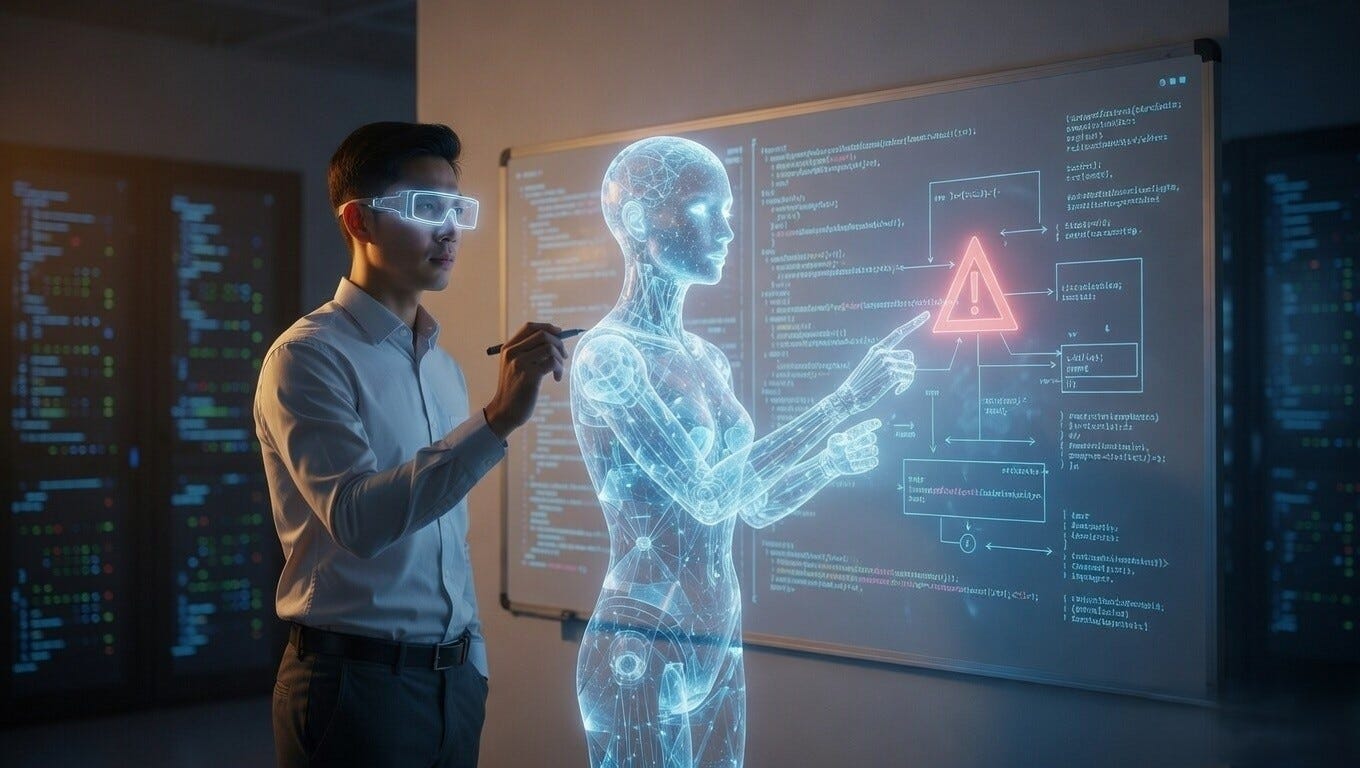
AI tools wrote the code. AI agents are now reviewing that code. The human developer sits in the middle, making final merge decisions about a process they are increasingly less involved in at the mechanical execution level.
This is not a dystopian frame. It is a description of where software engineering is heading, and it is moving faster than most people in the industry expected even eighteen months ago.
According to The Pragmatic Engineer, teams adopting AI coding assistants can see engineers submit multiple pull requests per day, compared to one or two per week in traditional workflows. The volume change is not incremental. It is structural. And structural changes in how work gets done require structural responses from the tools that support that work.
Code Review is that structural response. The flood of AI-generated pull requests created a genuine problem, not a theoretical one, but a real bottleneck that was costing engineering teams time and shipping bugs into production. The agents process pull requests at the speed and volume that human reviewers cannot match, and they surface only the findings that actually require human attention.
Human reviewers are not being replaced in this model. They are being freed. Freed from hunting for the bug on line 847 of a two-thousand-line pull request. Freed from the context switching that comes with reviewing fifty small changes in an afternoon. Freed to focus on the architectural questions, the product decisions, the judgment calls that require someone who has been living with the system for years.
Whether that feels like progress or something more complicated probably depends on where you are sitting and how much of your identity is tied to the work that is being automated. Both responses are understandable. The question is what you choose to do with the space that automation creates.
The flood is real. Anthropic built a dam. What happens next is still being written.