When I told my infrastructure team we were deploying production LLM services on a Mac Studio, they thought I had lost my mind. Macs are for designers and video editors, not serious infrastructure. Yet here we are six months later, serving thousands of inference requests daily from a machine that sits silently on a desk, draws less power than a gaming console, and has never required maintenance beyond macOS updates.
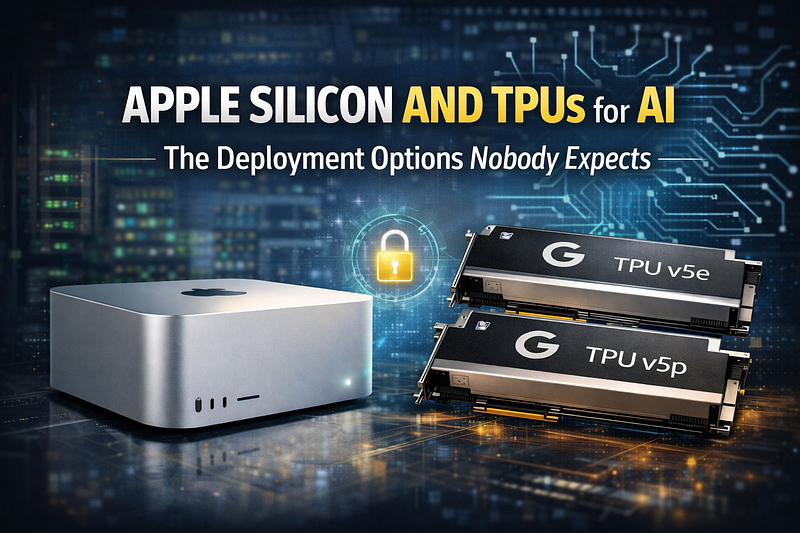
The conversation around AI hardware fixates on NVIDIA versus AMD, data center GPUs versus gaming cards, cloud versus on-premises. But some of the most interesting deployment options exist outside this narrow debate. Google’s Tensor Processing Units deliver efficiency that GPUs cannot match for specific workloads. Apple Silicon brings a unified memory architecture that fundamentally changes how models access data. These alternatives are not curiosities. They solve real problems that traditional GPU deployments struggle with.
Why Unified Memory Changes Everything
Traditional GPU architectures maintain separate memory pools for system RAM and GPU VRAM. Your model parameters live in VRAM. Your application data lives in RAM. Moving data between these pools requires explicit transfers across the PCIe bus. This architecture made sense for graphics rendering, where you load textures once and reuse them thousands of times. It makes no sense for LLM inference where you constantly access different parts of the model based on input context.
Apple Silicon eliminates this separation. The M-series chips implement unified memory where CPU and GPU access the same physical memory at full bandwidth without transfers. An M3 Max with 128 gigabytes of unified memory can run a 70B model using GPU acceleration for tensor operations while seamlessly accessing parameters stored in the same memory pool the CPU uses. There is no VRAM ceiling forcing aggressive quantisation. There is no performance cliff when model size exceeds GPU memory capacity.
The memory bandwidth specifications reveal why this architecture works for AI. The M3 Max achieves four hundred gigabytes per second of memory bandwidth. That exceeds typical DDR5 system memory at eighty to one hundred gigabytes per second by a factor of four. It falls short of GPU HBM memory at one to three terabytes per second, but not by as much as you might expect. For LLM inference, where memory bandwidth determines performance, Apple Silicon sits between consumer systems and professional data centre hardware.
Power efficiency is where unified memory architecture delivers advantages that traditional GPUs cannot match. Mac Studio under full LLM inference load draws approximately 120 to 150 watts compared to three hundred to four hundred watts for equivalent GPU server builds. Over a year of continuous operation, this difference saves roughly $100 to $200 in electricity costs in typical markets. More importantly, the thermal characteristics let you deploy AI infrastructure in office environments without dedicated cooling or tolerating server fan noise.
Mac Mini as a Serious LLM Platform
The Mac Mini with M4 Pro represents something genuinely new in AI deployment. Configured with sixty-four gigabytes of unified memory, total cost sits around $1,800 to $2,000. This configuration comfortably runs thirteen billion-parameter models at full precision or thirty billion-parameter models at 4-bit quantisation. Inference speed reaches approximately twelve to eighteen tokens per second on Llama 3 13B, which is entirely usable for personal productivity, development work, and small team deployments.
The form factor is what makes this interesting beyond specifications. A completely silent system drawing under fifty watts sits on a desk requiring no specialised infrastructure. You do not need a server room. You do not need dedicated cooling. You do not need to explain to facilities why you need a 240-volt circuit installed. You buy the machine, run a few commands to install Ollama, and you have production-ready LLM infrastructure.
The limitations are obvious but manageable. Sixty-four gigabytes caps you at 30B models with reasonable quantisation. Training and fine-tuning work for 7B and 13B models, but larger models exceed memory capacity when you account for gradients and optimiser states. Maximum throughput cannot match data centre GPUs with their higher memory bandwidth and specialised tensor cores. But many real-world deployments do not need maximum throughput. They need reliable inference at a modest scale with minimal operational complexity.
The economics work particularly well for specific scenarios. Individual developers building LLM-powered applications spend months iterating on prompts and application logic before they need serious scale. A Mac Mini lets you develop and test locally without burning cloud credits. Small consultancies building client-specific AI applications can deploy Mac Minis on-premises for clients with strict data residency requirements. Research teams can equip every researcher with local inference capability rather than sharing limited GPU server access.
Mac Studio for Production Deployment
Mac Studio with M3 Ultra transforms unified memory architecture into genuinely serious infrastructure. The M3 Ultra configuration with 192 gigabytes of unified memory costs approximately $7,500 to $8,500. This positions it as price-competitive with mid-tier data centre GPUs while offering a dramatically simpler deployment. The system handles seventy billion-parameter models at 4-bit quantisation with excellent performance around twenty-five to thirty-five tokens per second.
The dual-die architecture in M3 Ultra is where Apple’s engineering shines. Two M3 Max chips connect via an ultra-wide fabric delivering eight hundred gigabytes per second of memory bandwidth. Each die contributes ninety-six gigabytes of unified memory for a combined 192 gigabytes. This capacity enables running multiple 13B or 30B models simultaneously for A/B testing or serving different specialised models to different users without the complexity of managing multiple GPU servers.
Real-world production experience reveals where Mac Studio excels. We run a customer support chatbot serving roughly two thousand requests daily. Response time averages around 1.2 seconds, including prompt processing and token generation. The system runs continuously with zero maintenance beyond monthly macOS updates. Power draw stays around 140 watts even during peak load. The entire deployment fits in a standard office without special cooling or power requirements.
The constraints become clear when you push beyond this scale. Mac Studio cannot match H100 batch inference throughput for serving thousands of concurrent users. The 192 gigabytes cap you at roughly 405B models with aggressive quantisation, whereas multi-GPU systems can scale much larger. Training workloads larger than 30B models exceed practical memory limits when accounting for training overhead.
But for moderate-scale production inference where simplicity and reliability matter more than absolute maximum performance, Mac Studio delivers compelling value.
Google TPUs and the ASIC Approach
Google’s Tensor Processing Units represent a fundamentally different philosophy from general-purpose GPUs. Where NVIDIA and AMD build architectures supporting diverse workloads from gaming to scientific computing to AI, TPUs are application-specific integrated circuits designed exclusively for neural network operations. The architecture eliminates anything unrelated to matrix multiplication and tensor operations. This specialisation delivers extraordinary efficiency for supported workloads but complete inflexibility for anything else.
The systolic array design is what makes TPUs efficient. Rather than the shader core model GPUs use, TPUs implement grids of simple processing elements where data flows through in a synchronised pattern. Each processing element performs one multiplication and accumulation per cycle. This dataflow model eliminates the complex control logic and memory management overhead in GPU architectures.
Google claims TPUs deliver two to three times better performance per watt than equivalent-generation GPUs for transformer workloads.
Memory configurations position TPUs competitively with GPU alternatives. TPU v5e with sixteen gigabytes of HBM2 per chip targets inference workloads. TPU v5p with ninety-five gigabytes focuses on training. Memory bandwidth scales proportionally with TPU v5e, achieving approximately 1.6 terabytes per second and v5p reaching 4.8 terabytes per second. These specifications suggest performance comparable to NVIDIA H100, though direct comparison is complicated by architectural differences in how computation and memory access are distributed.
The cloud-only deployment model is the defining constraint. Google manufactures TPUs exclusively for internal use and cloud customer access through Google Cloud Platform. You cannot purchase TPUs as standalone accelerators. This restriction stems from both business strategy and practical reality. TPUs require tightly integrated software stacks, specialised cooling infrastructure, and system-level coordination that does not map to standalone cards.
When TPUs Actually Make Sense
Large-scale training of foundation models is where TPUs excel most clearly. Google trained Gemini, PaLM, and other major models on TPU pods comprising thousands of interconnected chips. The combination of efficient matrix multiplication, high-speed interconnect between TPUs, and tight integration with distributed training frameworks enables training at scales difficult to match on GPU clusters. For organisations conducting genuinely large-scale training runs measured in months of compute time across hundreds of accelerators, TPU pods deliver better economics than equivalent GPU clusters.
Batch inference on highly parallel workloads also favours TPUs. Processing millions of documents for embedding generation, running batch translation across large corpora, or generating synthetic training data at a massive scale all fit the TPU architecture well. A TPU v5e pod can process batch inference at roughly half the cost per token compared to GPU equivalents when optimised properly. The efficiency advantages compound at scale.
The framework constraint is where many organisations hit limitations. TensorFlow and JAX receive first-class TPU support since Google develops both frameworks. PyTorch support exists through PyTorch/XLA, but with notable performance degradation compared to native TensorFlow. Most LLM serving frameworks like vLLM and Text Generation Inference primarily target GPUs. Deploying on TPUs requires additional integration work that many teams cannot justify.
The economic calculation favours burst workloads rather than sustained deployment. Running inference continuously on dedicated TPU capacity costs as much as purchasing equivalent GPU hardware over twelve to eighteen months. TPUs excel for intermittent workloads where you spin up capacity for hours or days and release it when done. Organisations with sustained 24/7 inference needs typically find GPU economics more favourable.
The Software Ecosystem Reality
MLX is Apple’s framework targeting M-series hardware specifically. Built by Apple’s machine learning team, MLX provides NumPy-like array operations with automatic acceleration on Neural Engine and GPU components. For LLM inference, MLX offers excellent performance on quantized models with straightforward Python APIs. The framework feels more polished than early CUDA or ROCm tooling, with clear documentation and sensible defaults.
The limitation is ecosystem breadth. MLX is Apple-exclusive and relatively new, meaning fewer pre-built models, less community documentation, and narrower framework integration compared to the mature CUDA ecosystem. You can deploy common models like Llama, Mistral, and Qwen easily. Custom architectures or bleeding-edge research models often lack MLX support entirely.
Llama.cpp with the Metal backend provides the practical choice for most Apple Silicon users. The Metal acceleration delivers GPU performance competitive with MLX for inference. Ollama built on llama.cpp runs natively on Apple Silicon with the same one-command deployment that made it popular in Linux environments. You execute ollama pull llama3 and within minutes have a production-ready endpoint. This removes infrastructure complexity that plagues traditional GPU server deployments.
TensorFlow and JAX on TPUs represent mature ecosystems with comprehensive tooling. Google invests heavily in these frameworks since they power its internal infrastructure. Documentation is extensive. Example code exists for common scenarios. Performance optimisation guides help you extract maximum efficiency. The trade-off is framework lock-in. Organizations standardized on PyTorch face substantial migration costs to access TPU capabilities.
The Deployment Decision Framework
Privacy and data governance requirements often determine deployment choices before performance considerations matter. Healthcare organisations subject to HIPAA regulations, financial services under SOC2 compliance, and legal firms handling privileged communications cannot casually send data to cloud providers. Mac Studio deployments eliminate external data transmission. The unified memory architecture means data never crosses PCIe boundaries vulnerable to hardware attacks. macOS security features like secure boot and System Integrity Protection provide defence-in-depth appropriate for sensitive information.
Operational complexity tolerance varies dramatically between organisations. Large enterprises with dedicated infrastructure teams can manage GPU clusters, troubleshoot ROCm driver issues, and optimize batch inference pipelines. Small teams and individual developers often lack this expertise. Mac Studio or TPU cloud deployments that abstract infrastructure complexity become worth substantial performance trade-offs when they let small teams focus on building applications rather than managing servers.
Scale requirements separate viable options quickly. Serving dozens to hundreds of requests daily fits the Mac Studio's capability. Thousands of concurrent users need data centre GPUs with higher bandwidth and batch processing optimisation. Millions of requests daily require TPU pods or large GPU clusters with sophisticated load balancing. Understanding your actual scale requirements prevents over-engineering solutions or under-provisioning capacity.
Development velocity sometimes matters more than infrastructure cost. A startup validating a product concept needs to iterate quickly. Spending weeks optimising GPU infrastructure before proving product-market fit wastes time. Mac Studio lets you deploy a working infrastructure immediately and iterate on application logic. You migrate to cloud GPUs or data centre hardware after validation when you understand the actual requirements.
What the Future Holds
Apple Silicon evolution remains somewhat unpredictable. Apple could continue incremental M-series improvements, or they could develop dedicated AI accelerator products targeting professional deployment. The unified memory architecture provides genuine advantages for certain workloads. Apple’s vertical integration enables optimization difficult for discrete GPU manufacturers. If Apple decides to compete seriously in professional AI infrastructure, their entry would disrupt existing market dynamics significantly.
TPU availability through cloud providers will likely expand as Google invests in AI infrastructure broadly. The efficiency advantages for specific workloads justify continued development even though TPUs will probably never become available as standalone purchases. Organizations should evaluate TPUs for large-scale training and batch inference scenarios where efficiency directly impacts operational costs.
The practical reality for most organizations remains straightforward. NVIDIA GPUs provide the safest path with maximum software compatibility. AMD offers better economics for memory-intensive workloads if you can manage ROCm. Apple Silicon delivers unmatched simplicity for modest-scale deployments.
TPUs excel for specific scenarios but lack flexibility for general-purpose AI infrastructure. Understanding these trade-offs lets you match deployment options to actual requirements rather than following industry consensus toward unnecessarily expensive solutions.