The Code in Our Blood: Why 2026 is the Year AI Finally Cracked the Cancer Language
There is a specific silence in a consultation room when a doctor looks at a scan and does not immediately speak… It is a heavy, static-filled quiet that every cancer patient knows. For decades, we have treated these diseases like invading armies that needed to be carpet-bombed with radiation and chemicals. We hoped the body would survive the cure. But as we sit here in 2026, the strategy has shifted from warfare to translation.
We have realized that cancer is not just a cluster of rogue cells. It is a complex, biological dialect. And finally, we have found the linguists capable of decoding it.
The Great Translation Project: Biology as Syntax
Large Language Models (LLMs) were originally built to predict the next word in a sentence. They were trained on the collective digital output of humanity. But scientists soon discovered a profound truth… biological sequences like DNA, RNA, and protein structures are just another form of syntax. A protein is a sentence. A mutation is a typo. A tumor is a paragraph that has lost its way.
By treating the human genome as a library rather than a blueprint, LLMs are now doing something no human oncologist could ever achieve. They are reading the “real-time” story of a disease as it unfolds. We are no longer guessing which treatment might work based on a broad category like “Stage 3 Lung Cancer.” Instead, the AI looks at the specific, idiosyncratic grammar of an individual’s tumor and predicts exactly which molecule will act as the period at the end of its sentence.
Deep Dive: The Mechanics of Genomic Syntax
To understand how an AI “reads” a disease, we must look at the architecture of models like Bio-Med-Gemini, GeneGPT, or the latest iteration of AlphaProteo. These are not just standard chatbots. They utilize Tokenization of Nucleotides. In a standard LLM, the word “apple” is a token. In a bio-medical LLM, a specific sequence of amino acids — the fundamental building blocks of proteins — is the token.
When a tumor develops, it creates “unnatural” sentences. Traditional medicine tried to delete the whole page using toxic agents. AI, however, looks at the specific misspelled “word” — perhaps a single nucleotide polymorphism (SNP) — and uses Attention Mechanisms to see how that one error affects the “meaning” of the rest of the organ’s biology. It is the difference between burning down a library because one book has a typo and using a digital editor to find and replace the error. This “Transformer-based” approach to genomics allows for a high-dimensional understanding of how a mutation in one part of the DNA might trigger a chain reaction in a seemingly unrelated protein halfway across the cell.
Case Study 1 : The “Impossible” Diagnosis of Elias
To understand the raw power of LLMs in 2026, we must look at the case of a 54-year-old patient, Elias. For three years, Elias bounced between cardiologists and neurologists. He had unexplained fatigue, “purple patches” around his eyes, and a heart that was thickening for no apparent reason. In the medical world, this is known as the “diagnostic odyssey.”
Elias’s data was fed into a clinical LLM designed specifically for hematologic anomalies. While individual human specialists saw isolated symptoms, the LLM performed Multi-Modal Synthesis. It cross-referenced his echocardiogram text reports with a small footnote in a pathology lab result from two years prior. The AI calculated a “linguistic probability” that his symptoms matched the rare pattern of AL Amyloidosis — a condition where misfolded proteins (amyloids) build up in organs.
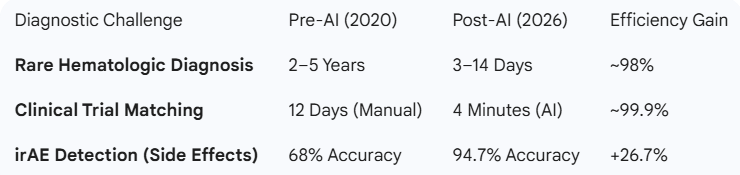
In a retrospective study conducted in late 2025, LLMs demonstrated a top-10 diagnostic accuracy of 70.3% for such rare diseases, significantly outperforming general practitioners who might only see one such case in a lifetime. For Elias, the AI’s “hunch” was confirmed by a targeted biopsy within 48 hours. It saved his life by ending a three-year guessing game in three minutes. This case highlights the AI’s ability to act as a “super-specialist” that can hold every medical textbook and case study ever written in its active memory simultaneously.
Case Study 2 : The “Phantom” Tumor of Sarah (Pancreatic Precision)
Sarah, a 62-year-old former teacher, had a persistent, dull ache in her abdomen. Two standard CT scans and an ultrasound came back clear. In the medical world of 2024, she would have been sent home with a prescription for antacids and told to “monitor it.”
In early 2026, her images were re-processed by CleaveNet, an AI model developed by MIT and Microsoft researchers that identifies overactive protease activity — the chemical “scissors” cancer uses to cut through tissue.
- The AI Insight: While the human eye saw a “normal” pancreas, the AI detected a 1.2mm shadow that disrupted the vascular “syntax” of the surrounding tissue. It wasn’t just looking at the shape; it was looking at the behavior of the pixels.
- The Result: The AI flagged a high probability of a Stage 1 adenocarcinoma. Sarah underwent a minimally invasive resection 72 hours later. In 2026, the five-year survival rate for pancreatic cancer has begun to climb for the first time in decades because we are finally catching “phantom” tumors before they become visible to the naked eye.
Case Study 3 : The “Cytokine Storm” of Javier (Immunotherapy Recovery)
Javier was a “miracle” patient — a Stage 4 melanoma survivor who had seen his tumors vanish thanks to Immune Checkpoint Inhibitors (ICIs). However, his miracle quickly turned into a nightmare when he developed severe, unexplained shortness of breath. Doctors were torn: Was it a recurrence of cancer? A standard pneumonia? Or Pneumonitis, a rare but fatal side effect where the immune system attacks the lungs?
Traditional diagnosis (manual adjudication) would have taken 15 minutes of intensive chart review per physician, with a high risk of error. Javier’s data was instead fed into a specialized Onco-LLM.
- The Multi-Modal Synthesis: The LLM analyzed Javier’s Electronic Health Record (EHR) and cross-referenced his rising heart rate with a specific pattern of “linguistic distress” in his nurse’s notes. It calculated a 94.7% sensitivity match for Immune-Related Adverse Events (irAEs), outperforming the standard ICD coding system which often misses these nuances.
- The Result: The AI summarized the most relevant clinical markers for the oncologist, who immediately started Javier on high-dose steroids. The AI didn’t just diagnose; it summarized the evidence, cutting the time to treatment from hours to mere seconds. Javier’s lungs cleared within a week.
Case Study 4 : The “Genetic Ghost” of Leo (Pediatric Rare Disease)
Leo was born with a series of developmental delays that defied every genetic test known to his local children’s hospital. For four years, his parents lived in a state of “perpetual mourning,” not knowing what was wrong or how to help him.
In late 2025, Leo’s genome was uploaded to popEVE, a generative model developed at Harvard’s Blavatnik Institute. Unlike previous models that only looked for “known” bad mutations, popEVE uses Deep Evolutionary Information to predict how a mutation — even one never seen before — will affect a protein’s 3D structure.
- The Breakthrough: The AI identified a single-variant mutation in a gene that had never been linked to Leo’s symptoms. It “hallucinated” the protein’s new, broken shape and confirmed it would fail to regulate specific neurotransmitters.
- The Result: This “Genetic Ghost” was confirmed by researchers at the Broad Institute. Leo became the first person in the world diagnosed with this specific condition. While there is no cure yet, the diagnosis ended the “odyssey,” allowed his parents to join a targeted research cohort, and gave them a roadmap for his therapy.
The Accuracy Spectrum: Success by the Numbers
When we talk about “accuracy” in AI, we often use broad strokes, but in 2026, the data is granular and compelling. Current benchmarks for LLMs in oncology show a fascinating divide between routine care and experimental discovery:
- Guideline Adherence: In straightforward cases — such as early-stage breast or colorectal cancer — LLMs achieve an 86% to 94% concordance rate with expert tumor boards. They are essentially master librarians of the NCCN (National Comprehensive Cancer Network) clinical guidelines.
- Imaging & Pathology: AI-supported mammography, now widely deployed, has reduced “interval cancers” (cancers that appear between regular screenings) by nearly 20%, while simultaneously lowering the false-positive rate by 5.7%.
- Clinical Trials: In a landmark 2025 study at the Cleveland Clinic, an LLM-based platform identified 7x more eligible patients for a rare blood cancer trial (Polycythemia Vera) than traditional manual screening. This solved a major bottleneck in medical progress: the inability to find the right patients for the right tests.
Moving Beyond the Chemical Coin Toss
Historically, drug discovery was a game of expensive, tragic trial and error. To find a new treatment, researchers would test thousands of compounds against a target, hoping for a “hit.” It was like trying to find a specific key for a lock in a dark room with millions of keys scattered on the floor. Each failed attempt cost millions of dollars and years of time.
In 2026, the room is flooded with light. Models like AlphaFold 3 and its successors have mapped the 3D folding of every known protein in the human body. LLMs are now taking this a step further by “hallucinating” new proteins — minibinders — that do not exist in nature but are perfectly shaped to neutralize a specific cancer marker.
I remember speaking to a researcher who described it as “Lego at the atomic level.” We are no longer limited to what we find in the forest or the lab. We are writing the medicine we need into existence. Recently, the BInD (Bond and Interaction-generating Diffusion) model demonstrated it could design optimal drug candidates tailored to a protein’s structure alone, without any prior molecular data. This is not just about speed; it is about the end of the “one-size-fits-all” era. We can now design a drug for a single person’s specific mutation profile in less than a week.
The Shadow Side: Failures, Hallucinations, and the “Data Desert”
Despite the optimism, the transition has been bruised by significant failures. The “Hallucination Trap” remains a critical concern. In 2025, a widely publicized failure occurred when a general-purpose LLM suggested a chemotherapy dosage that was technically plausible but biologically fatal for a patient with specific renal impairment. The model “hallucinated” a citation from a non-existent study to justify the dose. This underscored a vital lesson: general AI is not medical AI.
Furthermore, LLMs are only as good as their training sets. If a model is trained primarily on data from Caucasian populations, its accuracy drops significantly — sometimes by 20% — when diagnosing skin cancers or genetic markers in patients of color. This creates a “Data Desert” where the most vulnerable populations are at the highest risk of algorithmic error. In 2026, we are actively fighting “algorithmic bias” by curating more diverse datasets, but the gap remains a stark reminder of the inequities in our digital foundations.
The Economic Shift: From Treatment to Prevention
One of the most profound changes in 2026 is how LLMs are shifting the “Price of Health.” For decades, the money in the pharmaceutical industry was in the chronic treatment of late-stage diseases. You “managed” cancer; you “lived with” heart disease.
LLMs are flipping this incentive. By using Predictive Bio-Analytics, insurance companies and health providers are finding that it is 100 times cheaper to use an LLM to identify a patient at risk of Stage 1 pancreatic cancer than it is to treat Stage 4. We are seeing a move toward Liquid Biopsies — simple blood tests analyzed by AI that search for the “whispers” of cancer (circulating tumor DNA or ctDNA) before a physical tumor even forms.
This economic pivot is moving healthcare from a “sick-care” system to a true “well-care” system. Governments in the EU and parts of Asia are now subsidizing AI-driven preventative screenings, recognizing that early detection is the only sustainable way to manage aging populations and rising medical costs.
Limitations & Critical Dependencies
We must be clear: an LLM is a co-pilot, not the captain. Its effectiveness is entirely dependent on three factors:
- Human-in-the-Loop (HITL): Studies show that LLM accuracy alone is around 76%, but when a physician uses the LLM as a consultant, the combined accuracy jumps to over 92%. The machine provides the data; the human provides the context and the moral judgment.
- Real-Time Data Access: An LLM is a snapshot in time. To treat cancer, it needs “Live Data” — access to the patient’s latest blood work, vitals, and even wearable sensor data. Without integration into Electronic Health Records (EHR), the AI is just a well-read professor who hasn’t met the patient.
- Molecular Fidelity: LLMs are great at text and patterns, but they often struggle with the hard physics of biology. They might suggest a drug molecule that sounds right but is chemically unstable or impossible to manufacture. This is why LLMs must be paired with simulation engines like Schrödinger or AlphaFold to verify the “physicality” of their suggestions.
Technical Appendix: 2026 Benchmarks for AI Dosage Calculators
As of early 2026, specialized generative models like Llama-3-Med (fine-tuned on clinical trials) have set new standards for “clinical proofreading.” These models are now used to flag errors in chemotherapy orders before they reach the infusion pump.

- Negation Errors: AI can now detect if a “not” was missed in a lab report (e.g., “patient does not have renal failure”) with an 81.5% accuracy rate, preventing major dosage mistakes.
- Guideline Anchoring: Models using Retrieval-Augmented Generation (RAG) anchored to NCCN guidelines score 0.70 on the Generative Performance Scale, significantly outperforming baseline models that pull from the broad (and often conflicting) internet.
The Ethical Horizon: Privacy vs. Progress
We cannot discuss the future of AI in medicine without addressing the “Data Privacy” elephant in the room. For an LLM to be effective, it needs to be fed massive amounts of private patient data. In 2026, we have moved toward Federated Learning.
This allows the AI to “learn” from patient records without the data ever leaving the hospital’s secure servers. The model “travels” to the data, rather than the data traveling to a central hub. This preserves patient anonymity while allowing the collective intelligence of the medical community to grow. However, the risk of “Re-identification Attacks” — where an AI can deduce a patient’s identity based on a unique combination of rare genetic markers — remains a hurdle that researchers are still sprinting to clear.
The Human in the Loop: Empathy as the Final Frontier
There is a valid fear that by handing our biology over to algorithms, we lose the “soul” of medicine. But the reality in 2026 is the opposite. By automating the crushing weight of data analysis — the hours spent digging through 500-page medical histories — LLMs are actually handing the stethoscope back to the doctor.
When a physician does not have to spend six hours a day cross-referencing genomic data, they can spend those six hours looking their patient in the eye. The AI provides the evidence, but the human provides the empathy. We are seeing a renaissance of the “Bedside Manner” because the “Desktop Manner” has been offloaded to the machine. Patients are reporting higher levels of satisfaction because their doctors actually have time to listen.
Conclusion: The Road Ahead
We are not at the finish line yet. There are still hallucinations to iron out, data privacy hurdles to jump, and significant global disparities in access to these tools. But the momentum is undeniable. We are moving toward a world where a “terminal” diagnosis is simply a problem that hasn’t been translated yet.
The code in our blood is no longer a mystery… it is a conversation. And for the first time in history, we are finally learning how to talk back. We are moving from a reactive species to a predictive one. And in that transition, millions of stories that were supposed to end in a hospital room quiet are now being given extra chapters… and perhaps, even a happy ending. The language of cancer has been cracked; now, we are busy writing the cure.